poetics of space
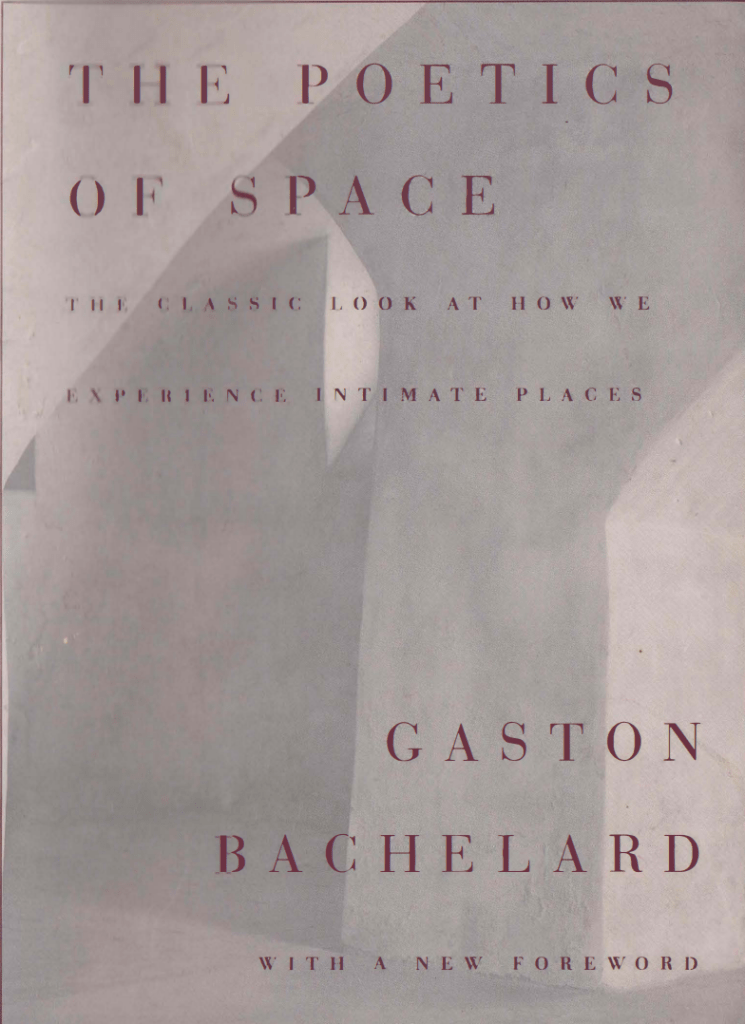
(1958) by gaston bachelard – the poetics of space.. translated from french.. bachelard oikos law et al
oikos (the economy our souls crave).. ‘i should say: the house shelters day-dreaming, the house protects the dreamer, the house allows one to dream in peace.’ – gaston bachelard, the poetics of space
wow.. don’t even have a page for him [https://en.wikipedia.org/wiki/Gaston_Bachelard]:
Gaston Bachelard (/bæʃəˈlɑːr/; French: [baʃlaʁ]; 27 June 1884 – 16 October 1962) was a French philosopher. He made contributions in the fields of poetics and the philosophy of science. To the latter, he introduced the concepts of epistemological obstacle and epistemological break (obstacle épistémologique and rupture épistémologique). He influenced many subsequent French philosophers, among them Michel Foucault, Louis Althusser, Dominique Lecourt and Jacques Derrida, as well as the sociologists Pierre Bourdieu and Bruno Latour.
For Bachelard, the scientific object should be constructed and therefore different from the positivist sciences; in other words, information is in continuous construction. Empiricism and rationalism are not regarded as dualism or opposition but complementary, therefore studies of a priori and a posteriori, or in other words reason and dialectic, are part of scientific research.
In addition to epistemology, Bachelard’s work deals with many other topics, including poetry, dreams, psychoanalysis, and the imagination. The Psychoanalysis of Fire (1938) and The Poetics of Space (1958) are among the most popular of his works: Jean-Paul Sartre cites the former and Bachelard’s Water and Dreams in his Being and Nothingness (1943), and the latter had a wide reception in architectural theory circles, and continues to be influential in literary theory and creative writing. In philosophy, this nocturnal side of his work is developed by his student Gilbert Durand.
finally getting around to reading it.. while re-reading colin ward’s ch 5 of child in the city.. found 279 page pdf [https://sites.evergreen.edu/wp-content/uploads/sites/88/2015/05/Gaston-Bachelard-the-Poetics-of-Space.pdf]
notes/quotes:
vii/6
foreward to the 1994 edition by john r stilgoe
in the house bachelard discovers a metaphor of humanness
no other writer closes so accurately, so deftly w the meanings of domestic space.. bachelard admits that every house is first a geometrical object of planes and right angles.. but asks his reader to ponder how such rectilinearity so welcomes human complexity, idiosyncrasy, how the house adapts to is inhabitants.. ‘a house that has been experienced is not an inert box.. inhabited space transcends geometrical space’
viii/7
if the house is the first universe for its young children, the first cosmos, how does its space shape all subsequent knowledge of other space, of any larger cosmos? is that house ‘a group of organic habits’ or even something deeper, the shelter of the imagination itself?.. t
bachelard finds the bits/pieces of evidence he weaves into his argument that the house is a *nest for dreaming, a shelter for imagining.. his insistence that people need houses in order to dream, in order to imagine, remains one of the most unnerving, most convincing arguments in western philosophy.. t gales, hurricanes, and downpours haunt the poetics of space, all vicissitudes that make the simplest of simple huts shine in strength of sheltering.. storm makes sense of shelter, and if the shelter is sounds, the shelter makes the surrounding storm good, enjoyable, recreational, something that bachelard uses to open his understanding of house and universe, of intimacy and immensity
*huge.. econ our souls crave..
ix/8
out of the house spin worlds w/in worlds, the personal cosmoses bachelard describes perhaps more acutely than any other writer concerned w space.. t
resonations with rooms in the be you house – and museum of care
bachelard writes of hearing by imagination, of filtering, of distorting sounds, of lying awake in his city apt and hearing in the roar of paris the rote of the sea, of hearing what is and what is not..t
*quiet enough ness..
in struggling to look ‘thru the thousand windows of fancy’ bachelard elevates language, pushes adjectives and nouns to far off limits, perhaps to voluptuous heights, certainly to intimacy elsewhere unknown.. t
idiosyncratic jargon ness.. lanier beyond words law.. rumi words law.. et al.. vs.. language as control/enclosure.. et al
x/9
it is a book that makes its readers dissatisfied w much contemp structure and landscape, for it demonstrates to its readers that space can be poetry.. t
every reader of it will never again see ordinary spaces in ordinary ways.. instead the reader will see w the soul of the eye, the glint of gaston bachelard.. t
john r stilgoe.. harvard uni
xi/10
foreward to the 1964 edition by etienne gilson
an unusual man w an unusual career and a still more unusual mind, gaston bachelard was so modes that probably few of his contemps will remember him as a young man when he was slowly working his way form small jobs in public admin up to a chair of philosophy in the sorbonne.. the bachelard they will remember is the last one, a debonair patriarch, w a marked provincial accent, dearly loved by his students to whom he was so generously devoted, but chiefly known to his neighbors as an old man fond of choosing his own cut of meat at the market or of buying his own fish..
i wish i could make clear how his provincial origins and his familiarity w the things of the earth affected his intellectual life and influenced the course of his philosophical reflections. owing to his courageous efforts, bachelard finally succeeded in giving himself a uni ed, got all the uni degrees one can get and ended as a uni prof; yet, unlike most of us, at least in france, he never allowed himself to become molded by the traditional ways of thinking to which unis unavoidably begin by submitting their students.. his intellectual superiority was such that he could not fail to succeed in all his academic ventures. we all loved him, admired him and envied him a little, because we felt he was a free mind, unfettered by any conventions.. either in his choice of the problems he wanted to handle or in his way of handling them.. t
xii/11
what i want to make clear is that as a uni prof his whole career was founded upon his philosophical critique of sci knowledge and his conception of a free type of rationalism, quite diff from the abstract mode of thinking which the world usually designates, and wholly bent upon the art of using reason as an instrument to achieve an always closer approach to concrete reality..
having specialized in the philosophy of sci, he was likely to write a dozen more books on the same subject.. but things were not to be that way.. bachelard fired his first warning shot when he unexpectedly published a book curiously entitled the psychoanal of fire.. i distinctly remember my first reaction to it.. it was: what are they going to say? who, they? well, we, all of us , the colleagues.. after appointing a man to teach the philosophy of sci and seeing him successfully do so for a number of years, we don’t like to learn that he has suddenly turned his interest to a psychoanal of the most unorthodox sort, .. t since what then was being psychoanalyzed was not even people.. but an element..
more volumes in same vein were to follow.. water and dreams, air and revery, the earth and the reveries of the will, the earth and the reveries of rest, in which bachelard was resolutely turning from the universe of reason and sci to that of imagination and poetry.. everything in them was new and i feel quite certain that their ultimate import has not yet been fully realized..t perhaps they never will be, for what bachelard calls imagination is a most secret power that is as much of a cosmic force as a psychological faculty..
xiii/12
in other words, he was then turning form the philosophy of sci to the philosophy of art and to esthetics
this could not be done w/o extreme care, esp on the part of a mind for so many years intent on the intricate, but always precise, moves of the sci mind.. from the very beginning, as will be seen in the first lines of this work, bachelard realized that he would have to forget all his acquired knowledge, all the philosophical habits contracted during years of sci reflection, if he wanted fruitfully to approach the problems raised by the poetic imagination.. t
detox ing intellect ness et al
xiv/13
i only wanted to mark the striking originality of a man so deeply rooted in the soil of everyday life and in such intimate relation w the concrete realities of nature, that after carefully scrutinizing the methods whereby man achieves sci cognition, he yielded to an irresistible urge personally to communicate w the forces that create it.. the only field where he could hope to observe them at play was poetry..t hence the series of writings in which gaston bachelard has applied the principles of his new method, and quite particularly this one, in which he finally brought it to perfection
etienne gilson aug 1963
xv/14
intro
a philosopher who has evolved his entire thinking from the fundamental themes of the philosophy of sci and followed the main lien of the active, growing rationalism of contemp sci as closely as he could, *must forget his learning and break w all his habits of philosophical research if he wants to study the problems posed by the poetic imagination.. for here the cultural past doesn’t count..t the long day in day out effort of putting together and constructing his thoughts is ineffectual.. one must be receptive, receptive to the image **at the moment it appears: if there be a philosophy of poetry, it must appear and re appear thru a significant verse, in total adherence to an isolated image; to be exact in the very ecstasy of the newness of the image..
*so too.. if wanting to address problem deep enough.. to get to a legit free world.. research ness and history ness.. all irrelevant s.. all cancerous distractions.. all of non legit data (like from whales in sea world)
**imagine if we listened to the itch-in-8b-souls 1st thing everyday & used that data to connect us (tech as it could be.. ai as augmenting interconnectedness as nonjudgmental expo labeling)
xvii/16
we shall return to this question of communion thru brief, isolated, rapid actions.. t
infinitesimal structures approaching the limit of structureless\ness and/or vice versa .. aka: ginorm/small ness
xviii/17
in order to clarity the problem of the poetic image philosophically, we shall have to have recourse to a phenomenology of the imagination. by this should be understood a study of the phenom of the poetic image when it emerges into the consciousness as a direct product of the heart, soul and being of man, apprehended in his actuality
sounds like itch-in-the-soul ness.. already on each heart ness.. the little prince – see with your heart.. et al
the ‘prudent’ attitude itself is a refusal to obey the immediate dynamics of the image.. i have come to realize how difficult it is to break away form this ‘prudence’.. *to say that one has left certain intellectual habits behind is easy enough, but how is it to be achieved?..t for a rationalist, this constitutes a minor daily crisis, a sort of split in one’s thinking which, even though its object be partial.. a mere image.. **has none the less great psychic repercussions.. t however, this minor cultural crisis, this crisis on the simple level of a new image, contains the entire paradox of a phenomenology of the imagination, which is: how can an image, at times very unusual, appear to be a concentration of the entire psyche? how.. ***w no prep.. can this singular, short lived event constituted by the appearance of an unusual poetic image, react on other minds and in other hearts, despite all the barriers of common sense, all the ****disciplined schools of thought, content in their immobility?
*need a global detox/re\set.. because it has to be all of us for it to legit happen.. so.. need tech as it could be – ai as nonjudgmental expo labeling)
**yeah.. warning ness.. costello screen\service law.. again.. why it has to be all of us.. everyone in sync.. for it to happen w/o damage.. for it to happen at all
***if it’s deep enough that 8bn souls already crave/have it.. prep et al.. is what keeps blocking us from it..
****supposed to’s of school/work et al.. any form of m\a\p
xix/18
the image, in its simplicity, has no need of scholarship. it is the property of a naive consciousness; in its expression, it is youthful language. . the poet, in the novelty of his images, is always the origin of language.. to specify exactly what a phenomenology of the image can be, to specify that the image comes before thought, we should have to say that poetry, rather than being a phenomenology of the mind, is a phenomenology of the soul.. t we should then have to collect documentation on the subject of the dreaming consciousness..
so much here.. ie: idiosyncratic jargon ness..
phenomenology: the science of phenomena as distinct from that of the nature of being. • an approach that concentrates on the study of consciousness and the objects of direct experience.
xx
the language of contemp french philosophy.. and even more so psychology.. hardly uses the dual meaning of the words soul and mind.. as a result, they are both somewhat deaf to certain themes that are very numerous in german philosophy, in which the distinction between mind and soul is so clear.. the word ‘soul’ is an immortal word.. in certain poems it cannot be effaced, for it is a word born of our breath..
xxi/20
the soul.. possesses an inner light .. not a reflection of a light from the outside world.. the oeuvre (work of art) must redeem an impassioned soul.. a consciousness associated w the soul is more relaxed, less internationalized than of the mind.. forces are manifested in powers that do not pass thru the circuits of knowledge.. the mind is able to relax, but in poetic revery the soul keeps watch, w no tension, calmed and active.. for a simple poetic image.. there is no project; a flicker of the soul is all that is needed.. t
imagine if we listened to the itch-in-8b-souls 1st thing everyday & used that data to connect us (tech as it could be.. ai as augmenting interconnectedness as nonjudgmental expo labeling)
xxiii/22
the poetic image places us at the origin of the speaking being
one would not be able to meditate in a zone that preceded language
so perhaps let’s let go of meditation ness as well.. either that our let go of language ness.. for idio jargon ness.. et al.. rumi words law.. lanier beyond words law.. et al
xxvi/25
*to speak well is part of living well.. the poetic image is an emergence from language, it is always a little above the language of signification.. by living the poems we read, we have then the salutary experience of emerging.. these acts of emergence are repeated; **poetry puts language in a state of emergence, in which life becomes manifest thru its vivacity.. these linguistic impulses, which stand out from the ordinary rank of pragmatic language, are ***miniatures of the vital impulse a micro-bergsonism that abandoned the thesis of language-as-instrument in favor of the thesis of language-as-reality would find in poetry numerous documents on the intense life of language.. t
*yeah.. i don’t think so
unless more like **idiosyncratic jargon ness than what we know/practice in sea world as language as control/enclosure.. aka: whalespeak et al
like ***this – imagine if we listened to the itch-in-8b-souls 1st thing everyday & used that data to connect us (tech as it could be.. ai as augmenting interconnectedness as nonjudgmental expo labeling).. and this – infinitesimal structures approaching the limit of structureless\ness and/or vice versa .. aka: ginorm/small ness
xxvii/26
thus, along w considerations on the life of words, as it appears in the evolution of language across the centuries, *the poetic image, as a mathematician would say, presents us w a sort of differential of this evolution.. a great verse can have a great influence on the soul of a language.. it awakens images that has been effaced, at the same time it confirms the unforeseeable nature of speech.. and if we render speech unforeseeable, is this not an apprenticeship to freedom?..t what delight the poetic imagination takes in making game of censors.. time was when the poetic arts codified the licenses to be permitted.. contemp poetry, however, has intro’d freedom in the very body of the language.. as a result, poetry appears as a phenom of freedom
*yeah that.. as the ginorm/small ness of idiosyncratic jargon ness
here we are in the presence of a minuscule phenomenon of the shimmering consciousness..
xxviii/27
j b pontalis presents michel leiris as a ‘lonely prospector in the galleries of words’.. which describes extremely well this fibered space traversed by the simple impetus of words that have been experienced. the atomism of conceptual language demands reasons for fixation, forces of centralization. but the verse always has a movement, the image flows into the line of the verse, carrying the imagination along w it.. **as though the imagination created a nerve fiber.. very clearly, the poetic image furnished one of the simplest experiences of language that has been lived.. and ***if, as i propose to do, it is considered as an origin of consciousness, it points to a phenomenology
*that deep
**to me.. imagination (itch-in-the-soul et al) is the nerve fiber..
***to me.. the poetic image is an expression.. not an origin.. to me.. origin is deep inside.. and creates the expressions..
j h van den berg writes: ‘poets and painters are born phenomenologist’ and noting that things ‘speak’ to us and that, as a result of this fact, if we give this language its full value, we have a contact w things, van den berg adds: ‘we are continually living a solution of problems that reflection cannot hope to solve’..
to me.. yeah.. if legit free.. not about solving problems anyway
xxix/28
the new being is happy man
xxx/29
sublimation (modify into more socially acceptable) in poetry towers above the psychology of the mundanely unhappy souls. for it is a fact taht poetry possesses a felicity of its own.. however great the tragedy it may be called upon to illustrate..
pierre-jean jouve has said ‘poetry constantly surpasses its origins and because it suffers more deeply in ecstasy or in sorrow, it retains greater freedom’
xxxi//30
in the region of ‘the pure form of language’ the psychoanalysts’ causes do not allow us to predict the poetic image in its newness.. they are at the very most, opps for liberation.. and in the poetic age in which we live, it is in this that poetry is specifically ‘surprising’.. its images are therefore unpredictable.. most literary critics are insufficiently aware of this unpredictability, which is precisely what upsets the plans of the usual psychological explanations.. but the poet states clearly: ‘poetry, in its present endeavors, can only correspond to attentive thought that is enamored of something unknown and essentially receptive to becoming’.. t
graeber unpredictability/surprise law.. graeber can’t know law.. et al
xxxii/31
jean lescure: ‘knowing must therefore be accompanied by an equal capacity to forget knowing.. non-knowing is not a form of ignorance but a difficult transcendence of knowledge. this is the price that must be paid for an oeuvre to be, at all times, a sort of pure beginning, which makes its creation an exercise in freedom’ .. in poetry, non-knowing is a primal condition; .. the entire life of the image is in its dazzling splendor, in the fact that an image is a transcending of all the premises of sensibility.. t
usefully ignorant.. graeber can’t know law.. intellect ness.. et al.. lanier beyond words law et al
xxxiii/32
it becomes evident then that a man’s work stands out from life to such an extent that life cannot explain it.. art then is an increase of life, a sort of competition of surprises that stimulates our consciousness..t and keeps it from becoming somnolent (sleepy)
rheingold (mom) art law: my mom (art teacher) didn’t teach technique so much as she taught permission. ie: not so much about the art – but the conversation you have with yourself while you’re making/creating art
self-talk as data.. idiosyncratic jargon et al
lapicque: ‘i expect my painting to give me as much that is unexpected, although of another kind, as the actual race i witnessed gave me.. not for a second can there be any question of reproducing exactly a spectacle that is already in the past.. but i have to relive it entirely, in a manner that is new and, this time, from the standpoint of painting.. by doing this, i create for myself the possibility of a fresh impact‘
imagine if we ness
lescure: ‘an artist does not create the way he lives, he lives the way he creates’
xxxiv/33
word ‘image’ surrounded w confusion.. the image is everything except a direct product of the imagination.. this production remains, therefore, an act of lesser freedom.. that has no relation to the great free acts stressed by bergsonian philosophy.. t
norton productivity law and art – being human et al
i propose to consider the imagination as major power of human nature.. put end to comparisons of images w memories..
imagination separates us from past as well as form reality.. it faces the future.. to the function of reality.. wise in experience of the past.. should be added a function of unreality, equally positive.. any weakness in the function of unreality will hamper the productive psyche.. if we cannot imagine, we cannot foresee..
xxxv/34
we are offered a veritable cure of rhythmo analysis thru the poem, which interweaves real and unreal and gives dynamism to language by means of the dual activity os signification and poetry.. in poetry, the commitment of the imagining being is such that it is no longer merely the subject of the verb ‘to adapt oneself’.. actual conditions are no longer determinant.. w poetry, the imagination takes its place on the margin, exactly where the function of unreality comes to charm or to disturb.. always to awaken.. t
again to self-talk as data.. and imagine if we ness via rheingold (mom) art law et al
art (by day/light) and sleep (by night/dark) as global re\set.. to fittingness (undisturbed ecosystem)
the sleeping being lost in its automatisms.. the most insidious of these automatisms, the automatism of language, ceases to function when we enter into the domain of pure sublimation.. t (modify to higher).. seen from this height of pure sublimation, reproductive imagination ceases to be of much importance.. jean-paul richter: ‘reproductive imagination is the prose of productive imagination’
to language as control/enclosure et al
in this philosophical intro.. doubtless to long.. i have summarized certain gen themes i should like to put to the test in the work that follows.. the images i want to examine are the quite simple images of felicitous (well chosen, suited) space.. in this orientation, these investigations would deserve to be called topophilia.. they seek to determine the human value of the sorts of space that may be grasped, that may be defended against adverse forces, the space we love..t for diverse reasons, and w the differences entailed by poetic shadings, this is eulogized (praised highly) space.. attached to its protective value, which can be a positive one, are also imagined values, which soon become dominant.. space that has been seized upon by the imagination cannot remain indifferent space subject to the measures and estimates of the surveyor.. it has been lived in, not in it positivity, but w all the partiality of the imagination.. t particularly, it nearly always exercises and attraction.. for it concentrates being w/in limits that protect.. in the realm of images, *the play between the exterior and intimacy is not a balanced one.. on the other hand, hostile space is hardly mentioned in these pages.. the space of hatred and combat can only be studied in the context of impassioned subject matter and apocalyptic images. for the present, we shall consider the images that attract.. and w regard to images, it soon becomes clear that to attract and to repulse do not give contrary experiences.. the terms are contrary.. when we study electricity or magnetism, we can speak symmetrically of repulsion and attraction.. all that is needed is a change of algebraic signs.. but images do not adapt themselves very well to quiet ideas, or above all, to definitive ideas.. the imagination is ceaselessly imagining and enriching itself w new images.. it is this wealth of imagined being that i should like to explore
*maté trump law et al
xxxvi/35
here this is a rapid account of the chapters that compose this book.
first of all.. as is proper in a study of images of intimacy, we shall pose the problem of the poetics of the house.. the questions abound: how can secret rooms, rooms that have disappeared, become abodes for an unforgettable past.. where and how does repose (state of sleep or tranquility) find esp conducive situations? how is it that at times a provisional refuge or an occasional shelter is endowed in our intimate day dreaming w virtues that have no objective foundation.. w the house image we are in possession of a veritable principle of psych integration.. descriptive psych depth psych psychoanal and phenomenology could constitute.. w the house.. the corpus of doctrines that i have designated by the name of topo-analysis.. on whatever theoretical horizon we examine it, the house image would appear to have become the topography of our intimate being.. t
art (by day/light) and sleep (by night/dark) as global re\set.. to fittingness (undisturbed ecosystem)
xxxvii/36
in order to give an idea of how complex is the task of the psychologist who studies the depths of the human soul, cg jung asks his readers to consider the following comparison: ‘we have to describe and to explain a building the upper story of which was erected in 19th cent.. ground floor 16th cent, masonry reconstructed from dwelling tower of 11th cent.. cellar and under a filled -in cave.. floor glacial fauna .. that would be a sort of picture of our mental structure’.. naturally, jung was well aware of the limitations of this comparison.. but from the very fact that it may be so easily developed, there is ground for taking the house as a tool for analysis of the human soul.. w the help of this tool, can we not find w/in ourselves, while dreaming in our own modest homes.. the consolations of the cave? are the towers of our souls razed for all time? are we to remain, to quote nerval’s famous line, beings who ‘towers have been destroyed’.. not only our memories, but the things we have forgotten are ‘housed’.. our soul is an abode.. and by remembering ‘houses’ and ‘rooms’ we learn to ‘abide’ w/in ourselves.. t now everything becomes clear, the house images move in both directions: the are in us as much as we are in them, and the play is so varied that two long chapters are needed to outline the implication of house images
cage home law.. unauthorized home less ness.. home less ness.. home ness.. iwan baan ness et al.. year 2 – the be you house et al..
after these two chapters on the houses of man, i studied a series of images which may be considered the houses of things: drawers, chests and wardrobes.. what psychology lies behind their locks and keys.. they bear w/in themselves a kind of esthetics of hidden things.. to pave the way now for a phenomenology of what is hidden, on prelim remark will suffice: an empty drawer is unimaginable.. it can only be thought of.. and for us, who must describe what we imagine before what we know.. what we dream before what we verify.. all wardrobes are full
batra hide in public law.. fix vs not hidden.. nothing hidden et al..
xxxviii/37
at times when we believe we are studying something, we are only being receptive to a kind of day dreaming. the two chapters that i devoted to nests and shells, the two refuges of vertebrates and invertebrates.. bear witness to an activity of the imagination which is hardly curbed by the reality of objects.. during my length meditation upon the imagination of the four elements, i re-lived countless aerial or aquatic day dreams, according to whether i followed the poets into the nest in the tree, or into the sort of animal cave that is constituted by a shell.. sometimes, even when i touch things, i still dream of an element
after having followed the day dreams of inhabiting these uninhabitable places, i returned to images that, in order for us to live them, require us to become very small, as in nests and shells.. indeed, in our houses we have nooks and corners in which we like to curl up comfortably.. to curl up belongs to the phenomenology of the verb to inhabit, and only those who have learned to do so can inhabit w intensity.. in this respect, we have w/in ourselves and entire assortment of images and recollections that we would not readily disclose..t no doubt, a psychoanalyst , who desired to systematize these images of comforting retreat, could furnish numerous documents.. all i had at my disposal were literary ones.. i thus wrote a short chapter on ‘nook and corner’ and was surprised myself to see that important writers gave literary dignity to these psychological documents..
infinitesimal structures – ginorm/small ness
after all these chapters devoted to intimate space, i wanted to see what the dialectics of large and small offered for poetics of space, how, in exterior space, the imagination benefited from the relativity of size, w/o the help of ideas and, as it were, quite naturally. i have put the dialectics of small and large under the signs of miniature and immensity,..t but these two chapters are not as antithetical as might be supposed. in both cases, small and large are not to be seized in their objectivity, since, in this present work, i only deal w them as the two poles of a projection of images. in other of my books, particularly w regard to immensity, i have tried to delineate the poet’s meditations before the more imposing spectacles of nature.. here, it is a matter of participating more intimately in the movement of the image. for instance, i shall have to prove in following certain poems that the impression of immensity is in us, and not necessarily related to an object
infinitesimal structures approaching the limit of structureless\ness and/or vice versa .. aka: ginorm/small ness
xxxix/38
1/39
1 – the house. from cellar to garret. the significance of the hut
the house, quite obviously, is a privileged entity for phenomenological study of the intimate values of inside space, provided, of course, that we take it in both its unity and its complexity and endeavor to integrate all the special valued in one fundamental value..
infinitesimal structures approaching the limit of structureless\ness and/or vice versa .. aka: ginorm/small ness
transcending our memories of all the houses in which we have found shelter, above and beyond al the houses we have dreamed we lived in, can we isolate an intimate, concrete essence that would be a justification of the uncommon value of all of our images of protected intimacy?.. this then is the main problem..
just needs to be a space that facils (protects) missing pieces/maté basic needs.. mostly missing piece #1 – authenticity – pascal quiet law.. quiet in room.. et al.. so that brown belonging law is in play.. for in the city.. as the day ness (perhaps: be you in the house for us in the city).. though with you on the house thing as we did in year 2 – the be you house
4/40
not a question of describing houses.. or enumerating features for which they are comfortable.. on contrary.. we must go beyond the problems of description.. in order to attain to the primary virtues, those that reveal an attachment that is native in some way to the primary function of inhabiting.. in every dwelling, even the richest, the first task of the phenomenologist is to find the original shell
imagine a turtle ness et al
we should therefore have to say how we inhabit our vital space, in accord w all the dialectics of life.. how we take root, day after day, in a ‘corner of the world’
has to be sans any form of m\a\p.. ie: ‘have to say ness’.. is a form of m\a\p
for our house is our corner of the world.. our fist universe.. if we look at it intimately .. the humblest dwelling has beauty.. a primitiveness which belongs to all.. rich and poor alike, if they are willing to dream..
dream.. ness et al.. bachelard oikos law et al
but our adult life is so dispossessed of the essential benefits.. its anthropocosmic ties have become so slack.. that we do onto feel their first attachments in the universe of the house..
aka: all in sea world.. so.. hari present in society law et al
6/42
we comfort ourselves by reliving memories of protection.. by recalling these memories, we add to our store of dreams; we are never real historians, but always near poets, and our emotion is perhaps nothing but an expression of a poetry that was lost
thus by approaching the house images w care not to break up the solidarity of memory and imagination.. we may hope to make others feel all the psychological elasticity of an image that moves us at an unimaginable depth..
if i were asked to name the chief benefit of the house, i should say: the house shelters daydreaming the house protects the dreamer, the house allows one to dream in peace.. t
bachelard oikos law
thought and experience are not the only things that sanction human values.. the values that belong to daydreaming mark humanity in its depts..
rather.. sustain whales ness value..
7/43
before he is ‘cast into the world’.. *man is laid in the cradle of the house.. and always in our daydreams, the house is a large cradle..
*not yet tried
8/44
topoanalysis would be the systematic psychological study of the sites of our intimate life..
10/46
we return to them in our night dreams.. these retreats have the value of a shell
the normal unconscious knows how to make itself at home everywhere, and psychoanal comes to the assistance of the ousted unconscious, of the unconscious that has been roughly or insidiously dislodged
cage home law.. home ness.. et al
12/48
thus we cover the universe w drawings we have lived.. these drawings need not be exact.. they need only to be tonalized on the mode of our inner space..
little prince ness
13/49
over picturesqueness in a house can conceal its intimacy.. this is also true in life.. but it is true still in daydreams.. for the real houses of memory, the houses to which we return in dreams, the houses that are rich in unalterable oneirism (daydream), do not readily lend themselves to description.. to describe them would be like showing them to visitors.. t
naming the colour ness et al
all we communicate to others is an orientation towards what is secret w/o ever being able to tell the secret objectively..
what would be the use, for instance, in giving the plan of the room that was really my room,..t in describing the little room at the end of the garret, in saying that from the window, across the indentations of the roofs, one could see the hill..
14/50
but over and beyond our memories, the house we were born in is physically inscribed in us.. it is a group of organic habits.. after 20 yrs.. in spite of all the other anonymous stairways; we would recapture the reflexes of the ‘first stairway’.. the feel of the tiniest latch has remained on our hands
your own song ness et al
15/51
in short, the house we were born in has engraved w/in us the hierarchy of the various functions of inhabiting.. t.. the diagram of the function of inhabiting that particular house and all the other houses are but variation on a fundamental them..
the great function of poetry is to give us back the situations of our dreams..
the house we were born in is more than an embodiment of home, it is also an embodiment of dreams.. each one of its nooks and corners was a resting place for daydreaming..
? what about house born in only being traumatic?
16/52
the positivity of psychological history and geography cannot serve as a touchstone for determining the real being of our childhood, for childhood is certainly greater than reality.. in order to sense, across the years, our attachment for the house we were born in, dream is more powerful than thought.. if a compact center of daydreams of repose had not existed in this first house, the very different circumstances that surround actual life would have clouded our memories.. it is on the plane of the daydream and not on that of facts that childhood remains alive and poetically useful w/in us.. to inhabit oneirically the house we were born in means more than to inhabit it in memory; it means living in this house that is gone, the way we used to dream in it.
what special depth there is in a child’s daydream.. and how happy the child who really possesses his moments of solitude.. it is a good thing, it is even salutary, for a child to have periods of boredom, for him to learn to know the dialectics of exaggerated play and causeless pure boredom.. the boredom that is not the equiv of the absence of playmates..t there are children who will leave a game to go and be bored in a corner of the garret.. how often have i wished for the attic of my boredom when the complications of life made me lose the very germ of all freedom.. t
bored\om et al
17/53
and so beyond all the positive values of protection, the house we were born in becomes imbued w dream values which remain after the house is gone.. centers of boredom, centers of solitude, centers of daydream group together to constitute the oneiric house which is more lasting than the scattered memories of our birthplace.. t
ie of need to org around deeper needs
and we should not forget that these dream values communicate poetically from soul to soul..t ..to read poetry is essentially to daydream
a house constitutes a body of images that give mankind proofs or illusions of stability.. to distinguish all these images would be to describe the soul of the house..
19/55
in our civilization, which has the same light everywhere, and puts electricity in its cellars, we no longer go to the cellar carrying a candle.. but the unconscious cannot be civilized.. it takes a candle when it goes to the cellar.. t
20/56
where is the fear that does not become exaggerated..t
thurman interconnectedness law: when you understand interconnectedness it makes you more afraid of hating than of dying – Robert Thurman
21/57
every good book should be re read as soon as it is finished.. after the sketchiness of the first reading comes the creative work of reading.. we must then know the problem that confronted the author.. the second, then the third reading .. give us, little by little, the solution of this problem.. imperceptibly, we give ourselves the illusion that both the problem and the solution are ours.. the psychological nuance: ‘i should have written that’.. establishes us as phenomenologists of reading.. but so long as we have not acknowledge this nuance, we remain psychologists, or psychoanalysts..
31/67
*how many dwelling places there would be, fitted one into the other,..t if we were to realize in detail, and in their hierarchical order, all the images by means of which we live our day dreams of intimacy.. **how many scattered values we should succeed in concentrating, if we lived the images of our daydreams in all sincerity..t
*iwan baan ness..
**imagine if we listened to the itch-in-8b-souls 1st thing everyday & used that data to connect us (tech as it could be.. ai as augmenting interconnectedness as nonjudgmental expo labeling)
infinitesimal structures approaching the limit of structureless\ness and/or vice versa .. aka: ginorm/small ness
need 1st/most: means to undo our hierarchical listening to self/others/nature so we can org around legit needs
33/69
*in the realm of absolute imagination we remain young late in life..t **but we must lose our earthly paradise in order actually to live in it..t to experience it in the reality of its images.. ***in the absolute sublimation that transcends all passion.. t
*the.. this is not ridiculous ness and for (blank)’s sake ness of imagine if we ness
**rather lose (get out of) sea world
***rather.. that transcends all whalespeak.. have yet to see legit passion .. of legit free people
victo-emile michelet: ‘alas, we have to grow old to conquer youth, to free it from its fetters and live according to its original impulse‘
actually.. only need ‘to grow old to conquer’ because in sea world (wouldn’t need to do that if were legit free.. if weren’t already intoxicated).. ie: not yet scrambled ness et al
so.. need 1st/most: means to undo our hierarchical listening to self/others/nature as global detox/re\set.. so we can org around legit needs
poetry gives not so much a nostalgia for youth, which would be vulgar, as a nostalgia for the expressions of youth. .. it offers us *images as we should have imagined them during the ‘original impulse’ of youth..t primal images, simple engravings are but so many **invitations to ***start imagining again.. they give us back areas of being,..t houses in which the human being’s certainty of being is concentrated, and we have the impression that, by living in such images as these, in images that are as ****stabilizing as these are, we could start a new life, a life that would be our own, that would belong to us in our very depths.. t
*let’s listen that deep – to itch-in-the-soul ness.. what’s already on each heart (the little prince – see with your heart).. to the not yet scrambled ness
**i’d say conditions (ie: sans any form of m\a\p) .. because invited vs invented ness et al
***let’s do this first: free art\ists
****bachelard oikos law – oikos (the economy our souls crave).. ‘i should say: the house shelters day-dreaming, the house protects the dreamer, the house allows one to dream in peace.’ – gaston bachelard, the poetics of space
when we look at images of this kind.. when we read the images in bachelin’s book, we start musing on primitiveness.. and because of this very primitiveness, restored, desired and experienced thru simple images, an album of pictures of huts would constitute a textbook of simple exercises for the phenomenology of the imagination
just adding this because resonating w my bent toward images of living spaces et al
38/74
2 – house and universe
43/79
the author (henri bosco in malicroix talking of a humble house that appears to lack resistance.. built on an island..shall see what fortitude it possessed) takes many pages to prepare us for the storm that is brewing. a poetic weather forecast goes to the very source from when the sound and the movement are to come.. w what art, to begin with, he achieves absolute silence, the immensity of these silent stretches of space.. ‘there is nothing like silence to suggest a sense of unlimited space.. sounds lend color to space, and confer a sort of sound body upon it.. but absence of sound leaves it quite pure and, in the silence, we are seized w the sensation of something vast and deep and boundless..t it took complete hold of me and, for several moments, i was overwhelmed by the grandeur of this shadowy peace..
44/80
here, the author takes the time to show the narrowing of he space at the center of which the house is to live like an anguished heart.. a kind of cosmic anguish precedes the storm.. this author knows instinctively that all aggression, whether it come from man or from the world, is of animal origin.. however subtle, however indirect, hidden or contrived a human act of aggression may be, it reveals an origin that is unredeemed.. in the tiniest of hatreds, there is a little, live, animal filament.. *it is also a terrible trait of men that they should be incapable of understanding the forces of the universe intuitively, otherwise than in terms of a psychology of wrath.. t
*need 1st/most: means to undo our hierarchical listening to self/others/nature ie: tech as it could be for global detox/re\set
45/81
everything swayed under the shock of this blow, but the flexible house stood up to the beast. *no doubt it was holding firmly to the soil of the island by means of the unbreakable roots from which its thin walls of mudcoated reeds and planks drew their supernatural strength..t though the shutters and doors were insulted, though huge threats were proffered, and there was loud bugling in the chimney, it was of no avail. the already human being in whom i had sought shelter for my body yielded nothing to the storm.. the house clung close to me.. like a she wolf.. and at times, i could smell her odor penetrating maternally to my very heart.. that night she was really my mother
*missing pieces as roots.. as healing (roots of)
‘she was all i had to keep and sustain me. we were alone’
discussing maternity in my book.. i quoted the following magnificent lines by milosz.. in which the mother image and the house image are united: ‘i say mother, and my thoughts are of you oh house.. house of the lovely dark summers of my childhood’ melancholy
what an image of concentrated being we are given w this house that ‘clings’ to its inhabitant and becomes the cell of a body with its walls close together.. the refuge shrinks in size and w its protective qualities increase, it grows outwardly stronger.. from having been a refuge, it has become a redoubt.. the thatched cottage becomes a fortified castle for the recluse, who must learn to conquer fear w/in its walls..
46/82
in a house that has become for the imagination the very heart of a cyclone, we have to go beyond the mere impressions of consolation that we should feel in any shelter.. we have to participate in the dramatic cosmic events sustained by the combatant house.. but the real drama of malicroix is an ordeal by solitude.. the inhabitant of la redousse must dominate solitude in a house on an island where there is no village.. he must attain to the dignity of solitude that had been achieved by one of his ancestors, who had become a man of solitude as a result of a deep tragedy in his life.. he must live alone in a cosmos which is not that of his childhood.. this man, who comes of gentle, happy people, must cultivate courage in order to confront a world that is harsh, indigent and cold.. the isolated house furnishes him w strong images, that is, w *counsels of resistance
so.. imagine the house.. as condition/space to dream in peace et al.. but as our global econ.. so that (via gershenfeld sel et al) resistance ness becomes irrelevant
61/97
it is better to live in a state of impermanence than in one of finality..t ie: having desired vainly ever since he was young, to have a house in the country, w a small garden, he had made up his mind, at the age of 70, to give them to himself on his own authority as a poet, and w/o putting his hand in his pocket.. he had begun by acquiring a house, then, as the charm of ownership in creased, had added the garden, the little wood, etc.. none of this existed outside his imagination; but it sufficed for these little fancied possessions to take on reality in his eyes.. he spoke of them and derived pleasure form them as though they were real; and so powerful was his imagination that i should not be surprised if, on frosty april nights, he didn’t show signs of anxiety about his marly vineyards
62/98
houses everywhere but nowhere shut in, this is the motto of the dreamer of dwellings.. in the last house as well as in the actual house, the day dream of inhabiting is thwarted.. a daydream of elsewhere should be left open therefore at all times.. t
63/99
george sand said people could be classified according to whether they aspired to live in cottage or palace.. but question is more complex than that.. – when we live in a manor house we dream of a cottage, and when we live in a cottage we dream of a palace.. better still, we all have our cottage moments and our palace moments..
on binary ness
65/101
the word chrysalis alone is an unmistakable indication that here two dreams are joined together, dreams that bespeak both the repose and flight of being, evening’s crystallization and wings that open to the light.. in the body of the winged manor, which dominated both town and sea, man and the universe, he retained a cottage chrysalis in order to be able to hide alone, in complete repose.. t
referring to work of brazilian philosopher, lucio alberto pinheiro dos santos.. i once said that by examining the rhythms of life in detail, by descending form the great rhythms forced upon us by the universe to the finer rhythms that play upon man’s most exquisite sensibilities, it would be possible to work out a rhythmanalysis that would tend to reconcile and lighten the ambivalences that psychoanalysts find in the disturbed psyche.. but if what poets say is true, alternating daydreams cease to be rivals..t the two extreme realities of cottage and manor, to be found in the case of saint pol roux, take into account our need for retreat and expansion, for simplicity and magnificence.. for here we experience a rhythmanalysis of the function of inhabiting.. to sleep well we do not need to sleep in a large room, and to work well we do not have to work in a den.. but to dream of a poem, then write it, we need both.. it is the creative psyche that benefits from rhythmanalysis..
maté trump law.. brown belonging law.. et al.. both missing pieces of an undisturbed ecosystem
crazywise (doc) ness et al
thus the dream house must possess every virtue. however spacious, it must also be a cottage, a dove cote, a nest, a chrysalis.. intimacy needs the heart of a nest.. erasmus, his biographer tells us, was long ‘in finding a nook in his fine house in which he could put his little body w safety.. he ended by confining himself to one room until he could breathe the parched air that was necessary to him..
oi 2023 ness
and how many dreams look everywhere in their house , or in their room.. for the garment that suits them
66/102
but i repeat: nest, chrysalis and garment only constitute one moment of a dwelling place.. the more concentrated the repose (rest, sleep), the more hermetic (sealed, protected) the chrysalis, the more the being that emerges from it is a being from elsewhere, the greater is his expansion.. t
infinitesimal structures approaching the limit of structureless\ness and/or vice versa .. aka: ginorm/small ness
listen to supervielle: ‘all that makes the woods, the rivers or the air has its place between these walls which believe they close a room.. make haste, ye gentlemen, who ride across the seas.. i’ve but one roof from heaven, there’ll be room for you’.. the house’s welcome is so genuine that even what may be seen from the windows belongs to it..‘.. t the body of the mountain hesitates before my window: ‘how can one enter if one is the mountain, if one is tall, with boulders and stones, a piece of earth, altered by sky?’
nationality: human ness et al
when we have been made aware of a rhythmanalysis by moving from a concentrated to an expanded house, the oscillations reverberate and grow louder.. like supervielle, great dreamers profess intimacy w the world.. they learned this intimacy, however, meditating on the house..t
and in it.. bachelard oikos law et al
67/103
supervielle’s house is a house that is eager to see, one for which seeing is having.. it both sees the world and has it.. but like a greedy child, its eyes are bigger than its stomach..
rather.. how we have taught/scrambled the child to be greedy.. oi
it has furnished us w one of those exaggerated images that a philosopher of the imagination is obliged to note right away w a reasonably critical smile..
but after this holiday of the imagination we shall have to return to *reality, in order to speak of daydreams that accompany household activities.. for they keep vigilant watch over the house. they link its immediate past to its immediate future, they are what maintains it in the security of being
*not yet ever been in legit reality (always been in sea world to date).. so we have no idea if ‘household activities’ are legit.. am thinking not.. like.. needing a gym and a trashman.. et al.. only because we are cope\ing with sea world..
but how can housework be made into a creative activity?
oi.. wrong question.. deeper to ask.. how to unleash/uncover/facil creativity already in each one of us
ie: imagine if we listened to the itch-in-8b-souls 1st thing everyday & used that data to connect us (tech as it could be.. ai as augmenting interconnectedness as nonjudgmental expo labeling).. and trust the dance of an undisturbed ecosystem
the minute we apply a glimmer of consciousness to a *mechanical gesture, or practice phenomenology while polishing a piece of old furniture, **we sense new impressions come into being beneath this familiar domestic duty.. for ***consciousness rejuvenates everything, giving a ****quality of beginning to the most everyday actions.. it even dominates memory.. how wonderful it is to really become once more the inventor of a mechanical action.. and so when a poet rubs a piece of furniture.. even vicariously.. he creates a new object.. *****he increases the object’s human dignity.. he registers this object officially as a member of the human household..
*rowson mechanical law et al
**to me.. rather.. new whalespeak.. perpetuating sea world.. part\ial ness as cancerous distraction
***only if legit free consciousness.. need global detox/re\set first
****rather .. to everyday sea world actions (aka: voluntary compliances).. oi
*****to me.. dignity ness and member ness.. red flags we’re doing it/life wrong
68/104
they produce a *new reality of being.. and they take their place not only in an order but in a community of order.. from one object in a room to another, **housewifely care weaves the ties that unite a very ancient past to the new epoch.. the housewife ***awakens furniture that was asleep
*note legit new/diff till we get out of sea world.. let’s do this first
**rather.. just how we’re cope\ing in sea world
***what we need is the energy of 8b alive (awake) people.. for (blank)’s sake
*a house that shines from the care it receives appears to have been rebuilt from the inside; it is as though it were new inside.. in the intimate harmony of walls and furniture, it may be said that we become conscious of a house that is **built by women, since men only know how to build a house from the outside, and they know little or nothing of the ‘wax’ civilization..
*again.. nicer.. because cope\ing et al.. but not legit freedom.. not legit inside.. until we get out of sea world.. we don’t want/need a new inside.. we just need to uncover/unleash/facil what is already there..
**red flag built by woman not the answer.. can’t be binary ness.. has to be all of us ..
no one has written better of this integration of revery into work .. of our *vastest dreams into the humblest of occupations,.. than henri bosco.. in his description of the old faithful servant, sidoine.. ‘this vocation for happiness, so far from prejudicing her practical life, nurtured its actions.. when she washed a sheet or a tablecloth, when she polished a brass candlestick, little movements of joy mounted from the depths of her heart, enlivening her household tasks.. she did not wait to finish these tasks before withdrawing into herself.. where she could contemplate to her heart’s content the supernatural images that dwelt there.. indeed, figures form this land appeared to her familiarly, **however commonplace the work she was doing.. and w/o in the least seeming to dream, she washed, dusted and swept in the company of angels’
*oi.. sinclair perpetuation law et al
**and.. same song.. perpetuating ie: takes a lot of work ness of myth of tragedy and lord.. oi
71/107
the striking line w which it opens: ‘i was magnificently alone‘.. alone.. as we are at the origin of all real action that we are not ‘obliged’ to perform.. and the marvelous thing about easy actions is that they do, in fact, place us at the origin of action
be {alone} et al
there is also the courage of the writer who braves the kind of censorship that forbids ‘insignificant’ confidences.. but what a joy reading is, when we recognize the importance of these insignificant things, when we can add our own personal daydreams to the ‘insignificant’ recollections of the author.. then insignificance becomes the sign of extreme sensitivity to the intimate meanings that establish spiritual understanding between writer and reader
74/110
3 – drawers, chests, and wardrobes
79/115
in the wardrobe there exists a center of order that protects the entire house against uncurbed disorder.. here order reigns, or rather, this i the reign of order.. order is not merely geometrical; it can also remember the family history .. a poet knew this: ‘orderliness.. harmony.. piles of sheets in the wardrobe.. lavender in the linen’
oi.. aziz let go law.. carhart-harris entropy law.. et al..
w the presence of lavender the history of the seasons enters into the wardrobe.. indeed, lavender alone intro’s a bergsonian duree into the hierarchy of the sheets.. would we not wait, before using them, for them to be, as they say in france, sufficiently ‘lavendered’?.. what dreams are reserved for us if we can recall, if we can return to .. the land of tranquility..
83/119
in the moment of positive joy that accompanies the opening of a new box, like this young girl who receives implicit permission form her father to hide her secrets; that is to say, to conceal her mystery. in this story by franz hellens.. two human beings ‘understand’ each other w/o a word,..t w/o knowing it, in fact.. two pen up human beings communicate by means of the same symbol
lanier beyond words law.. rumi words law..
rilke has spoken of the pleasure he felt when he saw a box that closed well ‘a box top that is in good conditions.. w its edges unbattered, should have no other desire than to be on its box’.. if one accepts the germ of daydream contained in the gently closed box.. proverb: ‘every pot has its cover’.. the world would get along better if pots and covers could always stay together.. gentle closing calls for gentle opening, and we should want life always to be well oiled.. what concrete images to express the ‘open sesame’ formula.. and what secret pressure, what soft words, are needed to gain access to a spirit,..t to calm a rilkean heart..
84/120
the casket contains the things that are unforgettable, unforgettable for us, but also unforgettable for those to whom we are going to give our treasures.. here the past, the present and a future are condensed.. thus the casket is memory of what is immemorial (very old.. in way past)
85/121
when a casket is closed, it is returned to the gen community of objects; it takes its place in exterior space.. but it opens.. for this reason .. a philosopher-mathematician would say that it is the first differential of discovery. in later chapter i plan to study the dialectics of inside and outside.. but from the moment the casket is opened.. dialectics no longer exist.. the outside is effaced w one stroke, an atmosphere of novelty and surprise reigns.. the outside has no more meaning.. and quite paradoxically, even cubic dimensions have no more meaning.. for the reason that a new dimension.. the dimension of intimacy.. has just opened up.. t
graeber unpredictability/surprise law.. graeber revolution law.. et al
86/122
for someone who is a good judge of values, and who sees things form the angle of the values of intimacy, this dimension can be an infinite one
the imagination can never say: was that all, for there is always more than meets the eye.. and as i have said several times, an image that issues from the imagination is not subject to verification by reality..t
unjustifiable strategy ness et al
jean pierre richard: ‘we shall never reach the bottom of the casket’.. the infinite reality of the intimate expression could not be better expressed.. we open it and discover that it is a dwelling place.. that a house is hidden in it.. to illustrate, there exists a marvel of this kind in a prose poem by charles cros.. in which poet carries on where cabinet maker left off..
87/123
indeed.. the imagination sharpens all of our senses.. the imagining attention prepares our attention for instantaneousness..t
fromm spontaneous law.. taleb antifragile law.. taleb makes sense law.. et al
need 1st/most: means to undo our hierarchical listening to self/others/nature ie: tech as it could be.. so we can org around legit needs
88/124
the poet has given concrete form to a very general psychological theme, namely, that there will always be more things in a closed, than in an open, box.. to verify images kills them and it is always more enriching to imagine than to experience.. t
yes to naming the colour ness.. but perhaps we can experience w/o verifying.. (another ie that we have no idea what legit free people are like)
all intimacy hides form view.. joe bousquet: ‘no one see me changing.. but who sees me? i am my own hiding place’
batra hide in public law.. fix vs not hidden et al.. all symptoms of being in sea world
hari present in society law.. hari rat park law.. et al
89/125
in other words.. there is only one place for the superlative element of what is hidden.. the hidden in men and the hidden in things belong in the same topoanalysis.. we must leave the positive for the imaginary.. *we must listen to poets
*ie of people telling other people what to do.. let go
90/126
4 – nests
92/128
‘the enterprise and skill w which animals make their nests is so efficient that it is not possible to do better, so entirely do they surpass all masons, carpenters and builders; for there is not a man who would be able to make a house better suited to himself and to his children than these little animals build for themselves.. this is so true, in fact, that we have a proverb according to which men can do everything except build a bird’s nest’
holmgren indigenous law et al
103/139
and so when we examine a nest, we place ourselves at the origin of confidence in the world, we receive a beginning of confidence, an urge toward cosmic confidence.. would a bird build its nest if it did not have its instinct for confidence in the world? if we heed this call and make an absolute refuge of such a precarious shelter as a nest.. paradoxically no doubt, but in the very impetus of the imagination.. we return to the sources of the oneiric house. our house, apprehended in its dream potentiality, becomes a nest in the world, and we shall live there in complete confidence if, in our dreams, we really participate in the sense of security of our first home.. in order to experience *this confidence, which is deeply graven in our sleep, there is not need to enumerate material reasons for confidence.. the nest, quite as much as the oneiric house, and the oneiric house quite as much as the nest.. if we ourselves are at the origin of our dreams.. knows nothing of the hostility of the world.. human life starts w refreshing sleep and all the eggs in a nest are kept nicely warm.. the experience of the hostility of the world.. and consequently, our dreams of defense and aggressiveness.. come much later.. in this germinal form, therefore, all of life is well being.. being starts w well being.. when a philosopher considers a nest, he calms himself by meditating on the subject of his own being in the calm world being.. and if we were to translate the absolute naïveté of his daydream in to the metaphysical language of today, a dreamer might say that the world is the nest of mankind
*art (by day/light) and sleep (by night/dark) as global re\set.. to fittingness (undisturbed ecosystem)
104/140
boris pasternak: ‘man himself is mute, and it is the image that speaks.. for it is obvious that the image alone can keep pace w nature’
can it?
105/141
5 – shells
106/142
in this case, the mollusk’s motto would be: one must live to build one’s house, and not build one’s house to live in.. t
107/143
is it possible for a creature to remain alive inside stone, inside this piece of stone?.. amazement of this kind is rarely felt twice.. life quickly wears it down
an empty shell, like an empty nest, invites day dreams of refuge..t
squatting ness
the surest sign of wonder is exaggeration..
108/144
when we accept slight amazement, we prepare ourselves to imagine great amazement and, in the world of the imagination, it becomes normal for an elephant, which is an enormous animal, to come out of a snail shell.. it would be exceptional, however, if we were to ask him to go back into it.. in a later chapter, i shall have an opp to show that, in the imagination, to go in and come out are never symmetrical images.. one of the powers of attraction of smallness lies in the fact that large things can issue from small ones..t
infinitesimal structures approaching the limit of structureless\ness and/or vice versa .. aka: ginorm/small ness
110/146
if we were able to recapture absolute naïveté in our observation itself, that is, really to re experience our initial observation, we should give fresh impetus to the complex of fear and curiosity that accompanies all initial action on the world.. we want to see and yet we are afraid to see.. t
importance of ‘1st thing every day’ ness to – imagine if we listened to the itch-in-8b-souls 1st thing everyday & used that data to connect us
111/147
if we remain at the heart of the image under consideration, we have the impression that, by staying in the motionlessness of its shell, the creature is preparing temporal explosions not to say whirlwinds, of being.. the most dynamic escapes take place in cases of repressed being and not in the flabby laziness of the lazy creature whose only desire is to go and be lazy elsewhere..
112/148
if we experience the imaginary paradox of a vigorous mollusk.. the engravings in question give us excellent depictions of them.. we attain to the most decisive type of aggressiveness.. which is postponed aggressiveness.. aggressiveness that bides its time.. wolves in shells are crueler than stray ones
116/152
charbonneaux-lassay: ‘taken as a whole, w both its hard covering and its sentient organism, the shell, for the ancients, was the symbol of the human being in its entirety, body and soul.. in fact, ancient symbolics used the shell as a symbol for the human body, which encloses the souls in an outside envelope, while the soul quickens the entire being, represented by the organism of the mollusk.. thus.. they said.. the body becomes lifeless when the soul has left it, in same way shell becomes incapable of moving when separated from the part that gives it life’
118/154
(on how a mollusk/snail chosen to symbolize this ardent, invincible hope – p 117)… how in this creature that is entirely shut in, the great cosmic rhythm of winter and spring vibrates nonetheless.. as soon as we start to dream of a house that grows in proportion to the growth of the body that inhabits it.. t.. how can the little snail grow in its stone prison? this is a natural question, which can be asked quite naturally.. but for abbe de vallemont, a question that remains unanswered: ‘when it is a matter of nature, we rarely find ourselves on familiar ground. at every step, there is something that humiliates and mortifies proud minds’.. in other words, a snail’s shell, this house that grows w its inmate.. is one of the marvels of the universe.. t
if we reduce a fern to ashes, which we dissolve in pure water, then allow the water to evaporate, we obtain lovely crystals that have the form of a fern frond.. and many other ie’s could be furnished of dreamers meditating in order to discover what i should call saturated growth salts of form causality
120/156
nest and shell are two great images that reflect back their daydreams.. here forms do not suffice to determine such affinities.. indeed, the principle of the daydreams that welcome such legends goes beyond experience.. for here the dreamer has entered into the domain in which convictions that originate beyond what we see/touch, are formed.. w eyes closed, and w/o respect to form/color, the dreamer is seized by convictions of a refuge in which life is concentrated, prepared and transformed..t nests and shells cannot unite as strongly as this otherwise than by virtue of their oneirism.. here an entire branch of ‘dream houses’ finds two remote roots that intermingle in the same way, that, in human daydreams, everything remote intermingles.. t
no words for that dance.. (aka: undisturbed ecosystem)
one hesitated to be too explicit about these daydreams, which no memory can either clarify or explain..t
naming the colour ness et al
unjustifiable strategy ness et al
lanier beyond words law.. rumi words law
135/171
i am moreover convinced that the human psyche contain nothing that is insignificant
136/172
6 – corners
the point of departure of my reflections is the following: every corner in a house, every angle in a room, every inch of secluded space in which we like to hide, or withdraw into ourselves, is a symbol of solitude for the imagination; that is to say, it is the germ of a room or of a house..
the documents available in lit works are few, for the reason that this purely physical contraction into oneself already bears the mark of a certain negativism.. also.. in many respects, a corner that is ‘lived in’ tends to reject, and restrain, even to hide, life.. the corner becomes a negation of the universe.. *in one’s corner one does not talk to oneself.. **when we recall the hours we have spent in our corners, we remember above all silence, the silence of our thoughts. this being the case, why describe the geometry of such indigent solitude? psychologist and above all metaphysician will find these circuits of top analysis quite useless.. ***they know how to observe ‘uncommunicative’ natures directly.. they do not need to have a sullen person in a corner described to them as ‘cornered’.. but it is not easy to efface the factors of place.. and ****every retreat on part of the soul possesses, in my opinion, figures of havens.. that most sordid of all havens, the corner, deserves to be examined.. to withdraw into one’s corner is undoubtedly a meager expression.. but despite its meagerness, it has numerous images, some, perhaps, of great antiquity, images that are psychologically primitive. at time, the simpler the image, the vaster the dream..
*this is odd.. to me.. ie: solitude ness would be most natural place for self-talk ness.. perhaps again.. us just not grokking what legit free people are like..?
**ah yes.. basing this on our time spent in corners in sea world.. oi
***ha.. right.. oi
****yeah.. well not examined.. but we need to quit assuming things about spaces.. about freedom.. t al.. there is never nothing going on ness.. but too.. in order to not keep perpetuating myth of tragedy and lord ness.. need a means for all of us to have access to corners ness.. to solitude ness.. in sync.. otherwise wack a mole.. part\ial ness will keep keeping us from us.. from legit solitude and self-talk et al
137/173
to begin with, the corner is a haven that ensures us one of the things we prize most highly.. immobility.. it is the sure place, the place next to my immobility.. the corner is a sort of half box, part walls, part door. it will serve as an illustration for the dialectics of inside and outside, which i shall discuss in a later chapter
sound like whalespeak (aka: assumptions about what legit free people are like).. perhaps we think immobility because it’s become a habitual cope\ing mech et al..?
consciousness of being at peace in one’s corner produces a sense of immobility, and this, in turn, radiates immobility. an imaginary room rises up around our bodies, which think that they are well hidden when we take refuge in a corner.. already, the shadows are walls, a piece of furniture constitutes a barrier, hangings are a roof.. but all of these images are over imagined.. so we have to designate the space of our immobility by making it the space of our being.. noel arnaud writes: ‘i am the space where i am’.. this is a great line.. but nowhere can it be better appreciated than in a corner
yeah.. to me.. that’s more a whale’s response to sea world to fear/trauma/whatever.. not a legit free person needing spaces of permission where they have nothing to prove.. where they can listen deep/quiet enough
in mein leben ohne mich (my life w/o me) rilke writes: ‘suddenly, a room with its lamp appeared to me, was almost palpable in me.. i was already a corner in tit, but the shutters sensed me and closed.’.. it would be hard to find a more felicitous (suited) way of saying that the corner is the chamber of being.
148/184
7 – miniature
to make others believe, we must believe ourselves. is it worthwhile then for a philosopher to raise a phenomenological problem w regard to these literary ‘miniatures’ these objects that are so easily made smaller thru literary means.. (ie: houses that can be set on a pea).. yet we are obliged to grant these images a certain objectivity .. here the process of imagination is typical and poses a problem that must be distinguished from the general problem of geometrical similarities..a geometrician sees exactly the same ting in two similar figures drawn to diff scales.. the plan of a house drawn on a reduced scale implies none of the problems that are inherent to a philosophy of the imagination.. our study should be specified as belonging definitely under the imagination
beyond of math and men ness
149185
everything will be clear for instance if in order to enter into the domain where we imagine, *we are forced to cross the threshold of absurdity.. ie: get into a fairy’s coach the size of a bean.. there is thus a contradiction in numbers as well as in the size of the space involved.. 6k beans fit into one.. once inside.. he feels at home.. sees its vast number of rooms.. from the interior he discover interior beauty.. in order to explain psychologically this entry into the tiny house, he recalls the little cardboard houses children play with.. in other words, the tiny things we imagine simply **take us back to childhood, to familiarity w toys and the reality of toys
*this is not ridiculous ness.. what we need more.. is just to quit measuring things.. **like a not yet scrambled child..
but the imagination deserves better than that.. in point of fact imagination in miniature is natural imagination which *appears at all ages in the daydreams of born dreamers… indeed.. the element of amusement must be removed.. if we are to find its true psychological roots.. ie (one might devote a serious reading to this fragment by hermann hesse: prisoner paints landscape on wall of cell showing miniature train entering a tunnel.. when jailers come to get hime he asks them ‘politely to wait a moment to allow me to verify something in the little train in my picture.. as usual.. they started to laugh, because thy considered me to be weak minded.. i made myself very tiny, entered into my picture and combed into the little train, which started moving, then disappeared in to the darkness of the tunnel. for a few seconds longer, a bit of flaky smoke could be seen a coming out of the round hole.. then this smoke blew away and w it the picture and w the picture.. my person’.. how many times poet painters in their prisons have broken thru walls by way of a tunnel.. how many times as they panted their dreams they have escaped thru a crack in the wall.. and **to get out of prison all means are good ones.. if need be, mere absurdity can be a source of freedom
*all of us if legit free
on david’s puppet ness.. et al
150/186
and so if we follow the poets of miniature sympathetically if we take the prisoned painter’s little train, geometrical contradiction is redeemed, and representation is dominated by imagination.. rep becomes nothing but a body of expressions w which to communicate our own images to others.. schopenhauer: ‘the world is my imagination’ the cleverer i am at miniaturizing the world, the better i possess it.. but in doing this, it must be understood that values become condensed and enriched in miniature.. platonic dialectics of large and small do not suffice for us to become cognizant of the dynamic virtues of miniature thinking.. one must go beyond logic in order to experience what is large in what is small..
infinitesimal structures approaching the limit of structureless\ness and/or vice versa .. aka: ginorm/small ness
imagine if we listened to the itch-in-8b-souls 1st thing everyday & used that data to connect us (tech as it could be.. ai as augmenting interconnectedness as nonjudgmental expo labeling)
the ginorm small ness of nonjudgmental expo labeling
by analyzing several ie’s, i shall show that miniature lit.. that is to say, the aggregate of lit images that are commentaries on inversions in the perspective os size.. stimulates profound value..
151/187
the mind that imagines follows the opposite path of the mind that observes, the imagination does not want to end in a diagram that summarizes acquired learning.. t
153/189
there is a sort of innate optimism in all works of the imagination.. gerard de nerval: ‘i believe that the human imagination never invented anything that was not true, in this world or any other‘..t
159/195
all small things must evolve slowly, and certainly a long period of leisure, in a quit room, was needed to miniature the world.. also one must love space to describe it as minutely as though there were world molecules.. there is an important dialectics of the intuition.. which always sees big .. and work.. which is hostile to flights of fancy.. intuitionists take in everything at one glance.. it is as though the miniaturist challenged the intuitionist philosopher’s lazy contemplation .. as though he said to him ‘you would not have seen that.. take the time needed to see all these little things that cannot be seen all together’.. unflagging attention is required to integrate all the detail..
161/197
miniature is an exercise that has metaphysical freshness; it allows us to be world conscious at slight risk.. miniature rests us w/o ever putting us to sleep.. here the imagination is both vigilant and content..
but in order to devote myself to this miniaturized metaphysics w a clear conscience.. i should need the *increased support of additional texts.. otherwise, by confessing my love of miniature.. i should be afraid of confirming the diagnosis suggested, some 25 yrs ago.. by my old friend mme favez-boutonier.. who told me that my lilliputian hallucinations were characteristic of alcoholism..
*huge oi.. no train.. no intellect ness et al..
162/198
paradoxically, it seems that by living in the world of miniature, one relaxes in a small space
166/202
the infinitesimal is master of energies, small commands large..
infinitesimal structures approaching the limit of structureless\ness and/or vice versa .. aka: ginorm/small ness via ai as augmenting interconnectedness as nonjudgmental expo labeling
172/208
if a poet looks thru a microscope or a telescope, he always sees the same thing (on ginorm/small ness of poetry)
get pivot (z dance) ness
176/212
the poet has brought us to an extreme situation beyond which we are afraid to venture, a situation that lies between mental disorder and reason, between the living and a some who is dead (via the smallest of senses).. the slightest sound prepares a catastrophe while mad winds prepare general chaos.. in this tense state of fore hearing we are asked to become aware of the slightest indications ..here genius teaches us some quite simple things..
quiet enough to see ness
man and the world are in a community of dangers.. they are dangerous for each other.. all this can be heard and pre heard in the sub rumbling murmur of the poem..
maté trump law et al.. need spaces where they dance rather than compete
poets often intro us into a world of impossible sounds,..t so impossible in fact that their authors may be charged w creating fantasy that has no interest.. one smiles and goes one’s way.. and yet, most often, the poet did not take his poem lightly and a certain tenderness presided over these images
rumi words law et al.. millman never nothing law .. et al
177/213
rene buy cadou.. who lived in the village of happy homes was moved to write: ‘you can hear the prattle of the flowers on the screen’
because all flowers speak and sing,..t even those we draw and it is impossible to remain unsociable when we draw a flower or a bird..
another poet writes: ‘her secret was listening to flowers wear out their color’..t
riot of flowers ness et al
like so many poets, claude vegee hears the grass grow
such images as these must be taken, at the least, in their existence as a reality of expression.. for they owe their entire being to poetic expression and this being would be diminished if we tried to refer them to a reality, even to a psychological reality.. indeed, the dominate psychology and correspond to no psychological impulse, save the simple need for self expression, in one of those leisurely moments when we listen to everything in nature that is unable to speak..t
lanier beyond words law et al
unjustifiable strategy et al
and why we need ai as nonjudgmental expo labeling
178/214
(on poet smoking hashish) ‘i heard the noises of colors; green, red, blue, yellow sounds came to me in perfectly distinct waves’..is it the hashish or the poet that exaggerates? .. alone, the hashish would not have succeeded in exaggerating so well.. and we quiet readers, whose knowledge of hashish impressions has been acquired thru literary proxy, would not hear colors shudder if a poet had not known how to make us listen, not to say, super listen.
then how shall we see w/o hearing? there exist complicated forms which, even when they are at rest, make a noise.. twisted things continue to make creaking contortions and rimbaud knew this when ‘he listened to mangy trellises crawling’
179/215
this root in human form must cry out when it is pulled up from the ground. and for ears that dream, what a noise of syllables there is in its name..
there are also great waves of silence that vibrate in poems.. ‘listen.. now there’s nothing.. but complete silence.. listen’
it is the silence, rather that obliges the poet to listen, and gives the dream greater intimacy.. we hardly know where to situate this silence, whether in the vast world or in the immense past.. but we do know that it comes from beyond a wind that dies down or a rain that grows gentle.. milosz: ‘the odor of silence is so old’.. as life grows older, we are besieged by many a silence
never nothing going on ness..
180/216
how hard it is to situate the values of being and non being.. and where is the root of silence.. is it a distinction of non being or a domination of being.. it is deep.. but where is the root of its depth.. in the universe where sources about to be born are praying.. or in the heart of a man who has suffered.. and at what height of being should listening ears become aware?
need 1st/most: means to undo our hierarchical listening to self/others/nature ie: tech as it could be
being myself a philosopher of adjectives, i am caught up in the perplexing dialectics of deep and large; of the infinitely diminished that deepens, or the large that extends beyond all limits.. the dialogue between violaine and mara reaches down to unplumbed depths, establishing in a few words the ontological link between invisible and inaudible.. violeane (who is blind): ‘i hear’.. mara: what do yo hear?.. violaine: ‘things existing w me’
infinitesimal structures approaching the limit of structureless\ness and/or vice versa .. aka: ginorm/small ness
lanier beyond words law… rumi words law.. quiet enough ness
here the touch goes so deep that one would have to meditate at length upon a world that exists in depth by virtue of its sonority, a world the entire existence of which would be the existence of voices.. this frail, ephemeral thing, a voice, can bear witness to the most forceful realities.. in claudel’s dialogues.. abundant proof of this would be easy to find.. the voice assumes the certainties of a reality that unites man and the world.. but before speaking, one must listen.. claudel was a great listener..
imagine if we listened to the itch-in-8b-souls 1st thing everyday & used that data to connect us (tech as it could be.. ai as augmenting interconnectedness as nonjudgmental expo labeling)
181/217
‘i heard myself close my eyes, then open them’.. all solitary dreamers know that they hear differently when they close their eyes.. and when we want to think hard, to listen to the inner voice, or compose the tightly constructed key sentence that will express the very core of our thinking, is there one of us who hasn’t his thumb and forefinger pressed firmly against his lids.. ? the ear knows then that the eyes are closed, it knows that it is responsible for the being who is thinking and writing. relaxation will come when the eyes are reopened..
so weirdly resonating.. i do most things these days with my eyes closed..
but who will tell us the daydreams of closed, half closed or even wide open eyes.. how much of the world must one retain in order to be accessible to transcendency.. j j moreau: ‘with certain patients, merely to lower their eye lids, while still awake suffice to produce visual hallucinations’.. baillarger: ‘auditory hallucinations as well’
ultra seeing/hearing.. hearing oneself seeing..
holmgren indigenous law et al
another poet teaches us, if one may say this, to hear ourselves listen: ‘but listen well.. not to my words, but to the tumult that rages in your body when you listen to yourself’
quiet enough ness..
182/218
here rene daumal has seized upon a point of departure for phenomenology of the verb to listen..
if we were to describe how silence affects not only man’s time and speech, but also his very being, it would fill a large volume.. fortunately, this volume exists.. i recommend max picard’s the world of silence..
183/219
8- intimate immensity
r m rilke: ‘the world is large, but in us it is deep as the sea’. t
jules valles: ‘space has always reduced me to silence’
the daydream transports the dreamer outside the immediate world to a world that bears the mark of infinity
infinitesimal structures approaching the limit of structureless\ness and/or vice versa .. aka: ginorm/small ness
daydreaming, from the very first second, is an entirely constituted state. we do not see it start, and yet it always starts the same way, that is, it flees the object nearby and right away it is far off elsewhere in the space of elsewhere..
184/220
when this elsewhere is in natural surroundings, that is, *when it is not lodged in the houses of the past, it is immense.. and one might say the at daydream is original contemplation..
*aka: sea world
since immense is not an object, a phenomenology of immense would refer us directly to our imagining consciousness.. in analyzing images of immensity, we should realize w/in ourselves the pure being of pure imagination.. it then becomes clear that works of art are the by products of this existentialism of the imagining being.. in this direction of daydreams of immensity, *the real product is consciousness of enlargement.. we feel that we have been promoted to the dignity of the admiring being..
*this part unsettles me.. ie: dignity? admiring? product?.. oi
we then return to the natural activity of our magnifying being..
detox ness
*immensity is w/in ourselves.. t it is attached to a sort of expansion of being that life curbs and caution arrests, but which **starts again when we are alone..t as soon as we become motionless, we are elsewhere; we are dreaming in a world that is immense.. indeed, immensity is the movement of motionless man.. it is one of the dynamic characteristics of quiet daydreaming
*just need a means for all of us to listen that deep.. in sync..
**ie: imagine if we listened to the itch-in-8b-souls 1st thing everyday & used that data to connect us (tech as it could be.. ai as augmenting interconnectedness as nonjudgmental expo labeling)
205/241
as it happens, he has had long, delightful experience of deep sea diving and for him.. the ocean has become a form of ‘space’.. *at a little over 125 feet under the surface of the water, he discovered ‘absolute depth’.. depth that is beyond measuring, and would give no greater powers of dream and thought if it were doubled or even tripled.. by means, then .. of his diving experiences diole really entered into the volume of the water..t and when we have read his earlier books and shared w him this conquest of the **intimacy of water, we come to a point where we recognized in this space-substance, a one dimensional space.. one substance, one dimension.. and we are so remote from the earth and life on earth, that this dimension of water bears the mark of limitlessness..t to try and find high, low, right or left in a world that is so well unified by its substance, is thinking, not living.. thinking as formerly we did in life on earth; but it is not living in the new world conquered by diving.. as for my self, before i read diole’s books, i did not imagine ***that limitlessness could be attained so easily. it suffices to dream of pure depth which needs no measuring, to exist.. t
*yeah.. felt that.. w/o going physically deep
**cold (naked) swim ness et al
***on ability/ease of going infinitesimal structures approaching the limit of structureless\ness and/or vice versa .. aka: ginorm/small ness.. if we listen ginorm/small.. and stop measuring things
but since these problem of the fusing of being in highly qualitative, concrete space are interesting for phenomenology of the imagination.. for one has to imagine very actively to experience new space.. let us examine the hold that fundamental images have on this author.. while in the desert, diole does not detach himself from the ocean and in fact, desert space, far from contradicting deep sea space is expressed in diole’s dreams in terms of water.. here we have a veritable drama of the material imagination born of the conflict of two such hostile elements arid desert sand and water assured of its mass, w/o any compromise w pastiness or mud.. indeed this passage of diole’s shows such sincerity of imagination that i have left it uncut
206/242
so why did diole go into the desert? as a result of what cruel dialectics did he decide to leave limitless water for infinite sand?.. diole answers these questions as a poet would.. he knows that each new contact w the cosmos renews our inner being, and that every new cosmos is open to us when we have freed ourselves from the ties of a former sensitivity.. at the beginning of his book, diole tells us that he had wanted to ‘terminate in the desert the magical operation that, in deep water, allows the divers to loosen the ordinary ties of time and space and make life resemble an obscure inner poem’
at the end of his book diole concludes that ‘to go down into the water, or to wander in the desert, is to change space’ and by changing space by leaving the space of one’s usual sensibilities, one enters into communication w a space that is psychically innovating. ‘neither in the desert nor on the bottom of the sea does one’s spirit remain sealed and indivisible’.. this change of concrete space can no longer be a mere mental operation that could be compared w consciousness of geometrical relativity.. for we do not change place, we change our nature..
diole does not detach himself from the ocean and in fact ..desert space.. far from contradicting deep sea space, is expressed in diole’s dreams in terms of water.. here we have a veritable drama of the material imagination born of the conflict of two such hostile elements as arid desert sand and water assured of its mass, w/o any compromise w pastiness or mud.. indeed this passage of diole’s shows such sincerity of imagination that i have left it uncut
207/243
diole: ‘*i once wrote that a man who was familiar w the deep sea could never be like other men again..t such moments as this (in the midst of the desert) prove my statement.. because i realize that, as i walked along, my mind filled the desert landscape w water.. in my imagination i flooded the space around me while walking thru it.. i lived in a sort of invented immersion in which i moved about in the heart of a fluid, luminous, beneficent, dense matter, which was sea water, or rather the memory of sea water.. this artifice sufficed to humanize for me a world that was dishearteningly dry, reconciling me w its rocks, its silence, its solitude, its sheet of sun gold hanging from the sky.. even my weariness was lessened by it.. i dreamed that my bodily weight reposed on this imaginary way.. ‘
*can’t unsee ness..
here diole gives us a psychological technique which *permits us to be elsewhere.. in an absolute elsewhere that bars the way to the forces that hold us imprisoned in the ‘here’.. this is not merely an escape into a space that is open to adventure on every side.. diole transports us to the elsewhere of another world.. his only resources are the great, lasting realities that correspond to fundamental, material images; those that are at the basis of all imagination.. nothing, in other words, that is either chimerical or illusory
*which is great for cope\ing ness.. but to me.. not enough to get us out of sea world.. has to be all of us in sync for the dance to dance
211/247
9 – the dialectics of outside and inside
dialectics (art of investigating truth of opinions)
213/249
i should like to examine a little more closely, this geometrical cancerization of the linguistic tissue of contemp philosophy..for in reality, the experiences of being that might justify ‘geometrical’ expression are among the most indigent (poor) t
cancerous distraction ness of math and men
214/250
the being of man is an unsettled being which all expression unsettles.. in the reign of the imagination, an expression is hardly proposed.. before being needs another expression.. before it must be the being of another expression..t
language as control/enclosure et al.. lit & num as colonialism
in my opinion, verbal conglomerates should be avoided.. there is no advantage to metaphysics for its thinking to be cast in the molds of linguistic fossils.. on the contrary, it should benefit by the extreme mobility of modern languages and at the same time..t remain in the homogeneity of a mother tongue; which is what real poets have always done..
on need for means to ie: idiosyncratic jargon ness
to benefit by all the lessons of modern psych and all that has been learned about man’s being thru psychoanalysis, metaphysics should therefore be resolutely discursive (rambling, meandering, wandering).. it should beware of the privileges of evidence that are the property of geometrical intuition.. sight says too many things at one time.. being does not see itself.. perhaps it listens to itself..t it does not stand out, it is not bordered by nothingness: one is never sure of finding it, or of finding it solid, when one approaches a center of being.. and if we want to determine man’s being, we are never sure of being closer to ourselves if we ‘withdraw’ into ourselves, if we move toward the center of the spiral; for often it is in the heart of being that being is errancy..t (straying from accepted standards).. sometimes, it is in being outside itself that being tests consistencies.. sometimes too.. it is close in as it were.. on the outside.. later.. i shall give a poetic text in which the prison is on the outside..
215/251
i have wanted to make these general remarks because, form the pov of geometrical expressions, the dialectics of outside and inside is supported by a reinforced geometrism.. in which limits are barriers.. we must be free as regards all definitive intuitions.. and geometrism records definitive intuitions..t if we are to follow the daring of poets (as we shall do later) who invite us to the finesses of experience of intimacy, to ‘escapades’ of imagination..
217/253
in this ‘horrible inside-outside’ of unuttered words and unfulfilled intentions, w/in itself, being is slowly digesting its nothingness.. outside and inside are both intimate.. they are always ready to be reversed, to exchange their hostility.. if there exists a border line surface between such an inside and outside.. this surface is painful on both sides..t we absorb a mix of being and nothingness.. the center of ‘being there’ wavers and trembles.. intimate space loses its clarity, while exterior space loses its void, void being the raw material of possibility of being.. we are banished from the realm of possibility.. t
siddiqi border law et al
218/254
*in this drama of intimate geometry, where should one live? the philosopher’s advice to withdraw into oneself in order to take one’s place in existence, loses its value and even its significance when the supplest image of ‘being there’ has just been experience thru the ontological nightmare of this poet.. let us observe, however that this nightmare is not visually frightening.. the fear does not come from the outside.. nor is it composed of old memories.. it has no past, no physiology.. nothing in common, either, w having one’s breath taken away.. **here fear is being itself.. where can one flee, where find refuge? in what shelter can one take refuge? space is nothing but a ‘horrible outside-inside’
*outside of sea world
**hari rat park law
221/257
supervielle: ‘too much space smothers us much more than if there were not enough’
also supervielle on ‘exterior dizziness’ and ‘interior immensity’.. inside outside exchange their dizziness
222/258
and language bears w/in itself the dialectics of open and closed.. thru meaning it encloses, while thru poetic expression, it opens up
225/261
for my problem is to discuss the images of a pure, free imagination, a liberating imagination that has no connection w organic incitements..
the abnormal nature of the image does not mean that it is artificially produced.. for the imagination is the most natural of faculties.
226/262
then the great stream of simple humility that is in the silent room flows into ourselves.. the intimacy of the room becomes our intimacy.. and core relatively, intimate space has becomes so quiet.. so simple, that all the quietude of the room is localized and centralized in it. the room is very deeply our room, it is in us.. we no longer see it.. it not longer limits us.. because we are in the very ultimate depth of its repose.. in the repose that it has conferred upon us.. and all our former rooms come and fit into this one.. how simple everything is
232/268
10 – the phenomenology of roundness
234/270
full contemplation would divide into the observing being and being observed
need to let go of observation ness.. no?
236/272
how then w/o ‘dephilosophizing’ ourselves may we hope to experience the shocks that being receives from new images, shocks which are always the phenomena of youthful being? when we are at an age to imagine, we cannot say how or why we imagine.. then.. when we could say how we imagine, we cease to imagine..we should therefore dematurize ourselves.. let me say again.. i have sensed the necessity here.. as on many other occasions.. of ‘de psychoanalyzing’ ourselves.. t
back/to not yet scrambled ness
spaces of permission (san observation.. sans any form of m\a\p).. with nothing to prove
global detox/re\set
242/278
bachelard was born in 1884 in the small champagne town of bar-sur-aube.. a postman in his youth, he studied chemistry and physics and at the age of 35 became a college prof of natural sciences.. he then turned to philosophy, teaching at the university of dijon and, until his retirement, at the college de france.. he died in 1962, an honorary prof at the sorbonne an one of europe’s leading philosophers
__________
_________
__________
__________
__________
__________
__________
_______





 be you.