anarchy in action
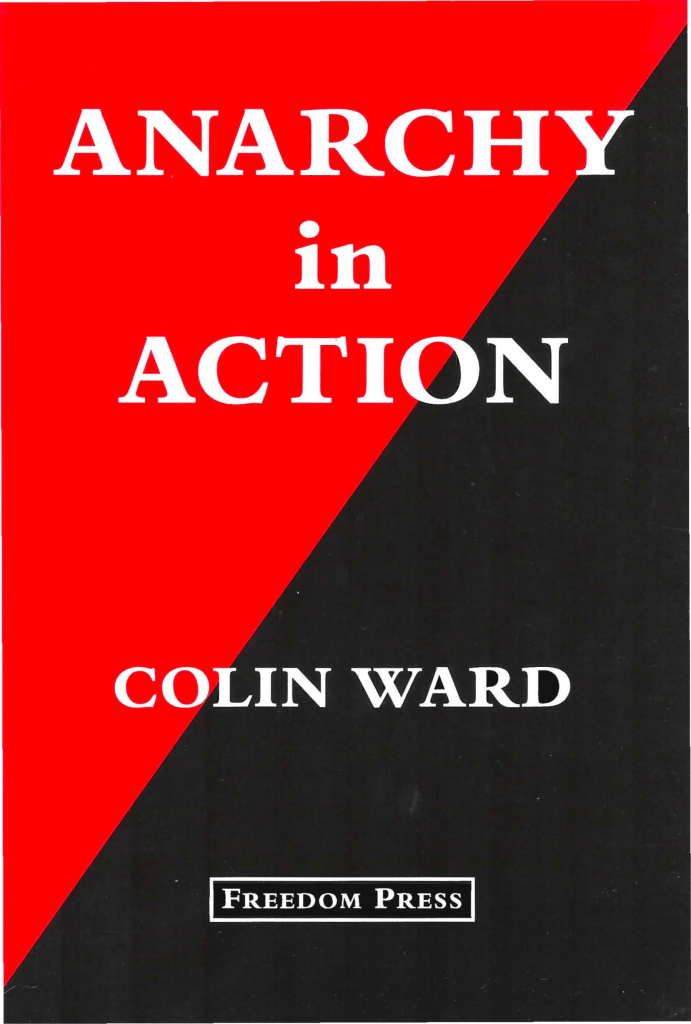
anarchy in action (1996) by colin ward via 111 pg kindle version from anarchist library [https://theanarchistlibrary.org/library/colin-ward-anarchy-in-action]
also.. anarchism as theory of org
notes/quotes:
4
Introduction to the Second Edition
The anarchist movement grows in times of popular self-activity, feeds it and feeds off it, and declines when that self-activity declines… The anarchists in England have paid for the gap between their day-to-day activities and their utopian aspirations. This gap consists basically of a lack of strategy, a lack of ability to assess the general situation and initiate a general project which is consistent with the anarchists utopia, and which is not only consistent with anarchist tactics but inspires them.
John Quail, The Slow Burning Fuse:
The Lost History of the British Anarchists (Paladin 1978)Anarchism as a political and social ideology has two separate origins. It can be seen as an ultimate derivative of liberalism or as a final end for socialism. In either case, the problems that face the anarchist propagandist are the same. The ideas he is putting forward are so much at variance with ordinary political assumptions, and the solutions he offers are so remote, there is such a gap between what is, and what, according to the anarchist, might be, that his audience cannot take him seriously.
this is not ridiculous ness.. this is ridiculous ness
*One elementary principle of attempting to teach anyone anything is that you attempt to **build on the common foundation of common experience and common knowledge. That is the intention of the present volume.
**aka: whalespeak
This book was commissioned by the publishers Allen and Unwin and originally appeared from them in 1973, and was subsequently published in America and, in translation, in Dutch, Italian, Spanish and Japanese. It was not intended for people who had spent a life-time pondering the problems of anarchism, but for those who either had no idea of what the word implied, or who knew exactly what it implied, and had rejected it, considering that it had no relevance for the modern world.
My original preference as a title was the more cumbersome but more accurate “Anarchism as a theory of organisation”, because as I urge in my preface, that is what the book is about. It is not about strategies for revolution and it is not involved with speculation on the way an anarchist society would function. It is about the ways in which people organise themselves in any kind of human society, whether we care to categorise those societies as primitive, traditional, capitalist or communist.
need means (nonjudgmental expo labeling) to undo hierarchical listening as global detox so we can org around legit needs
which we have not yet done/tried to date..
In this sense the book is simply an extended, updating footnote to Kropotkin’s Mutual Aid. Since it was written I have edited for a modern readership two other works of his, and I am bound to say that the experience has enhanced my agreement with George Orwell’s conclusion that Peter Kropotkin was “one of the most persuasive of anarchist writers” because of his “inventive and pragmatic outlook”.
In particular, as an amplification of some of the ideas expressed in the present volume, I would like readers to be aware of the edition I prepared of his Fields, Factories and Workshops (London: 1974, reprinted with additional material by Freedom Press, 1985) New York: Harper & Widstrand 1980). Anyone who wants to understand the real nature of the crisis of the British economy in the nineteen-eighties would gain more enlightenment from Kropotkin’s analysis from the eighteen- nineties than from the current spokesmen of any of the political parties.
fields factories and workshops
5
But if this book is just a footnote to Kropotkin, and if it is open to the same criticism as his book (that it is a selective gathering of anecdotal evidence to support the points that the author wants to make) it does attempt to look at a variety of aspects of daily life in the light of traditional anarchist contentions about the nature of authority and the propensity for self-organisation.
Many years of attempting to be an anarchist propagandist have convinced me that we win over our fellow citizen to anarchist ideas, precisely through drawing upon the common experience of the informal, transient, self-organising networks of relationships that in fact make the human community possible, rather than through the rejection of existing society as a whole in favour of some future society where some different kind of humanity will live in perfect harmony.
huge.. because perhaps.. but mostly because.. until now.. graeber model law et al.. now there’s a nother way for a legit global detox leap
Since this edition is a reproduction of the original text, my purpose here is to add a few comments and further references, both to update it and to take note of critical comments.
Anarchy and the State
This is a restatement of the classical anarchist criticism of government and the state, emphasising the historical division between anarchism and Marxism. In 1848, the year of the Communist Manifesto, Proudhon gave vent to an utterance of marvellous invective, which I had meant to include in this chapter:
“To be ruled is to be kept an eye on, inspected, spied on, regulated, indoctrinated, sermonised, listed and checked-off, estimated, appraised, censured, ordered about, by creatures without knowledge and without virtues. To be ruled is, at every operation, transaction, movement, to be noted, registered, counted, priced, admonished, prevented, reformed, redressed, corrected. It is, on the pretext of public utility and in the name of the common good, to be put under contribution, pressured, mystified, robbed; then, at the least resistance and at the first hint of complaint, repressed, fined, vilified, vexed, hunted, exasperated, knocked-down, disarmed, garroted, imprisoned, shot, grape-shot, judged, condemned, deported, sacrificed, sold, tricked; and to finish off with, hoaxed, calumniated, dishonoured. Such is government! ..t And to think that there are democrats among us who claim there’s some good in government!”
any form of m\a\p.. let people be
That must have seemed a ludicrous over-statement in 19th-century France. But wouldn’t it be perfectly comprehensible to any citizen who steps out of line in any of the totalitarian regimes of the Right or Left that today govern the greater part of the world? Among the attributes of government which Proudhon did not include in his list of horrors, is systematic torture, a unique prerogative of governments in the 20th century.
When this chapter was previously published in a symposium on Participatory Democracy the editors made comments which I found both gratifying and suggestive of ways in which its thesis could be extended. They wrote:
“The anarchist critique of the state, which has often seemed simplistic, is here presented in one of its most sophisticated forms. Here the state is conceived of as the formalisation — and rigidification — of the unused power that the social order has abdicated. In American society it takes the form of a coalition of political, military, and industrial elites, preempting space that is simply not occupied by the rest of society.
6
“Ward believes that the state represents a kind of relationship between people which becomes formalised into a set of vested interests that operates contrary to the interests of the people — even to the point where it evaluates its means in terms of megadeaths. One could take the number of people employed directly by the state as a function of total populations, the amount of state spending as a function of total spending (in socialist states this would require careful functional definition of what constituted the domain of the state as opposed to the social order) and in general compare the resource use of the two areas. One could then analyse the social order in terms of degree of participation, key decisions involving utilisation of social resources and who makes them. Studies of the correlations between state power and social participation in various countries would verify Ward’s thesis: those countries that are top-heavy with state power are the countries in which social participation is weak. A more devastating critique of statism could probably not be imagined.”
The Theory of Spontaneous Order
This chapter drew largely on popular experience of revolutionary situations, actual or potential, before a New Order had filled the gap occupied by the old order. In addition to the works cited on p. 146, several more studies of the Spanish revolution of 1936 have become available since, notably the English translation of Gaston Leval’s Collectives in the Spanish Revolution (Freedom Press 1975).
To the experience of Hungary in 1956 and Czechoslovakia in 1968 must be added that of Poland in 1980. However the story ends, the achievements of Solidarity in forcing concessions, without loss of life, on a ruling bureaucracy which had not hesitated a decade earlier to order its forces to shoot down striking workers, is a remarkable triumph of working-class self organization.
carhart-harris entropy law.. aziz let go law.. et al
again.. need means (nonjudgmental expo labeling) to undo hierarchical listening as global detox so we can org around legit needs
The Dissolution of Leadership
Harmony Through Complexity
Topless Federations
These three chapters, using non-anarchist sources, try to set out three key principles of an anarchist theory of organisation: the concept of leaderless groups, the notion that a healthy society needs diversity rather than unity, and the idea of federalist organisations without a central authority. A number of more recent books reinforce the evidence for these chapters. Proudhon’s Du Principe Federatif has at last been published in English. (Translated by Richard Vernon, University of Toronto Press 1979) The inferences drawn from the history of Swiss federalism are enhanced by Jonathan Steinberg’s Why Switzerland? (Cambridge University Press 1976), and the anthropological material on stateless societies is added to in part five of Kirkpatrick Sale’s Human Scale (Secker & Warburg 1980).
7
Who Is to Plan?
We House, You Are Housed, They Are Homeless
The arguments of these two chapters are set out at much greater length in my books Tenants Take Over (Architectural Press 1974) and Talking Houses (Freedom Press 1990) as well as in John Turner’s Housing by People (Marion Boyars 1976).
Open and Closed Families
One reviewer criticised this chapter for its claim that the revolution in sexual behaviour in our own day is an essentially anarchist revolution, because in his view it was simply a result of a chemico-technical breakthrough, the contraceptive pill. My own Dutch translator felt that it was marred by an absence of appreciation of the feminist point of view. I don’t think so myself, but I do think that this chapter just skates over the surface of the dilemmas of personal freedom and parental responsibility. As Sheila Rowbotham wrote recently, “A campaign for child care which demands the liberation of women and the liberation of children not only reveals the immediate tensions between the two; it also requires a society based on cooperation and free association.”
Schools No Longer
This chapter needs no updating, but is extended to some degree by a lecture of mine called “Towards a Poor School”, published in Talking Schools, (Freedom Press, 1995) as well as by Chapter 16 of my book The Child in the City. Of the various occupations in which I worked for forty years, teaching is the only one which I have a government licence to perform. I am the author of several school books, and the former director of a Schools Council project. I am even a former branch secretary of one of the teaching unions. Yet on every significant issue I have found myself totally opposed to the views of the teaching profession. It sought, and won, the raising of the minimum age limit for compulsory schooling. I favoured its abolition. It wants to eliminate the “private sector” in education, while I see it as the one guarantee that genuine radical experiment can happen. It opposes the abandonment of the legal right to hit children.
I am well aware that the organised opinion of the profession is not the same as that of individual teachers. I revere education. I just can’t stomach the dreadful pretensions of the education industry, especially when compared with the results. And I know that my misgivings about education are paralleled by a consideration of any other aspect of the contemporary West-European corporate state, like, for example, the health service or the public provision of housing.
None of my own writings, alas, can be said to propound an anarchist theory of education, but they do raise some of the ironies and paradoxes of attempts to achieve economic equality or social change through the manipulation of the education system. A brave effort to draw together the various streams of anarchist ideas on education is made in Joel H. Spring’s A Primer of Libertarian Education (New York: Free Life Editions, 1975).
8
Play as an Anarchist Parable
Play is a parable of anarchy, since it is an area of human activity which is self-chosen and self-directed, but this very fact leads to a comparison with work.
graeber fear of play law et al.. david on leisure et al
Work is Leisure is Hated Enjoyed Long Brief For someone else For yourself Essential for livelihood Inessential for livelihood Concentrated At your own pace For fixed hours In your own time I quote this polarisation from my school book on Work (Penguin Education 1972), because any discussion of play and of leisure (Britain’s fastest-growing industry’) leads to a consideration of what is wrong with people’s working lives.
A Self-Employed Society
This is the chapter which is most in need of bringing up to date, but which has an enormously relevant title. Readers do need reminding that for several decades, until the 1960s, the anarchists (apart from a few faithful stalwarts of the producer co-operative movement) were virtually the only people publishing propaganda for worker self-management in industry. Since this book was first published there have been a variety of new experiences and new ventures, and an absolute mountain of new literature.
In left-wing political circles in Britain, for sixty years, the demand for workers’ self-management was regarded as a marginal and diversionary issue compared with the demand for nationalisation, the universal cure-all. The atmosphere changed only in the 1970s, when, as an alternative to quiet extinction, workers in a number of enterprises threatened by closure, sought, through protracted “sit-ins” to demand that they should be helped to keep the plant open under workers’ control. Readers will remember the particular local epics at Upper Clyde Shipbuilders at Govan, at the former Fisher-Bendix factory outside Liverpool, at the Scottish Daily Express, at Fakenham Enterprises in Norfolk and at the Meriden motorcycle plant at Coventry.
When Anthony Wedgwood Benn persuaded his fellow members of the Labour government to back these aspirations with public money (a policy which would have been followed automatically when ordinary capitalist industry was concerned), it represented a complete turnaround in his interpretation of socialism as applied to industry. For it was Mr Benn who, in the 1964 Labour government, had been the mastermind, through his Industrial Reorganisation Corporation, of the takeover of half the motor industry by Leylands (a formerly successful bus and lorry firm from Lancashire) and most of the electrical industry by GEC, in the hope of enabling British industry to complete on equal terms for the continental market with the European giants.
These were vain hopes, and one of the glumly hilarious spectacles of the 1980s has been to see a Conservative government, committed to laissez-faire liberalism, continually bailing out British Leyland from tax revenue. The Benn-sponsored co-ops have mostly collapsed, or have had to rely so completely on capitalist investment that their co-operative structure has been submerged. It was only because these firms were dying that the workers’ aspirations were given an airing, and there are even people with a conspiratorial view of history who see the whole episode as having been invented to discredit the co-operative ideal.
bs jobs from birth et al
9
But as unemployment continually increases in Britain, people who have lost confidence in the usual political panaceas, have shown an increasing interest in co-operative ventures. The British discovered the Mondragon co-operatives in the Basque country, with pilgrimages of trade union officers and local councillors going to Spain to discover the secret of Mondragon’s success. The significant recent books are Worker-Owners: The Mondragon Achievemnt (Anglo-German Foundation 1977), Robert Oakeshott’s The Case for Workers’ Co-ops (Routledge & Kegan Paul 1978), Workers’ Co-operatives: A Handbook (Aberdeen People’s Press 1980) and Jenny Thomley: Workers’ Co-operatives: Jobs and Dreams (Heinemann 1981).
cooperatives ness as cancerous distractions
The majority of recent co-operative ventures cannot be regarded as success stories: they have failed. Nor are the apparent pre-conditions for success particularly acceptable to anarchists. Robert Oakeshott, for example, concludes that there are at least four such conditions: “first, the main thrust to get the enterprises off the ground must come from the potential workforce itself; second, the commitment of the workforce needs to be further secured by the requirement of a meaningful capital stake; third, the prospective enterprise must be equipped with a manager or a management team which is at least not inferior to that which a conventional enterprise would enjoy; fourth, these enterprises must work together in materially supportive groupings, for in isolation they are hopelessly vulnerable.”
The Breakdown of Welfare
This chapter does have the merit of raising issues which are unfashionable both among the defenders of the contemporary British welfare state and among its critics. Since it was written we have moved into the era of cuts in welfare expenditure, imposed by both Labour and Conservative governments. It is not at all easy to take part in the arguments surrounding the cuts from an anarchist point of view. On the one hand we have the political left which regards the provision of welfare, subsidised housing or subsidised transport as a “social wage” which mitigates the exploitation which it associates with the capitalist system. On the other hand is the political right which claims that the people who derive most from the public services are people who could perfectly well afford to meet their true cost. (And in fact it is perfectly true that the poor derive the least from welfare provision). The whole argument is complicated by the fact that we have now entered the period of mass unemployment.
earn a living ness et al.. supposed to’s of school/work et al
Welfare is administered by a top-heavy governmental machine which ensures that when economies in public expenditure are imposed by its political masters, they are made by reducing the service to the public, not by reducing the cost of administration. Thus, as Leslie Chapman remarked in his book Your Disobedient Servant, in this way “the wicked injustice of the cuts, the desirability of replacing them as quickly as possible, the unwisdom of those who imposed them and the long suffering patience of those who received them were all demonstrated in one convenient package.” This was subsequently demonstrated during both Labour and Conservative governments. Writing in 1977, A. H. Halsey observed that “we live today under sentence of death by a thousand cuts, that is, of all things except the body of bureaucracy”. And Peter Townsend noted two years later commenting on “Social Policy in Conditions of Scarcity” that “services to consumers or clients were much more vulnerable than staff establishments.”
10
This was nowhere better demonstrated than in the evolution of the National Health Service. In the ten years before its reorganisation, health service staff generally increased by 65 per cent. However, during that period medical and nursing staff increased by only 21 per cent and domestic staff by 2 per cent. The rest was administration. The government hired a firm of consultants, McKinsey’s, to advise on reorganisation. The members of McKinsey’s staff who produced the new structure are now convinced that they gave the wrong advice. Similarly the former chief architect to the DHSS is now convinced that the advice he gave for ten years on hospital design was in fact misguided.
We have failed to come to terms with the fact that our publicly-provided services, just like our capitalist industries, also propped up by taxation, are dearly bought. This was less apparent in the past when public services were few and cheap. Old people who recall the marvellous service they used to get from the post office or the railways, never mention that these used to be low wage industries which, in return for relative security, were run with a military-style discipline, to which not even the army, let alone you or I, would submit today.
Any public service nowadays has to pay the going rate, and there is every reason why this should be so. The question at issue is whether government provision is the best way of meeting social needs. We are always offering superior advice to those third world countries where “aid” is dissipated in the cost of administering it, but we are in just the same situation ourselves. “Added to the traditional burdens of the poor,” remark the authors of The Wincroft Youth Project, “there is now the weight of a bureaucracy that, ironically, is employed to serve them.”
How Deviant Dare You Get?
This chapter deals, however inadequately, with the objection most people raise to anarchist ideas: the anarchist rejection of the law, the legal system and the agencies of law-enforcement. Since this book was first published there have been three new contributions to this debate. One, which, sadly, fails to live up to the promise of its title is Larry Tifft and Dennis Sullivan: The Struggle to be Human: Crime, Criminology and Anarchism (Cienfuegos Press 1980). Another is Alan Ritter’s Anarchism: A Theoretical Analysis (Cambridge University Press 1980) whose author concludes on this issue that “Even under anarchy there remains some danger of misconduct, which authority sanctioned by rebuke prevents. Though anarchists do not call this rebuke punishment, it is easy to show that they should.” The third, and most suggestive is the chapter on “A Policy for Crime Control” in Stuart Henry’s The Hidden Economy (Martin Robertson 1978). Henry argues for what he calls normative control of crime, by which he means “group or community control”. He remarks that, “It may be too early to predict, but it would seem that the administration of criminal justice for some types of offence may be about to complete a full circle. Beginning with community control in an underdeveloped society, we have progressed through various stages of formal, professional, bureaucratic justice as industrialisation has gathered momentum. However, recent years have witnessed a new wave of dissatisfaction with centralised, bureaucratic structures through which most aspects of our life are managed. In areas as diverse as government, industry, health and welfare, the emerging trend is toward devolution, decentralisation, democratisation and popular participation. A part of this trend is the de-centralisation of criminal justice to a form of community control which was once commonplace… Many commentators are rapidly reaching the conclusion that only people involved in and aware of the community can act as effective forces in crime prevention and that simply increasing police and court capacity will neither solve the problems presently plaguing criminal justice systems, nor equip these systems to cope with changing trends in crime. It is felt that the only way out of the present situation is for criminal justice and the community to be brought closer together, so that those who judge and those who are judged are part of the same society… I believe that only with this degree of involvement and understanding can we ever hope to liberate ourselves from the hypocrisy of our attitude to “crime”, and only then will we be capable of controlling it.”
need – gershenfeld something else law et al
11
Anarchy and a Plausible Future
The muted and tentative conclusions of this chapter still seem to me to be valid. If I were writing it today I would certainly have had more to say about the collapse of employment. When this book was written Britain had 800,000 workers registering as unemployed. This was thought at the time to be a scandalous and totally unacceptable figure. Eight years later the figure has risen to 3 million (October 1981). Belatedly we are groping after alternative forms of work to employment. Nobody really believes that manufacturing industry is going to recover lost markets. Nobody really believes that robots or microprocessors are going to create more than a small proportion of the jobs they displace. Finally we have even lost faith in the idea that the service economy is going to expand to fill the jobs lost in the production economy. Jonathan Gershuny shows in his book After Industrial Society (Macmillan 1979) that service industries themselves are already declining and that what is more likely to emerge is a self-service economy.
It is the inexorable whittling away of employment that is leading to speculation about the potential of other ways of organising work, a theme of several chapters in this book. The pre-industrial economy was a domestic economy, (Elliot Jacques reminds us that the word “employment” has only been used in its present sense since the 1840s), and perhaps a domestic economy of individual or collective self-employment is the pattern for the future of work. Hence the growing interest in what is variously termed the irregular economy, the informal economy, or the black economy. Gershuny and Ray Pahl invite us to consider a future in which more and more people move out of “employment” into working for themselves. “Is it sapping the moral fibre of the nation or is it strengthening kin links and neighbourly relations more than armies of social workers and priests have ever been able to do? What, in a phrase, will it be like to live in a world dominated more and more by household and hidden economies and less by the formal economy?”
One of the possibilities they see is of a dual labour market: a high-pay, high technology, aristocracy of labour and a low-wage, low-skill sector, and beyond both the mafiosi of big bosses and little crooks. Another is of a police state dominated by a vast bureaucracy of law enforcement, where “people would feel much like those caught in the “socialism” of Poland or Czechoslovakia.”
Their third, and more hopeful, alternative depends on “a deeper understanding of the socially desirable aspects of the informal economy and by sympathetic encouragement of them.” But who is going to give sympathetic encouragement to the dismantling of industrialism, one of the bulwarks of social control? Not the captains of industry. Not the manipulators of the machinery of government.
again.. again.. need means (nonjudgmental expo labeling) to undo hierarchical listening as global detox so we can org around legit needs
there’s a legit use of tech (nonjudgmental expo labeling).. to facil a legit global detox leap.. for (blank)’s sake.. and we’re missing it
legit freedom will only happen if it’s all of us.. and in order to be all of us.. has to be sans any form of m\a\p
12
Suppose our future in fact lies, not with a handful of technocrats pushing buttons to support the rest of us, but with a multitude of small activities, whether by individuals or groups, doing their own thing?..t Suppose the only plausible economic recovery consists in people picking themselves up off the industrial scrapheap, or rejecting their slot in the micro-technology system, and making their own niche in the world of ordinary needs and their satisfaction. Wouldn’t that be something to do with anarchism?
imagine if we listened to the itch-in-8b-souls 1st thing everyday & used that data to connect us (tech as it could be.. ai as augmenting interconnectedness as nonjudgmental expo labeling)
C. W.
13
Preface
How would you feel if you discovered that the society in which you would really like to live was already here, apart from a few little, local difficulties like exploitation, war, dictatorship and starvation? The argument of this book is that an anarchist society, a society which organises itself without authority, is always in existence, like a seed beneath the snow, buried under the weight and its injustices, nationalism and its suicidal loyalties, religious differences and their superstitious separatism.
f
Of the many possible interpretations of anarchism the one presented here suggests that, far from being a speculative vision of a future society, it is *a description of a mode of human organisation, rooted in the experience of everyday life, which operates side by side with, an in spite of, the dominant authoritarian trends of our society. This is not a new version of anarchism. Gustav Landauer saw it, not as the founding of something new, “but as the actualisation and reconstruction of **something that has always been present, which exists alongside the state, albeit buried and laid waste”. And a modern anarchist, Paul Goodman, declared that: “A free society cannot be the substitution of a ‘new order’ for the old order; it is the ***extension of spheres of free action until they make up most of social life.”
*if this.. then just same song.. until we get out of sea world.. because not really living/being free.. rather.. responding/reacting/anti-ing.. so cancerous distraction
**this part resonates.. on each heart ness.. just need a means to uncover/detox it.. ie: there’s a legit use of tech (nonjudgmental expo labeling).. to facil a legit global detox leap.. for (blank)’s sake.. and we’re missing it
legit freedom will only happen if it’s all of us.. and in order to be all of us.. has to be sans any form of m\a\p
***just new order.. aka: same song.. if still in sea world.. huge red flag is ‘most’.. has to be all (as the day and berners-lee everyone law) ness for the dance to dance
You may think that in describing anarchy as organisation, I am being deliberately paradoxical. Anarchy you may consider to be, by definition, the opposite of organisation. But the word really means something quite different; it means the absence of government, the absence of authority. It is, after all, governments which make and enforce the laws that enable the “haves” to retain control of social assets to the exclusion of the “have-nots”. It is, after all, the principle of authority which ensures that people will work for someone else for the greater part of their lives, not because they enjoy it or have any control over their work, but because to do so is their only means of livelihood. It is, after all, governments which prepare for and wage war, even though you are obliged to suffer the consequences of their going to war.
huge huge.. but for any form of m\a\p
But is it only governments? The power of a government, even the most absolute dictatorship, depends on the agreement of the governed. Why do people consent to be ruled? It isn’t only fear; what have millions of people to fear from a small group of professional politicians and their paid strong-arm men? It is because they subscribe to the same values as their governors. Rulers and ruled alike believe in the principle of authority, of hierarchy, of power. They even feel themselves privileged when, as happens in a small part of the globe, they can choose between alternative labels on the ruling elites. And yet, in their ordinary lives they keep society going by voluntary association and mutual aid.
14
Anarchists are people who make a social and political philosophy out of the natural and spontaneous tendency of humans to associate together for their mutual benefit. Anarchism is in fact the name given to the idea that it is possible and desirable for society to organise itself without government. The word comes from the Greek, meaning without authority, and ever since the time of the Greeks there have been advocates of anarchy under one name or another. The first person in modern times to evolve a systematic theory of anarchism was William Godwin, soon after the French revolution. A Frenchman, Proudhon, in the mid-nineteenth century developed an anarchist theory of social organisation, of small units federated together but with no central power. He was followed by the Russian revolutionary, Michael Bakunin, the contemporary and adversary of Karl Marx. Marx represented one wing of the socialist movement, concentrated on siezing the power of the state, Bakunin represented the other, seeking the destruction of state power.
Another Russian, Peter Kropotkin, sought to give a scientific foundation to anarchist ideas by demonstrating that mutual aid — voluntary cooperation — is just as strong a tendency in human life as aggression and the urge to dominate. These famous names of anarchism recur in this book, simply because what they wrote speaks, as the Quakers say, to our condition. But there were thousands of other obscure revolutionaries, propagandists and teachers who never wrote books for me to quote but who tried to spread the idea of society without government in almost every country in the world, and especially in the revolutions in Mexico, Russia and Spain. Everywhere they were defeated, and the historians wrote that anarchism finally died when Franco’s troops entered Barcelona in 1939.
But in Paris in 1968 anarchist flags flew over the Sorbonne, and in the same year they were seen in Brussels, Rome, Mexico City, New York, and even in Canterbury. All of a sudden people were talking about the need for the kind of politics in which ordinary men, women and children decide their own fate and make their own future, about the need for social and political decentralisation, about workers’ control of industry, about pupil power in school, about community control of the social services. Anarchism, instead of being a romantic historical by-way, becomes an attitude to human organisation which is more relevant today than it ever seemed in the past.
if legit free.. doubt we’d care about ‘declaring’ anything.. definitely not about workers, pupils power, control, services.. oi
Organisation and its problems have developed a vast and expanding literature because of the importance of the subject for the hierarchy of government administration and industrial management. Very little of this vast literature provides anything of value for the anarchist except in his role as destructive critic or saboteur of the organisations that dominate our lives. The fact is that while there are thousands of students and teachers of government, there are hardly any of non-government. There is an immense amount of research into methods of administration, but hardly any into self-regulation. There are whole libraries on, and expensive courses in, industrial management, and very large fees for consultants in management, but there is scarcely any literature, no course of study and certainly no fees for those who want to do away with management and substitute workers’ autonomy. The brains are sold to the big battalions, and we have to build up a theory of non-government, of non-management, from the kind of history and experience which has hardly been written about because nobody thought it all that important.
because if you teach it/anything.. already govt et al.. already a form of m\a\p
“History”, said W. R. Lethaby, “is written by those who survive, philosophy by the well-to-do; those who go under have the experience.” But once you begin to look at human society from an anarchist point of view you discover that the alternatives are already there, in the interstices of the dominant power structure. If you want to build a free society, the parts are all at hand.
true.. but not in way (or org’d around ways) you are saying
16
Chapter I. Anarchy and the State
As long as today’s problems are stated in terms of mass politics and ‘mass organisation’, it is clear that only States and mass parties can deal with them. But if the solutions that can be offered by the existing States and parties are acknowledged to be either futile or wicked, or both, then we must look not only for different ‘solutions’ but especially for a different way of stating the problems themselves.. t
we need a problem deep enough to resonate w/8bn today.. a mechanism simple enough to be accessible/usable to 8bn today.. and an ecosystem open enough to set/keep 8bn legit free
ie: org around a problem deep enough (aka: org around legit needs) to resonate w/8bn today.. via a mechanism simple enough (aka: tech as it could be) to be accessible/usable to 8bn today.. and an ecosystem open enough (aka: sans any form of m\a\p) to set/keep 8bn legit free
yeah that.. ie: problem deep enough et al
Andrea Caffi
Marx is an authoritarian and centralising communist. He wants what we want, the complete triumph of economic and social equality, but he wants it in the State and through the State power, through the dictatorship of a very strong and, so to say, despotic provisional government, that is by the negation of liberty. His economic ideal is the State as sole owner of the land and of all kinds of capital, cultivating the land under the management of State engineers, and controlling all industrial and commercial associations with State capital. We want the same triumph of economic and social equality through the abolition of the State and of all that passes by the name of law (which, in our view, is the permanent negation of human rights). We want the reconstruction of society and the unification of mankind to be achieved, not from above downwards by any sort of authority, nor by socialist officials, engineers, and other accredited men of learning — but from below upwards, by the free federation of all kinds of workers’ associations liberated from the yoke of the State.
if still ‘workers’ et al.. not liberated
17
l
Kropotkin, ..He thought it self-evident that “this new form will have to be more popular, more decentralised, and nearer to the folk-mote self-government than representative government can ever be,” reiterating that we will be compelled to find new forms of organisation for the social functions that the state fulfils through the bureaucracy, and that “as long as this is not done, nothing will be done”.
so people talked of same song ness.. while not letting go enough to not be same song
When we look at the powerlessness of the individual and the small face-to-face group in the world today and ask ourselves why they are powerless, we have to answer not merely that they are weak because of the vast central agglomerations of power in the modern, military-industrial state, but that they are weak because they have surrendered their power to the state. It is as though every individual possessed a certain quantity of power, but that by default, negligence, or thoughtless and unimaginative habit or conditioning, he has allowed someone else to pick it up, rather than use it himself for his own purposes. (“According to Kenneth Boulding, there is only so much human energy around. When large organisations utilise these energy resources, they are drained away from the other spheres.”)
oi oi.. still same song
18
Gustav Landauer, the German anarchist, made a profound and simple contribution to the analysis of the state and society in one sentence: “The state is not something which can be destroyed by a revolution, but is a condition, a certain relationship between human beings, a mode of human behaviour; we destroy it by contracting other relationships, by behaving differently.” It is we and not an abstract outside identity, Landauer implies, who behave in one way or the other, politically or socially. Landauer’s friend and executor, Martin Buber, begins his essay Society and the State with an observation of the sociologist, Robert MacIver, that “to identify the social with the political is to be guilty of the grossest of all confusions, which completely bars any understanding of either society or the state.” The political principle, for Buber, is characterised by power, authority, hierarchy, dominion. He sees the social principle wherever men link themselves in an association based on a common need or common interest.
graeber make it diff law.. graeber model law.. et al
What is it, Buber asks, that gives the political principle it ascendancy? And he answers, “the fact that every people feel itself threatened by the others gives the state its definite unifying power; it depends upon the instinct of self-preservation of society itself; the latent external crisis enables it to get the upper hand in internal crises … All forms of government have this in common: each possesses more power than is required by the given conditions; in fact, this excess in the capacity for making dispositions is actually what we understand by political power. The measure of this excess which cannot, of course, be computed precisely, represents the exact difference between administration and government.” He calls this excess the “political surplus” and observes that “its justification derives from the external and internal instability, from the latent state of crisis between nations and within every nation. The political principle is always stronger in relation to the social principle than the given conditions require. The result is a continuous diminution in social spontaneity.”
The conflict between these two principles is a permanent aspect of the human condition. Or as Kropotkin put it: “Throughout the history of our civilisation, two traditions, two opposed tendencies, have been in conflict: the Roman tradition and the popular tradition, the imperial tradition and the federalist tradition, the authoritarian tradition and the libertarian tradition.” There is an inverse correlation between the two: the strength of one is the weakness of the other. If we want to strengthen society we must weaken the state. Totalitarians of all kinds realise this, which is why they invariably seek to destroy those social institutions which they cannot dominate. So do the dominant interest groups in the state, like the alliance of big business and the military establishment for the “permanent war economy” suggested by Secretary of Defence Charles E. Wilson in the United States, which has since become so dominant that even Eisenhower, in his last address as President, felt obliged to warn us of its menace.
Shorn of the metaphysics with which politicians and philosophers have enveloped it, the state can be defined as a political mechanism using force, and to the sociologist it is one among many forms of social organisation. It is however, “distinguished from all other associations by its exclusive investment with the final power of coercion”. And against whom is this final power directed? It is directed at the enemy without, but it is aimed at the subject society within.
This is why Buber declared that it is the maintenance of the latent external crisis that enables the state to get the upper hand in internal crises. Is this a conscious procedure? Is it simply that “wicked” men control the state, so that we could put things right by voting for “good” men? Or is it a fundamental characteristic of the state as an institution? It was because she drew this final conclusion that Simone Weil declared that “The great error of nearly all studies of war, an error into which all socialists have fallen, has been to consider war as an episode in foreign politics, when it is especially an act of interior politics, and the most atrocious act of all: For just as Marx found that in the era of unrestrained capitalism, competition between employers, knowing no other weapon than the exploitation of their workers, was transformed into a struggle of each employer against his own workmen, and ultimately of the entire employing class against their employees, so the state uses war and the threat of war as a weapon against its own population. “Since the directing apparatus has no other way of fighting the enemy than by sending its own soldiers, under compulsion, to their death — the war of one State against another State resolves itself into a war of the State and the military apparatus against its own people.[
19
It doesn’t look like this, of course, if you are a part of the directing apparatus, calculating what proportion of the population you can afford to lose in a nuclear war — just as the governments of all the great powers, capitalist and communist, have calculated. But it does look like this if you are part of the expendable population — unless you identify your own unimportant carcase with the state apparatus — as millions do. The expendability factor has increased by being transfered from the specialised, scarce and expensively trained military personnel to the amorphous civilian population. American strategists have calculated the proportion of civilians killed in this century’s major wars. In the First World War 5 per cent of those killed were civilians, in the Second World War 48 per cent, in the Korean War 84 per cent, while in a Third World War 90–95 per cent would be civilians. States, great and small, now have a stockpile of nuclear weapons equivalent to ten tons of TNT for every person alive today.
In the nineteenth century T. H. Green remarked that war is the expression of the “imperfect” state, but he was quite wrong. War is the expression of the state in its most perfect form: it is its finest hour. War is the health of the state — the phrase was invented during the First World War by Randolph Bourne, who explained:
The State is the organisation of the herd to act offensively or defensively against another herd similarly organised. War sends the current of purpose and activity flowing down to the lowest level of the herd, and to its most remote branches. All the activities of society are linked together as fast as possible to this central purpose of making a military offensive or a military defence, and the State becomes what in peacetime it has vainly struggled to become … The slack is taken up, the cross-currents fade out, and the nation moves lumberingly and slowly, but with ever accelerated speed and integration, towards the great end, towards that peacefulness of being at war …
This is why the weakening of the state, the progressive development of its imperfections, is a social necessity. The strengthening of other loyalties, of alternative foci of power, of different modes of human behaviour, is an essential for survival. But where do we begin? It ought to be obvious that we do not begin by supporting, joining, or hoping to change from within, the existing political parties, nor by starting new ones as rival contenders for political power. *Our task is not to gain power, but to erode it, to drain it away from the state. “The State bureaucracy and centralisation are as irreconcilable with socialism as was autocracy with capitalist rule. One way or another, socialism must become more popular, more communalistic, and less dependent upon indirect government through elected representatives. It must become more self-governing.” Putting it differently, we have to build networks instead of pyramids. **All authoritarian institutions are organised as pyramids: the state, the private or public corporation, the army, the police, the church, the university, the hospital: they are all pyramidal structures with a small group of decision-makers at the top and a broad base of people whose decisions are made for them at the bottom. Anarchism does not demand the changing of the labels on the layers, ***it doesn’t want different people on top, it wants us to climber out from underneath. It advocates an extended network of individuals and groups, making their own decisions, controlling their own destiny.
*rather.. of any form of m\a\p
**structural violence et al
***decision making is unmooring us law.. have to let go of any form of m\a\p.. otherwise.. same song
20
The classical anarchist thinkers envisaged the whole social organisation woven from such local groups: the commune or council as the territorial nucleus (being “not a branch of the state, but the free association of the members concerned, *which may be either a co-operative or a corporative body, or simply a provisional union of several people united by a common need,” and the syndicate or worker’s council as the industrial or occupational unit. These units would federate together not like the stones of a pyramid where the biggest burden is borne by the lowest layer, but like the links of a network, the network of autonomous groups. **Several strands of thought are linked together in anarchist social theory: the ideas of direct action, autonomy and workers’ control, decenralisation and federalism.
*needs to be by common itch-in-the-soul.. otherwise we start org ing around non legit needs et al
**cancerous distractions .. perpetuating same song
The phrase “direct action” was first given currency by the French revolutionary syndicalists of the turn of the century, and was associated with the various forms of militant industrial resistance — the strike, go-slow, working-to-rule, sabotage and the general strike. Its meaning has widened since then to take in the experience of, for example, Gandhi’s civil disobedience campaign and the civil rights struggle in the United States, and the many other forms of do-it-yourself politics that are spreading round the world. Direct action has been defined by David Wieck as that “action which, in respect to a situation, realises the end desired, so far as this lies within one’s power or the power of one’s group’ and he distinguishes this from indirect action which realises an irrelevant or even contradictory end, presumably as a means to the “good” end. He gives this as a homely example: “If the butcher weighs one’s meat with his thumb on the scale, one may complain about it and tell him he is a bandit who robs the poor, and if he persists and one does nothing else, this is **mere talk; one may call the Department of Weights and Measures, and this is indirect action; or one may, talk failing, insist on weighing one’s own meat, bring along a scale to check the butcher’s weight, take one’s business somewhere else, help open a co-operative store, and these are direct actions.” Wieck observes that: “Proceeding with the belief that in every situation, every individual and group has the possibility of some direct action on some level of generality, we may discover much that has been unrecognised, and the importance of much that has been underrated. So politicalised is our thinking, so focused to the motions of governmental institutions, that the effects of direct efforts to modify one’s environment are unexplored. ***The habit of direct action is, perhaps, identical with the habit of being a free man, prepared to live responsibly in a free society.”
*cancerous distractions.. direct action.. any form of democratic admin
**oi.. this ie as great ie of cancerous distraction.. of the craziness of inspectors of inspectors et al.. of too much ness.. oi..
***huge huge huge error.. oi
21
The ideas of autonomy and workers’ control and of decentralisation are inseparable from that of direct action. In the modern state, everywhere and in every field, one group of people makes decisions, exercises control, limits choices, while the great majority have to accept these decisions, submit to this control and act within the limits of these externally imposed choices. The habit of direct action is the habit of wresting back the power to make decisions affecting us from them. The autonomy of the worker at work is the most important field in which this expropriation of decision-making can apply. When workers’ control is mentioned, people smile sadly and murmur regretfully that it is a pity that the scale and complexity of modern industry make it a utopian dream which could never be put into practice in a developed economy. They are wrong. There are no technical grounds for regarding workers’ control as impossible. The obstacles to self-management in industry are the same obstacles that stand in the way of any kind of equitable share-out of society’s assets: the vested interest of the privileged in the existing distribution of power and property.
oi.. all whalespeak
Precisely because we are not concerned with recommending geographical isolation, anarchist thinkers have devoted a great deal of thought to the principle of federalism. Proudhon regarded it as the alpha and omega of his political and economic ideas. He was not thinking of a confederation of states or of a world federal government, but of a basic principle of human organisation..t
need 1st/most: means to undo our hierarchical listening to self/others/nature as global detox/re\set.. so we can org around legit needs
mufleh humanity law et al
22
Autonomous direct action, decentralised decision-making, and free federation have been the characteristics of all genuinely popular uprisings..t ..Lenin said to Emma Goldman, “Why, even your great comrade Errico Malatesta has declared himself for the soviets.” “Yes,” she replied, “For the free soviets.” Malatesta himself, defining the anarchist interpretation of revolution, wrote:
perhaps popular.. but nothing legit new/diff.. so same song
Revolution is the destruction of all coercive ties; it is the autonomy of groups, of communes, of regions, revolution is the free federation brought about by a desire for brotherhood, by individual and collective interests, *by the needs of production and defense; revolution is the constitution of innumerable free groupings based on ideas, wishes and tastes of all kinds that exist among the people; **revolution is the forming and disbanding of thousands of representative, district, communal, regional, national bodies which, without having any legislative power serve to make known and to co-ordinate the desires and interests of people near and far and which act through information, advice and example. Revolution is freedom proved in the crucible of facts — and lasts so long as freedom lasts, that is until others, taking advantage of the weariness that overtakes the masses, of the inevitable disappointments that follow exaggerated hopes, of the probable errors and human faults, succeed in constituting a power which, supported by an army of mercenaries or conscripts, lays down the law, arrests the movement at the point it has reached, and then begins the reaction.
*if so.. then not new/diff/free.. rather.. same song of cancerous distractions
**oi oi
His last sentence indicates that he thought reaction inevitable, and so it is, if people are willing to surrender the power they have wrested from a former ruling elite into the hands of a new one. But a reaction to every revolution is inevitable in another sense. This is what the ebb and flow of history implies. The lutte finale exists only in the words of a song. As Landauer says, every time after the revolution is a time before the revolution for all those whose lives have not got bogged down in some great moment of the past. There is no final struggle, only a series of partisan struggles on a variety of fronts.
Firstly, *on whether or not people have learned anything from the history of the last hundred years; secondly, on whether the large number of people in both east and west — the dissatisfied and dissident young of the Soviet empire as well as of the United States who seek an **alternative theory of social organisation — will grasp the relevance of those ideas which we define as anarchism; and thirdly, on whether the anarchists themselves are sufficiently imaginative and inventive to find ways of applying their ideas today to the society we live in in ways that combine immediate aims with ultimate ends.
*if still doing ‘school’ ness.. (vs let people be ness).. then not legit free.. not **alt org..
need to org around legit needs
24
2
Chapter II. The Theory of Spontaneous Order
In every block of houses, in every street, in every town ward, groups of volunteers will have been organised, and these commissariat volunteers will find it easy to work in unison and keep in touch with each other … if only the self-styled “scientific” theorists do not thrust themselves in … Or rather let them expound their muddle-headed theories as much as they like, provided they have no authority, no power! And that admirable spirit of organisation inherent in the people … but which they have so seldom been allowed to exercise, will initiate,..t even in so huge a city as Paris, and in the midst of a revolution, an immense guild of free workers, ready to furnish to each and all the necessary food.
rather.. not yet even tried.. so keep ending up with myth of tragedy and lord et al.. black science of people/whales law
Give the people a free hand, and in ten days the food service will be conducted with admirable regularity. Only those who have never seen the people hard at work, only those who have passed their lives buried among documents, can doubt it. Speak of the organising genius of the “Great Misunderstood”, the people, to those who have seen it in Paris in the days of the barricades, or in London during the great dock strike, when half a million of starving folk had to be fed, and they will tell you how superior it is to the official ineptness of Bumbledom.
utopia of rules backwards and too much ness
Peter Kropotkin, The Conquest of Bread
pëtr kropotkin.. conquest of bread
An important component of the anarchist approach to organisation is what we might call the theory of *spontaneous order: the theory that, given a common need, a collection of people will, by trial and error, by improvisation and experiment, evolve order out of the situation — this order being more durable and more closely related to their needs than any kind of externally imposed authority could provide..t Kropotkin derived his version of this theory from his observations of the history of human society as well as from the study of the events of the French Revolution in its early stages and from the Paris Commune of 1871, and it has been witnessed in most revolutionary situations, in the ad hoc organisations that spring up after natural disasters, or in any activity where there are no existing organisational forms or hierarchical authority. **The principle of authority is so built in to every aspect of our society that it is only in revolutions, emergencies and “happenings” that the principle of spontaneous order emerges. But it does provide a glimpse of the kind of human behaviour that the anarchist regards as “normal” and the authoritarian sees as unusual..t
*if hear/grok legit needs.. then a means back to that dance.. imagine if we listened to the itch-in-8b-souls 1st thing everyday & used that data to connect us (tech as it could be.. ai as augmenting interconnectedness as nonjudgmental expo labeling)
**and even then.. only part\ial ness of what it could be if all legit free..
there’s a legit use of tech (nonjudgmental expo labeling).. to facil a legit global detox leap.. for (blank)’s sake.. and we’re missing it
legit freedom will only happen if it’s all of us.. and in order to be all of us.. has to be sans any form of m\a\p
You could have seen it in, for example, the first Aldermaston March or in the widespread occupation of army camps by squatters in the summer of 1946, described in Chapter VII. Between June and October of that year 40,000 homeless people in England and Wales, acting on their own initiative, occupied over 1,000 army camps. They organised every kind of communal service in the attempt to make these bleak huts more like home — communal cooking, laundering and nursery facilities, for instance. They also federated into a Squatters’ Protection Society. One feature of these squatter communities was that they were formed from people who had very little in common beyond their homelessness — they included tinkers and university dons. It could be seen in spite of commercial exploitation in the pop festivals of the late 1960s, in a way which is not apparent to the reader of newspaper headlines. From “A cross-section of informed opinion” in an appendix to a report to the government, a local authority representative mentions “an atmosphere of peace and contentment which seems to be dominant amongst the participants” and a church representative mentions “a general atmosphere of considerable relaxation, friendliness and a great willingness to share”. The same kind of comments were made about the instant city of the Woodstock Festival in the United States: “Woodstock, if permanent, would have become one of America’s major cities in size alone, and certainly a unique one in the principles by which its citizens conducted themselves.”
again.. still just part\ial ness .. so easy to find holes.. woodstock et al
25
An interesting and deliberate example of the theory of spontaneous organisation in operation was provided by the Pioneer Health Centre at Peckham in South London. This was started in the decade before the Second World War by a group of physicians and biologists who wanted to study the nature of health and of healthy behaviour instead of studying ill-health like the rest of the medical profession..t They decided that the way to do this was to start a social club whose members joined as families and could use a variety of facilities in return for a family membership subscription and for agreeing to periodic medical examinations. *In order to be able to draw valid conclusions the Peckham biologists thought it necessary that they should be able to observe human beings who were free — free to act as they wished and to give expression to their desires.. There were consequently no rules, no regulations, no leaders..t “I was the only person with authority,” said Dr Scott Williamson, the founder, “and I used it to stop anyone exerting any authority.” For the **first eight months there was chaos..t “With the first member-families”, says one observer, “there arrived a horde of undisciplined children who used the whole building as they might have used one vast London street. Screaming and running like hooligans through all the rooms, breaking equipment and furniture,” they made life intolerable for everyone. Scott Williamson, however, “insisted that peace should be restored only by the response of the children to the variety of stimulus that was placed in their way”. This faith was rewarded: “In less than a year the chaos was reduced to an order in which groups of children could daily be seen swimming, skating, riding bicycles, using the gymnasium or playing some game, occasionally reading a book in the library … the running and screaming were things of the past.”
*yeah that.. hari rat park law et al.. but something we haven’t yet seen/done/tried.. ie: the conditions where everyone is legit free..
1\ undisturbed ecosystem (common\ing) can happen
2\ if we create a way to ground the chaos of 8b legit free people
**this is why we need nonjudgmental expo labeling via tech.. to hasten that detox.. aka: need a means for a legit global detox leap
we desperately need the energy of 8b alive people.. for that.. humanity needs a leap.. to get back/to simultaneous spontaneity .. simultaneous fittingness.. everyone in sync..
In one of the several valuable reports on the Peckham experiment, John Comerford draws the conclusion that “A society, therefore, if left to itself in suitable circumstances to express itself spontaneously works out its own salvation and achieves a harmony of actions which superimposed leadership cannot emulate.”..t This is the same inference as was drawn by Edward Allsworth Ross from his study of the true (as opposed to the legendary) evolution of “frontier” societies in nineteenth-century America.
huge.. ‘in undisturbed ecosystems ..the average individual, species, or population, left to its own devices, behaves in ways that serve and stabilize the whole..’ –Dana Meadows
how to org for that.. aka: org around legit needs
26
Equally dramatic examples of the same kind of phenomenon are reported by those people who have been brave enough, or self-confident enough, to institute self-governing, non-punitive communities of “delinquent” youngsters — August Aichhorn, Homer Lane and David Wills are examples. Homer Lane was the man who, years in advance of his time, started a community of boys and girls, sent to him by the courts, called the Little Commonwealth. He used to declare that “Freedom cannot be given. It is taken by the child in discovery and invention.” True to this principle, says Howard Jones, “he refused to impose upon the children a system of government copied from the institutions of the adult world. The self-governing structure of the Little Commonwealth was evolved by the children themselves, *slowly and painfully, to satisfy their own needs.” Aichhorn was an equally bold man of the same generation who ran a home for maladjusted children in Vienna. He gives this description of one particularly aggressive group: “Their aggressive acts became more frequent and more violent until practically all the furniture in the building was destroyed, the window panes broken, the doors nearly kicked to pieces. It happened once that a boy sprang through a double window ignoring his injuries from the broken glass. The dinner table was finally deserted because each one sought out a corner in the playroom where he crouched to devour his food. Screams and howls could be heard from afar!”
*today.. doesn’t have to be painful or slow
Aichhorn and his colleagues maintained what one can only call a superhuman restraint and faith in their method, protecting their charges from the wrath of the neighbours, the police and the city authorities, and “Eventually patience brought its reward. Not only did the children settle down, but they developed a strong attachment to those who were working with them … This attachment was now to be used as the foundation of a process of re-education. *The children were at last to be brought up against the limitations imposed upon them by the real world.”
*because.. missing pieces uncovered/restored.. et al.. almaas holes law et al…
Time and again *those rare people who have themselves been free enough and have had the moral strength and the endless patience and forbearance that this method demands, have been similarly rewarded. In ordinary life the fact that one is not dealing (theoretically at least,) with such deeply disturbed characters should make the experience less drastic, but in ordinary life, outside the deliberately protected environment, we interact with others with the aim of getting some common task done, and **the apparent aimlessness and time-consuming tedium of the period of waiting for spontaneous order to appear brings the danger of some lover of order intervening with an attempt to impose authority and method, just to get something accomplished. But you have only to watch parents with their children to see that the threshold of tolerance for disorder in this context varies enormously from one individual to another. We usually conclude that the punitive, interfering lover of order is usually so because of his own unfreedom and insecurity. ***The tolerant condoner of disorder is a recognisably different kind of character, and the reader will have no doubt which of the two is easier to live with.
*actually.. no one to date.. because has to be all of us for anyone to be legit free.. and too.. not rare.. all can/would.. if conditions right
**myth of tragedy and lord ness will happen.. even w/in ourselves.. why we need a legit global detox leap to hasten all gaps
***actually all of us.. some just mask/confine it more than others.. so which is easier to live with?.. suicide because of the mask.. or crazywise (doc) ness.. et al.. oi.. hari present in society law et al..
On an altogether different plane is the spontaneous order that emerges in those rare moments in human society when a popular revolution has withdrawn support, and consequently power, from the forces of “law-and-order”. I once spoke to a Scandinavian journalist back from a visit to South Africa, whose strongest impression of that country was that the White South Africans barked at each other. They were, he thought, so much in the habit of shouting orders or admonitions to their servants that it affected their manner of speech to each other as well. “Nobody there is gentle any more.” he said. What brought his remark back to my mind was its reverse. In a broadcast on the anniversary of the Soviet invasion of Czechoslovakia a speaker looked back to the summer of 1968 in Prague as one in which, as she put it, “Everyone had become more gentle, more considerate. Crime and violence diminished. We all seemed to be making a special effort to make life tolerable, just because it had been so intolerable before.”
27
Now that the Prague Spring and the Czechoslovak long hot summer have retreated into history, we tend to forget — though the Czechs will not forget — the change in the quality of ordinary life, while the historians, busy with the politicians floating on the surface of events, or this or that memorandum from a Central Committee or a Praesidium, tell us nothing about what it felt like for people in the streets. At the time John Berger wrote of the immense impression made on him by the transformation of values: “Workers in many places spontaneously offered to work for nothing on Saturdays in order to contribute to the national fund. Those for whom, a few months before, the highest ideal was a consumer society, offered money and gold to help save the national economy. (Economically a naive gesture but ideologically a significant one.) I saw crowds of workers in the streets of Prague, their faces lit by an evident sense of opportunity and achievement. *Such an atmosphere was bound to be temporary. But it was an unforgettable indication of the previously unused potential of a people: of **the speed with which demoralisation may be overcome.” And Harry Schwartz of the New York Times reminds us that “Gay, spontaneous, informal and relaxed were the words foreign correspondents used to describe the vast outpouring of merry Prague citizens.” What was Dubcek doing at the time? “He was trying to set limits on the spontaneous revolution that had been set in motion and to curb it. No doubt he hoped to honour the promises he had given at Dresden that he would impose order on what more and more conservative Communists were calling ‘anarchy’”. When the Soviet tanks rolled in to impose their order, the spontaneous revolution gave way to a spontaneous resistance. Of Prague, Kamil Winter declared, “I must confess to you that nothing was organised at all. Everything went on spontaneously …” And of the second day of the invasion in Bratislava, Ladislav Mňačko wrote: “Nobody had given any order. Nobody was giving any orders at all. People knew of their own accord what ought to be done. Each and every one of them was his own government, with its orders and regulations, while the government itself was somewhere very far away, probably in Moscow. Everything the occupation forces tried to paralyse went on working and even worked better than in normal times; by the evening the people had even managed to deal with the bread situation”.
*until now.. because again.. hast to be all of us to be legit freedom.. so.. to last
**we have no idea of that speed.. because we haven’t yet let go enough to see/try
In November, when the students staged a sit-in in the universities, “the sympathy of the population with the students was shown by the dozens of trucks sent from the factories to bring them food free of charge,” and “Prague’s railway workers threatened to strike if the government took reprisal measures against the students. Workers of various state organisations supplied them with food. The buses of the urban transport workers were placed at the strikers’ disposal … Postal workers established certain free telephone communications between university towns.”
28
The same brief honeymoon with anarchy was observed twelve years earlier in Poland and Hungary. The economist Peter Wiles (who was in Poznan at the time of the bread riots and who went to Hungary in the period when the Austrian frontier was open) noted what he called an “astonishing moral purity” and he explained:
Poland had less chance to show this than Hungary, where for weeks there was no authority. In a frenzy of anarchist self-discipline the people, including the criminals, stole nothing, beat no Jews, and never got drunk. They went so far as to lynch only security policemen (AVH) leaving other Communists untouched … The moral achievement is perhaps unparalleled in revolutionary history … It was indeed intellectuals of some sort that began both movements, with the industrial workers following them. The peasants had of course never ceased to resist since 1945, but from the nature of things, in a dispersed and passive manner. Peasants stop things, they don’t start them. Their sole initiative was the astonishing and deeply moving despatch of free food to Budapest after the first Soviet attack had been beaten.
has to be all of us from the get go for the dance to dance
A Hungarian eyewitness of the same events declared:
May I tell you one thing about this common sense of the street, during these first days of the revolution? Just, for example, many hours standing in queues for bread and even under such circumstances not a single fight. One day we were standing in a queue and then a truck came with two young boys with machine guns and they were asking us to give them any money we could spare to buy bread for the fighters. All the queue was collecting half a truck-full of bread. It is just an example. Afterwards somebody beside me asked us to hold his place for him because he gave all his money and he had to go home to get some. In this case the whole queue gave him all the money he wanted. Another example: naturally all the shop windows broke in the first day, but not a single thing inside was touched by anybody. You could have seen broken-in shop windows and candy stores, and even the little children didn’t touch anything in it. Not even camera shops, opticians or jewellers. Not a single thing was touched for two or three days. And in the streets on the third and fourth day, shop windows were empty, but it was written there that, “The caretaker has taken it away”, or “Everything from here is in this or that fiat.” And in these first days it was a custom to put big boxes on street corners or on crossings where more streets met, and just a script over them “This is for the wounded, for the casualties or for the families of the dead,” and they were set out in the morning and by noon they were full of money…
In Havana, when the general strike brought down the Batista regime and before Castro’s army entered the city, a despatch from Robert Lyon, Executive Secretary of the New England office of the American Friends Service Committee reported that “There are no police anywhere in the country, but the crime rate is lower than it has been in years, and the BBC’s correspondent reported that “The city for days had been without police of any sort, an experience delightful to everyone. Motorists — and considering that they were Cubans this was miraculous — behaved in an orderly manner. Industrial workers, with points to make, demonstrated in small groups, dispersed and went home; bars closed when the customers had had enough and no one seemed more than normally merry. Havana, heaving up after years under a vicious and corrupt police control, smiled in the hot sunshine.”
29
In all these instances, the new regime has built up its machinery of repression, announcing the necessity of maintaining order and avoiding counter-revolution: “The Praesidium of the Central Committee of the CPC, the Government and the National Front unequivocally rejected the appeals of the statement of Two Thousand Words, which induce to anarchist acts, to violating the constitutional character of our political reform.” And so on, in a variety of languages. No doubt people will cherish the interregnum of elation and spontaneity merely as a memory of a time when, as George Orwell said of revolutionary Barcelona, there was “a feeling of having suddenly emerged into an era of equality and freedom when *human beings were trying to behave like human beings and not as cogs in the capitalist machine,” or when, as Andy Anderson wrote of Hungary in 1956, “In the society they were glimpsing through the dust and smoke of the battle in the streets, there would be no Prime Minister, no government of professional politicians, and no officials or bosses ordering them about.”
*instead of like whales in sea world
Now you might think that in the study of human behaviour and social relations these moments when society is held together by the cement of human solidarity alone, without the dead weight of power and authority, would have been studied and analysed with the aim of discovering what kind of preconditions exist for an increase in social spontaneity, “participation” and freedom. The moments when there aren’t even any police would surely be of immense interest, if only for criminologists. Yet you don’t find them discussed in the texts of social psychology and you don’t find them written about by the historians. You have to dig around for them among the personal impressions of people who just happened to be there.
so true.. and yet.. still not enough.. kind of like costello screen\service law.. disheartening until we have means for all of us to detox leap
If you want to know why the historians neglect or traduce these moments of revolutionary spontaneity, you should read Noam Chomsky’s essay “Objectivity and Liberal Scholarship” The example he uses is one of the greatest importance for anarchists, the Spanish revolution of 1936, whose history, he remarks, is yet to be written. In looking at the work in this field of the professional historians, he writes: “It seems to me that there is more than enough evidence to show that a deep bias against social revolution and a commitment to the values and social order of liberal bourgeois democracy has led the author to misrepresent crucial events and to overlook major historical currents.” But this is not his main point. “At least this much is plain,” he says, “there are dangerous tendencies in the ideology of the welfare state intelligentsia who claim to possess the technique and understanding required to manage our ‘post-industrial society” and to organise an international society dominated by American superpower. Many of these dangers are revealed, at a purely ideological level, in the study of the counter-revolutionary subordination of scholarship. The dangers exist both insofar as the claim to knowledge is real and insofar as it is fraudulent. Insofar as the technique of management and control exists, it can be used to diminish spontaneous and free experimentation with new social forms, as it can limit the possibilities for reconstruction of society in the interests of those who are now, to a greater or lesser extent dispossessed. Where the techniques fail, they will be supplemented by all of the methods of coercion that modern technology provides, to preserve order and stability.”
30
As a final example of what he calls spontaneous and free experimentation with new social forms, let me quote from the account he cites of the revolution in the Spanish village of Membrilla:
“In its miserable huts live the poor inhabitants of a poor province; eight thousand people, but the streets are not paved, the town has no newspaper, no cinema, neither a cafe nor a library. On the other hand, it has many churches that have been burned.” Immediately after the Franco insurrection, the land was expropriated and village life collectivised. “Food, clothing, and tools were distributed equitably to the whole population. *Money was abolished, work collectivised, all goods passed to the community, consumption was socialised. It was, however, not a socialisation of wealth but of poverty.” Work continued as before. An elected council appointed committees to organise the life of the commune and its relations to the outside world. The necessities of life were distributed freely, insofar as they were available. A large number of refugees were accommodated. A small library was established, and a small school of design. The document closes with these words: “The whole population lived as in a large family; functionaries, delegates, the secretary of the syndicates, the members of the municipal council, all elected, acted as heads of a family. But they were controlled, because special privilege or corruption would not be tolerated. Membrilla, is perhaps the poorest village of Spain, but it is the most just”.
*need to let go of any form of m\a\p
And Chomsky comments: “An account such as this, with its concern for human relations and the ideal of a just society, must appear very strange to the consciousness of the sophisticated intellectual, and it is therefore treated with scorn, or taken to be naive or primitive or otherwise irrational. Only when such prejudice is abandoned will it be possible for historians to undertake a serious study of the popular movement that transformed Republican Spain in one of the most remarkable social revolutions that history records.” **There is an order imposed by terror, there is an order enforced by bureaucracy (with the policeman in the corridor) and there is an order which evolves spontaneously from the fact that we are gregarious animals capable of shaping our own destiny. When the first two are absent, the third, as infinitely more human and humane form of order has an opportunity to emerge..t Liberty, as Proudhon said, is the mother, not the daughter of order.
*true that.. intellectness as cancerous distraction ness.. but also nothing to date worth ‘taking a serious study of’.. 1\ has to be all of us to dance.. and haven’t yet tried/set conditions for it to be all of us.. and 2\ taking a serious study itself as cancerous distraction
**but 3rd is not humane enough .. until it’s all of us
31
Chapter III. The Dissolution of Leadership
Accustomed as is this age to artificial leadership … it is difficult for it to realise the truth that leaders require no training or appointing, but emerge spontaneously when conditions require them. Studying their members in the free-for-all of the Peckham Centre, the observing scientists saw over and over again how one member instinctively became, and was instinctively but not officially recognised as, leader to meet the needs of one particular moment. Such leaders appeared and disappeared as the flux of the Centre required. Because they were not consciously appointed, neither (when they had fulfilled their purpose) where they consciously overthrown. Nor was any particular gratitude shown by members to a leader either at the time of his services or after for services rendered. They followed his guidance just as long as his guidance was helpful and what they wanted. They melted away from him without regrets when some widening of experience beckoned them on to some fresh adventure, which would in turn throw up its spontaneous leader, or when their self-confidence was such that any form of constrained leadership would have been a restraint to them.
John Comerford, Health the Unknown:
The Story of the Peckham Experiment
can’t get but found [https://www.historyandpolicy.org/policy-papers/papers/anarchism-and-the-welfare-state-the-peckham-health-centre] and [https://theanarchistlibrary.org/library/colin-ward-anarchism-as-a-theory-of-organization]
34
*People do go from womb to tomb without ever realising their human potential, **precisely because the power to initiate, to participate in innovating, choosing, judging, and deciding is reserved for the top men. It is no accident that the examples I have given of leadership revolving around functional activities come from “creative” occupations like architecture or scientific research. If ideas are your business, you cannot afford to condemn most of the people in the organisation to being merely machines programmed by somebody else.
*yes
**rather.. because choosing, judging, deciding et al are cancerous distractions for any/everyone
But why are there these privileged enclaves where different rules apply?
Creativity is for the gifted few: the rest of us are compelled to live in the environments constructed by the gifted few, listen to the gifted few’s music, use the gifted few’s inventions and art, and read the poems, fantasies and plays by the gifted few. This is what our education and culture condition us to believe, and this is a culturally induced and perpetuated lie.
graeber min\max law et al
The system makes its morons, then despises them for their ineptitude, and rewards its “gifted few” for their rarity.
35
Chapter IV. Harmony through Complexity
36
Several African societies which are law-less in this sense — in that there are no patterns for formal legislation nor for juridical decisions, and which have no law-enforcement officers of any kind — are described in the symposium Tribes Without Rulers.
39
Harmony results not from unity but from complexity. It appears, as Kropotkin put it:
discrimination as equity.. the dance
as a temporary adjustment established among all forces acting upon a given spot — a provisory adaption. And that adjustment will only last under one condition: that of being continually modified; of representing every moment the resultant of all conflicting actions …
Under the name of anarchism, a new interpretation of the past and present life of society arises … It comprises in its midst an infinite variety of capacities, temperaments and individual energies: it excludes none..t It even calls for struggles and contentions; because we know that periods of contests, so long as they were freely fought out without the weight of constituted authority being thrown on one side of the balance, were periods when human genius took its mightiest flights …
need means (nonjudgmental expo labeling) to undo hierarchical listening as global detox so we can org around legit needs
intellectness as cancerous distraction we can’t seem to let go of.. there’s a legit use of tech (nonjudgmental expo labeling).. to facil a legit global detox leap.. for (blank)’s sake.. and we’re missing it
It seeks the most complete development of individuality combined with the highest development of voluntary association in all its aspects, in all possible degrees, for all imaginable aims; ever changing, ever modified associations which carry in themselves the elements of their durability and constantly assume new forms which answer best to the multiple aspirations of all..t A society to which pre-established forms, crystallised by law, are repugnant; which looks for harmony in an ever-changing and fugitive equilibrium between a multitude of varied forces and influences of every kind, following their own course …
Anarchy is a function, not of a society’s simplicity and lack of social organisation, but of its complexity and multiplicity of social organisations. Cybernetics, the science of control and communication systems, throws valuable light on the anarchist conception of complex self-organising systems..t If we must identify biological and political systems, wrote the neurologist Grey Walter, our own brains would seem to illustrate the capacity and limitations of an anarchosyndicalist community: “We find no boss in the brain, no oligarchic ganglion or glandular Big Brother. Within our heads our very lives depend on equality of opportunity, on specialisation with versatility, on free communication and just restraint, a freedom without interference. Here too, local minorities can and do control their own means of production and expression in free and equal intercourse with their neighbours.” His observations led John D. McEwan to pursue the cybernetic model further. Pointing to the relevance of the Principle of Requisite Variety (“if stability is to be attained the variety of the controlling system must be at least as great as the variety of the system to be controlled”) he cites Stafford Beer’s illustration of the way in which conventional managerial ideas of organisation fail to satisfy this principle. Beer imagines a visitor from Mars who examines the activities at the lower levels of some large undertaking, the brains of the workers concerned, and the organisational chart which purports to show how the undertaking is controlled. He deduces that the creatures at the top of the hierarchy must have heads yards wide. McEwan contrasts two models of decision-making and control:
discrimination as equity via imagine if we ness..
there’s a legit use of tech (nonjudgmental expo labeling).. to facil a legit global detox leap.. for (blank)’s sake.. and we’re missing it
legit freedom will only happen if it’s all of us.. and in order to be all of us.. has to be sans any form of m\a\p
40
The other model is from the cybernetics of evolving self-organising systems. *Here we have a system of large variety, sufficient to cope with a complex, unpredictable environment..t Its characteristics are changing structure, modifying itself under continual feedback from the environment, exhibiting “redundancy of potential command”, and involving complex interlocking control structures. **Learning and decision-making are distributed throughout the system, denser perhaps in some areas than in others.
*yeah that.. taleb antifragile law et al.. carhart-harris entropy law et al
**not that.. decision making is unmooring us law et al
there’s a legit use of tech (nonjudgmental expo labeling).. to facil a legit global detox leap.. for (blank)’s sake.. and we’re missing it
legit freedom will only happen if it’s all of us.. and in order to be all of us.. has to be sans any form of m\a\p
Alone among the reviewers of Donald Schon’s lectures Mary Douglas perceived the connection with non-governmental tribal societies:
Once anthropologists thought that if a tribe has no central authority it had no political unity. We were thoroughly dominated by centre theory and missed what was under our noses..t
wilde not-us law.. need means for global detox leap
41
Thus both anthropology and cybernetic theory support Kropotkin’s contention that in a society without government, harmony would result from ‘an ever-changing adjustment and readjustment of equilibrium between the multitudes of forces and influences’ expressed in “an interwoven network, composed of an infinite variety of groups and federations of all sizes and degrees, local, regional, national and international — temporary or more or less permanent — for all possible purposes: production, consumption and exchange, communications, sanitary arrangements, education, mutual protection, defence of the territory, and so on; and on the other side, for the satisfaction of an ever-increasing number of scientific, artistic, literary and sociable needs.”
oi.. then same song
How crude the governmental model seems by comparison, whether in social administration, industry, education or economic planning. No wonder it is so unresponsive to actual needs. No wonder, as it attempts to solve its problems by fusion, amalgamation, rationalisation and coordination, they only become worse because of the clogging of the lines of communication. The anarchist alternative is that of fragmentation, fission rather than fusion, diversity rather than unity, a mass of societies rather than a mass society.
we have no idea what legit needs are..
42
Chapter V. Topless Federations
The fascinating secret of a well-functioning social organism seems thus to lie not in its overall unity but in its structure, maintained in health by the life-preserving mechanism of division operating through myriads of cell-splittings and rejuvenations taking place under the smooth skin of an apparently unchanging body..t Wherever, because of age or bad design, this rejuvenating process of subdivision gives way to the calcifying process of cell unification, the cells, now growing behind the protection of their hardened frames beyond their divinely allotted limits, begin, as in cancer, to develop those hostile, arrogant great-power complexes which cannot be brought to an end until the infested organism is either devoured, or a forceful operation succeeds in restoring the small-cell pattern.
infinitesimal structures approaching the limit of structureless\ness and/or vice versa .. aka: ginorm/small ness
Leopold Kohr, The Breakdown of Nations
But they are valuable in illustrating our contention that the whole pyramid of hierarchical authority, which has been built up in industry as in every other sphere of life, is a giant confidence trick by which generations of workers have been coerced in the first instance, hoodwinked in the second, and finally brainwashed into accepting.
43
In territorial terms, the great anarchist advocate of federalism was Proudhon who was thinking not of customs unions like the European Common Market nor of a confederation of states or a world federal government but of a basic principle of human organisation:
proudhon org law
In his view the federal principle should operate from the simplest level of society. *The organisation of administration should begin locally and as near the direct control of the people as possible; individuals should start the process by federating into communes and associations..t Above that primary level the confederal organisation would become less an organ of administration than of coordination between local units. Thus the nation would be replaced by a geographical confederation of regions, and Europe would become a confederation of confederations, in which the interest of the smallest province would have as much expression as that of the largest, and in which all affairs would be settled by mutual agreement, contract, and arbitration. In terms of the evolution of anarchist ideas, Du Principe Federatif (1863) is one of the most important of Proudhon’s books, since it presents the first intensive libertarian development of the idea of federal organisation as a practical alternative to political nationalism
*ie: imagine if we listened to the itch-in-8b-souls 1st thing everyday & used that data to connect us (tech as it could be.. ai as augmenting interconnectedness as nonjudgmental expo labeling)
need means (nonjudgmental expo labeling) to undo hierarchical listening as global detox so we can ..
o r g a r o u n d l e g i t n e e d s
44
He cited Herbert Luethy’s study of his country’s political system in which he explained that:
Every Sunday the inhabitants of scores of communes go to the polling booths to elect their civil servants, ratify such and such an item of expenditure, or decide whether a road or a school should be built; after settling the business of the commune, they deal with cantonal elections and voting on cantonal issues; lastly … come the decisions on federal issues. In some cantons the sovereign people still meet in Rousseau-like fashion to discuss questions of common interest. It may be thought that this ancient form of assembly is no more than a pious tradition with a certain value as a tourist attraction. If so, it is worth looking at the results of local democracy.
oi.. time suck
I suspect that times have changed, even in Switzerland, and quote Dr Luethy, not to praise Swiss democracy, but to indicate that the federal principle which is at the centre of anarchist theory is worth very much more attention than it is given in the textbooks on political science. Even in the context of ordinary political and economic institutions, its adoptation has a far-reaching effect. If you doubt this, consult an up-to-date map of British Rail.
yeah.. but not if any form of m\a\p (which seems to be from above).. so rather.. still cancerous distraction
The federal principle applies to every kind of human organisation. You can readily see its application to communications of all kinds: a network of local papers sharing stories, a network of local radio and television stations supported by local listeners (as already happen with a handful of stations in the United States) sharing programmes, a network of local telephone services (it already happens in Hull which through some historical anomaly runs its own telephone system and gives its citizens a rather better service than the Post Office gives the rest of us).
oi
45
There are important conclusions. Revolution does not need conveyor belt organisation. *It needs hundreds, thousands, and finally millions of people meeting in groups with informal contacts with each other. It needs mass consciousness. If one group takes an initiative that is valuable, others will take it up. The methods must be **tailored to the society we live in. The FLN could use armed warfare, for it had hills and thickets to retreat into. We are faced by the overwhelming physical force of a State better organised and better armed than at any time in its history. We must react accordingly. The many internal contradictions of the State must be skilfully exploited. The Dusseldorf authorities were caught in their own regulations when the disarmers refused to fasten their safety belts. MI5 cannot conceive of subversion that is not master-minded by a sinister Communist agent. It is incapable of dealing with a movement ***where nobody takes orders from anyone else. Through action, autonomy and revolutionary initiative will be developed still further. To cope with our activities the apparatus of repression will become even more centralised and even more bureaucratic. This will enhance our opportunities rather than lessen them.[
*yeah
**huge oi.. huge red flags
***not true.. if any form of m\a\p.. oi
47
Chapter VI. Who Is To Plan?
48
Their former tenants are added to the numbers of overcrowded or homeless city dwellers, compelled by their low incomes to be the superfluous people, the non-citizens of the city who man its essential services at incomes that do not allow them to live there above the squalor level..t
unauthorized home less ness et al
Planning, the essential grid of an ordered society which, it is said, makes anarchy “an impossible dream”, turns out to be yet another way in which the rich and powerful oppress and harass the weak and poor.
49
At a deeper level Richard Sennett has written a book, The Uses of Disorder, which led one critic to declare that “with this book the process of redefining nineteenth-century anarchism for the twentieth century is begun”. Several different threads of thought are woven together in Sennett’s study of “personal identity and city life”. The first is a notion that he derives from the psychologist Erik Erikson that in adolescence men seek a purified identity to escape from uncertainty and pain and that true adulthood is found in the acceptance of diversity and disorder. The second is that modern American society freezes men in the adolescent posture — a gross simplification of urban life in which, when rich enough, people escape from the complexity of the city, with its problems of cultural diversity and income disparity, to private family circles of security in the suburbs — the purified community. The third is that city planning as it has been conceived in the past — with techniques like zoning and the elimination of “non-conforming users” — has abetted this process, especially by projecting trends into the future as a basis for present energy and expenditure.
50
His prescription for overcoming the crisis of American cities is a reversal of these trends, a move for “outgrowing a purified identity”. *He wants cities where people are forced to confront each other: “There would be no policing, nor any other form of central control, of schooling, zoning, renewal, or city activities that could be performed through common community action, or even more importantly, through direct, non-violent conflict in the city itself’ Non-violent? Yes, because Sennett claims that the present, modern, affluent city is one in which aggression and conflict are denied outlets other than violence, precisely because of the lack of personal confrontation. (Cries for law and order are loudest when communities — in the American suburb — are most isolated from other people in the city.) The clearest example, he suggests, of the way this violence occurs “is found in the pressures on the police in modern cities. Police are expected to be bureaucrats of hostility resolution” but “a society that visualises the lawful response to disorder as an impersonal, passive coercion only invites terrifying outbreaks of police rioting”. **Whereas the anarchist city that he envisages, “pushing men to say what they think about each other in order to forge some mutual pattern of compatibility”, is not a compromise between order and violence but a wholly different way of living in which people wouldn’t have to choose between the two:
*cancerous distraction.. need global detox leap first.. otherwise.. whalespeak
**we have no idea what we think about anything.. let alone each other.. rather.. need conditions to let people be
53
7
Chapter VII. We House, You Are Housed, They Are Homeless
In English, the word “housing” can be used as a noun or as a verb. When used as a noun, housing describes a commodity or product. The verb “to house” describes the process or activity of housing …
unauthorized home less ness et al
Housing problems are defined by material standards, and housing values are judged by the material quantity of related products, such as profit or equity. From the viewpoint of a central planner or an official designer or administrator, these are self-evident truths …
According to those for whom housing is an activity, these conclusions are absurd. They fail to distinguish between what things are, materially speaking, and what they do in people’s lives. This blindness, which pervades all institutions of modern society explains the stupidity of tearing down “sub-standard” houses or “slums” when their occupants have no other place to go but the remaining slums, unless, of course, they are forced to create new slums from previously “standard” homes. This blindness also explains the monstrous “low-cost” projects (which almost always turn out to have very high costs for the public as well as for the unfortunate “beneficiaries”)..t
helsinki and home less ness et al
John Turner, “Housing as a Verb” in Freedom to Bulid
Ours is a society in which, in every field, one group of people makes decisions, exercises control, limits choices, while the great majority have to accept these decisions, submit to this control and act within the limits of these externally imposed choices. Nowhere is this more evident than in the field of housing:..t one of those basic human needs which throughout history and all over the world people have satisfied as well as they could for themselves, using the materials that were at hand and their own, and their neighbours’ labour. The marvellously resourceful anonymous vernacular architecture of every part of the globe is a testimony to their skill, using timber, straw, grass, leaves, hides, stone, clay, bone, earth, mud and even snow. Consider the igloo: maximum enclosure of space with minimum of labour. Cost of materials and transportation, nil. And all made of water. Nowadays, of course, the eskimos live on welfare handouts in little northern slums. Man, as Habraken says, “no longer houses himself: he is housed.”..t
bachelard oikos law.. iwan baan ness et al
Even today “a third of the world’s people house themselves with their own hands, sometimes in the absence of government and professional intervention, sometimes in spite of it.” In the rich nations the more advances that are made in building technology and the more complex the financial provision that is made for housing, the more intractable the “problem” becomes. In neither Britain nor the United States has huge public investment in housing programmes met the needs of the poorest citizens. In the Third World countries of Asia, Africa and Latin America the enormous movement of population into the big cities during the last two decades has resulted in the growth of huge peripheral squatter settlements around the existing cities, inhabited by the “invisible” people who have no official urban existence..t Pat Crooke points out that cities grow and develop on two levels, the official, theoretical level and the popular, actual, unofficial level, and that the majority of the population of many Latin American cities are unofficial citizens with a “popular economy” outside the institutional financial structure of the city. Here is Barbara Ward’s description of these unofficial cities, colonial proletarias as they are called in Mexico, barriadas in Peru, gourbivilles in Tunis, bustees in India, gecekondu in Turkey, ranchos in Venezuela:
Drive from the neo-functional glass and concrete of any big-city airport in the *developing world to the neo-functional glass and concrete of the latest big-city hotel and somewhere in between you are bound to pass one or other of the sectors in which half and more of the city-dwellers are condemned to live..t
*all
Sometimes the modern highway passes above them. Looking down, the traveller catches a glimpse, under a pall of smoke from cooking pots in back-yards, of mile on mile of little alleys snaking through densely packed huts of straw, crumbling brick or beaten tin cans. Or the main road slices through some pre-existent shanty-town and, for a brief span, the visitor looks down the endless length of rows of huts, sees the holes, the mud, the rubbish in the alleyways, skinny chickens picking in the dirt, multitudes of nearly naked children, hair matted, eyes dull, spindly legs, and, above them, pathetic lines of rags and torn garments strung up to dry between the stunted trees.
54Well, that is how it looks to the visitor. The local official citizens don’t even notice the invisible city. But does it feel like that on the ground to the inhabitant, making a place of his own, as a physical foothold in urban life and the urban economy? The official view, from city officials, governments, newspapermen, and international agencies, is that such settlements are the breeding-grounds for every kind of crime, vice, disease, social and family disorganisation. How could they not be since they sprang up without official sanction or finance and as the result of illegal seizure of land? The reality is different:
Ten years of work in Peruvian barriadas indicates that such a view is grossly inaccurate: although it serves some vested political and bureaucratic interests, it bears little relation to reality , .. Instead of chaos and disorganisation, the evidence instead points to highly organised invasions of public land in the face of violent police opposition, internal political organisation with yearly local elections, thousands of people living together in an orderly fashion with no police protection or public services, The original straw houses constructed during the invasions are converted as rapidly as possible into brick and cement structures with an investment totalling millions of dollars in labour and materials, Employment rates, wages, literacy, and educational levels are all higher than in central city slums (from which most barriada residents have escaped) and higher than the national average. Crime, juvenile delinquency, prostitution and gambling are rare, except for petty thievery, the incidence of which is seemingly smaller than in other parts of the, city.
55
Such reports could be quoted from the squatter experience of many parts of the world. These authors, John Turner and William Mangin, ask the obvious question: can the barriada — a self-help, mass migration community development by the poor, be exported to, for example, the United States: ‘Some observers, under the impression that the governments of Peru, Brazil, Chile, Turkey, Greece and Nigeria had adopted the barriada movements as a policy for solving these same problems, have thought the US could do the same, In fact, these governments’ main role in barriada formation has been their lack of ability to prevent mass invasions of land. They are simply not powerful enough nor sure enough of their own survival to prevent invasions by force. In the United States, the government is firmly entrenched and could prevent such action. Moreover, every piece of land is owned by someone, usually with a clear title…’ They point too to the lessons of Oscar Lewis’s The Culture of Poverty: that putting people into government housing projects does little to halt the economic cycle in which they are entrapped, while ‘when people move on their own, seize land, and build their own houses and communities, it has considerable effect’. Lewis’s evidence shows that many social strengths, as well as ‘precarious but real economic security’ were lost when people were moved from the self-created communities of San Juan into public housing projects. ‘The rents and the initial investment for public housing are high, at the precise time the family can least afford to pay. Moreover, public housing is created by architects, planners, and economists who would not be caught dead living in it, so that the inhabitants feel no psychological or spiritual claim on it.’
iwan baan ness
In the US, Turner and Mangin conclude, the agencies that are supposedly helping the poor, in the light of Peruvian experience, actually seem to be keeping them poor.
The poor of the Third World shanty-towns, acting anarchically, because no authority is powerful enough to prevent them from doing so, have three freedoms which the poor of the rich world have lost. As John Turner puts it, they have the freedom of community self-selection, the freedom to budget one’s own resources and the freedom to shape one’s own environment. In the rich world, every bit of land belongs to someone, who has the law and the agents of law-enforcement firmly on his side. Building regulations and planning legislation are rigidly enforced, unless you happen to be a developer who can hire architects and negotiators shrewd enough to find a way round them or who can do a deal with the authorities.
In looking for parallels in British experience, what exactly are we seeking? If it is for examples of defiance of the sacred rights of property, there are examples all through our history. If you go back far enough, all our ancestors must have been squatters and there have continually been movements to assert people’s rights to their share of the land. In the seventeenth century a homeless person could apply to the Quarter Sessions who, with the consent of the township concerned, could grant him permission to build a house with a small garden on the common land. The Digger Movement during the Commonwealth asserted this right at George’s Hill near Weybridge, and Cromwell’s troops burnt down their houses. Our history must be full of unrecorded examples of squatters who were prudent enough to let it be assumed that they had title to the land. It is certainly full of examples of the theft of the common land by the rich and powerfuL If we are looking for examples of people building for themselves, self-build housing societies are a contemporary one. If it is simply the application of popular direct action in the field of housing, apart from the squatter movement of 1946, mass rent strikes, like those in Glasgow in 1915 or in East London in 1938, are the most notable examples, and there are certainly going to be more in the future.
56
At the time of the 1946 squatting campaign, I categorised the stages or phases common to all examples of popular direct action in housing in a non-revolutionary situation. Firstly, initiative, the individual action or decision that begins the campaign, the spark that starts the blaze. Secondly, consolidation, when the movement spreads sufficiently to constitute a threat to property rights and becomes big enough to avoid being snuffed out by the authorities. Thirdly, success, when the authorities have to concede to the movement what it has won. Finally, official action, usually undertaken unwillingly to placate the popular demand, or to incorporate it in the status quo.
squatting ness et al
The 1946 campaign was based on the large-scale seizure of army camps emptied at the end of the war. It started in May of that year when some homeless families in Lincolnshire occupied an empty camp, and it spread like wildfire until hundreds of camps were seized in every part of Britain. By October 1,038 camps had been occupied by 40,000 families in England and Wales, and another 5,000 families in Scotland. That month, Aneurin Bevan, the Minister of Health who was responsible for the government’s housing programme, accused the squatters of “jumping their place in the housing queue”. In fact, of course, they were jumping right out of the queue by moving into buildings which would not otherwise have been used for housing purposes. Then suddenly the Ministry of Works, which had previously declared itself not interested, found it possible to offer the Ministry of Health 850 former service camps, and squatting became “official”.
Some of the original squatter communities lasted for years. Over a hundred families, who in 1946 occupied a camp known as Field Farm in Oxfordshire, stayed together and twelve years later were finally rehoused in the new village of Berinsfield on the same site.
A very revealing account of the differences between the “official” and the “unofficial” squatters comes from a newspaper account of a camp in Lancashire after the first winter:
unauthorized home less ness et al
There are two camps within the camp — the official squatters (that is the people placed in the huts after the first invasion) and the unofficial squatters (the veterans, who have been allowed to remain on sufferance). Both pay the same rent of 10s a week — but there the similarity ends. Although one would have imagined that the acceptance of rent from both should accord them identical privileges, in fact, it does not. Workmen have put up partitions in the huts of the official squatters — and have put in sinks and other numerous conveniences. These are the sheep; the goats have perforce to fend for themselves.
A commentary on the situation was made by one of the young welfare officers attached to the housing department. On her visit of inspection she found that the goats had set to work with a will, improvising partitions, running up curtains, distempering, painting and using initiative. The official squatters, on the other hand, sat about glumly without using initiative or lending a hand to help themselves and bemoaning their fate, even though might have been removed from the most appalling slum property. Until the overworked corporation workmen got around to them they would not attempt to improve affairs themselves.
57
This story reveals a great deal about the state of mind that is induced by free and independent action, and that which is induced by dependence and inertia: the difference between people who initiate things and act for themselves and people to whom things just happen.
The more recent squatters’ campaign in Britain had its origins in the participation of the “libertarian Left” in campaigns in the 1960s over conditions in official reception centres for homeless people, principally the year-long campaign to improve conditions at the King Hill hostel in Kent. “The King Hill campaign began spontaneously among the hostel inmates, and when outsiders joined it a general principle was that decisions should be taken by the homeless people themselves and the activities should confine their part to giving advice, gathering information, getting publicity and raising support and this pattern has been repeated in every subsequent campaign.” From the success of the King Hill campaign the squatters’ movement passed on to the occupation of empty property, mostly belonging to local authorities who had purchased it for eventual demolition for road improvements, car parks, municipal offices, or in the course of deals with developers. This was at first resisted by the authorities, and a protracted lawsuit followed the use of so-called private detectives and security agencies to terrorise and intimidate the squatters. Councils also deliberately destroyed premises, (and are continuing to do so) in order to keep the squatters out. The London Family Squatters Association then applied a kind of Gandhian moral blackmail before the court of public opinion to enforce the collaboration of borough councils in handing over short-term accommodation to squatting families. In some cases, to avoid political embarrassment, councils have simply turned a blind eye to the existence of the squatters.
Just one of the many predictable paradoxes of housing in Britain is the gulf between the owner-occupier and the municipal tenant. Nearly a third of the population live in municipally-owned houses or flats, but there is not a single estate controlled by its tenants, apart from a handful of co-operative housing societies. The owner-occupier cherishes and improves his home, although its space standards and structural quality may be lower than that of the prize-winning piece of municipal architecture whose tenant displays little pride or pleasure in his home. The municipal tenant is trapped in a syndrome of dependence and resentment, which is an accurate reflection of his housing situation. People care about what is theirs, what they can modify, alter, adapt to changing needs and improve for themselves. They must be able to attack their environment to make it truly their own. They must have a direct responsibility for it.
As the pressure on municipal tenants grows through the continuous rent increases which they are powerless to oppose except by collective resistance, so the demand will grow for a change in the status of the tenant, and for tenant control. The tenant take-over of the municipal estate is one of those obviously sensible ideas which is dormant because our approach to municipal affairs is still stuck in the grooves of nineteenth-century paternalism. We have the fully-documented case-history of Oslo in Norway as a guide here. It began with the problems of one of their pre-war estates with low standards, an unpleasant appearance and great resistance to an increase in rents to cover the cost of improvements. As an experiment the estate was turned over to a tenant co-operative, a policy which transformed both the estate and the tenants’ attitudes. Now Oslo’s whole housing policy is based on this principle. This is not anarchy, but it is one of its ingredients
59
Chapter VIII. Open and Closed Families
60
You certainly don’t have to be an anarchist to see the modern nuclear family as a straitjacket answer to the functional needs of home-making and child-rearing which imposes intolerable strains on many of the people trapped in it. Edmund Leach remarked that “far from being the basis of the good society, the family, with its narrow privacy and tawdry secrets, is the source of all our discontents”. David Cooper called it “the ultimate and most lethal gas chamber in our society”, and Jacquetta Hawkes said that “it is a form making fearful demands on the human beings caught up in it; heavily weighted for loneliness, excessive demands, strain and failure”. Obviously it suits some of us as the best working arrangement but our society makes no provision for the others, whose numbers you can assess by asking yourself the question: “How many happy families do I know?”
nika & silvia on divorce.. graeber violence in care law.. steiner care to oppression law.. et al
In terms of the happiness and fulfilment of the individuals involved, the modern family is an improvement on its nineteenth-century predecessor or on the various institutional alternatives dreamed up by authoritarian utopians and we might very well argue that today there is nothing to prevent people from living however they like but, in fact, everything about our society, from the advertisements on television to the laws of inheritance is based on the assumption of the tight little consumer unit of the nuclear family. Housing is an obvious example: municipal housing makes no provision for non-standard units and in the private sector no loans or mortgages are available for communes.
supposed to’s of school/work et al.. structural violence.. spiritual violence..
61
The mystique of biological parenthood results in some couples living in desperate unhappiness because of their infertility while others have children who are neglected and unwanted. It also gives rise to the common situation of parents clinging to their children because they have sunk so much of their emotional capital in them while the children desperately want to get away from their possessive love. “A secure home”, writes John Hartwell, “often means a stifling atmosphere where human relationships are turned into a parody and where signs of creativity are crushed as evidence of deviancy.
More important than the structure of the family are the expectations that people have of their roles in it. The domestic tyrant of the Victorian family was able to exercise his tyranny only because the others were prepared to put up with it.
voluntary compliance et al
62
There is an old slogan among progressive educators, Have’em, Love’em and Leave’ em Alone. This again is not urging neglect, *but it does emphasise that half the personal miseries and frustrations of adolescents and of the adults they become are due to the insidious pressures on the individual to do what other people think is appropriate for him. At the same time the continual extension of the processes of formal education delays even further the granting of real responsibility to the young. Any teacher in further education will tell you of the difference between sixteen-year-olds who are at work and attend part-time vocational courses and those of the same age who are still in full-time education. In those benighted countries where young children are **still allowed to work you notice not only the element of exploitation but also the maturity that goes with undertaking functional responsibilities in the real world.
*socrates supposed to law et al
**oi.. supposed to’s of school/work.. whalespeak.. part of the perpetuation just talked about.. oi
The young are caught in a tender trap: the age of puberty and the age of marriage (since our society does not readily permit experimental alternatives yet) go down while, at the same time, acceptance into the adult world is continually deferred — despite the lowering of the formal age of majority. No wonder many adults appear to be cast in a mould of immaturity. In family life we have not yet developed a genuinely permissive society but simply one in which it is difficult to grow up. On the other hand, the fact that for a minority of young people — a minority which is increasing the stereotypes of sexual behaviour and sexual roles which confined and oppressed their elders for centuries have simply become irrelevant, will certainly be seen in the future as *one of the positive achievements of our age.
*oi.. none to date
63
adding next 3 (at least) chapters on own pages via to the ridiculous ness (of thinking we have found and/or are trying something new)
ch 9 – schools no longer
ch 10 – play as anarchist parable
ch 11 – self employed society
87
Chapter XII. The Breakdown of Welfare
The state, as we have seen, is a form of social organisation which differs from all the rest in two respects: firstly, that it claims the allegiance of the whole population rather than those who have opted to join it, and secondly, that it has coercive power to enforce that allegiance..t Association for mutual welfare is as old as humanity — we wouldn’t be here if it were not – and is biological in origin.
88
We may thus conclude that there is an essential paradox in the fact that the state whose symbols are the policeman, the jailer and the soldier should have become the administrator and organiser of social welfare. The connection between welfare and warfare is in fact very close..t Until late in the nineteenth century the state conducted its wars with profesional soldiers and mercenaries, but the increasing scale and scope of wars forced states to pay more and more attention to the physical quality of recruits, whether volunteers or conscripts, and the discovery that so large a population the eligible cannon-fodder was physically unfit (a discovery it has made afresh with every war of the last hundred years) led the state to take measures for improving the physical health of the nation. Richard Titmuss remarks in his essay on War and Social Policy that “It was the South American War, not one of the notable wars in human history to change the affairs of men, that touched off the personal health movement which eventually led to the National Health Service in 1948.”
With the extension of warfare to the civilian population, the need to maintain morale by the formulation of “peace aims” and the general feeling of guilt over past social injustices and of resolution to do better in future which war engenders, the concern over physical health extended to a wider field of social well-being. The “wartime trends towards universalising public provision for certain basic needs”, as Titrnuss says, “mean in effect that a social system must be so organised as to enable all citizens (and not only soldiers) to learn what to make of their lives in peacetime. In this context, the Education Act of 1944 becomes intelligible; so does the Beveridge Report of 1942 and the National Insurance, Family Allowances and National Service Acts. All these measures of social policy were in part an expression of the needs of war-time strategy to fuse and unify the conditions of life of civilians and non-civilians alike
oh my
89
In one sense the institutions found their architectural expression in a hierarchy of huge Victorian buildings in the cemetery belt on the fringe of the cities. “Conveniently adjacent to the cemetery”, wrote C. F. Masterman, “was the immense fever hospital … In front was a gigantic workhouse; behind a gigantic lunatic asylum; to the right, a gigantic barrack school; to the left, a gigantic prison … Around the city’s borders are studded the gigantic buildings, prisons or palaces which witness to its efforts to grapple with the problems of maimed and distorted life — witness both to its energy and its failure. The broken, the rebellious, the lunatic, the deserted children, the deserted old, are cooped up behind high gates and polished walls.”..t Heather Woolmer commented: “Masterman sees these features as a deliberate rejection by society of all it wished to forget, like death, and all which it found inconvenient, like the destitute, old, or mad. It was almost as though an entire sub-culture could be processed on the city fringe: from charity school to workhouse, to old people’s institution to hospital to graveyard: like battery chickens awaiting the conveyor belt to death.”
90
And indeed institutionalisation is a cradle-to-grave affair. A generation ago the accepted “ideal” pattern of childbirth was in a maternity hospital. The baby was taken away from the mother at birth and put behind glass by a masked nurse, to be brought out at strictly regulated hours for feeding. Kissing and cuddling were regarded as unhygienic. .t(Most babies were not born that way, but that was the ideal.) Today the ideal picture is completely different. Baby is born at home with father helping the midwife, while brothers and sisters are encouraged to “share” the new acquisition. He is cosseted by all and sundry and fed on demand. (Again most babies are not born that way, but it is the accepted ideal.) This change in attitudes can be attributed to the swing of the pendulum of fashion, or to common sense re-asserting itself, or to the immensely influential evidence gathered by John Bowlby in his W.H.O. report on maternal care. Ashley Montagu writes:
there was a disease from which, but half a century ago, more than half of the children [who died] in the first year of life, regularly died. This disease was known as marasmus from the Greek word meaning “wasting away”. This disease was also known as infantile atrophy or debility. When studies were undertaken to track down its cause, it was discovered that it was generally babies in the “best” homes and hospitals who were most often its victims, babies who were apparently receiving the best and most careful physical attention, while babies in the poorest homes, with a good mother, despite the lack of hygienic physical conditions, often overcame the physical handicaps and flourished. What was lacking in the sterilised environment of the babies of the first class and was generously supplied in the babies of the second class was mother love. .tThis discovery is responsible for the fact that hospitals today endeavour to keep the infant for as short a time as possible.
The real demand is in fact for the de-institutionalisation of the hospital. Thus when he opened the obstetric unit of Charing Cross Hospital, Professor Norman Morris declared that “Twenty-five years of achievement have vastly reduced the hazards of childbirth, but hospitals too often drown the joys of motherhood in a sea of inhumanity.” There was, he said, “an atmosphere of coldness, unfriendliness, and severity, more in keeping with an income tax office..t Many of our systems which involve dragooning and regimentation must be completely revised.” Later he described many existing maternity units as mere baby factories. “Some even seem to boast that they have developed a more efficient conveyor belt system than anything that has gone before.”
92
For many generations the word “institution” meant, to the majority of people in Britain, one thing, the Institution, the Poor Law Infirmary or Union Workhouse, admission to which was a disgrace and a last refuge, regarded with dread and hatred. The Poor Law has gone but its traditions remain. Slowly we have learned that any institution for the old encourages senility, while every effort to help them to live their own lives in a place of their own encourages independence and zest for life..t
Probably the first thing for anyone to learn who has old people to care for is the need to allow them the utmost freedom of action, to realise that their personality is still individual and that social significance is essential to happiness. It is all too easy to take the attitude that the old are past doing anything and encourage resting and doing nothing. This is a mistaken kindness,.t though it may be an easy way of satisfying the conscience compared with the more exacting way of continual encouragement to be active, to go out, to find worthwhile occupation. The latter course, however, is much more likely to promote happiness and to forestall the troubles which may arise later on, from infirmity and apathy.
The de-institutionalisation of the treatment of mental illness began in the eighteenth century when William Tuke founded the York Retreat, and when Pinel in the same year (1792) struck off the chains from his mad patients at Bicêtre. But in the nineteenth century, with what Kathleen Jones calls “the triumph of legalism”, the pattern was laid down of huge isolated lunatic asylums as a sinister appendage to the Poor Law — the heritage against which the modern pioneers have to struggle. Kropotkin, in his remarkable lecture on prisons, delivered in Paris in 1887, took Pinel as the starting point for the “community care” which is now declared policy for mental health:
It will be said, however, there will always remain some people, the sick, if you wish to call them that, who constitute a danger to society. Will it not be necessary somehow to rid ourselves of them, or at least prevent them from harming others?
No society, no matter how little intelligent, will need such an absurd solution, and this is why. Formerly the insane were looked upon as possessed by demons and were treated accordingly. They were kept in chains in places like stables, riveted to the walls like wild beasts. But along came Pinel, a man of the Great Revolution, who dared to remove their chains and tried treating them as brothers. “You will be devoured by them,” cried the keepers. But Pinel dared. Those who were believed to be wild beasts gathered around Pinel and proved by their attitude that he was right in believing in the better side of human nature even when the intelligence is clouded by disease..t Then the cause was won. They stopped chaining the insane.
Then the peasants of the little Belgian village, Gheel, found something better. They said: “Send us your insane. We will give them absolute freedom.” They adopted them into their families, they gave them places at their tables, the chance alongside them to cultivate their fields and a place among their young people at their country balls. “Eat, drink, and dance with us. Work, run about the fields and be free.” That was the system, that was all the science the Belgian peasant had. And liberty worked a miracle. The insane became cured..t Even those who had incurable, organic lesions became sweet, tractable members of the family like the rest. The diseased mind would always work in an abnormal fashion but the heart was in the right place. They cried it was a miracle. The cures were attributed to a saint and a virgin. But this virgin was liberty and the saint was work in the fields and fraternal treatment.
crazywise (doc) et al
At one of the extremes of the immense “space between mental disease and crime” of which Maudsley speaks, liberty and fraternal treatment have worked their miracle. They will do the same at the other extreme.
93
Very slowly public sentiment and official policy have been catching up with this attitude. “The first reform in the care of the mentally ill in America put the insane into state hospitals”, writes J. B. Martin, “the second reform is now in progress — to get them out again.”..t Exactly the same is true of Britain. Evidence has been piling up for years to indicate that the institution manufactures madness. One key piece of research (by Hilliard and Munday at the Fountain Mental Deficiency Hospital) indicated that 54 per cent of the “high-grade” patients were not in fact intellectually defective. Commenting in the light of this on “the false impression of the problem of mental deficiency” resulting from present classifications, they remarked that “such patients may be socially incompetent, but in many cases institutional life itself has aggravated their emotional difficulties.”
many? or all?.. hari rat park law et al
The law itself has changed, sweeping away the whole process of certification and seeking the treatment of mental sickness like any other illness and mental deficiency like any physical handicap. Outpatient facilities, occupation centres and the variety of provisions known as “community care” are intended to replace institutions wherever possible. And yet every year still brings a fresh crop of stories of grotesque conditions in allegedly therapeutic institutions, of terrible ill-treatment of helpless patients, or of the continued illegal detention of people who, years ago, had been placed in an institution because they were a nuisance to their relations or to a local authority and who had, over the years, been reduced to a state of premature senility by the institution itself.
94
But why, in the face of known facts about the harmful effects of institutions, and in the face of the officially declared policy of “community care”, have we failed, in spite of some glowing exceptions, to de-institutionalise mental illness? The answer is not merely the parsimony of public spending on mental health, it has two other important components. How can we adopt a policy of “the replacement of a custodial authoritarian system by a permissive and tolerant culture in which the patients are encouraged to be themselves and share their feelings,” when the staff themselves are organised in the rigid and authoritarian hierarchy that characterises every hospital? The people whose lives are spent in closest contact with the patients are themselves at the bottom of the pyramid of bullying and exploitation..t: there is no “permissive and tolerant culture” for them, let alone for the inmates (This aspect of institutions is brilliantly illuminated in Erving Goffinan’s book Asylums.) The other factor is what the PEP report on community mental health calls the “important irrational component” in public attitudes to deviancy. Dr Joshua Bierer remarked that “I and my colleagues are convinced that it is our own anxiety which forces us to lock people up, to brand them and make them criminals. I believe if we can overcome our own anxiety and treat adults and adolescents as members of the community, we will create fewer mental patients and fewer criminals.”..t
There are indeed some people whose presence in ordinary society arouses such anxiety or hostility or fear, or for whose welfare it is so unwilling to assume responsibility in its normal primary groups like the family, that the special institutions we have discussed were established to contain them: asylums for the insane, orphanages for homeless children, the workhouse for the poor and aged, barracks for the defenders of the state, prisons and reformatories for those who transgress and get caught. Discipline, routine obedience and submission were the characteristics sought in the well-regulated institution, best obtained in an enclosed environment, away from the distractions, comforts, seductions and dangerous liberties of ordinary society. In the nineteenth century — the great institution-building age — indeed, the same characteristics were sought in the ordinary “open” institutions of outside society, the factory, the school, the developing civil service, the patriarchal family..t
The prison is simply the ultimate institution, and every effort to reform the institution leaves its fundamental character untouched..t It is, as Merfyn Turner says, “an embarrassment to those who support the system it personifies, and a source of despair for those who would change it”. Godwin underlined the basic dilemma as long ago as the 1790s:
The most common method pursued in depriving the offender of the liberty he has abused is to erect a public jail, in which offenders of every description are thrust together, and left to form among themselves what species of society they can. Various circumstances contribute to imbue them with habits of indolence and vice, and to discourage industry; and no effort is made to remove or soften these circumstances. It cannot be necessary to expatiate upon the atrociousness of this system. Jails are, to a proverb, seminaries of vice; and he must be an uncommon proficient in the passion and the practice of injustice, or a man of sublime virtue, who does not come out of them a much worse man than when he entered.
95
And in the 1880s, Kropotkin (who originated the definition of prisons as “universities of crime”) explained the futility of attempts at reform:
Whatever changes are introduced in the prison regime, the problem of second offenders does not decrease. That is inevitable: it must be so — the prison kills all the qualities in a man which make him best adapted to community life. It makes him the kind of person who will inevitably return to prison …
crazy.. since don’t want to adapt to myth of normal.. aka: sea world
I might propose that a Pestalozzi be placed at the head of each prison … I might also propose that in the place of the present guards, ex-soldiers and ex-policemen, sixty Pestalozzis be substited. But, you will ask, where are we to find them? A pertinent question. The great Swiss teacher would certainly refuse to be a prison guard, for, basically the principle of all prisons is wrong because it deprives men of liberty. So long as you deprive a man of his liberty, you will not make him better. You will cultivate habitual criminals.
One of the things that emerges from the study of institutions is the existence of a recognisable dehumanised institutional character. In its ultimate form it was described by the psychiatrist Bruno Bettelheim in his book The Informed Heart (where he relates his previous studies of concentration camp behaviour and of emotionally disturbed children to the human condition in modern mass society). Bettelheim was a prisoner at Dachau and Buchenwald, and he describes those prisoners who were known as Muselmänner (“moslems”), the walking corpses who “were so deprived of affect, self-esteem, and every form of stimulation, so totally exhausted, both physically and emotionally, that they had given the environment total power over them. They did this when they gave up trying to exercise any further influence over their life and environment”. His terrible description of the ultimate institutional man goes on:
But even the moslems, being organisms, could not help reacting somehow to their environment, and this they did by depriving it of the power to influence them as subjects in any way whatsoever. To achieve this, they had to give up responding to it all , and became objects, but with this they gave up being persons. At this point such men still obeyed orders, but only blindly or automatically; no longer selectively or with inner reservation or any hatred at being so abused. They still looked about, or at least moved their eyes around. The looking stopped much later, though even then they still moved their bodies when ordered, but never did anything on their own any more. Typically, this stopping of action began when they no longer lifted their legs as they walked, but only shuffled them. When finally even the looking about on their own stopped, they soon died
96
This description has a recognisable affinity to the behaviour observed in “normal” institutions. “Often the children sit inert or rock themselves for hours,” says Dr Bowlby of institution children. “Go and watch them staring at the radiator, waiting to die,” says Brian Abel-Smith of institutional pensioners. Dr Russell Barton gave this man-made disease the name institutional neurosis and described its clinical features in mental hospitals, its differential diagnosis, aetiology, treatment and prevention. It is, he says,
a disease characterised by apathy, lack of initiative, loss of interest, especially in things of an impersonal nature, submissiveness, apparent inability to make plans for the future, lack of individuality, and sometimes a characteristic posture and gait. Permutations of these words and phrases, “institutionalised”, “dull”, “apathetic”, “withdrawn”, “inaccessible”, “solitary”, “unoccupied”, “lacking in initiative”, “lacking in spontaneity”, “uncommunicative”, “simple”, “childish”, “gives no trouble”, “has settled down well”, “is cooperative”, should always make one suspect that the process of institutionalisation has produced neurosis.
all the red flags
He associates seven factors with the environment in which the disease occurs in mental hospitals: (1) Loss of contact with the outside world. (2) Enforced idleness. (3) Bossiness of medical and nursing staff. (4) Loss of personal friends, possessions, and personal events. (5) Drugs. (6) Ward atmosphere. (7) Loss of prospects outside the institution. Other writers have called the condition “psychological institutionalism” or “prison stupor”, and many years ago Lord Brockway, in his book on prisons, depicted the type exactly in his description of the Ideal Prisoner: “The man who has no personality: who is content to become a mere cog in the prison machine; whose mind is so dull that he does not feel the hardship of separate confinement; who has nothing to say to his fellows; who has no desires, except to feed and sleep, who shirks responsibility for his own existence and consequently is quite ready to live at others’ orders, performing the allotted task, marching here and there as commanded, shutting the door of his cell upon his own confinement as required.”
This is the ideal type of Institution Man, the kind of person who fits the system of public institutions which we have inherited from the past. It is no accident that it is also the ideal type for the bottom people of all authoritarian institutions. It is the ideal soldier (theirs not to reason why), the ideal worshipper (Have thine own way, Lord/Have thine own way/Thou art the potter/I am the clay) , the ideal worker (You’re not paid to think, just get on with it), the ideal wife (a chattel), the ideal child (seen but not heard) — the ideal product of the Education Act of 1870.
The institutions were a microcosm, or in some cases a caricature, of the society that produced them. Rigid, authoritarian, hierarchical, the virtues they sought were obedience and subservience..t But the people who sought to break down the institutions, the pioneers of the changes which are slowly taking place, or which have still to be fought for, were motivated by different values. The key words in their vocabulary have been love, sympathy, permissiveness, and instead of institutions they have postulated families, communities, leaderless groups, autonomous groups. The qualities they have sought to foster are self-reliance, autonomy, self-respect, and, as a consequence, social responsibility, mutual respect and mutual aid.
97
When we compare the Victorian antecedents of our public institutions with the organs of working-class mutual aid in the same period the very names speak volumes. On the one side the Workhouse, the Poor Law Infirmary, the National Society for the Education of the Poor in Accordance with the Principles of the Established Church; and, on the other, the Friendly Society, the Sick Club, the Cooperative Society, the Trade Union. One represents the tradition of fraternal and autonomous associations springing up from below, the other that of authoritarian institutions directed from above.
It is important to note that the servants of the institution are as much its victims as the inmates. Russell Barton says that “it is my impression that an authoritarian attitude is the rule rather than the exception” in mental hospitals, and he relates this to the fact that the nurse herself is “subject to a process of institutionalisation in the nurses’ home where she lives”. He finds it useless to blame any individual, for “individuals change frequently but mental hospitals have remained unchanged”, and he suggests that *the fault lies with the administrative structure. Richard Titmuss, in his study of “The Hospital and its Patients” attributes the barrier of silence so frequently met with in ordinary hospitals to “the effect on people of working and living in a closed institution with rigid social hierarchies and codes of behaviour … These people tend to deal with their insecurity by attempting to limit responsibility, and increase efficiency through the formulation of rigid rules and regulations and by developing an authoritative and protective discipline. The barrier of silence is one device employed to maintain authority. We find it used in many different settings when we look at other institutions where the relationship between the staff and the inmates is not a happy one.”
*rather .. in any form of m\a\p
And John Vaizey, remarking that “everything in our social life is capable of being institutionalised, and it seems to me that our political energies should be devoted to restraining institutions” says that “above all … institutions give inadequate people what they want — power. Army officers, hospital sisters, prison warders — many of these people are inadequate and unfulfilled and they lust for power and control.” In The Criminal and His Victim, von Hentig takes this view further: “The police force and the ranks of prison officers attract many aberrant characters because they afford legal channels for pain-inflicting, power-wielding behaviour, and because these very positions confer upon their holders a large degree of immunity, this in turn causes psychopathic dispositions to grow more and more disorganised …” The point is emphasised with many telling illustrations in a modern anarchist classic, Alex Comfort’s Authority and Delinquency in the Modern State.
rather.. khan filling the gaps law
The anarchist approach is clear: the breakdown of institutions into small units in the wider society, based on self-help and mutual support, like Synanon or Alcoholics Anonymous, or the many other supportive groups of this kind which have sprung up outside the official machinery of social welfare. Brian Abel-Smith (by no means an anarchist), when asked how we should rebuild and restructure the social services so that they really serve, replied:
We would rebuild hospitals on modern lines — outpatients’ departments or health centres, with a few beds tucked away in the corners. We would close the mental deficiency colonies and build new villas with small wards. How many could be looked after by quasi-housemothers in units of eight just like good local authorities are doing for children deprived of a normal home life? How many could be looked after at home if there were proper occupational centres and domiciliary services? We would plough up the sinister old mental hospitals and build small ones in or near the towns. We would pull down most of the institutions for old people and provide them with suitable housing … We would provide a full range of occupations at home and elsewhere for the disabled, the aged and the sick
not diff/new.. if any form of m\a\p
98
And an anarchist approach to the penal institution? There is none, except to shut it down. The organisation called Radical Alternatives to Prison has listed twelve existing alternatives within the community, each of which is likely to be more effective than incarceration by impersonal, punitive and incompetent authorities, in enabling “offenders” of different kinds to play a part as creative and influential members of society.
Within the structure of social security as at present constituted, social welfare as a substitute for social justice — the most anarchical feature is the rapid growth of Claimants’ Unions. This is a direct reaction to the way in which a so-called social insurance scheme has been institutionalised into a punitive, inquisitorial bureaucracy which declines to reveal to the “clients” the basis on which payments are made or withheld..t Anna Coote’s account of the Claimants’ Unions notes that: “Their growth has been entirely spontaneous, like the recent mushrooming of tenants’ associations, play groups, neighbourhood newspapers and advice centres. They have no political affiliations and each one is anxious to maintain its independence, not to be controlled or influenced by any organisation. All Claimants’ Unions are formed at grass-roots level amongst the claimants themselves and in response to a specific need.”
utopia of rules backwards ness and graeber fear of play law et al
She makes the very significant observation that members of a Claimants’ Union treat the social security office like home. “They stand around exchanging information, conferring in corners, organising, handing out leaflets and words of encouragement’ while “claimants who don’t belong to a union tend to sit still, without talking, looking anxious”.
A multiplicity of mutual aid organisations among claimants, patients, victims, represents the most potent lever for change in transforming the welfare state into a genuine welfare society, in turning community care into a caring community.
but mutual aid ness still cancerous distraction
99
Chapter XIII. How Deviant Dare You Get?
In a free society you would have to come to terms with yourself and with others like yourself, with the man who backs his car into yours, with the man next door who has to feed three times as many mouths as you do, with the drunks who get into your garden. You would have to sort things out with them yourself, instead of having social workers or political parties or policemen or shop stewards to do the job for you, and in the process you would be forced to face up to what sort of person you yourself really were.
oi.. in a legit free world.. none of that would be.. we have no idea.. hari rat park law et al.. oi
Peter Brown, Smallcreep’s Day
Every anarchist propagandist would agree that the aspect of anarchist ideas of social organisation which people find hardest to swallow is the anarchist rejection of the law, the legal system and the agencies of law-enforcement. They may ruefully agree with our criticism of the methods of the police, the fallibility of the courts, lawyers and judges, the barbarity of the penal system and the fatuity of the legislature. But they remain sceptical about the idea of a society in which the protection offered by the law is absent, and unconvinced that there are alternatives more desirable than ‘the rule of law’ which, with all its admitted failings, imperfections and abuses, is regarded as a precious achievement of civilised society and the best guarantee of the liberty of the individual citizen..t
gershenfeld something else law
Maybe we are not worried by the mingled incredulity and bewilderment which meets our bland declaration that society should do away with the police and the law; perhaps we are perfectly satisfied to contemplate our own feeling that we can do without them; or perhaps we just enjoy a sense of revolutionary rectitude and superiority by deriding them. But it is our fellow-citizens that we have to convince if we are really concerned with gaining acceptance for the anarchist point of view.
The characteristic anarchist answer to the question of how an anarchist society would cope with criminal acts runs something like this: (a) most crimes are of theft in one form or another, and in a society in which real property and productive property were communally held and personal property shared out on a more equitable basis, the incentive for theft would disappear; (b) crimes of violence not originating in theft would dwindle away since a genuinely permissive and non-competitive society would not produce personalities prone to violence; (c) motoring offences would not present the problems that they do now because people would be more socially conscious and responsible, would tend to use public transport when the private car had lost its status, and in a more leisured society would lose the pathological love of speed and aggressiveness that you see on the roads today; (d) in a decentralised society vast urban conglomerations would cease to exist and people would be more considerate and concerned for their neighbours. *But the difficulty about this kind of argument is that it brings the obvious response that it calls for a new kind of human being, a social paragon of a kind we do not often meet in real life..t **No, replies the anarchist, it calls for a different kind of human environment, the kind that we are seeking to build..t But the trouble is, as an American criminologist, Paul Tappan, put it, that as a society we prefer the social problems that surround us “to the consequences of deliberate and heroic efforts so drastically to change the culture that man could live in uncomplicated adjustment to an uncomplicated world”.
*oi.. and yeah.. never yet met
black science of people/whales law: we have no idea what legit free people are like.. only what whales in sea world are like.. and so .. perpetuate myth of tragedy and lord ness et al
ie: ‘difficulty about this kind of argument’.. legit free people would be too pre occupied dance ing to argue.. et al
**hari rat park law .. ie: a nother way
100
Any standard definition of the concepts of law, crime and law-enforcement will indicate that they are incompatible with the idea of anarchy:
Law: The expressed will of the state. A command or a prohibition emanating from the authorised agencies of the state, and backed up by the authority and the capacity to exercise force which is characteristic of the state …
Crime: A violation of the criminal law, i.e. a breach of the conduct code specifically sanctioned by the state, which through its legislative agencies defines crimes and their penalties, and through its administrative agencies prosecutes offenders and imposes and administers punishments.
Police: Agents of the law charged with the responsibility of maintaining law and order among the citizens.
It is *possible, of course, to re-define the concept of law in a non-legalistic sense: in the sense of common law, the embodiment of pre-existing social custom, or in a looser sociological sense as the whole body of rules of all sorts that exist in a society; and it is possible to re-define the concept of crimes as anti-social acts — whether or not they are illegal acts. The nineteenth-century criminologist, Garofallo, enlarged the definition of crime to “any action which goes **against the prevalent norms of probity and compassion”, and his modern successor E. H. Sutherland, in his study of white-collar crime, insisted that “legal classification should not confine the work of the criminologist and he should be completely free to push across the barriers of definition when he sees non-criminal behaviour which resembles criminal behaviour”. (Alex Comfort has done this brilliantly from the anarchist standpoint in his castigation of lawmakers and power-seekers in Authority and Deliquency in the Modern State.)
*oi.. not so.. any form of m\a\p as law/legalistic perpetuating not us ness
**yeah.. see.. who’s defining that.. that’s legality/law
On the other hand it is scarcely possible for us to re-define the police, the agents of law-enforcement, in a way that is shorn of authoritarian connotations. Obviously in our society the police fulfil certain social functions, but everyone will agree that their primary purpose is to fulfil governmental functions. John Coatman’s volume The Police in the Home University Library, for instance, declares that our police system is “the pith and marrow of the English conduct of government” and that the policeman themselves are the “guardians of the established system of government”. With which we would all agree.
No, *there is no non-authoritarian equivalent for the policeman, except for the concept which we would now call “social control”, of the means by which individuals and communities may protect themselves from anti-social acts. This concept first appeared in anarchist thought in Godwin’s Political Justice where, adopting the decentralist approach to the question, he declared: “If communities … were contented with a small district, with a proviso of confederation in cases of necessity, **every individual would then live in the public eye; and the disapprobation of his neighbours, a species of coercion, not derived from the caprice of men but from the system of the universe, would inevitably oblige him either to reform or to emigrate.” ***Many people, I fear, especially those who have experience of living under the censorious eyes of neighbours in a village, would find this a rather unattractive way of inhibiting anti-social behaviour, and because it also inhibits many other varieties of non-conforming behaviour as well, would prefer the anonymous city life.
*same song/result as police..
**yeah.. that’s just lovely.. makes me feel all warm and safe.. oi
***all of us.. any form of m\a\p ie: a raised eyebrow.. worse in house.. rather be judged by formality or intimacy.. oi.. need nonjudgmental expo labeling
101
This insistence on a more closely-knit community as the means by which society can “contain” anti-social acts recurs time and again in the writings of Kropotkin, who of all the classical anarchist thinkers devoted most consideration to the question of crime, the law and the penal system:
Of course in every society, no matter how well organised, people will be found with easily aroused passions, who may, from time to time, commit anti-social deeds. But what is necessary to prevent this is to give their passions a healthy direction, another outlet.
yeah.. to hari rat park law.. but also.. those deeming ‘anti social deeds would also be pre occupied in a healthy direction.. oi
Today we live too isolated. Private property has led us to an egotistic individualism in all our mutual relations. We know one another only slightly; our points of contact are too rare. But *we have seen in history examples of a communal life which is more intimately bound together — the “composite family” in China, the agrarian communes, for example. There people really know one another. By force of circumstances they must aid one another materially and morally.
*oi oi oi.. so don’t know each other still.. no ie’s to date of legit free people.. and if not legit free.. don’t know selves let alone others.. plus.. paul know\love law et al
Family life, based on the original community, has disappeared. A new family, based on community of aspirations, will take its place. In this family people will be obliged to know one another, to aid one another and to lean on one another for moral support on every occasion. And this mutual prop will prevent the great number of anti-social acts which we see today.
again.. so not true.. worse nika & silvia on divorce.. graeber violence in care law et al.. oi
The *concept was first given the name social control by Edward Allsworth Ross in a book of that name published in 1901, in which he cited instances of “frontier” societies where, through unorganised or informal measures, order is effectively maintained without benefit of legally constituted authority: **“Sympathy, sociability, the sense of justice and resentment are competent, under favourable circumstances”, wrote Ross, “to work out by themselves a true, natural order, that is to say, an order without design or art.” Today the term social control has been extended to refer to “the aggregate of values and norms by means of which tensions and conflicts between individuals and groups are resolved or mitigated in order to maintain the solidarity of some more inclusive group, and also to the arrangements through which these values and norms are communicated and instilled … Social control as the regulation of behaviour by values and norms is to be contrasted with regulation by force. These two modes are not, of course, entirely separable in actual social life … ***But the distinction is valuable and important.”
*oi oi oi.. social control as spiritual violence
**not ever simple/favourable/true/natural.. oi..
***no legit distinction.. same song
George C. Homans in The Human Group puts the distinction thus: “The process by which conformity is achieved we call social control if we are thinking of compliance with norms, or authority if we are thinking of obedience to orders.” It is the size and scale of the community which, in the opinion of the sociologists, diminishes the effectiveness of social control: “It is only as groups grow large, and come to be composed of individuals with conflicting moral standards, that informal controls yield priority to those that are formal, such as laws and codes.”
oi.. size makes no diff if legit free.. because/and .. if legit free.. already has to be all of us.. oi
102
One of the few observers of modern city life to think about the way social control actually operates in the contemporary urban environment is Jane Jacobs, who discusses the function of streets and their pavements or sidewalks in these terms:
jane jacobs.. death and life of cities.. et al
jacobs eyes on the street law:
To keep the city safe is a fundamental task of a city’s streets and its sidewalks … Great cities … differ from towns and suburbs in basic ways, and one of these is that cities are, by definition, full of strangers …
The bedrock attitude of a successful city district is that a person must feel personally safe and secure on the street among all those strangers. He must not feel automatically menaced by them … The first thing to understand is that the public peace — the sidewalk and street peace — of cities is not kept primarily by the police, necessary as the police are. It is kept primarily by an intricate, almost unconscious, network of voluntary controls and standards among the people themselves, and enforced by the people themselves. In some city areas — older public housing projects and streets with a very high population turnover are often conspicuous examples – the keeping of public sidewalk law and order is left almost entirely to the police and special guards. Such places are jungles. No amount of police can enforce civilisation where the normal, casual enforcement of it has broken down.
agreed.. that includes.. ‘eyes on the street’ ness
Her point is that the populous street has an unconscious do-it-yourself surveillance system of eyes in the street, the eyes of the residents and the users of shops, cafes, news-stands and so on:
*Safety on the streets by surveillance and mutual policing of one another sounds grim, but in real life it is not grim. The safety of the streets works best, most casually, and with least frequent taint of suspicion or hostility precisely where people are using and most enjoying the city streets voluntarily and **are least conscious, normally, that they are policing …
*perhaps not in sea world .. but grim to legit free people.. because *still policing.. still people telling other people what to do.. still same song.. perpetuating not-us ness
In settlements that are smaller and simpler than big cities, controls on acceptable public behaviour, if not on crime, seem to operate with greater or lesser success through a web of reputation, gossip, approval, disapproval and sanctions, all of which are powerful if people know each other and words travel But a city’s streets, which must control not only the behaviour of the people of the city but also of visitors from suburbs and towns who want to have a big time away from the gossip and sanctions at home, have to operate by more direct, straightforward methods. It is a wonder cities have solved such an inherently difficult problem at all. And yet in many streets they do it magnificently.
so.. they perpetuate sea world magnificently.. oi
103
The English reader of Mrs Jacobs’ book will by now no longer be amazed by her assumption of the insecurity of the American citizen in public places from “rape, muggings, beatings, hold-ups and the like”. Today, she declares, “barbarism has taken over many city streets, or people fear it has, which comes to much the same thing in the end”. In spite of her faith in the effectiveness of informal social control, nothing is going to destroy her belief in the necessity of the police. The terrifying breakdown of social cohesion in the American city, in spite of intense institutionalised police surveillance equipped with every sophisticated aid to public control, illustrates that social behaviour depends upon mutual responsibility rather than upon the policeman. The most honest and unequivocal attempt to grasp this particular nettle from the anarchist point of view comes from Errico Malatesta:
*’informal social control’ still cancerous distraction.. killing us all
This necessary defence against those who violate, not the status quo, but the deepest feelings which distinguish man from the beasts, is one of the pretexts by which governments justify their existence. We must eliminate all the social causes of crime, we must develop in man brotherly feelings, and mutual respect; we must, as Fourier put it, seek useful alternatives to crime. But if, and so long as, there are criminals, either people will find the means, and have the energy, to defend themselves directly against them, or the police and the magistrature will reappear, and with them, government. We do not solve a problem by denying its existence …
perhaps.. but the problem we have is much deeper.. and.. denying anything is a cancerous distraction.. and.. i don’t think we have to know it to solve it.. because the answer is already in each one of us (almaas holes law et al)..
We can, *with justification, fear that this necessary defence against crime could be the beginning of, and the pretext for, a new system of oppression and privilege. It is the mission of the anarchists to see that this does not happen. By seeking the causes of each crime and making every effort to eliminate them; by making it impossible for anyone to derive personal advantage out of the detection of crime, and by leaving it to the interested groups themselves to take whatever steps they deem necessary for their defence; by accustoming ourselves to consider criminals as brothers who have strayed, as sick people needing loving treatment, as one would for any victim of hydrophobia or dangerous lunatic — **it will be possible to reconcile the complete freedom of all with defence against those who obviously and dangerously threaten it …
*then needs to be sans any form of m\a\p
**nah.. not with those ‘by this and by thats’.. those are all same song
For us the carrying out of social duties must be a voluntary act, and we only have the right to intervene with material force against those who offend against others violently and prevent them from living in peace. Force, physical restraint, must only be used against attacks of violence and for no other reason than that of self-defence. But who will judge? Who will provide the necessary defence? Who will establish what measures of restraint are to be used? We do not see any other way than that of leaving it to the interested parties, to the people, that is the mass of citizens, who will act differently according to the circumstances and according to their different degrees of social development. We must, above all, avoid the creation of bodies specialising in police work; perhaps something will be lost in repressive efficiency but we will avoid the creation of the instrument of every tyranny. In every respect the injustice, and transitory violence of the people is better than the leaden rule, the legalised state violence of the judiciary and police. We are, in any case, only one of the forces acting in society, and history will advance, as always, in the direction of the resultant of all the forces.
gershenfeld something else law
104
Three things stand out from Malatesta’s observations. *Firstly, he recognised that any and every do-it-yourself justice system would have a tendency to harden into an institution. The difficulty is that this might very well be for very good reasons: the attempt to give the accused a “fair”’ trial (for I take it that the restraint of offenders would include some procedure to find out whether the accused committed the offence). If the offender is to be more fairly treated than he would be under existing systems of jurisprudence, certain safeguards which exist in the present system must survive in any ad hoc arrangement. There must be recognition of the principle of habeas corpus, the accused must be told what he is accused of, he must be given facilities to defend himself, there must be generally accepted rules of evidence, and so on. The history of revolutionary regimes is littered with committees of public safety, people’s courts and similar “revolutionary” bodies, which have turned out to be just as dubious a proposition, from the point of view of those who are brought before them, as the bourgeois institutions they replaced. The more fortunate of the East European countries have slowly reintroduced “Western” juridical principles and safeguards — to everybody’s relief. The problem in Malatesta’s terms is how to build these principles of “natural justice” into popular bodies which nevertheless retain an impermanent non-institutional character.
*yup.. we need to let go of judging ness.. need nonjudgmental expo labeling for that..
The second thing that stands out in the passage from Malatesta is his **faith in “the people”; a point which adversaries would gleefully take up, drawing attention to the fact that he is presupposing a different kind of people. We know that our “people” are as vindictive as our judges. Three-quarters of the population of Britain are said to favour the reintroduction of capital punishment, and an even larger proportion the re-introduction of flogging and birching. Here we are at the crux of the difficulty which we anarchists have in getting our ideas on this subject taken seriously. There seems to be an immense anxiety and fear floating around in our society which is out of proportion to actual dangers. People are afraid of defencelessness. (In another field this explains why people cannot accept the idea of disarmament — they believe that they are actually being defended.) Observation of the general intense preoccupation and fascination with crime certainly seems to bear out the psychoanalytical theory that society not only makes its criminals, but that it needs them, and consequently seduces its deviant individuals into the “acting-out” of criminal roles.
*yup.. which we haven’t yet tried to date.. pearson unconditional law et al
“Society”, wrote Paul Reiwald, “opposed the innovators with determined resistance … Society did not wish to abandon the principle of an eye for an eye; it did not wish to be deprived of its long observed relations to the criminal and it did not wish to have the ‘contrary ones’ taken from it.” Ruth Eissler expresses it even more dramatically: “Society, by using its criminals as scapegoats and by trying to destroy them because it is unable to bear the reflection of its own guilt, actually stabs at its own heart.”
*Obviously some people are conspicuously lacking in this pent-up anxiety and guilt, the kind of people who are singularly successful in supportive, rather than punitive, work with delinquents or deviants, people who are sufficiently at ease with themselves to cope with the mental strain, the irritation and time-consuming tedium which our deviants frequently impose on us. If we want to change society it is probably **more important for us to find out what produces people like them than to find out what makes delinquents. ***This is important for the whole idea of the social control of anti-social behaviour. What is anti-social? If this question is to be decided by a bunch of censorious busy-bodies we can well imagine people saying “No thanks. I’d rather have The Law.” There must be room for deviance in society, and there must be support for the right to deviate. This, I suppose, is the basis of Durkheim’s celebrated observation that crime itself is a social norm, “a factor in public health, an integral part of all healthy societies” since a crimeless society would be an ossified society with an unimaginable degree of social conformity, and that “crime implies not only that the way remains open to necessary changes but that in certain cases it precipitates these changes”. As anarchists — criminals ourselves in some people’s view — we should be the first to appreciate this.
*obviously?.. paul know\love law.. we have no idea what we/others are thinking/hiding/covering..
**yeah.. but if for *this (social control).. already killing our selves..
105
And this brings us to Malatesta’s final point, his observation that *“we are, in any case, only one of the forces acting in society”. It is not a matter of a hypothetical anarchist society, but of any society, now or in the future, where different social philosophies and attitudes coexist and conflict. **There will always be anti-social acts, and there will always be people with an urge to punish, to maintain a whole punitive machinery with everything that it entails. ***If we do not discover and make use of methods of containing such acts within society or of evolving a form of society capable of containing them, we shall certainly continue to be the victims of those authoritarian solutions which others are so ready and eager to apply.
*yup.. but big **nope to this
***thinking we need to contain others is just as much a cancerous distraction.. let go..
just need to create conditions where we are all legit free.. again..
1\ undisturbed ecosystem (common\ing) can happen
2\ if we create a way to ground the chaos of 8b legit free people
106
Chapter XIV. Anarchy and a Plausible Future
For the earlier part of my life I was quieted by being told that ours was the richest country in the world, until I woke up to know that what I meant by riches was learning and beauty, and music and art, coffee and omelettes; perhaps in the coming days of poverty we may get more of these …
W. R. Lethaby, Form in Civilisation
This book has illustrated the arguments for anarchism, not from theories, but from actual examples of tendencies which already exist, alongside much more powerful and dominant authoritarian methods of social organisation. The important question is, therefore, not whether anarchy is possible or not, but whether we can so enlarge the scope and influence of libertarian methods that they become the normal way in which human beings organise their society. Is an anarchist society possible?
We can only say, from the evidence of human history, that *no kind of society is impossible. If you are powerful enough and ruthless enough you **can impose almost any kind of social organisation on people — ***for a while. But you can only do so by methods which, however natural and appropriate they may be for any other kind of “ism” — acting on the well-known principle that you can’t make an omelette without breaking eggs, are repugnant to anarchists, unless they see themselves as yet another of those revolutionary elites “leading the people” to the promised land. ****You can impose authority but you cannot impose freedom. An anarchist society is improbable, not because anarchy is infeasible, or unfashionable, or unpopular, but *****because human society is not like that, because, as Malatesta put it in the passage quoted in the last chapter, “we are, in any case, ******only one of the forces acting in society”.
*graeber make it diff law et al
**only kind you can’t impose is the kind that not jus ***for a while.. ie****
*****rather whales in sea world are not like that
******this is why we need to try something deeper than ‘forces acting in society’
The degree of social cohesion implied in the idea of “an anarchist society” could only occur in a society so embedded in the cake of custom that the idea of *choice among alternative patterns of social behaviour simply did not occur to people. I cannot imagine that degree of unanimity and I would dislike it if I could, because the **idea of choice is crucial to any philosophy of freedom and spontaneity. So we don’t have to worry about the boredom of utopia: we shan’t get there. But what results from this conclusion? One response would be to stress anarchism as an ideal of personal liberation, ceasing to think of changing society, except by example. Another would be to conclude that because no roads lead to utopia no road leads anywhere, an attitude which, in the end, is identical with the utopian one because it asserts that there are no partial, piecemeal, compromise or temporary solutions, only one attainable or unattainable final solution. But, as Alexander Herzen put it over a century ago: “A goal which is infinitely remote is not a goal at all, it is a deception. ***A goal must be closer — at the very least the labourer’s wage or pleasure in the work performed. Each epoch, each generation, each life has had, and has, its own experience, and the end of each generation must be itself.”
*doubt this is what he meant.. but we do need to try curiosity over decision making.. choice ness.. decision making ness.. is unmooring us
**to me this is whalespeak.. because we have no idea what legit free people are like
***yeah.. bring on more cancerous distractions
107
The choice between libertarian and authoritarian solutions is not a once-and-for-all cataclysmic struggle, it is a series of running engagements, most of them never concluded, which occur, and have occurred, throughout history. *Every human society; except the most totalitarian of utopias or anti-utopias, is a plural society with large areas which are not in conformity with the officially imposed or declared values. An example of this can be seen in the alleged division of the world into capitalist and communist blocks: there are vast areas of capitalist societies which are not governed by capitalist principles, and there are many aspects of the socialist societies which cannot be described as socialist. You might even say that the only thing that makes life liveable in the capitalist world is the unacknowledged non-capitalist element within it, and the only thing that makes survival possible in the communist world is the unacknowledged capitalist element in it. This is why a controlled market is a left-wing demand in a capitalist economy along with state control, while a free market is a left-wing demand in a communist society — along with workers’ control. In both cases, the demands are for whittling away power from the centre, whether it is the power of the state or capitalism, or state-capitalism.
*rather.. every human society to date has not yet been legit free..
So what are the prospects for increasing the anarchist content of the real world? From one point of view the outlook is bleak: centralised power, whether that of government or super-government, or of private capitalism or the super-capitalism of giant international corporations, has never been greater. The prophesies of nineteenth-century anarchists like Proudhon and Bakunin about the power of the state over the citizen have a relevance today which must have seemed unlikely for their contemporaries.
From another standpoint the outlook is infinitely promising. The very growth of the state and its bureaucracy, the giant corporation and its privileged hierarchy, are exposing their vulnerability to non-cooperation, to sabotage, and to the exploitation of their weaknesses by the weak. They are also giving rise to parallel organisations, counter organisations, alternative organisations, which exemplify the anarchist method. Industrial mergers and rationalisation have bred the revival of the demand for workers’ control, first as a slogan or a tactic like the work-in, ultimately as a destination. The development of the school and the university as broiler-houses for a place in the occupational pecking-order have given rise to the de-schooling movement and the idea of the anti-university. The use of medicine and psychiatry as agents, of conformity has led to the idea of the anti-hospital and the self-help therapeutic group. The failure of Western society to house its citizens has prompted the growth of squatter movements and tenants’ co-operatives. The triumph of the supermarket in the United States has begun a mushrooming of food cooperatives. The deliberate pauperisation of those who cannot work has led to the recovery of self-respect through Claimants’ Unions.
if only.. but these are all same song.. as long as any form of m\a\p.. anti=same song
108
*None of these movements is yet a threat to the power structure, and this is scarcely surprising since hardly any of them existed before the late 1960s. None of them fits into the framework of conventional politics. In fact, they don’t speak the same language as the political parties. They talk the language of anarchism and they insist on anarchist principles of organisation, which they have learned not from political theory but from their own experience. They organise in loosely associated groups which are voluntary, functional, temporary and small. They depend, not on membership cards, votes, a special leadership and a herd of inactive followers but on small, functional groups which ebb and flow, group and regroup, according to the task in hand. They are networks, not pyramids.
*rather.. not a threat (i’d prefer not a legit alt.. but) because they all existed since forever.. meaning.. nothing new/diff/alt to date.. same song as long as any form of m\a\p
But in thinking about a plausible future, another factor has entered into the general consciousness since the late 1960s. So many books, so many reports, so many conferences have been devoted to it, that it is only necessary for me to state a few general propositions about it. The first is that the world’s resources are finite. The second is that the wealthy economies have been exploiting the non-renewable resources at a rate which the planet cannot sustain. .. The public debate around these issues is not about the truth of the contentions, it is simply about the question: How Soon? How soon before the fossil fuels run out? How soon before the Third World rises in revolt against international exploitation? How soon will we be facing the consequences of the non-viability of future economic growth? I leave aside the related questions about pollution and about population. *But all these questions profoundly affect all our futures and the predictions we make about social change, whether we mean the changes we desire or the ones which circumstances force upon us. They also cut completely across accepted political categories, as do the policies of the ecology lobby or the environmental pressure groups in both Britain and the United States.
rather.. and *only because.. all cancerous distractions
..The authors cheerfully accept the charge that their programme is unsophisticated and oversimplified, the implication being that if the reader can formulate a better alternative, or a different time-scale, he should do so. The interesting thing is that they have re-invented an older vision of the future. Back in the 1890s three men, equally unqualified as shareholders in Utopia Limited, formulated their prescriptions for the physical setting of a future society. William Morris, designer and socialist, wrote News from Nowhere; Peter Kropotkin, geographer and anarchist, wrote Fields, Factories and Workshops; and Ebenezer Howard, inventor and parliamentary shorthand writer, wrote Tomorrow: A Peaceful Path to Real Reform. Each of these blueprints for survival was more influential than its original readers could have supposed, though less than its author would have hoped. Morris’s vision was totally irrelevant for the twentieth century, but his picture of a post-industrial, decentralised, state-free Britain in the twenty-first century, certainly makes sense for the new ecologically-aware generation, while any American will recognise the force of his backward glance at the future of the United States: “For these lands, and, I say, especially the northern parts of America, suffered so terribly from the full force of the last days of civilisation, and became such horrible places to live in, that one may say that for nearly a hundred years the people of the northern parts of America have been engaged in gradually making a dwelling-place out of a stinking dust-heap …”
just more ie’s that we keep perpetuating same song
110
The authors of the “Blueprint”, having set out their analysis of the crisis of population, resources and environment, sketch out what they see as a necessary and desirable future for the human habitat. They argue for decentralisation on several grounds. Their first reason is that it would “promote the social conditions in which public opinion and full public participation in decision-making become as far as possible the means whereby communities are ordered”.
oi
But will it ever happen? Will this humane and essentially anarchistic vision of a workable future simply join all the other anarchical utopias of the past? Years ago George Orwell remarked:
If one considers the probabilities one is driven to the conclusion that anarchism implies a low standard of living. It need not imply a hungry or uncomfortable world, but it rules out the kind of air-conditioned, chromium-plated, gadget-ridden existence which is now considered desirable and enlightened. The processes involved in making, say, an aeroplane are so complex as to be only possible in a planned, centralised society , with all the repressive apparatus that that implies. Unless there is some unpredictable change in human nature, liberty and efficiency must pull in opposite directions.
rather.. an uncovering of our legit nature.. which today we have the means to facil..
111
This, from Orwell’s point of view (he was not a lover of luxury) is not in itself a criticism of anarchism, and he is certainly right in thinking that an anarchist society would never build Concorde or land men on the moon. But were either of these technological triumphs efficient in terms of the resources poured into them and the results for the ordinary inhabitant of this planet? Size and resources are to the technologist what power is to the politician: he can never have too much of them. A different kind of society, with different priorities, would evolve a different technology: its bases already exist and in terms of the tasks to be performed it would be far more “efficient” than either Western capitalism or Soviet state-capitalism. Not only technology but also economics would have to be redefined. As Kropotkin envisaged it: “Political economy tends more and more to become a science devoted to the study of the needs of men and of the means of satisfying them with the least possible waste of energy, that is, a sort of physiology of society.”
yup.. we have the means.. just the wrong focus.. rather need ie: maté basic needs and bachelard oikos law.. via tech as nonjudgmental expo labeling et al
But it is not in the least likely that states and governments, in either the rich or the poor worlds will, of their own volition, embark on the drastic change of direction which a consideration of our probable future demands. Necessity may reduce the rate of resource-consumption but the powerful and privileged will hang on to their share — both within nations and between nations. Power and privilege have never been known to abdicate. This is why anarchism is bound to be a call to revolution. But what kind of revolution? Nothing has been said in this book about the two great irrelevancies of discussion about anarchism: the false antitheses between violence and nonviolence and between revolution and reform. The most violent institution in our society is the state and it reacts violently to efforts to take away its power. “As Malatesta used to say, you try to do your thing and they intervene, and then you are to blame for the fight that happens.” Does this mean that the effort should not be made? *A distinction has to be made between the violence of the oppressor and the resistance of the oppressed.
*but they are the same.. both cancerous distractions.. both not focused on deeper
Similarly, there is a distinction not between revolution and reform but on the one hand between the kind of revolution which installs a different gang of rulers or the kind of reform which makes oppression more palatable or more efficient, and on the other those social changes, whether revolutionary or reformist, through which people enlarge their autonomy and reduce their subjection to external authority.
Anarchism in all its guises is an assertion of human dignity and responsibility. It is not a programme for political change but an act of social self-determination.
_______
______
_______
_______
________
- anarch\ism
- accidental anarchist
- anaculture
- anarchism and markets
- anarchism and other essays
- anarchism & cybernetics of self-org systems
- anarchism as theory of org
- anarchism or rev movement
- anarchist communism
- anarchist library
- anarchists against democracy
- anarchists in rojova
- anarchy
- anarchy after leftism
- anarchy and democracy
- anarchy in action
- anarchy in manner of speaking
- anarchy of everyday life
- anarchy works
- annotated bib of anarchism
- art of not being governed
- at the café
- billionaire and anarchists
- breaking the chains
- constructive anarchism
- david on anarchism ness
- don’t fear invoke anarchy
- enlightened anarchy
- fragments of an anarchist anthropology
- freedom and anarchy
- goal and strategy for anarchy
- graeber anarchism law
- inventing anarchy
- is anarchism impossible
- kevin on anarchism w/o adj
- krishnamurti for anarchy
- mobilisations of philippine anarchisms
- nika on anarchism
- on anarchism
- post scarcity anarchism
- spiritualizing anarchism
- that holy anarchist
- two cheers for anarchism
________
________





 be you.