anarcho blackness
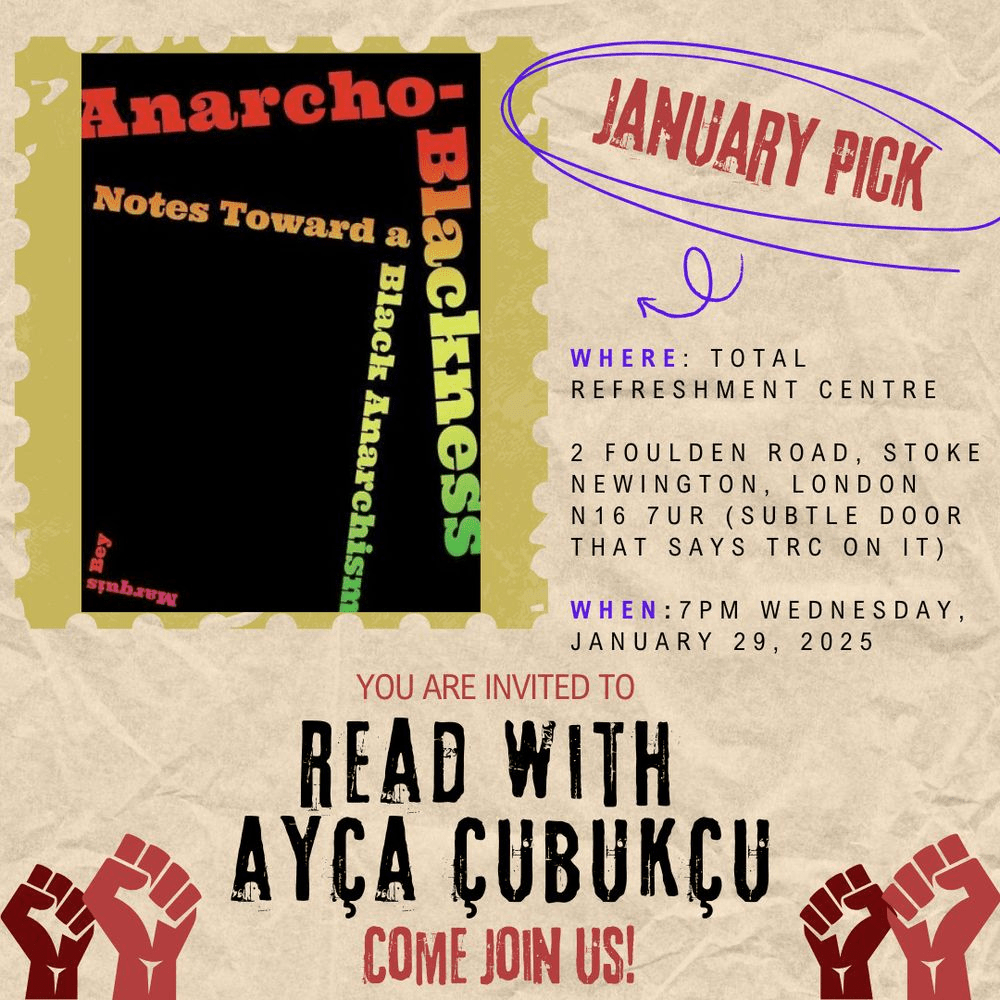
via ayça çubukçu tweet [https://bsky.app/profile/aycacu.bsky.social/post/3lfme7mk5xk2u]:
London, what are you reading this month? Come join us to discuss Anarcho-Blackness: Notes Toward a Black Anarchism by Marquis Bey Wednesday, January 29, 2025 at 7 pm, Total Refreshment Centre, Stoke Newington, London
Anarcho-Blackness – Notes Toward a Black Anarchism (2020) by marquis bey – via 55 pg kindle version from anarchist library [https://theanarchistlibrary.org/library/marquis-bey-anarcho-blackness]
https://blackstudies.northwestern.edu/people/faculty/marquis-bey.html: Marquis Bey’s work focuses on thinking blackness not as racial identification but as “paraontological,” and utilizes this understanding to recalibrate how we might move through questions of nonnormative subjectivity—via race, gender, and personhood. Through black feminist theory, trans and nonbinary studies, and abolitionist theory, Bey articulates a project of black trans feminism that is not beholden to a veneration of particular subjects but rather an assertion of the dismantling of the normative constraints that define the world—white supremacy, cisnormativity, and heteropatriarchy as well as the categories of race and gender themselves.
notes/quotes:
3
Introduction: Black Anarchic Notes
I myself am an anarchist, but of another type.
—Mahatma Gandhi, Benares University Speech, February 4, 1916
This endeavor into what might be understood as Black anarchism, a Black anarchism that is indebted to and circulates endemically within Black queer and trans feminisms, is a brief attempt to crystallize but also depart from tenets found in established Black anarchism, anarcha-feminism, and “classical anarchism”—the likes of Pyotr Kropotkin, Pierre-Joseph Proudhon, Mikhail Bakunin, and the like. While my aim will be to articulate a theoretical praxis for Black anarchism through what I will deem an anarcho-Blackness springing from but also supplementing (and even disagreeing with) self-described Black anarchists, in this meditation—a pamphlet, of sorts—I do not take as my sole purpose to demonstrate a fidelity to Black people who are anarchists. Nor, I must state, is my goal to recover Black people who demonstrated anarchic tendencies and induct them into the fold of anarchism. I want to in fact resist the penchant to absorb various thinkers into the fold of anarchism; I do not want to “claim” them necessarily as anarchists when they do not avow themselves anarchists. Rather, my intent is a reconfigurative project, to express what anarchism might be, what it might look like, when encountering a sustained engagement with Blackness in general, and Black queer and trans feminisms more specifically.
In this sense, I take as a propelling force that, “Anarchism, like anything else,” as Hannibal Abdul Shakur notes, “finds a radical new meaning when it meets blackness.” The anarchism of, say, Bakunin is no longer anarchism proper when it meets Blackness. To clarify, there are certainly threads that connect different iterations of anarchism, making them all, in some sense, “anarchist” (e.g., emphasis on mutual aid, direct participation, anti-authoritarianism, etc.). But to meet with Blackness entails that anarchism undergoes a shift in focus and tenor. Classical anarchism, for example, rested on an axiomatic commitment to the dismantling of the State and capitalism as a defining factor for anarchist sentiments, but this foundation often does not consider the racialization and gendering of either of them, nor how hierarchization bears a racialized and gendered texture. To be sure, this project will advance beyond mere finger-pointing of the racist and sexist habits of anarchists past—an argument that many Black anarchists and anarcha-feminists have made to a valid but, to be frank, boring and expected effect. As I will discuss momentarily, the dramatic shift entailed in this iteration of Black anarchism is, perhaps more accurately, an anarcho-Blackness in that it is not Black people practicing an anarchism that goes unchanged; it is anarchism as expressed through and necessarily corrupted by the radicality, the lawlessness, the mutinous primordiality of Blackness..t
If indeed, as remarked upon by Dana M. Williams, “The term Black anarchism implies an interaction between ‘Black’ and ‘anarchism,’” Anarcho-Blackness: Notes Toward a Black Anarchism dwells in the texture of that interaction. This text is an effort to mine what that interaction entails: What happens to Blackness when circulating with and through anarchism? What happens to anarchism when being acted on by and in Blackness? *What is yielded in this interaction—an additive sum, a multiplicative product, an exponential result?..t Neither anarchism nor Blackness can be what it once was (which is itself an unsettled open question) after colliding in a critical, generative intimacy with one another, so I attempt here in this text to illustrate a facet of that intimacy. That intimacy is anarcho-Blackness; it is a Black queer feminist anarchism that disorders the various mechanisms that hierarchize, circumscribe, and do violence to the moments that do life on the outskirts of order (those moments of, as it were, unfettered and ungoverned sociality), an anticolonial sensibility. Anarcho-Blackness, and Black anarchism more broadly, is an anarchism of another type, to purloin Gandhi. It is another type that recognizes its intimacy with anarchism as conventionally understood, but it revises anarchism, anarchizes anarchism, remixes and samples anarchism to produce something distinct but very much indebted.
*if sans any form of measuring, accounting, people telling other people what to do.. then expo.. aka: global detox leap
4
Anarchism is to be rightly understood as a more radical theoretical praxis than Maoism, socialism, or nationalist revolution because, from the Black radical perspective of Kuwasi Balagoon, “the goals of anarchy don’t include replacing one ruling class with another, neither in the guise of a fairer boss or as a party.” Indeed, it is the name for the radical world-making project that, unlike the aforementioned political ideologies, refuses the “socialization process that makes exploitation and oppression possible and prevalent in the first place,” Balagoon .. t continues. Black anarchic notes, as the chapters herein, deemphasize representational politics, as if having Black people as one’s oppressors makes oppression more bearable—we know that “oppressors never have a problem finding Black leaders to condemn their blatant disregard for life.”
When researching anarchism and Black people’s relationship to it for this book, there was a notable dearth of self-described Black anarchists. Perhaps the reason for this, I pondered, even though the history of Black radicality is a history of anarchic thought, is because Blackness necessarily alters anarchism’s capacity. Perhaps what I am designating as anarcho-Blackness, as the operative modality for Black anarchism, is no mere incorporation of Black people into the folds of anarchism—i.e. add and stir. I am thus designating Black anarchism’s anarcho-Blackness as a Black feminist critique and taking up of anarchism, asserting that 1) the “Black” in front of anarchism is to be understood not as a “mere” marker of identity but as a political and capaciously politicized affixation. It designates more of a mode and posture of reading, engaging, and undermining the tenets upon which hegemonic sociality rest. 2) Inherent to (Black) feminist mobilizations is ground-disturbing, and thus to disturb grounds—even its own grounds—is a necessary component of the project at hand. Anarcho-Blackness thus designates the disturbing of anarchism’s ground, which capacitates what anarchism can be and who it can liberate. And 3) processes of racialization and gendering must be at the forefront of any and all radical politics. More specifically, the radical work that queerness and gender nonnormativity do, as expressed in Black queer and trans feminisms, is anarchic par excellence in that the dismantling of racial and gender hierarchies too often overlooked or merely glossed in classical anarchism is a fundamental rebuking of authoritarian rule, hierarchies, determination from without, and injustice.
5
The titular anarcho-Blackness of this volume moves toward an anarchic social life in that it is delinked from oppressive forms of governance and rule. This is why each of the chapters in this book are prefixed “un”—this volume’s commitment to anarchism stretches to subjective, intersubjective, discursive, systemic, and historical realms via a fundamental commitment to being and becoming unraced, ungendered, unclassed, unruled, and unbound. These notes toward a Black anarchism argue that, oddly enough, it is not necessary to find all the Black people who are anarchists and the anarchists who are Black people and roll out their writings and thoughts as the definitive statement on what constitutes Black Anarchism proper. Rather, the reason why this volume is titled “Anarcho-Blackness” and not simply “Black Anarchism” (aside from the fact that the Black Rose Federation’s reader, Black Anarchism, already exists) is because affixation of Blackness is itself an anarchic extension and disruption of political ideologies like anarchism and Marxism and socialism. We may not “need” a clearly defined Black Anarchism because to anarchically push anarchism, as it were, is to introduce to it a Blackness—or more specifically, an anarcho-Blackness—that radicalizes any and every political ideology that moves toward liberation and freedom. Whereas historians like Carl Levy have focused on the –ism of anarchism, anarchism as a defined social movement that arose in the late-nineteenth century with clear originators, I focus instead on the anarcho-, the prefixal thrust and spirit, as it were, of anarchic tendencies and modalities. Focus on the anarcho- is to focus on a world-making sensibility that I am interested in, not a particular political cadre of writing and movements..t Anarcho-Blackness in apposition to (not “rather than”) Black anarchism does not dwell in delineating criteria for a discernible Black anarchism as a movement but concerns the variegated modalities, methodologies, habits, trends, thoughts, and imaginaries that might be given to anarchic—which is to say unruled, non-coercive, coalitional—affinities and textures for being with others.
Anarcho-Blackness expresses what might be understood as a Black anarchism insofar as it designates a gratuitous disorder that engenders the possibility of living unbounded by law, which is to say unbounded by violence and circumscription. Black anarchist histories attest to how, in imagining what comes after the collapse of the State, one should not “design” this future beforehand as if we know what we will need. Black anarchism is critical in the destructive sense that it unclothes fallacies and injustices; too, though, it is aspirational, searching and hoping for other modes of life and living that depart from “this.” Contrary to the Marxian castigation of anarchists as vitiating the world only to imagine one that cannot exist, anarchists writ large, but more importantly Anarcho-Blackness’s conceptualization of Black anarchism specifically, demands the impossible (á la Peter Marshall’s encyclopedic history of anarchism). The impossible is the name for the world outside of, or after, or differently within, an anarchic destruction of the racial and sexual capitalist State. This world-outside is Black, or lawless; this world-outside is anarchic, or stateless, radically liberated.
I take my cue in this from an etymological source. One of the first recorded uses of “anarchy” comes in 1539 from Richard Taverner, who writes, “This unleful lyberty or lycence of the multytude is called an Anarchie.” Anarchy becomes more than what classical anarchists note: the negation of a head or chief; without a ruler or leader; stateless. Though Taverner surely connoted his usage of anarchy negatively, one can read this iteration in a way that precisely captures how the anarchism of Black anarchism seeks to operate. That is, *an “unleful lyberty” is a freedom or liberation that arises not as a product of a bestowal by the State. Unlawful liberty is an illegal liberty, a liberation achieved by other means not beholden to the juridical sphere or a general lawfulness. Perhaps this is liberty as such, liberty that is taken without making recourse or appeal to governmental agencies..t We grant our own “lycence” to be free, and it is multitudinous, a mass, a heady swarm, that takes this liberty and license. **A promotion of disorder inasmuch as it is an anarchy that refuses to cater to order as instantiated by regimes of governance.[5] The prefix anarcho-, an index of all of this, embraces a political disorder begotten by an encounter with Blackness’s troubling ethos, its radicalization of radicality. The history of Blackness, in short, is a history of disruption toward freedom. How anarchic.
*spaces of permission.. ie: a sabbatical ish transition..
**huge.. carhart-harris entropy law et al
endnote 5: It bears mentioning that an anarchist like William Godwin, for example, was, as his 1795 Considerations signature describes him, “a lover of order.” His order was one that he felt could only be achieved by anarchy, a society that was free yet ordered. I want to embrace the disorder, however, as order necessitates a particular adherence to a preordained structure, itself a normative—and hence violent, circumscriptive—ideal..t I am not faulting Godwin necessarily. After all, he is writing about a society that is still put together, as it were, despite the lack of government and authority. I am, though, parting with the implicit buttressing of an ideal normality that is embedded within a conception of order.
myth of normal et al
6
The idea to write about Black anarchism came from a question I received during a Q&A session following a reading of my first book, Them Goon Rules: Fugitive Essays on Radical Black Feminism. The student, a white woman who studies anarchism, asked about the dearth of self-identified Black anarchists even though so much of what she’s read about the Black Radical Tradition and Black feminism expresses anarchic sentiments. I received her question genuinely; she was curious, yearning for a way to bring strands of Leftist thought and politics together in a way she had not yet encountered. I could not provide her with a substantive answer. What I mustered was, in short, an elaborated and extended “I don’t know.” Subsequent to the reading, a colleague of mine—a Black man, scholar of twentieth-century African American literature—apprised me of some of the work being done by the admittedly few Black anarchists out there. He named the Black Rose Federation and Zoé Samudzi, the latter being quite foundational for my meditation in this text. We came, ultimately, to the question: Does there need to be a “Black anarchism”? That is, if Black radicals are doing work that is anarchic without calling themselves anarchists, does there need to be a proliferation of a discernible Black anarchism? It is a valid position that one must not be overly concerned with whether someone calls themselves an anarchist or what have you. Such a concern mimics an experience I had in college, being obsessed with calling myself, and making sure others called themselves, feminists, to the detriment of a concern with whether one did feminist work. Make yourself legible to me and others on terms not your own, this sentiment implies. But it may be precisely the point of the anarcho- to blur such legibilities, finding freedom in escaping political ontologies..t One does not, in short, need to call oneself a Black anarchist to be doing Black and anarchic work. And the work is where our interests should lie.
marsh label law.. legible ness
Nevertheless, though one does not need to deem themselves such does not mean that one cannot or should not. Too, part of the work might be in the declaration, an unwavering commitment to be identified as and through a denigrated political subjectivity, and a steadfast rejoice over occupying at least a titular subversive relation to the State. Furthermore, there might be some utility in articulating not so much a Black genealogy of anarchism but a differently inflected mode of relating to being amongst others that finds radical expression at the nexus of Black and anarchist. To make Blackness and anarchism meet is doing a particular kind of work, and that work—when acknowledging the inherent Black queer feminist resonances of theorizations of Blackness—is much less likely to be done when simply following the classical strain of anarchism. To follow, and deviate from, the beaten and unbeaten path of the history of Blackness, a history that is always already queer, always already Black feminist, and, most fundamentally, always and already trans and nonnormative, is to bring an archive of radicality that breaches all major confines of sociality and subjectivity. (If Blackness does the work of disturbing assumed grounds that make things legible in a hegemonic way, this shares an affinity with the queer and feminist projects of undoing and dislodging gender and sexual normativity. There is thus an overlapping circulation happening with Blackness, queerness, and feminism.) It is for these reasons that it might be necessary to move toward a Black anarchism.
all very fred moten .. stefano harney.. the undercommons.. ish so far
7
So while I was unable to answer the student’s question adequately during the Q&A, I’ve committed to giving her something of a response in the form of this text. I am still unsure why there are few who describe themselves as Black anarchists despite the strong resonances of anarchism within Black feminism and the Black Radical Tradition, but this is the beginning of an answer.
…
I am unsure if I would call myself an anarchist, nor am I certain that I care about whether others do so. Perhaps I am, the consequences of which I “own.” But my concern is in doing anarchic work. I am concerned with how to bring about an anarchic world and commit to an emancipatory, liberatory vision that somehow, somewhere, gets entwined with one’s subjectivity; I am concerned with treading “anarchic ground,” unsettling the world as-is and bringing about something radically different—an immersive rebuking of capitalism, white and cis male supremacy, imperialism. Such a world, if we are to tread the whispered roads of Kropotkin and Cedric Robinson, Emma Goldman and Zoé Samudzi, is anarchic in a robust sense. I want to live and do and become that, irrespective of whether those who bring about that world have declared themselves anarchists. That subjectivity, the performative product of committing to anarchic work, is what concerns me. If subjectivity implies an anarchist identity, lovely. If not, so be it. But subjectivity is the terrain on which anarchic aims are struggled over, so that must be my concern.
8
1 – Unblack
Anarchism portends the promise of the absence of authority/order…[it] is intent on creating mayhem against those epistemological and metaphorical foundations that have so violently scripted Black people and communities as a people without history, without knowledge, and without dream.
—H.L.T. Quan, “Emancipatory Social Inquiry: Democratic Anarchism and the Robinsonian Method”
William Godwin, Max Stirner, Mikhail Bakunin, Pyotr Kropotkin, Pierre-Joseph Proudhon, Emma Goldman, and Errico Malatesta didn’t really talk about Blackness, were not really concerned with Blackness, didn’t bring Blackness to bear on their thinking, and didn’t think that Blackness’s specificity demanded attention. Not to mention that, save, really, for Goldman, anarchists didn’t really think about the specificities of gender, let alone how gender circulates necessarily within capitalist and white supremacist formations (how race and class, that is, are constituted through and by gender). It was capitalism this, government that, authority, individualism, rulers, the State, and on and on.
But I am actually quite uninterested in the expected rhetorical move that implicitly garners one a kind of validity: that of pointing out racial and gendered elisions as the totality of one’s argument. I will, however, do just that, but only for a moment, before more importantly speaking of Blackness and its constitutive factors in this meditation (namely, queerness and [Black] feminism) on their own terms.
But, ahh, the classics… The anarchist canon, as it were, has had its central tenets—if such an anti-authoritarian, non-doctrinal intellectual praxis like anarchism can be said to have tenets—expressed by many of the aforementioned figures. To summarize, anarchism is the general critique of centralized, hierarchical, and thus oppressively coercive systems of power and authority. State power and capitalism are the culprits responsible for the horrors that surround us, being deemed by anarchists as monopolistic and coercive, and hence illegitimate. The State, for instance, is inextricable from domination, Bakunin arguing that, “If there is a State, there must be domination of one class by another.” In theory, anarchism is touted to oppose all kinds of oppression, be it racism, sexism, transanatagonism, classism, colonialism, ageism, etc. While there has been much less explicit meditation on the anarchist stance toward transanatagonism than, say, capitalism, the overarching claim of anarchist ideology is that any kind of coercive, dominative oppression is to be quashed. To be established instead is a society based on direct democratic collaboration, mutual aid, diversity, and equity. “From each according to his [sic] ability, to each according to his [sic] need.”
Though there are those who are more strict about incorporating those who preceded the nineteenth-century heyday of people beginning to explicitly call themselves, and rally around a political movement called anarchism, I will not partake in such gatekeeping, for better (where a longer lineage of anarchist thought can be mobilized) or worse (where any form of dissent might be unjustifiably subsumed under anarchism, diluting its specificity and historical situatedness). Like Kropotkin, one might understand the Epicureans and Cynics as anarchists, since they avoided participation in the political sphere, retreated from governmental life, and advocated allegiance to no state or party. They lacked the “desire to belong either to the governing or the governed class.” Kropotkin understands this as a proto-anarchic anti-State and anti-authoritarian disposition.
9
Far from meaning that everyone is left alone and unorganized, anarchism in the classical sense privileges democratic and communal relationality, obviating external rule and control. *This is a positive conception of anarchism as voluntary participation predicated on each individual’s autonomy and agreement with communal values. It bears noting, though, that an anarchist society may take different forms: socialist anarchism, which emphasizes developing communal groups that are intended to thrive in the absence of hierarchies and a centralized governmental structure; or individualist anarchism, some of which reject any and all group identities, communal mores of the good, and venerate individual autonomy. Max Stirner represented perhaps the furthest pole of this tendency, with his refusal to obey any law or any state, even if it was collectively arrived at. The self is the only arbiter of one’s life. As well, there is anarcho-syndicalism, which supports workers in a capitalist society gaining control over parts of the economy, and emphasizes solidarity, direct participation, and the self-management of workers. **Additionally, anarcho-syndicalism has the aim of abolishing the wage system, seeing it as inextricable from wage slavery.
*too me.. this is still same song.. not legit freedom
need to try/code money (any form of measuring/accounting/people telling other people what to do) as the planned obsolescence .. where legit needs are met w/o money.. till people forget about measuring..ie: sabbatical ish transition
Life under non-anarchist rule conceives of the political arena as a good that exists to protect and serve the people; or better, a system chosen by the people. So much of ancient Greek philosophies, modern liberal philosophies, and political philosophies assert, in various ways, that obedience to the law is a prima facie duty and inarguable good. Anarchism has called this very foundation into question. What arises in the hopeful disintegration of rule by an authoritarian nation-state is a society that cares for one another communally and *democratically without the need for a tyrannical force of coercion and sovereignty. Anarchists like Godwin and Proudhon and Bakunin based this anarchist society on beliefs in reason, universal moral law, education, and conscience.
*again.. same song.. if any form of democratic admin et al.. which is still a form of people telling other people what to do
With this very brief overview, the task set forth here is slightly different. It parallels yet departs from, as well as stands in contrast to, this anarchist history—an anarchic “shadow history,” if you will, a para-anarchism that *anarchizes anarchism..t What is not being done here is an attempt to find heads or figures of Black anarchism to give clout to it as a wing of anarchism as a whole. While I will surely cite throughout this chapter, as well as subsequent chapters, the thought of people like Lucy Parsons, the Black Rose Anarchist Federation, Lorenzo Kom’boa Ervin, and Zoé Samudzi, this project is in fact not concerned with simply trotting out a list of anarchist Black people as the meaning of Black anarchism. I am articulating an anarcho-Blackness, first and foremost, as an inhabitable modality of anarchic subjectivity and engagement. This may lead to a discernible Black anarchism. Fine. But the aim is not to arrive at Black anarchism; it is, rather, to engage an anarcho-Blackness that moves toward what might be called a Black anarchism.
*that’s the iteration/exponentiation we need.. iterating detox et al
…
There are a number of racialized, gendered, and racialized gendered elisions present in classical anarchist theorizations that demand being pointed out. Bakunin: “If there is a State, there must be domination of one class by another and, as a result, slavery; the State without slavery is unthinkable—and this is why we are the enemies of the State.” Overlooked here is how the history of the enslavement of peoples of Color, specifically Black people in the Western world, is the haunting specter of his claim. The condition of the slave, which is on one plane the condition of Blackness, is the relationship between a people to the State. Thus, anarchism, in its anti-Statism, must reckon full force with Blackness as Blackness serves as the distinct angle of vision for encountering the effects of State-sanctioned enslavement and oppression. To abolish slavery necessitates the liberation of Blackness, making anarchism an emancipatory project, a project that has as its foundation a grappling with Blackness.
but too.. any form of m\a\p as slavery ness.. graeber enslavement law.. gare enslavement law.. et al
10
A critique of the State is in order too, though. A traditional focus on the State as the end-all be-all of oppression must be thought of as more than simply a governmental agency or bastion up on high doling out sentences and decrees. The State is, too, a relation, a way of dictating how people are to be interacted with. We encounter one another on the logics of intelligibility that the State demands, and that structures how one can appear to others, circumscribing subjective parts and desires that fall outside of this framework. And this is a violence..t We must also note how this relation is not only in the public sphere but characterizes any sphere in which interaction is had. And furthermore, these relations are textured by racial and gender hierarchies. One relates to others on their presumed gender, their presumed race, and disallows them to be otherwise than this fundamentally externally imposed subjectivity. The other has had no opportunity to announce themselves to us on non-State grounds. Any anarchism, then, must recognize this and commit to dismantling their hierarchies within relationality and move toward the disorderly, disruptive refusal to continue living by State laws...t
So if anarchism truly does represent “to the unthinking what the proverbial bad man does to the child—a black monster bent on swallowing everything,” then we must recognize that the blackness of the “black monster” is no accident. It is in fact constitutive.
11
Saidiya Hartman writes in “The Terrible Beauty of the Slum”: “Better the fields and the shotgun houses and the dusty towns and the interminable cycle of credit and debt, better this than black anarchy.” These “zones of nonbeing” Hartman says, purloining Frantz Fanon, are the regulated domains of Black peoples, or more precisely of those who inhabit the rebellious posture of anarcho-Blackness. They are attempts to corral what Hartman calls “black anarchy,” or what William C. Anderson and Zoé Samudzi call “the anarchism of blackness.” This is anarcho-Blackness: the primordial mutiny to which regulation responds. It concerns what Michael Hardt, reading Foucault’s reading of Marx, calls a priority of the resistance to power. ..anarcho-Blackness comes in to describe the anarchic insurgency that defines the abolition of the State and hierarchization.
saidiya hartman.. michael hardt
But Black anarchism does not begin and end at that critique. What might a Black anarchism look like to itself, not simply a reactionary posture toward the implicit whiteness in classical anarchism?..t
this is the deeper question.. we keep perpetuating not-us ness (non legit freedom) by tangling ourselves in re ness
12
On one register, Black communities themselves are, one might say, anarchist communities: they don’t “involve the state, the police, or the politicians. We look out for each other, we care for each other’s kids, we go to the store for each other, we find ways to protect our communities.” ..Ashanti Alston ..“So, when I speak of a Black anarchism, it is not so tied to the color of my skin but to who I am as a person, as someone who can resist, who can see differently when I am stuck, and thus live differently.”
The Blackness here marks a non-homogeneous descriptor of subjectivity. Said subjectivity, however, is not so much skin color, as Alston notes. Blackness does not merely consolidate all those who meet a racial quantum. Such a measure would collapse and monolithize those under its rubric. What Alston advances is not Blackness as people who are Black; he advances an anarcho-Blackness: a conceptualization of Blackness as tied to a politicality and radical penchant for sociality and social arrangement. The implications of this make the Blackness of anarcho-Blackness open to whoever is committed to expressing the liberatory politics it calls for.
What does Black anarchism do in excess of reacting to white people? That is my concern, and I maintain that Black anarchism troubles the ground on which we stand, taps into a mutinous force that behaves in subversion of regulation, and attends to how people may be differently positioned (or differently position themselves). Developing spaces for “new revolutionaries” is one of the various iterations of anarchism, as is establishing a “political home” that, in my reading, the Black Rose Anarchist Federation sees as a different society in which everyone can live. It is not a parochial endeavor, as if focus on Blackness ever was; it is not particular to a specific demographic (though it is unapologetic in its focus on a particular demographic). Blackness as anarchy provides a glimpse into another kind of world by heeding the abundant trove of epistemological richness that can be found in that synecdoche for Blackness: the Negro. To C.W.E. Bigsby, the Negro is “a convenient image of the dark, spontaneous and anarchic dimension of human life” who has “anarchic impulses.” And this has “metaphysical as well as pragmatic implications.” The implications are vast. Blackness possesses a grounding anarchic impulse, an impulse to move without permission and live without rule. Human life flourishes in this; it thrives in this terrain. So, to speak of anarchism, one must speak of these dark impulses. One must speak of Blackness.
14
2 – Ungovernable
The internal difference of blackness is a violent and cruel re-routing, by way and outside of critique, that is predicated on the notion…that there’s nothing wrong with us (precisely insofar as there is something wrong, something off, something ungovernably, fugitively living in us that is constantly taken for the pathogen it instantiates).
—Fred Moten and Stefano Harney, “Blackness and Governance”
fred moten .. stefano harney.. the undercommons
It is misguided to presume that an anarchic world, a world in which, for classical anarchists, the State is eliminated—or a world in which, for Black queer feminist anarchists, racial capitalism and cisheteronormative patriarchy is overturned—is the “end” of anarchist pursuits. Anarcho-Blackness, with its disruptive disorderly conduct—its mode of conducting itself as, in other words, disorderly—advances a critical praxis that answers the fundamental political question, “What is to be done?” Kind of. The question “What is to be done?” demands an answer, not that the texture, tenor, or terms of that answer can be readily discerned. Nor does admitting this exculpate us from needing to, nevertheless, provide an answer. So again: what is to be done?
a perpetual openness that enables, always, the possibility of another beginning.
every day.. as the day.. hardt revolution law et al
15
The space cultivated by this critical praxis is where a Black anarchic politics and those subjectivated by an anarcho-Blackness, its attendant Black queer feminist electrical circuitry, show up. Those maroons, subversive intellectuals, fugitives, queers, feminists, anarchists, and rebellious workers meet to conspire together in the undercommons: a non-place where everyone is Black, queer, anarchic, because they are changed by the undercommons, which is not a place you enter but a groove that enters you. Critical praxis becomes a radical invitation to not only do but to be done by the undercommon insurgency that makes its own demands. And such an interrogation must suspend the presumption of an end goal. We know from Moten and Harney, and Jack Halberstam, that what we think we want before the crisis that precipitates our insurgency will necessarily shift after we’ve attained the limits of what our coalitional knowledge could compile. It is not because we are insufficient, as if insufficiency is a deficiency rather than a willingness to risk getting at the outer limits of what we dared to think; it is because we cannot, and must not, assume that the logics and rubrics we have when moving within the maelstrom of the hegemonic—radically altered as they may be—can operate to our benefit when we’ve unseated the hegemon. We will need new rubrics and metrics, unrubrics and unmetrics, because a radically other-world requires radically other means to love it, to caress it, to be all the way in it.
There is no “end” because to know the end is to think one knows the totality of the landscape, a line of thinking that cannot account for that which falls outside the dictates of legibility…t There might always be something else just outside, and we cannot close the discussion when we think it is over. Fugitive planning plans for what it cannot plan for by refusing to plan for it. So there is no end in sight because sight is not the only sense available to us. (But there is also no end in touch, smell, feel, or taste—or any other “sense.”) There is no end in sight because our end may only be someone else’s beginning or middle. Thus, our critical praxis, our interrogative social enactment, does something precisely when it commits to a political endeavor proliferating life where no life is said to be found..t
graeber can’t know law.. unjustifiable strategy ness.. et al
*And the “where” of “life where no life is said to be found” is the place brought about by abolition. Abolition is fundamentally anarchic,..t as will be discussed at greater length in the final chapter. It is the eradication “of a society that could have prisons, that could have slavery, that could have the wage, and therefore not abolition as the elimination of anything but abolition as the founding of a new society.” This entails, to put it simply, the eradication of society inasmuch as “Society” is predicated on, constituted by, the **existence of these things. Anarchism is the ground on which we assert the destitution of the terrain, a destitution that marks, according to the Invisible Committee, “a rupture in the fatality that condemns revolutions to reproduce what they have driven out, shattering the iron cage of counter-revolution.” Following this line of thinking, we might also say that destitution is another name for the position of Blackness, ***that “irreparable disturbance.” Destituting the world-as-is, the Blackening of the world, shifts what counts as the “real” terrain of politics. To be ungoverned is a quotidian practice (a way of life), and the space in which that practice is lived is a space of anarchy—not nihilism or chaos but life by other means. Anarcho-life.
*is it? isn’t that more re ness.. ie: moten abolition law: i also know that what it is that is supposed to be repaired is irreparable.. it can’t be repaired. the only thing we can do is tear this shit down completely and build something new – fred moten
***so to call abolition anarchism.. is a cancerous distraction
16
What Black anarchists seek to do is to found a new society, not necessarily by bringing about the destruction of myriad edifices of terror, violence, circumscription, and normativity but *by cultivating the spaces and places that, by dint of their existence, instantiate the impossibility of the normative bastions that now surround us..t We might call this justice, might call this a non-utopic utopia, a sanctuary. We might call it the undercommons..t
*aka: the irrelevant ness of a nother way.. making all else cancerous distractions
How, then, to do this? Upon a re-reading of The Undercommons, I was drawn, obsessively, to one phrase, one that struck me at first as dangerously wrongheaded. But, then, the revolutionary will always be dangerous. The revolutionary call that Moten and Harney require and that I’ve been obsessed with is this: *they insist that our radical politics, our anarchic world-building must be “unconditional—the door swings open for refuge even though it may let in police agents and destruction.”..t As my grandmother might quip, what kind of foolishness is this? But it is not foolishness precisely because the only ethical call that could bring about the radical revolutionary overturning we seek is one that **does not discriminate or develop criteria for inclusion and, consequently, exclusion.
*huge huge huge.. the undercommons ness = (ish) the unconditional part of left to own devices ness.. huge..
**perhaps rather.. discrimination as equity.. via the idiosyncratic jargon ness of self-talk as data.. et al
If the door swings open *without a bouncer checking names,..t it means that whoever shows up will be let in, unconditionally, without conditions. The ethical demand here is to be monstrously inclusive, a lesson learned in the Black Radical Tradition, Black feminisms, and trans activism. Yes, the **Law might send agents to infiltrate our conspiratorial sessions. Or, even worse, as has happened, our enemy might show up and sit with us in prayer before gunning us down..t But, at the same time, a salvational figure might show up or, better yet, a fugitive might show up, asking us to provide her refuge and a safe harbor. And we must let her in—this is what is to be done—we must feed and shelter her, because this fugitive, any fugitive, might be the one we didn’t know we were doing all this insurgent conspiratorial work for.
*aka: inspectors of inspectors ness
**and that’s why we need to org around legit needs (2 that every soul already craves.. every soul).. otherwise we just keep perpetuating khan filling the gaps law.. et al
other reasons for ie: myth of tragedy and lord ness.. costello screen\service law and warning ness et al.. this is why we need nonjudgmental expo labeling so we can have a global detox leap.. for (blank)’s sake..
Answering *“What is to be done?” carries a deeply ethical valence..t The manner by which things get done and the result of the doing inflects to whom we owe allegiances, who is or is not on our minds, and most fundamentally for whom we wish to see the world changed. The doing we seek is committed to making a world for people we don’t yet know, people who might need a drastically different world, while understanding that even our idea of “worldness” might be predicated on the logics of normative regimes that limit our horizons. **It is imperative, then, to commit to the work without presuming to know who the work is for, only committing to the work because it might allow for those we did not know existed to finally live. When we volunteer at the soup kitchen we must turn no one away, even and especially when they look like they just ate a hearty bowl of soup; when we are faced with imminent violence we must refuse to proliferate violence, because we’ve come into being via a violation and this bestows upon us the ethical commitment to mitigate that violence; when we hear a knock at the door and someone asking for help because they are being chased we must let them in. Again, “the door swings open…” Each entity that crosses the threshold is another possible signatory on our missives for “the antipolitics of dissent.”
*something we’ve not yet tried/seen: the unconditional part of left to own devices ness ie: a sabbatical ish transition
and again to costello screen\service law and warning ness.. et al
**rather.. to me (warning ness et al).. commit to the work that is for everyone
17
To take praxis seriously, a praxis that has as its never-ending end the proliferation of nonnormative life and the livelihood of the unemerged, is to risk what we ultimately come to. We cannot be afraid of what we find in our critical praxis precisely because, if it commits to the aforementioned, it will indeed be scary and impossible to prepare for. That is the work of the monstrous—a liberatory, unanticipated salvation, that troubling interrogation of gender Susan Stryker finds in the trans; that divine portent that Derrida would argue is *unannounceable, which is to say untamable, unable to be absorbed into existing logics; that claimable thingliness that Hortense Spillers says might “rewrite after all a radically different text.”..t Critical praxis in the undercommons—insurgent work being done by folks who were let in **without paperwork and without vouchers because they, despite where they came from, got down to work for the revolution—is work for monsters, monstrous work.
*unjustifiable strategy ness..
**again..diff.. not yet tried: the unconditional part of left to own devices ness.. nationality: human ness.. et al
In the end, what I am asking for is assemblic work for those who are impoverished in spirit, who come together, *an intimate proximity reached because we are doing the work not because of an ontologized accident. What I am asking for is a willingness to move toward becoming subjectivated by an analytical queerness, a radical transitivity, an anoriginal Blackness, where Blackness names a sociopoetic force of subversive irregularity and, as Moten expressed to me in an email exchange, **“must be claimed by any and every body” who seeks to do anarchic work. What is being asked for, what is to be done, is a Blackening that inducts all those who live and be in the undercommons, stealing life so it can steal more life, pilfering resources and asking no permission, taking no responsibility, because the ones who need this stuff might not know they need it, and neither do we. But if we must hack into government security systems and disseminate the firewalled information, that is what is to be done; if we must lie about the destination of funding we are given, allocating it to unauthorized and unadvised and undisclosed locations, that is what is to be done; if we must sully ourselves by hanging around a bad crowd that is bad only because the good’s violent optics and ethics deem it so, then that is what is to be done.
how we gather in a space is huge.. need to try spaces of permission where people have nothing to prove to facil curiosity over decision making.. because the finite set of choices of decision making is unmooring us.. keeping us from us..
**legit freedom will only happen if it’s all of us.. and in order to be all of us.. has to be sans any form of measuring, accounting, people telling other people what to do
ie: imagine if we listened to the itch-in-8b-souls 1st thing everyday & used that data to connect us (tech as it could be.. ai as augmenting interconnectedness)
need to try the unconditional part of left to own devices ness..
there’s a legit use of tech (nonjudgmental exponential labeling) to facil the seeming chaos of a global detox leap/dance.. the unconditional part of left-to-own-devices ness.. for (blank)’s sake.. and we’re missing it
ie: whatever for a year.. a legit sabbatical ish transition
So because the queer is a figurative specter haunting normativity, and because the trans is a generative disruption that opens into an otherwise realm of possibility, and because the Black is a lawlessness that marks a terrain of ethics because Law ain’t never been ethical, only disciplinary, then what is to be done is a becoming in the illustrious muck of the queerness, the transness, the Blackness of the undercommons. If fugitive planning and Black study is an invitation to be and remain broken, *to refuse fixedness and fixity and being fixed, then, to conclude this meditative strain, what is to be done is precisely the kind of study practiced in consciousness-raising coalitions by Black feminists and anarcha-feminists. “Instead of getting discouraged and isolated now, we should be in our small groups—discussing, planning, creating, and making trouble…we should always be actively engaging in and creating feminist activity, because we all thrive on it.” Fugitive planning and Black study; planning with and for fugitives, studying the effects of Blackness.
*lynch fixed hidden law et al.. but sans any re ness.. ie: refuse et al as cancerous focus/distraction
18
*To be ungoverned is, yes, disorderly. Many castigate this yearning, assert the utility and, indeed, value of order. But the order they speak of, and the order the ungoverned reject, is the order of the present society, a society ordered by virtue of its violent quelling of all those deemed disorderly. But **ours is an order that arises by way of ungoverned disorder, an order that is more accurately a harmony, a beautiful ensemblic swarm that supplants the order of the State. That is what ungovernance strives for. It is an ***ungovernability that characterizes life and livability. Motivating this urge to “not [be] governed quite so much,” but pushing this famous Foucauldian dictum beyond his reluctance to embrace (a negatively connoted) anarchism, is an insistence on the livability of ungovernance. Propelled in this pursuit by an “anoriginary drive” that, by its negating “an-,” rejects the hierarchization that “originary” would imply, an anarcho-Blackness promotes what Moten and Harney deem “the runaway anarchic ground of unpayable debt and untold wealth.” And this, they conclude, “is blackness which must be understood in its ontological difference from black people who are, nevertheless, (under)privileged insofar as they are given (to) an understanding of it.” We return obliquely to the opening definitional claim of anarcho-Blackness. This understanding of Blackness, and what the prefix anarcho- signifies, is a Blackness that implies not (only or “merely”) an epidermal saturation but a driving force that provides a certain kind of subversive disposition, “ungoverned” by physical or biological logics. It is the general sensoria we might call Blackness that arises from a radical aesthetic tradition, one that cares less about the assertion of an identity as its heft and more about the breakdown of impositions of racialization. ****Racialization understood as the child and not the parent of racism, gleaning this Blackness from the Black Radical Tradition is an anarchic, ungoverned disorder, an “anarchy of a radicalism that must oppose the form as well as the content of racial hate.” This is anarcho-Blackness. It emerges through a political subjectivity that *****lays the groundwork for the runaways and renegades, the apostates and defectors, who refuse to pay debts and, in that anarchic refusal, possess an untold wealth because metrics for quantifying this wealth are not beholden to the logics of the financial sector.
*and/or seemingly disorderly.. carhart-harris entropy law et al
**myth of normal et al.. the dance
***aka: the unconditional part of left to own devices ness
****gabor on childhood trauma et al
*****yeah.. but has to be for everyone.. even ie: inspectors of inspectors et al
There is a dovetailing here with traditional anarchist claims, to “reject all forms of external government and the State,” but also a rejection of governance—a distinction that tears the texture of sociality and encompasses affective, emotional, interpersonal relationships on the intersubjective level that are not quite captured in the larger institutions of government and the State. Advancing an anticapitalist mode of thinking and interaction, not simply one that is “anticlassist,” requires a radical break from capitalist relations: a world system dependent on racial slavery, violence, colonialism, genocide, and gendered labor; a system that is propelled by exploitative racialized and gendered labor practices, which have always been part and parcel of white/European economies; a system whose ethic is one of non-ethics, rebuking sentient life’s needs and desires and wellbeing in favor of a lethal combination of economic policies and cultural practices that collectively benefit hoarders of wealth to the detriment of poor people and poor folks of Color; a system of privatizing public services and functions, marketization, and commodification of social life—in short, as DJ Quik once put it, “If it don’t make dollars, it don’t make sense.” Learn, then, from Diogenes the Cynic, whom Kropotkin touts as an anarchist of the ancient world, and *deface the currency.
*rather than deface.. ie: try/code money (any form of measuring/accounting/people telling other people what to do) as the planned obsolescence.. where legit needs are met w/o money.. till people forget about measuring..ie: sabbatical ish transition
19
One might also note, though, that those “anarchists”—(scare quotes because it would be a dubious claim to anarchism, and doubly bracketed here in an em dash as well as parentheses because I resent having to give airtime to such ideologies)—*who take their crypto-currency and rush to South America to “not be governed” and instead instantiate regimes of stake-claiming and unencumbered accumulation of capital, are in fact merely capitalists; they are Ron Swanson-esque libertarians who reject all forms of being told what to do with their lives and their property and venerate unbridled capitalism and the free market because of a disdain for regulation. Such conditions are always highly regulated, however. Locks and chains are on the doors and the doorperson looks you up and down before turning you away because you called out the management on their privatizing, commodifying, tyrannical bullshit.
*yeah.. have to let go of any form of m\a\p
An anarchist disdain for governance, if I may be permitted to slip into a conflation with government for a moment, is predicated on an understanding of it as Pierre-Joseph Proudhon described it:
To be governed is to be watched over, inspected, spied on, directed, legislated, regimented, closed in, indoctrinated, preached at, controlled, assessed, evaluated, censored, commanded; all by creatures that have neither the right, nor wisdom, nor virtue…To be governed means that at every move, operation, or transaction one is noted, registered, entered in a census, taxed, stamped, priced, assessed, patented, licensed, authorized, recommended, admonished, prevented, reformed, set right, corrected….Then, at the first sign of resistance or word of complaint, one is repressed, fined, despised, vexed, pursued, hustled, beaten up, garroted, imprisoned, shot, machine-gunned, judged, sentenced, deported, sacrificed, sold, betrayed, and to cap it all, ridiculed, mocked, outraged, and dishonored. That is government, that is its justice and its morality!
yeah.. huge again.. proudhon ruled law et al (though now note bey addition from p28)
contact ing – note to marquis
Those who are surveilled with the most scrutiny (“watched over, inspected, spied on…”) are Black, nonnormatively gendered, and femme, and thus to seek the liberation of those who live through these nexuses requires the promotion of a Black anarchic ungovernance. The insurgent history of slave uprisings, wayward movements, racial and gender “passing,” and illicit sexualities is a swerve away from being regulated and registered. They are the people who did not have papers, but traversed colonized territories in search of land they could live with. They are the people who did not change their licenses and birth certificates, not caring about judicial and legal mandates to “align” with perinatal impositions, driving and traveling and getting stolen resources anyway. They are the people who did not care for biological dictates of kinship sold to them for tax purposes, and instead insisted on the closeness of “cousins,” “aunts,” “uncles,” “bruthas,” “sistahs,” and “sibs” despite having no “real” ties to them. They resisted these regimes because they knew that when they did they would be “despised, vexed, pursued, hustled, beaten up, garroted, imprisoned…” but understood that to be positioned this way, in proximity to criminality, meant that they were doing something, because indeed, “collective resistance and revolution [occurs] at the scene of crime itself.” *To be ungoverned is not to oppose governance; to be ungoverned is to operate beyond governance, to become disaffected by it, not even acknowledging its legitimacy, being, in other words, ungoverned by governance..t
*huge.. any form of re ness.. any form of m\a\p.. as cancerous distractions
21
4 – Unpropertied
23
To approach the matter of property—things divorcing the owner from the user—from the perspective of Black anarchism, from an anarcho-Blackness, is to begin from the assumption that to let go is a kind of salvific grace. To clarify: letting go points to a willingness to leap, in that Kierkegaardian sense, to immerse oneself in what might be. I offer these notes toward a Black anarchism with precisely this yearning for what might be possible, a world unfettered by ontological and epistemological straitjackets or by structural and dominative oppressions. Uncertainty is endemic to this anarchism: wanting that without knowing what it will be, but understanding it as an anarchic salvation precisely because it is not this. Property has at its base the thorough holding on and possessive spirit of its owner, an encompassing knowingness of the property possessed. To rebuke privatized ownership and property is to then let go and allow the possibility of something and some way else to be to, oddly enough, take hold.
property ness.. bauwens property law.. wilde property law.. et al
24
In “Black Ether,” Carter and Cervenak tie Blackness to an ethereality that, following Nathaniel Mackey, “announces a kind of ‘holding without having.’” How to hold but not have? Such an outlook is all the more pressing when shifting from an understanding of possessive relationships with things to possessive relationships with people (though again, it cannot be elided that historically there have been people understood as things). This interstitial space between property and grasplessness, this parapossession, is an attempt to maintain mutuality in which one can care for and share affinity with others without needing to possess them, without needing to own them as one’s own.
25
We demand the impossible, yes, and that impossible is a way to live without being owned and without owning; a way to be done with properties and the private without giving up sensibilities of holding and relating in specific, idiosyncratic ways is what we want. In contrast to the colonial and imperialist drive to capture and claim as one’s own, characterized by an expansive masculine whiteness that subjugates bodies of Color and uses the rape of feminized people as a propelling force for colonization, the anarchism of Blackness, as Williams and Samudzi would say, demands a new beginning that has as its precipitating force the end of this. The anarchism of Blackness indexes an unpropertied relationship to the world and others inasmuch as it discloses the impropriety of freedom, freedom’s unboundedness, which is to say its inability and unwillingness to demarcate the limits of sanctioned relationality—or, to propertize. The imperialist, settler-colonizer drive is manifested in white self-possession—whiteness as property par excellence—so Blackness comes to un-possess itself in order to become unbounded by the propertied, the heteropatriarcha
27
5 – Uncouth
A serious anarchism must also be feminist, otherwise it is a question of patriarchal half-anarchism, and not real anarchism.
—Anarchist Federation of Norway
28
“To be recognized as human, levelly human, is enough.”..t A horizontal, mutually aiding, radically non-hierarchical world is what they seek. An anarchic world.
nationality: human ness.. the unconditional part of left to own devices ness
If anarchists hold that “until all are free then no one is free,”.. t
this is huge.. the thing we’ve not yet tried.. because we can’t seem to let go enough to see/try legit unconditionality.. legit freedom will only happen if it’s all of us.. and in order to be all of us.. has to be sans any form of measuring, accounting, people telling other people what to do
none of us are free et al
Though anarchism is a method and praxis of thought that is non-hierarchical, there has nevertheless been an insistent sexism within many anarchist circles. Indeed, the first self-proclaimed anarchist, Proudhon, is noted as having said that, when “one compares sex with sex, women are inferior.” Proudhon and many of his followers retained the sense that the father held a legitimate position of power—an instantiation of a masculine, tough, honorable, and independent affect—and that women, unfortunately so, were “chained to nature” and entered society only through (heterosexual) marriage. A kind of “anarcho-sexism” has been a repeated current in anarchist movements and theories. But while Proudhon’s belief that women’s role is essentially to be the subordinated right hand to her husband, others like French anarcho-communist Joseph Déjacque state firmly that feminism and anarchism are inextricable. Anarchism and feminism have a fraught history, because still, while most male anarchist writers, like many leftist men in general, gave lip service to the “equality of the sexes,” groups of women within the movement’s ranks had to fight for anything resembling equality.
ooooof pierre-joseph proudhon.. can’t you hear proudhon ruled law.. ooooof
none of us are free (ungoverned) if one of us ness
legit freedom will only happen if it’s all of us.. and in order to be all of us.. has to be sans any form of measuring, accounting, people telling other people what to do
29
Traditionally, anarchism relegated revolutionary, anarchic work to the public sphere as if the (waged) workplace was the only place work and labor was being done, and from which people had to be liberated.
this is all anyone has done to date.. same song till we let go of any form of m\a\p
30
*This is not, as already alluded to, to reverse power relations. Misguided “female empowerment”-type feminism has no place in this political thought. Such feminism merely wishes to replace men at the top 1% with cis women. “[Anarcha-]Feminism doesn’t mean female corporate power or a woman President; it means no corporate power and no Presidents.”..t Discourses of “leaning in,” feminist-friendly capitalism, and rights-based equality that permit non-men to insinuate themselves into the still-functioning system as-is will not transform society in an anarchic way. ***Dismantling all hierarchies and authority means an anarcha-feminist revolution.
*not ie: re ness
**huge
***rather.. a quiet revolution
We believe our freedom lies in the abolition of oppression, in its many forms; economic; racist; homophobic; sectarian; and of course, sexist, etc. Anarchists strive for a society that is community based, *where we make decisions over our lives and communities directly through a system of local councils and delegates. Most importantly, we **aim for a society free from coercion and oppression.
oh my.. if *this.. not **this
31
What this amounted to was her belief, much like the Combahee River Collective, that women were not free until women globally were free.
then still not free.. has to be none of us are free ness
32
Reading anarchic strains in extant Black feminist texts like the CRC’s Statement; and noting the similarities in the end goals of anarchism and Black feminism, namely skepticism toward the benevolence of the State, non-coercion, dismantling of hierarchies, and the like, may bring us closer to actualizing the radical world transformation we seek.
only closer when we let go of any form of m\a\p
After all, what good is an insurrection if some of us are left behind?
—J. Rogue and Abbey Volcano, “Insurrection at the Intersections”
33
Bakunin is arguing a radical position. He asserts, in no uncertain terms, that anyone else’s suffering means that he suffers..Bakunin writes here, essentially, that until the lowest are free and unfettered by oppression—that is, in the CRC’s formulation, Black women—neither he, nor the Pope, nor the Czar, nor the emperor, can be free. His and others’ freedom rests on the memory-foam pillow of the freedom of the meekest. After linking this quote to the CRC’s perspective on interrelated and interlocking struggle, Hillary Lazar notes that foundational anarchist principles of reciprocity, mutual aid, interdependence, and direct action are the “other mainstays in both Black feminist and anarchist practice.
but if focus on who’s most oppressed.. et al.. then cancerous distraction
*There is no way anarchism can do anarchism to the fullest if it does not heed Black feminist theory. If anarchism seeks to actualize that world, it must focus on the plight of Black women, as that is a nexus that holds precisely the very systems anarchism needs to understand and destroy.
*then anarchism to fullest still isn’t deep enough.. black fem (any) theory ness.. a cancerous distraction
If we’re not understanding specifically the ways in which economic violence is inextricably linked to racialized violence and commodification of non-white bodies, then we actually have no understanding of how capitalism works.
don’t need to (at least not today.. today have means for global detox leap).. so.. cancerous distraction
34
“Black and Brown folks having a more thorough understanding of these kinds of radical, anti-capitalist class interests” is the aim of her Black feminist anarchism, and must be the aim of anyone’s anarchism
again.. cancerous distraction
We have a slightly altered definition of anarchy and anarchism in Hartman. What if we embraced it as our start to anarchist politics? She writes:
To embrace the anarchy—the complete program of disorder, the abiding desire to change the world, the tumult, upheaval, open rebellion…is to attend to other forms of social life, which cannot be reduced to transgression or to nothing at all, and which emerge in the world marked by negation, but exceed it.
to me.. won’t exceed/change anything if still ie: marked by negation.. any form of re ness
Anarchy is an *open rebellion. It cannot be closed, nor should it be closed, because its openness is what gives it its anarchic tenor for accepting the radical, the unknown that might arise when **all we’ve known is dismantled. Tending to other forms of social life makes us attentive to the “lower frequencies.” That is where something else might happen, something other than this. Conversing with Bakunin’s assertion that, within anarchism, “the passion for destruction is a creative passion, too,” ***Hartman does not wish to dwell in negation (“the passion for destruction”) but emphasizes how that negation is exceeded in what we ultimately hope for—to create something new.
*but open ness to any form of re ness.. isn’t really open
**nothing dismantled if any form of re ness.. just more perpetuation
***yeah..
35
These Black women—corporealized manifestations of, but not reducible to, Black feminism—show that anarchism needs to expand its thinking, see where its kin lie by seriously “recount[ing] the struggle against servitude, captivity, property, and enclosure that began in the barracoon and continued on the ship, where some fought, some jumped, some refused to eat.
any form of measuring, accounting, people telling other people what to do.. cancerous distraction
36
Hartman once more, in illustrious, anarchic prose on illustrious, anarchic life:
An everyday choreography of the possible unfolded in the collective movement, which was headless and spilling out in all directions, strollers drifted en masse, like a swarm or the swell of an ocean; it was a long poem of black hunger and striving. It was the wild rush from house service on the part of all who [could] scramble or run. It was a manner of walking that threatened to undo the city, steal back the body, break all the windows. The people ambling through the block and passing time on corners and hanging out on front steps were an assembly of the wretched and the visionary, the indolent and the dangerous. All the modalities sing a part in this chorus, and the refrains were of infinite variety. The rhythm and stride announced the possibilities, even if most were fleeting and too often unrealized. The map of what might be was not restricted to the literal trail of Esther’s footsteps or anyone else’s, and this unregulated movement encouraged the belief that something great could happen despite everything you knew, despite the ruin and the obstacles. What might be was unforeseen, and improvisation was the art of reckoning with chance and accident. Hers was an errant path cut through the heart of Harlem in search of the open city, l’ouverture, inside the ghetto. Wandering and drifting was how she engaged the world and how she understood it; this repertoire of practices composed her knowledge. Her thoughts were indistinguishable from the transient rush and flight of black folks in this city-within-the-city. The flow of it carried everyone along, propelled and encouraged all to keep on moving.
A coalitional, collective *quotidian choreography of possibility. That is not anarchism understood in the traditional sense; that is not anarchism begotten merely by adherence to what Kropotkin has preached. It is anarchism that is choreographed through the way we move and think about our bodies. Anarchic subjectivity in that we come into being through an anarchy of becoming, a way to exist in the world where our existence is predicated on how we aid each other mutually, **refuse the violence of the State, dismantle hierarchies, concede to a non-coerced ethic (not right, with all its judiciary baggage) of opacity.
*quotidian = occurring daily
**if having to refuse.. not in a free enough space for everyone.. hari rat park law et al
This choreography is “headless”—rulerless, without ruler, an-archist—and it spills out. The spilling makes it hard for the State to clamp down the movement. Such a Black feminist anarchism cannot be contained by inclusion into any organization; it has to be a modality, a “manner of walking that threaten[s] to undo the city, steal back the body, break all the windows” because that is where anarchy happens, in the theft of that which should never have been property, in the destruction of the State, in the ultimate undoing of the miniaturized State—the city. The quotidian is where it’s at, and Black women and Black feminism alert us to that everyday life. In continuing to “illuminate and inspire the quotidian struggles that black women must carry on to make a way out of no way for ourselves and other black women and girls,” the anarchic arteries of Black feminism emphasize the necessity to “still tend those discursive gardens, which excite and move us to action and change and teach us the value of women’s lives and living.” We must ensure the life and livelihood of those small moments, those moments that sustain life that is lived on the margins in that “assembly of the wretched and the visionary.” Those moments populated by the Black and women, the Black and femme. The moments that glimpse some other way of life, the “no way” out of which a way is made by Black women.
This unregulated, ambulatory movement flexes with an arrhythmic rhythm that reverberates on another scale. Another frequency to which we need to attune ourselves. Despite everything we know and all the horrors that lay about us, the something else is what we look to cultivate through our movements and actions, thoughts and desires, gardens and pots of food. There is something deeply apt about the Dark Star Collective’s decision to title their anarcha-feminist anthology Quiet Rumours. *Instead of the brash anarchic exclamations of anarchists past, something quiet invites a whole host of reverberatory tremors to unmoor instantiated ways of life. We might not hear it at first, but that doesn’t mean it’s not there, working, giving us an anarchic world to look forward to. It is unheard and unseen because its sights and sounds have refused the structuring logic of the State and hierarchy. Hartman’s “she” roams the world with a knowledge begotten by drifting, without the rule of roads and paths. There is a different city within this city, a city that is not recognized as a city—because it isn’t one. It is something else, another kind of sociality, an anarchic sociality where we can live free.
*itch-in-the-soul.. a quiet revolution ness et al
38
6 – Unhinged
39
By exploding the sex and gender binary we reject distinctions between the naturalness of sex and the cultural-ness of gender. ..We can’t find solace in presumed biological naturalness as something outside the coercions of the State. How we are gendered is a product of how the State and its various apparatuses seek to discipline and produce, to coerce and hierarchize different desires, bodies, and comportments. There is a political and ethical interest in the question of gender, which becomes anarchically pertinent when viewing it as not an unmediated natural phenomenon but a historical production that serves the interest of the State. Those anarchistically concerned with gender—who have been called “anarchist sex radicals”—argue that gender as binaristically construed rests at the heart of society’s structuration. Binary gender is regulated by the law, institutions, religion, medicine, and various other societal authorities. A radical departure from the State, then, necessitates a radical departure from compulsory binary genders.
to me.. more about unconditionality.. ie: maté addiction law
we have no idea..
Flipping the script is not enough; it is not enough to simply insist on the femaleness of the future or yearn for Black people to rule the world. Wanting a representational subject that embodies all the marginalized demographics we can (and can’t) imagine will not—I repeat: will not—actualize a radical anarchic world. Representation is not our end goal, not only because representation implies the non-participation of those whom the representative ultimately represents (that is, the representative holds power only when those they represent are absent, which is antithetical to the anarchic drive for direct participation); representation also assumes a legible subject, which must align with normative logics of socio-ontological existence—to represent someone or something, that someone or something has to already be known. But if anarchism wants to destroy the extant system, and if the extant system dictates what is and can be known, its destruction means that what arises after cannot be known or represented. It will be anarchic possibility, unanticipated and unbeholden to our current tenets of legibility.
legible ness et al.. legibility and control et al..
So anarchism allows for nothing but what is unallowable. Not even “women”—that feminist go-to site for the historically oppressed—can be our political figure.
has to be all of us for the dance to dance
40
Black and trans name the “revolutionary force” uncapturable by racial capitalism and heteronormative cis patriarchy, and they are pushing us toward explosions in ways of being, ways of organizing, and ways of living
but not enough..
again.. and again.. and again..
legit freedom will only happen if it’s all of us.. and in order to be all of us.. has to be sans any form of measuring, accounting, people telling other people what to do
how we gather in a space is huge.. need to try spaces of permission where people have nothing to prove to facil curiosity over decision making.. because the finite set of choices of decision making is unmooring us.. keeping us from us..
ie: imagine if we listened to the itch-in-8b-souls 1st thing everyday & used that data to connect us (tech as it could be.. ai as augmenting interconnectedness)
need to try the unconditional part of left to own devices ness..
there’s a legit use of tech (nonjudgmental exponential labeling) to facil the seeming chaos of a global detox leap/dance.. the unconditional part of left-to-own-devices ness.. for (blank)’s sake.. and we’re missing it
ie: whatever for a year.. a legit sabbatical ish transition
45
So often presumed to be parochial and particular, anarchist opposition to the State and capitalism, coupled with racial and gender critiques—from the purview of Blackness and transness, from Black feminism, from anarcho-Blackness—is the perspective from which we gain the widest vision of the task at hand.
not wide enough for the dance to dance.. wider = discrimination as equity ness
46
It is this radical reorientation to which the prefixal anarcho- refers, a departure from the normative, a normativity characterized by the white masculinity of a hierarchical, coercive State.
not deep/radical enough
Perhaps, then, what we are striving for is another genre of life. What we have now is one saturated with a stultifying violence. Looking to other and otherwise ways of life being lived outside the State gives us different genres of life and sociality. ..The Black and trans of our anarchic pursuits, the anarcho-, is our guide “to remak[ing], consciously and collectively, the new society in which our existential referent ‘we in the horizon of humanity’”—those who mobilize the masterless and rulerless anarcho- of the Black and trans of our ante- and anti-matter—“will all now live.”
if not deeper.. then not legit diff .. same song
47
7 – Uncontrolled
48
This concluding chapter takes aim at movement goals, such as abolition and tending to the material needs of the most marginalized, to round out what anarcho-Blackness can and has looked like. As I think explicitly about abolition, I am using as its definition, simply, the political strategy of eradicating rather than reforming systems, discourses, and institutions that structure life and livability. These systems (e.g. prisons, the gender binary, etc.) have at their foundation an ongoing violence that masquerades as banal or, worse, natural and good. Abolition, then, promotes a dismantling of these systems in search of life and livability by other means not predicated on violence. In meditating on abolition’s relationship to anarchism, STAR, and thinking like an anarchist, I want to highlight the beautifully sporadic embrace of free association, **direct participation, and radical democracy (what might also be termed non-hierarchical relationality); the emphasis on consent rather than coercion, and on self- and communal “governance” (or, a conception of organization); the advancement of direct action; the advocacy for the dismantling of all hierarchies and expressed global solidarity with all who are oppressed and subject to hierarchical tyranny.
*if we have/try something that makes all else irrelevant s.. but if have to ‘destroy’ or ‘dismantle’ or any form of re ness.. then 1\ cancerous distraction .. leading to 2\ same song
**these are (friendly/kind looking on the outside) 1\ cancerous distractions .. leading to 2\ same song
…
Prison, a social protection? What monstrous mind ever conceived such an idea? Just as well say that health can be promoted by a widespread contagion.
—Emma Goldman, “Prisons: A Social Crime and Failure”
49
Abolitionism is a visionary and political praxis and modality that struggles against the regimes of capitalism, white supremacy, heteronormative patriarchy, and cissexism. It is a daring rooted in a Black liberatory history of maroons—Black Proto-anarchists, one might say—“who dared to imagine their lives without shackles.” The desire to deshackle from any and all fetters imagines one’s being-in-the-world as anarchic—no gods, no masters, the old saying goes. To deshackle oneself marks a radical act of freedom in the broadest sense, a way of living not in defiance but in refusal and subversion of the State. I
refusal, subversion.. perpetuates.. doesn’t ‘deshackle’..
Abolition, in its radical totality, consists of constant, critical assessment of the economic, ecological, political, cultural, and spiritual conditions for the security and liberation of subjected peoples’ fullest collective being and posits that revolutions of material, economic, and political systems compose the necessary but not definitive or completed conditions for abolitionist praxis
ie of perpetuating and not ‘deshackle ing’.. aka: cancerous distractions
50
endnote 119: .. Recognizing that the institutions we fight against are both interconnected and unique, we refuse to take an *easy path of reveling in abstract ideals while accepting mere reforms in practice. Instead, we seek to **understand the specific power dynamics within and between these systems so we can make the impossible possible; so we can bring the entire monstrosity down
*takes a lot of work ness as red flag
**that would be ie: khan filling the gaps law.. root of problem
51
How can we bring all these different strands together? How can we bring in the Rastas? How can we bring in the people on the west coast who are still fighting the government strip-mining of indigenous land? How can we bring together all of these peoples to begin to create a vision of America that is for all of us?
by organizing around legit needs.. something every soul already craves.. so it’s not an invite ness
*Oppositional thinking and oppositional risks are necessary. I think that is very important right now and one of the reasons why I think anarchism has so much potential to help us move forward. It is not asking of us to dogmatically adhere to the founders of the tradition, but to be open to whatever increases our **democratic participation, our creativity, and our happiness.
*necessary to maintain same song.. but cancerous distractions is want something legit diff.. if want legit freedom
**red flag – any form of democratic admin
52
Their “primary goal was to help kids on the street find food, clothing, and a place to live” along with eventually “establishing a school for kids who’d never learned to read and write because their formal education was interrupted because of discrimination and bullying.” This is nothing but anarchic love. This is what anarcho- looks like, irrespective of a political affiliation.
supposed to’s of school/work as discrimination and bullying and cancerous distraction
53
“In an Anarchist society,” writes Lorenzo Kom’boa Ervin, “prisons would be done away with, along with courts and police…and be replaced with community-run programs and centers interested solely with human regeneration and *social training, rather than custodial supervision in a[n] inhuman lockup.” This eradication of prisons need not be a one-and-done gesture, that is, the razing of all prisons in one fell swoop. Abolition, to be sure, is not interested in mere reform and holds in contempt those who seek modest proposals such as having some prisons for the really bad apples. Abolition is not about that life. At the same time, it is acknowledged that there are **steps toward abolition; there are, in other words, things to be done between now and the dismantling of all prisons, and the things done in the interim may not have the look of complete abolition but are nonetheless in service of that end. In other words, I want to shy ever so modestly away from political purity as a requisite for affiliation; anarchism, I want to maintain, holds the capacity for “capitulations” without denigrating such efforts as characteristic of a person’s or organization’s entire enterprise.
*social training same song as inhuman lockup
**today we have the means to detox leap .. no prep.. no train.. for (blank)’s sake.. that incremental ness has kept us from us.. from the dance
54
What if anarcho-Blackness moved toward radical self-determination whereby we become, to ourselves and others, precisely what affirms our subjectivity, allowing us to live in this moment *unhindered by given scripts. This is a self-determination unconcerned with individuated identity, discrete and singular; it is, rather, the ethical comportment toward proliferating unrecognized forms of life. That is our aim: we seek to allow others and non-persons and un-people and impossible people and no ones—and those of us living by normative subjectivities because we believed they were all we had—to live. What we are cannot be fixed. We are becoming.
*has to be sans any form of m\a\p for that
Or, perhaps the scribbles on the perforated leaflets of Black anarchism invite not *rights, which will continually have us beholden to a State apparatus, but ethics, modalities of inter- and intrarelation. We must **encourage different ways of being-together, opening our homes to those who need them without charging rent, opening the park or the rooftops to those who wish to sleep outdoors under the stars without being disturbed, opening the abandoned houses down the way where squatters become instead stewards of the space because it is now their home. All because what it means to be a society, a commune, a swarm, a togetherness is to live in the groove of the anarcho-: needing nothing but wanting to share; answering to no one but responding to all. Our sociality needs no permission and we express it in defiance of all laws of property and propriety.
*yeah that.. rights ness as cancerous distraction
**rather.. need to listen for diff ways.. ie: imagine if we
Further still, how might it possibly benefit our world if there was medical treatment on demand, treatments that span the common cold to gender confirmation surgeries to therapy. And, we must note, the abrupt cessation of medical “treatments” that coercively alter intersexed newborn genitals, and the cessation of psychological evaluations for gender transition. The cessation, too, of medico-juridical, State-regulated requirements for identity document changes. The cessation of public and private regulation of appearance, of social comportment, of neurotypicality, of sartorial expression. Our bodies/minds/desires refuse State, or any other, regulation.
And maybe it is imperative for us to demand free education for all, no educational resources withheld based on zip code, no more disciplinary pedagogical habits (inclusive of all things from metal detectors to grades). No child, teen, or adult will go to school hungry. We educate for freedom, as freedom.
And abolish the police. Abolish prisons. Abolish the gender binary. Full stop.
not getting at root of problem
legit freedom will only happen if it’s all of us.. and in order to be all of us.. has to be sans any form of measuring, accounting, people telling other people what to do
how we gather in a space is huge.. need to try spaces of permission where people have nothing to prove to facil curiosity over decision making.. because the finite set of choices of decision making is unmooring us.. keeping us from us..
ie: imagine if we listened to the itch-in-8b-souls 1st thing everyday & used that data to connect us (tech as it could be.. ai as augmenting interconnectedness)
need to try the unconditional part of left to own devices ness..
there’s a legit use of tech (nonjudgmental exponential labeling) to facil the seeming chaos of a global detox leap/dance.. the unconditional part of left-to-own-devices ness.. for (blank)’s sake.. and we’re missing it
ie: whatever for a year.. a legit sabbatical ish transition
*We offer dances of thought, possibilities for how you, who hold this text in your hands, and those who your hands guide and nurture and build with, might go out into the world you find yourself in and begin, or continue, to manifest the fact that we are not yet broken. We are not subdued at the present time and are still here loving others, loving ourselves, loving those who may not yet be able to appear, and yes, loving those who have orchestrated this mess. **It is a multifaceted love, caressing some while slapping the shit out of others. We want you, yes you, are you listening? We want you to demand better by planting a garden and calling out white supremacist patriarchal cisheteropatriarchy; demand better by asking comrades and accomplices “You good?” and punching Nazis; demand better by opening the door for the many-and-non-gendered kinfolk who you’ve just met for the first time and literally stealing from universities and jails and corporations. Do what you can, do all you can, where you’re at right now and wherever else you might end up.
**oh my.. cancerous distractions
_______
_______
______
______
- anarch\ism(52)
- accidental anarchist
- anaculture
- anarchism and christianity
- anarchism and markets
- anarchism and other essays
- anarchism & cybernetics of self-org systems
- anarchism as theory of org
- anarchism of other person
- anarchism or rev movement
- anarchist communism
- anarchist library
- anarchist seeds beneath snow
- anarchists against democracy
- anarchists in rojova
- anarcho blackness
- anarcho transcreation
- anarchy
- anarchy after leftism
- anarchy and democracy
- anarchy in action
- anarchy in manner of speaking
- anarchy of everyday life
- anarchy works
- annotated bib of anarchism
- are you an anarchist
- art of not being governed
- at the café
- billionaire and anarchists
- breaking the chains
- christian anarchism
- constructive anarchism
- david on anarchism ness
- don’t fear invoke anarchy
- enlightened anarchy
- everyday anarchism
- fragments of an anarchist anthropology
- freedom and anarchy
- goal and strategy for anarchy
- graeber anarchism law
- inventing anarchy
- is anarchism impossible
- kevin on anarchism w/o adj
- krishnamurti for anarchy
- mobilisations of philippine anarchisms
- new anarchists
- nika on anarchism
- on anarchism
- post scarcity anarchism
- social anarchism – gustav on socialism
- spiritualizing anarchism
- that holy anarchist
- two cheers for anarchism
_______
_______
_______





 be you.