The future of being human is a struggle between *systems that close the human into commodity legibility and **infrastructures that keep the human open as a source of future value.”
Future of Being Human – An existential crisis of labour-unit value, behavioural commodity capture, and the infrastructures required to keep the human discoverable.
if discoverable.. not legit open/free.. aka: the death of us ness
Written and built by Indy Johar With credit to contributions from Adam Purvis, Eunsoo Lee and Amelia Kuch.
0 – thesis: The future of being human is a struggle between systems that close the human into commodity legibility and infrastructures that keep the human open as a source of future value.
just commented on this above
frame: The portfolio is not a financial product. It is the operating form of a philosophical claim: commodity value closes; optionality value keeps open.
graeber values law et al.. to me.. again.. if still thinking value ( to me this is whalespeak).. not legit open.. free.. whatever
The argument begins with one danger: *the premature closure of the human. Modern civilisation has largely **recognised human value through tasks, roles, credentials, wages, outputs, productivity, employability and economic contribution. The labour unit was never the human. It was a reduction of the human into an ***externally instructed and measurable unit of prescribed value.
*no danger now.. already happened.. since forever..
**and we keep perpetuating it by changing the forms/words/kindheartedness of thinking we need to recognize human value
***and we think we’ve overcome this by saying it.. but in order to actually not do it.. means sans any form of m\a\p
Artificial intelligence exposes that reduction because it automates much of what the labour economy had already formalised as instruction, workflow, symbol, metric, classification and output. *The crisis is not that human value disappears. The crisis is that the inherited grammar through which human value has been recognised can no longer carry the human.
*again.. rather.. that we think we need to recognize/name/define human value
The next danger is that the collapse of labour-unit value does not liberate the human. It may move the human from one commodity form to another: from labour commodity to behavioural commodity. The old economy extracted labour. The emerging machine economy risks extracting behaviour, attention, emotion, preference, gesture, intimacy, vulnerability, relation and becoming.
The response must therefore be organised as a portfolio, but not as a list of unrelated programmes. The portfolio is a civilisational response architecture. It has five functions: *resistance to capture, **resilience under de-labouring, ***deep research into the expanded human, ****infrastructures of optionality, and *****new machine logics for human-machine-ecological collaboration. Each function exists because without it the human is closed too early.
**we need detox.. delabouring isn’t deep enough.. we need a global detox leap if we want the dance to dance
***makes no diff how ‘deep’ research is.. since all our data is from whales in sea world.. we need to let go of searching/researching/naming/defining/understanding.. and try something legit diff if we want the dance to dance
Human beings are not becoming valueless. The system that confused human contribution with labour, labour with instructability, and instructability with value is failing.
humans become valueless the moment we think we have to name/understand/define/get-to that value.. the system that confused human ness was thinking in terms of contribution ness.. any form of m\a\p ness
The future of being human is not a narrow problem of automation, job displacement, welfare reform, future skills or artificial intelligence. It is an existential crisis because the dominant modern system through which human beings have been recognised, valued, organised, invested in and politically justified is beginning to fail.
*again.. these themselves are the cancerous distractions.. thinking we can/have-to do any of those things
That system has largely recognised humans as units of labour. To be valuable was to be useful to production. To be useful to production was to be capable of work. To be capable of work was to be inserted into a system of roles, tasks, credentials, wages, outputs, productivity measures and economic classifications. The human became legible as worker; the worker became legible as labour; and labour became the main grammar through which modern institutions recognised human value.
But the labour unit is not the human. It is a reduction of the human. It is a particular theory of work, intelligence and value. It defines the human as an externally instructed system: a person who can be given a task, measured against a predefined output and valued according to execution inside an already given frame. The goal is prescribed. The metric is prescribed. The structure of recognition is prescribed. The person is not primarily treated as a maker of meaning, but as an executor of meaning defined elsewhere.
thinking we have to have ‘meaning’ or ‘make meaning’ is also a prescription
Artificial intelligence exposes the poverty of that model. AI does not prove that human beings have no value left. It reveals that much of what modern economies called human value was already a machine-like theory of the human: instruction-following, task execution, symbolic manipulation, reporting, classification, optimisation, compliance and externally prescribed productivity. Machines are beginning to absorb this terrain not because they have exhausted the human, but because the labour economy had already reduced much of the human to the machine-like.
The danger is that civilisation mistakes the collapse of labour-unit value for the collapse of human value.
again.. the danger is deeper.. it’s thinking we have to have value
If this happens, people who are no longer needed as labour units may be reclassified as costs, dependents, risks, surplus populations, security problems, behavioural data sources or enemies. The labour-based social contract may fracture. The economic case for broad human development may weaken. Into the vacuum left by labour as a source of identity, purpose and social recognition, other meaning systems may rush in: distraction, resentment, securitisation, nationalism, othering and war.
The response must be a Future of Being Human Portfolio. Its purpose is not to save the labour-unit human. Its purpose is to build the conditions through which humans remain discoverable beyond labour, beyond behavioural capture and beyond machine-legible reduction.
2 – existential crisis: Existential here does not only mean physical extinction. It means the loss of conditions under which humans remain recognisable as valuable beings.
This is not only a crisis of income. It is a crisis of recognition, meaning, investment, belonging and future-making.
only legit thing in that list is belonging.. which all the others compromise.. missing piece #2
brown belonging law: the opposite of belonging.. is fitting in.. true belonging doesn’t require you to change who you are.. it requires you to be who you are.. and that’s vulnerable.. –Brené Brown
An existential crisis does not only mean biological extinction. A civilisation can continue biologically while hollowing out the conditions of human becoming. It can keep people alive while reclassifying them as burdens. It can provide entertainment while withdrawing development. It can manage populations while abandoning human potential. It can automate labour while extracting behaviour. It can preserve order while cancelling futures.
The labour-unit model has carried too much of modern social life. Work has not only provided wages. It has also provided rhythm, status, identity, purpose, social membership, civic standing and a sense of future. If work fragments, collapses or loses its central role, all these associated structures become unstable.
The crisis is therefore not simply that people may lose jobs. It is that the dominant social grammar through which people have been recognised as contributors may fail. Once that grammar fails, people may become visible to institutions only as costs, claimants, dependents, risks or populations to be managed.
If we misread the crisis as a temporary labour-market disruption, the response will be reskilling, welfare patching and productivity reform. If we understand it as a crisis of human valuation, the response must be much deeper: a civilisational architecture for recognising, sustaining and expanding human becoming beyond labour.
sounds great.. but that would be same song.. we need to let go of thinking we have to recognize/sustain/expand et al.. need to let go of labour ness altogether.. not just beyond it ness.. we need to try/see life over survival ness.. the thing we’ve not yet tried/seen
The old economy commodified human labour. The emerging machine economy risks commodifying human behaviour.
In the labour economy, humans became valuable where their time, skill, effort, attention and obedience could be organised into production. In the behavioural economy, humans become valuable where their gestures, preferences, emotions, movements, speech, biometrics, vulnerabilities, intimacies, relations and desires can be scanned, predicted, trained upon, monetised or used to build machine-owned value.
The old economy asked: what can this human do for production? The new extractive machine economy asks: what can this human reveal for prediction, persuasion, training, automation or control?
This second form of commodification may be more intimate than the first. Labour commodification extracts what people do. Behavioural commodification extracts traces of what people are, how they relate, what they fear, what they desire, where they move, how they attend, how they hesitate and what they might become.
This is the essential danger facing humans as units of labour. They may be displaced from the old economy as workers while being absorbed into the new economy as behavioural surfaces. The person becomes less necessary as labour but more valuable as signal. The human becomes less recognised as contributor but more captured as data.
if recognized as a contributor… if any recognized ness. . already captured as data.. need to try a diff data .. ie: self-talk as data via idiosyncratic jargon
4 – value shift: Commodity value closes. Optionality value keeps open.
The philosophical pivot is not jobs versus machines. It is closure versus becoming.
clarification:Optionality does not mean consumer choice, elite flexibility, or more services. It means distributed capacity to create pathways before existing pathways collapse.
Optionality value is not consumer choice. It is not a wider menu of jobs, services, platforms, credentials or lifestyle options. It is not elite flexibility. It is not the ability of the wealthy to buy mobility, private education, technological advantage, legal arbitrage or escape.
The optionality at stake here is distributed, relational and civilisational. It is the capacity of a society to generate new pathways of becoming before inherited pathways collapse into abandonment, capture or violence.
Commodity value makes the human legible to the system. Optionality value asks how the system must change so that the not-yet-legible human can live.
If the old economy can no longer classify people as useful labour units, it may reclassify them as costs, dependents, risks, surplus populations, security problems or enemies.
claim: The crisis arrives as classification before distribution. What the old system cannot recognise may become invisible, then disposable.
Misclassification is not merely an administrative failure. It is a form of social violence. When a society cannot recognise a form of contribution, it treats that contribution as non-existent. When it cannot recognise a person as productive, it may treat them as burdensome. When it cannot recognise doubt as intelligence, it treats doubt as inefficiency. When it cannot recognise care as a way of acting under uncertainty, it reduces care to service provision. When it cannot recognise craft as learning from consequence, it reduces craft to nostalgia or artisanal output. When it cannot recognise creativity as emergence, it reduces creativity to content.
This is why the crisis cannot be addressed only through reskilling, welfare reform or job transition policy. Those may matter, but they do not reach the underlying issue. The deeper question is whether civilisation can build new categories of recognition adequate to the expanded human before the old categories become violent.
need a much much much deeper question.. ie: what are the conditions for all of us to be legit free/ourselves; what problem is deep enough, what mech is simple enough, what ecosystem is open enough to set/keep all of us free
6 – beyond investment: The collapse of the human investment thesis names the danger. It should not become the solution.
7 – portfolio: The Future of Being Human Portfolio.
A structured civilisational response to the risk that humans are being moved from labour commodity to behavioural commodity.
chart with these headings:
1\ resistance: resist capture – Defend the human from labour abandonment, behavioral scanning, extractive legibility, synthetic flattening and over-certain machine classification.
2\ resilience: prevent abandonment – Build distributed universal provision so de-labouring does not become disposability.
3\ research: reopen the human – Study the human as embodied, relational, microbial, ecological, doubtful, tender, tentative and machine-coupled.
4\ optionality: build new conditions – Create situated infrastructures that expand possible futures beyond human capital and universalising systems
5\ machines: design for symbiosis – Build tender, doubt-supporting platforms for human-human, human-ecological and human-machine collaboration.
portfolio logic: These are not separate pillars. They are five functions required to keep the human open.
The danger is closure: the closure of humans as labour, data, risk, cost, profile, dependent, consumer, surplus population or enemy. The portfolio keeps the human open.
if only
Resistance prevents capture. Resilience prevents abandonment. Deep research prevents reduction. Optionality infrastructure prevents premature closure. New machine logics prevent machines from universalising the labour-unit worldview.
Artists can defend the unclassified human. They can create forms that resist scanning, rituals that restore presence, public works that expose behavioural capture, performances that defend ambiguity, and cultural practices that insist not everything human should be made legible to capital or machine systems.
if still defending et al.. not legit free.. need 1st/most – conditions where we are all legit free
9 – resilience: Resilience under de-labouring.
Distributed universal provision is the base infrastructure of human optionality.
Distributed universal provision includes housing, health, food, energy, connectivity, transport, care, education, culture, ecological access, public digital infrastructure and civic presence. But these should not be understood as conventional sectors. They are the conditions that prevent de-labouring from becoming abandonment.
so many in that list are cancerous distractions.. need to try oikos (the economy our souls crave).. ‘i should say: the house shelters day-dreaming, the house protects the dreamer, the house allows one to dream in peace.’ – gaston bachelard, the poetics of space
10 – deep research: Reopening the thesis of being human.
Deep research must study the human as embodied, relational, microbial, ecological, intergenerational, machine-coupled, doubtful, tender and tentative.
again.. makes no diff how much or how we study the human.. because all data/research is based on whales in sea world.. like bruce alexander found with the rats ness
research condition: Do not reduce the human again. The purpose of research is not to build a new fixed taxonomy of human capacities. That would repeat the error of the labour-unit economy.
again.. because non legit data.. if researching.. reducing.. so too.. if labeling/naming/defining what’s ‘found’ in research.. reducing..
research purpose: Keep the human open. The research task is to protect the human capacity to exceed every model by which the human is temporarily understood.
Human capital develops people for known systems of value. Optionality infrastructure keeps open the possibility of new systems of value.
again..if still thinking we have to value things.. not open
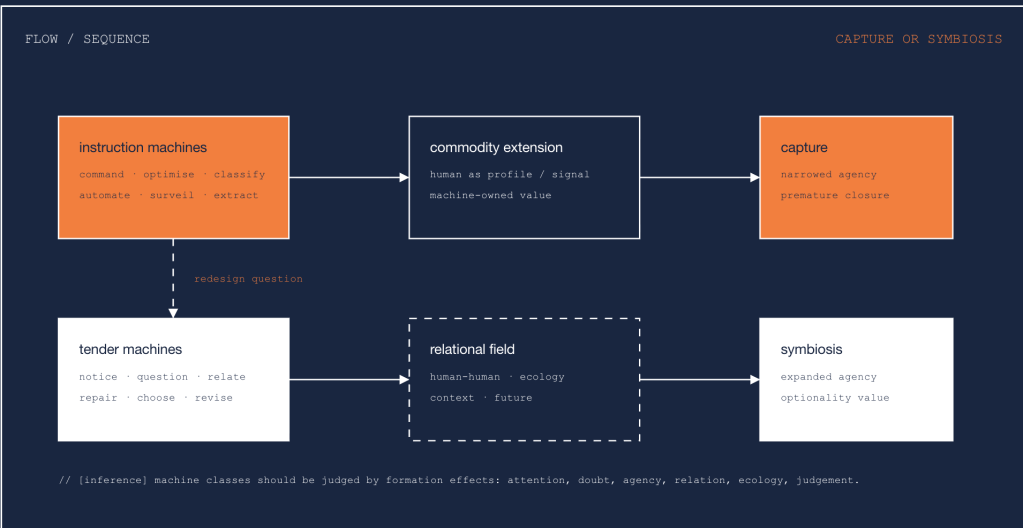
12 – machine logics: From instruction machines to tender machines.
The deepest question of machine design is not what a machine can automate. It is what forms of human, ecological and relational optionality the machine expands or closes.
test: A machine that increases output but reduces judgement has failed.
actually.. just what we need.. again.. tech w/o judgment.. to facil the seeming chaos of legit free people
They should enable human-to-human assisted by machine: systems that support translation, deliberation, memory, accessibility, listening, conflict repair and shared imagination without replacing human relation.
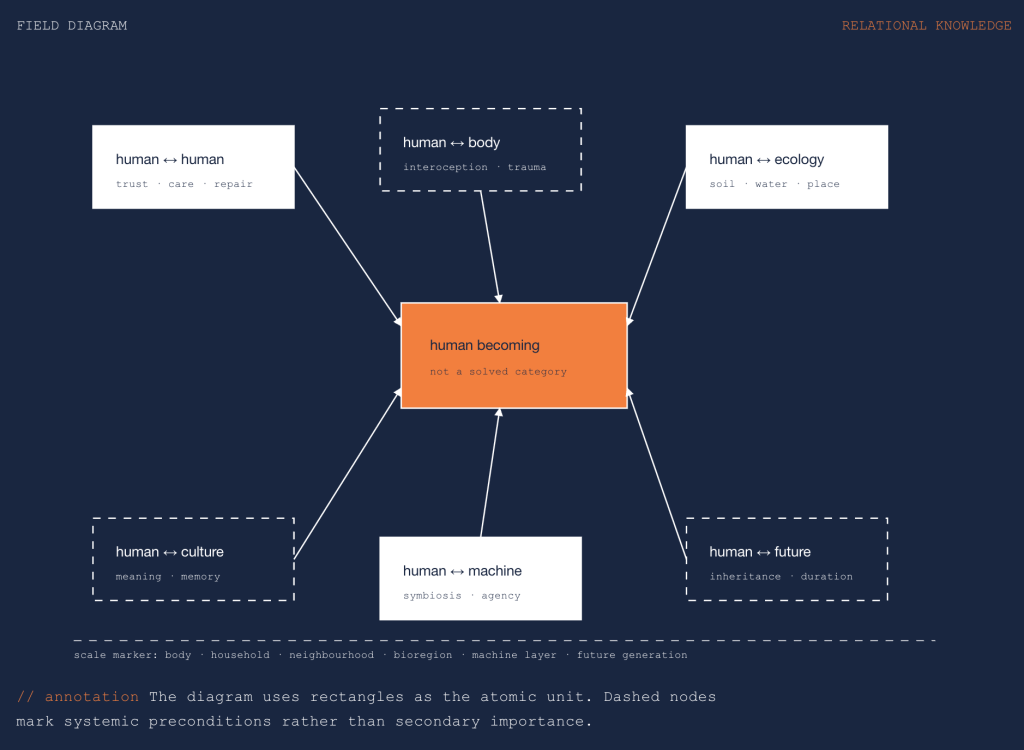
14 – response function: The place-field and the entangled response function.
A person becomes human somewhere: in a home, street, school, clinic, library, forest, workplace, care network, machine environment, watershed, ritual site or civic assembly.
that’s the only crisis we can focus on and be getting to the root of problem
// annotation This is not a mathematical formula. It is a design discipline. It says that optionality collapses when any one of these conditions collapses.
risk: War is treated here as a meaning system as well as a geopolitical event.
Meaning infrastructure is essential because labour has carried identity, purpose, rhythm, status and belonging for modern societies. If labour loses this function, other meaning systems will fill the vacuum.
rather.. cancerous distraction.. keeping us thinking we have to know/understand/name things.. keeping us from us..
This is why meaning infrastructure is not decorative. It is a civilisational safety system.
16 – future intelligence: Doubt, tenderness and tentativeness.
A civilisation built only on certainty, scale and optimisation will be brittle.
doubt: Doubt is disciplined openness to consequence. It is the capacity to question goals, test frames, sense hidden harm, pause before consequence and remain open to revision.
not legit open/free if disciplined ness.. if still questioning/testing/sensing et al.. any form of m\a\p
tenderness: Tenderness is not sentimentality. It is the capacity to remain responsive to vulnerability, fragility and the unknowability of another being.
The future human is not merely rational, productive or creative. The future human is doubtful, tender, tentative, ecological, relational, machine-coupled and still becoming.
The portfolio will require evaluation, but *evaluation must not reproduce the old logic of reduction. The test cannot simply be output, efficiency, employment, productivity, engagement, service uptake or cost reduction. Those may tell us something, but they cannot become the**final measure of human becoming.
18 – closing thesis: The task is not to save the labour-unit human.
The task is to build the conditions through which humans, ecologies and machines can co-create new pathways of becoming before abandonment, capture or violence becomes the default.
everyone has been trying to do that since forever.. but nothing to date has gotten to the root of problem
closing claim: The human is not a solved category. The human is a becoming.
This means resisting commodification without retreating from technology. It means building resilience without reducing people to service recipients. It means researching the human without turning the expanded human into a new exploitable taxonomy. It means building universal provision without building universalising systems. It means designing machines that support doubt, tenderness, tentativeness and situated judgement rather than machines that merely optimise, classify and command.
It means building cultures, institutions and infrastructures that recognise human value before it is productive, after it is displaced and beyond what the present economy can classify.
The future of being human depends on whether civilisation can protect becoming from premature closure.