colin ward and art of everyday anarchism
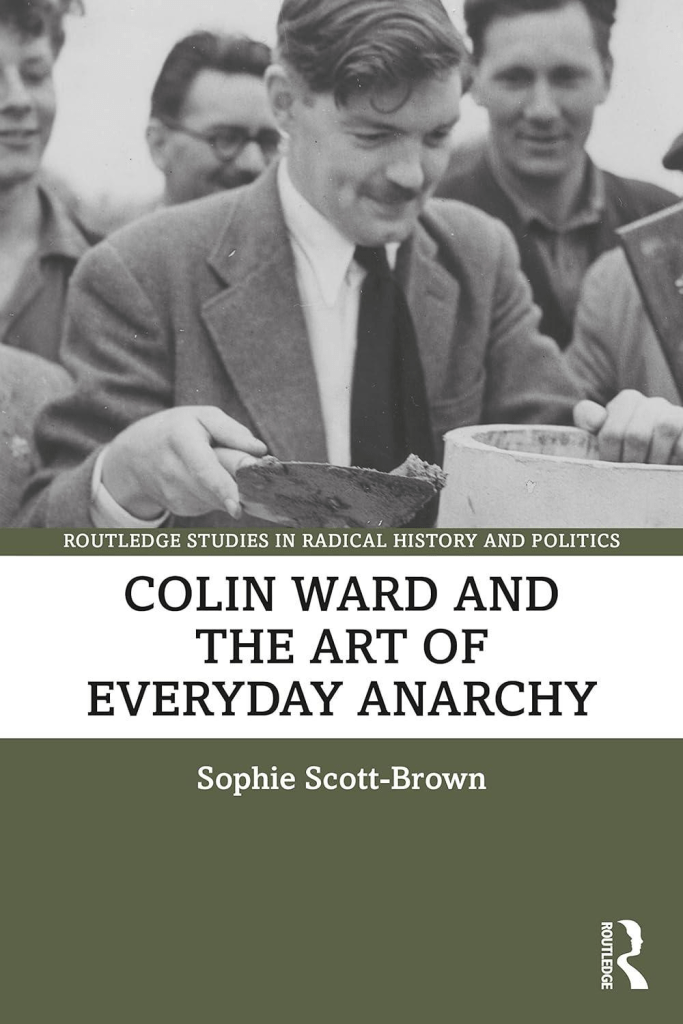
colin ward and art of everyday anarch\ism (2023) by sophie scott-brown via 235 pg kindle version from anarchist library [https://theanarchistlibrary.org/library/sophie-scott-brown-colin-ward-and-the-art-of-everyday-anarchy]
notes/quotes:
2-3
table of contents
anarchist ed/schoolbooks?.. oi.. ie’s of people telling other people what to do.. so cancerous distraction
4
Colin Ward and the Art of Everyday Anarchy is the first full account of Ward’s life and work. Drawing on unseen archival sources, as well as oral interviews, it excavates the worlds and words of his anarchist thought, illuminating his methods and charting the legacies of his enduring influence.
Colin Ward (1924—2010) was the most prominent British writer on anarchism in the 20th century. As a radical journalist, later author, he applied his distinctive anarchist principles to all aspects of community life including the *built environment, education, and public policy. His thought was subtle, universal in aspiration, international in implication, but, at the same time, deeply rooted in the local and the everyday. Underlying the breadth of his interests was one simple principle: freedom was always a social activity.
*to me.. these are form of people telling other people what to do.. so not legit sans govt (anarchism)
This book will be of interest to students, scholars, and general readers with an interest in anarchism, social movements, and the *history of radical ideas in contemporary Britain.
*non yet ‘radical’ enough to date.. anywhere
Sophie Scott-Brown is a Lecturer in the Humanities at the University of East Anglia, UK.
This book is for my parents, Lesley (teacher) and Steven (planner), and partner Matt (anarchist). With love.
6
Introduction
For Colin Ward, anarchy was ordinary, everywhere, and always in action. It happened on city streets, allotments, and around kitchen tables, in village halls, town squares, and pub snugs. It went about its business quietly, beneath and beyond official notice. Anarchists were anyone. Sensible, modest, and resourceful people without a bomb between them. They built houses, grew food, and ran workshops. When a thing needed doing, they banded together but parted their ways when done.
Beneath this calm, orderly facade lay startling claims. Schooling is organised mass ignorance. Centralised welfare is coercion by stealth. Ramshackle shanty towns contain more human dignity than the palatial creations of feted architects. For all that these ran counter to accepted ideas of social progress, in Ward’s hands they seemed intuitive, *like remembering something already known and just briefly forgot. Any reader of sound judgement and good character was hard pushed to object. And yet this was anarchism, the ideology defined, surely, by disorder and destruction. What had this to do with ‘common sense’?
*need 1st/most: means to undo our hierarchical listening to self/others/nature so we can org around legit needs
This book explores Ward and his everyday anarchism. Focusing on his role as a propagandist, a communicator of anarchist ideas, it examines how he crafted a ‘vernacular’ anarchism and transformed the impossible dream into a daily routine.
Talking Colin Ward
Ward was born in 1924, in Wanstead, Greater London. An unwilling schoolboy at Ilford County High School (ICHS), he left formal education at 15, becoming first an assistant building surveyor, later an architect’s assistant for Sidney Caulfield, the last living member of the Arts and Crafts generation. Conscripted in 1942, he was posted to Scotland, where he encountered the Glaswegian anarchists, began contributing to War Commentary (WC), the newspaper of the Freedom Press (FP), and stood as a witness for the prosecution in the FP trial (April 1944). From there, his relationship with the FP group flourished, and on demobilisation, he became an FP editor and writer for Freedom (the title War Commentary was abandoned after 1945), most notably through his column ‘People and Ideas’, at the same time as pursuing a parallel career in architecture.
In 1961, Ward launched Anarchy: A Journal of Anarchist Ideas, a monthly journal which, while remaining under FP’s umbrella, pursued a distinctive political project, *exploring anarchism across the fields of education, housing, work, and crime. **Through Anarchy, thinkers such as Murray Bookchin (writing as Lewis Herber) and Paul Goodman became more widely known amongst a British radical readership. After a decade at the editorial helm, in 1971 he moved on, taking up a post as Education Officer for the Town and Country Planning Association (TCPA) sparking another creative period in environmental education, during which time he began to write and publish book-length works, alongside articles. From 1979, Ward, now living in rural Suffolk, settled into life as a self-employed author, generating an extraordinary output of more than 30 collaborative and sole-authored books until his death in 2010
*not deep enough to get at root of problem
**murray bookchin.. paul goodman
7
The characteristic features of his anarchism are generally agreed upon: pacifist, gradualist, and, above all, practical. In politics he championed decentralisation, federation, and *localism; in society, mutual aid and **voluntarism; in economics, ***human need. He called for workers’ control in industry, citizens’ control in ****planning, dwellers’ control in housing, and students’ control in education. For some, he represented the shift from 19th-century classical anarchism to the so-called ‘new anarchism’[1] which, with its increased concern for culture and identity, practice, and prefiguration, became a dominant strand in the 1960s counterculture. ‘New anarchism’, with its stress on methods, functioned more as an adjective for describing an ‘ethics of practice’ than as a proper noun for a formal movement.[2] As Stuart White observed, adopting such a flexible stance allowed Ward to reconcile the social and individualist strands of the movement and bring anarchism further into mainstream consciousness.[3]
**all we’ve seen to date.. has been voluntary compliance
we have no idea what our legit needs are.. again.. need 1st/most: means to undo our hierarchical listening to self/others/nature so we can org around legit needs
****planning and ed.. both form of people telling other people what to do
endnote [1] David Goodway, ‘Colin Ward’, in Goodway, Anarchist Seeds Beneath the Snow: Left Libertarian Thought from William Morris to Colin Ward (Oakland: PM Press, 2012), 309—325;..
endnote [2] ..See David Graeber, ‘The New Anarchists’, 13 Jan/Feb (2002), @@@[[https://newleftreview.org][https://newleftreview.org/issues/ii13/articles/david-graeber-the-new-anarchists@@@[[https://newleftreview.org][ [last accessed June 2021]; David Graeber, Fragments of an Anarchist Anthropology (Chicago: Prickly Paradigm Press, 2004)..
david graeber.. new anarchists.. fragments of an anarchist anthropology..
endnote [3] ..See also: Murray Bookchin, Social Anarchism or Lifestyle Anarchism: The Unbridgeable Chasm (Edinburgh: AK Press, 1995)
8
He was equally distant from the cultural critique advanced through later youth-orientated movements: punk, the rave scene, or the militant components of the green movement. His favourite characters, allotmenteers, art teachers, or housing co-operativists, may have been on the fringes of society but they were not social outsiders; if anything they were quite the reverse.
?
His could-be anarchists were generally white, English, lower- middle-class men (and occasionally their wives). He accepted this, perhaps too easily; ‘anarchists are products of their times’, he told an interviewer when asked about the attitudes towards women in the anarchist movement of his youth. Of course, this was true, and, in his case, the awareness of the present and concern to write anarchism into it was what made him so interesting; nevertheless, it meant certain limits.
we have yet to try/see the unconditional part of left to own devices ness.. via nationality: human ness et al.. other wise.. ie’s of people telling other people what to do
Locating Ward’s Anarchism
Ward identified as a social anarchist which, situated at the intersection of liberalism and socialism, considers social equality as the necessary pre-condition for individual liberty. Unlike other attempted syntheses, such as social democracy, or even strains of libertarian socialism, which still entertain some role for governance, anarchists are distinguished by maintaining that *only through the complete abolition of all permanent authoritative structures could such a reconciliation be either logically or practically possible.
*the thing we haven’t yet tried/seen.. because we keep not letting go of all the forms of Ed ness (aka: people telling other people what to do)
Ward identified most with Pyotr Peter Kropotkin (1842—1921), describing his work as an ‘updating footnote’ to the Russian’s main ideas. As Kropotkin co-founded Freedom in 1886, it was inevitable that generations of its editors took him for their major influence. In essence, Kropotkin’s anarchism took humans to be fundamentally social beings whose individuality was most enriched *through the highest development of their capacity for voluntary association.
*oi.. then not legit free.. need meadows undisturbed law et al
9
Beyond this, it gets harder to specify. There were several possible ‘Kropotkins’ one could update dependent on inclination: the revolutionary-strategist,[13] the natural(ist)-philosopher, or the observer-activist. Ward favoured the third and took bits from the others to taste, supplementing this with nuggets gleaned from other classical anarchist thinkers. He found Pierre Joseph Proudhon’s ideas of limited property ownership, small-scale enterprise, and *gradualist transformation more prudent for his times than revolutionary communism. William Godwin’s attitude of **unconditional respect for children’s individuality meant more to him than any radical school or curricula design (especially when leavened by the penetrating compassion of Mary Wollstonecraft).
*perhaps .. until now.. now we have the means for a global detox leap.. humanity needs a leap.. to get back/to simultaneous spontaneity .. simultaneous fittingness.. everyone in sync.. otherwise perpetuating same song
**not unconditional if any form of m\a\p ie: anarch ed/schoolbooks et al.. summerhill meetings ness et al
legit freedom will only happen if it’s all of us.. and in order to be all of us.. has to be sans any form of measuring, accounting, people telling other people what to do
how we gather in a space is huge.. need to try spaces of permission where people have nothing to prove to facil curiosity over decision making.. because the finite set of choices of decision making is unmooring us.. keeping us from us..
ie: imagine if we listened to the itch-in-8b-souls 1st thing everyday & used that data to connect us (tech as it could be.. ai as augmenting interconnectedness)
need to try the unconditional part of left to own devices ness..
there’s a legit use of tech (nonjudgmental exponential labeling) to facil the seeming chaos of a global detox leap/dance.. the unconditional part of left-to-own-devices ness.. for (blank)’s sake.. and we’re missing it
ie: whatever for a year.. a legit sabbatical ish transition
endnote [13] Peter Kropotkin, Memoirs of a Revolutionist (London: Houghton Mifflin, 1899); The Conquest of Bread (Harmondsworth: Penguin, 2015 [1892]).
10
Another formative but complex influence on him was the British Labour movement, especially the ‘ethical socialist’ strand of it. Labour was the family politics with both parents Party members. During the interwar years, Labour exercised considerable influence in the Barking and Dagenham area (where his father worked for most of his life) by emphasising a local, *‘domestic’ agenda: social welfare, education, housing.
*ie’s of people telling other people what to do
By the turn of the century, that confidence had fractured as the impact of Darwin in the natural sciences, Nietzsche in philosophy, and Freud in psychology was fully absorbed. Amongst the anarchists, many now felt Kropotkin relied too heavily on science, even conflating the scientific ‘is’ with the ethical ‘ought’.[30] Errico Malatesta argued that while scientific knowledge could be useful it was neither moral nor stable. It could ‘prove’ the contrary as much as the case.
[30] Peter Marshall, Demanding the Impossible: A History of Anarchism (London: Fontana Press, 1993), 337.
11
*Anarchism conceived as a form of intimate human self-knowledge, related to one’s own experience and applied to one’s own fields of interest, meant that the urgency of violent revolution, along with the complex webs of factions, federations, and organisations attendant upon it, diminished in importance compared to the more private work of individual mind change. Not all welcomed this move sensing bourgeois elitism and the gateway to an increasingly depoliticised ‘lifestyle anarchism’. Nevertheless, such an expansion was crucial for cultivating a wider audience for anarchist ideas.
*i would say self listening.. because ie: graeber can’t know law.. graeber unpredictability/surprise law.. and the it is me ness..
12
Ward did not think that modern anarchism was condemned to permanent resistance alone, nor that it was necessary to abandon revolutionary sentiments altogether, only to reframe them.[37] Writing of the relationship between classical anarchism and its contemporary form in the late 1950s, he said of the latter ‘it rejects perfectionism, utopian fantasy, conspiratorial romanticism, revolutionary optimism; it draws from the classical anarchists their most valid, not their most questionable, ideas’. Taking his own advice, he *accentuated the more gradualist aspects of Kropotkin, turning the so-called ‘problems’ of the age into potential opportunities. Ideological fragmentation was not disastrous if it could lead in the direction of political decentralisation. The middle classes, swollen through education and the growing ‘semi-professions’, were not your traditional ‘workers’, granted, but a receptive audience on topics such as practical education and autonomous social organisation.
*oooof.. for (blank)’s sake
[37] Colin Ward, ‘Discussion: Constructive Anarchism’, Freedom, 28 May 1960.
13
To stress Ward’s work as a continuation of Kropotkin’s key ideas is not to detract from his intellectual creativity but to understand it as renovation, rather than innovation. He was fond of this metaphor and the virtues it implied — thrift, attention, and resourcefulness — all essential qualities for the aspiring activist engaged in a gradual, organic (r) evolution.
yeah.. would be that (aka: the death of us).. renovating evolution.. iterating/perpetuating same song
In another interview with Tony Gibson, a fellow anarchist and psychologist (1992), he stated ‘now one thing I’m not is original and this simply reflects that [people] haven’t been exposed to an anarchist point of view before’
As with his deferral to Kropotkin, his insistence on the role of propagandist has been dismissed as modesty, but for him, radical propaganda through independent journalism was a distinctive craft which he took seriously, gave considerable thought to, and served an unofficial apprenticeship in. For the post-war FP group, it was Malatesta who most informed their approach to propaganda. ‘Our task’, the Italian wrote in 1931, is that of ‘pushing’ the people to demand and to seize all the freedom they can and to make themselves responsible for providing their own needs without waiting for orders from any kind of authority. Our task is that of […] provoking by propaganda and action, all kinds of individual and collective initiatives
propaganda ness as people telling other people what to do
14
‘As a propagandist myself’, he once said, ‘I value other propagandists by their effectiveness in winning uncommitted people to an anarchist standpoint? .. He also expressed admiration for George Woodcock, Herbert Read, Murray Bookchin, and Noam Chomsky for their cultivation of a large general audience: ‘unlike the rest of us, they have broken through the sound barrier that limits other anarchists to a small minority audience. They have succeeded in battling through to a large minority audience’
need 1st/most: means to undo our hierarchical listening to self/others/nature as global detox/re\set.. so we can org around legit needs
not more invited vs invented ness.. not more dave’s campfire analogy ness
if we org around something every heart/soul already craves.. no ‘pushing’.. ‘convincing’ .. ‘winning’ over.. ness..
15
Now you are no longer just explaining a doctrine or prescribing a set of actions that will lead to an anarcho-communist society. You are attempting to implant and consolidate a whole habit of thinking.
if have to implant it.. not legit.. we need to uncover what is already there.. we need to trust that .. ie: the unconditional part of left to own devices ness
..making propaganda as much a method of revision as a tool of promotion.
either way.. cancerous distraction
How did he do this? To quote him directly, he worked from (italics my own) *‘the common foundation of common experience and common knowledge’, which was shrewd in that, as Kenneth Burke observed, ‘the ideal act of propaganda consists in imaginatively identifying your cause with values that are unques- tioned’.
*the common ness we need to org around: missing pieces – essential needs
17
This last point has special importance when considering the existing autobiographical sources on his life. Ward refused a request for his life story, explaining that, I have read plenty of such books and have seen how the first few chapters are the most absorbing, after which they tend to trail off into a catalogue of names, jobs and encounters. This in itself is a depressing thought. How can it be that for many people everything after childhood is an anti-climax. And I’m mindful too of Orwell’s sharp comment that an autobiography that is not a history of failures is a pack of lies.
Influences was a collection of essays discussing his favourite writers. The book is hard to categorise which makes it interesting and revealing. It was too personal to be anarchist literary criticism in the manner of Woodcock’s The Writer and Politics (1948), but too impersonal to be a memoir. It most resembled a propagandist’s commonplace book, a repository for the quotes and passages he built his arguments from. In it, he arranged this reading matter *according to the themes — education, politics, society, economics, planning, and architecture — he found they most spoke to. Given his life as a journalist, in which role he continually filleted reading matter to reassemble elsewhere, such a collage of fractured texts, was a fitting intellectual self-portrait.
*ie of perpetuating same song.. building on existing structure/themes..
20
1. The Forward View
22
But if his parents accepted the status quo and aspired to advance within it, this had an egalitarian spirit. Both had benefited from educational opportunities themselves and believed the same should be extended to others. Arnold’s school, Custom House Primary, taught children from poor families, children of dockworkers, whose parents would keep them off school for lack of shoes. Over his years as a teacher, then headmaster, he saw first-hand the vicious cycle of poverty and the role schools could play in breaking it. As such, theirs was an active Labour-supporting household. For the Wards, and, initially, their two sons, the Party took the place of any formal religion in providing the main moral outlook for their lives
oi.. rather.. perpetuates it.. supposed to’s of school/work et al
23
Marginalised political forces, including the Communist Party of Great Britain (CPGB), but also other independents including anarchists like art critic Herbert Read, now came to the fore, attracting support for their more decisive stances. This was the background against which Ward, then 13, was taken by his parents, to the 1938 May Day rally in Hyde Park where he saw Emma Goldman speak about the anarchist cause in Spain. From the perspective of his parents, this was less a sign of radicalisation than of their sustained commitment to a notion of democracy. From his perspective, this was important exposure, not necessarily, at this stage, to the nuances of different ideologies, but to a general set of values worth fighting for, not least individual freedom. Less directly, it also planted the idea that politics was not confined to parliamentary activity (and often more sincere outside of that framework) and that *ordinary people could have a stake and play their part.
*unfortunately to date.. has forever been their part in same song
Political activism did not dominate family life. There were other, more pleasurable activities such as concerts at Queen’s Hall in Langham Place where the BBC orchestra played popular classics, regular visits to grandparents still living in East London, seaside holidays in Southend and Clacton. Later, he and elder brother Harvey took long summer cycle rides in the Essex countryside where he encountered, first-hand, the plotlanders he would later champion. Cycling by these examples of ‘domestic bricolage’, the makeshift homes and productive gardens, far removed from the uniformity and constraints of suburban life, the association with freedom was intuitive. Especially when the alternative was a dull classroom.
24
He found school a dismal affair. Aged 10, he passed a scholarship examination, the forerunner of the 11-plus, to attend Ilford County High School (ICHS), a selective, all-boys grammar, part of a new wave of school building at the turn of the century to prepare children from the aspirant middle (or upper-working) classes for modern careers in industry, administration, and commerce. Ward, however, gained more from his rejection of formal education than his receipt of it. What was he rejecting? Lessons learnt by rote and tested by examinations. Uniforms, structured days, rules, and events, all the training needed to go on into professional jobs. Corporal punishment was used, ICHS was no exception there, but it was not especially rife. He had no tales of Dickensian cruelty to tell of it. He was just bored.
rather.. any form of people telling other people what to do.. any form of m\a\p
He was never openly rebellious, he just stared out of the window during his lessons, failed to distinguish himself, and left at 15. This seems young to contemporary eyes but in 1939 his grammar school education qualified him for administrative work (as his mother had done some years before). His early jobs on leaving school included being an assistant to a builder illegally erecting Anderson shelters in people’s gardens, and then a construction administrator for West Ham Council. Although formal academic study had not excited strenuous effort from him, it was at this time he conceived a passion for printing and typography, even acquiring his own small treadle-operated printing press, a clam model which one person could operate.
If all this furnishes a fuller social picture of his youth, it offers little by way of an emotional one. Ward was not generally given to personal divulgence but did later recall Arnold as a good-humoured man who rarely lost his temper. Ruby was sharper, ‘more punitive and moralistic’ but hardly tyrannical. Overall Ward’s upbringing might be called comfortable, if a little restrained, middleclass but not ostentatious, socially conscientious but not radical, based on the belief that government should ensure fair chances which individuals should seize for themselves. Naturally, education was valued — both parents had been the beneficiaries of it — as the means of self and social improvement. *Ward re-negotiated these values. He would spend a lifetime criticising the social ‘goods’, state education and parliamentary process, that his parents had taken for granted. But he, no less than they, retained respect for respectability and an appreciation for the everyday desires, comforts, and pleasures that many people cherished
*reiterated.. re perpetuated.. re played same song
25
In 1912, Caulfield joined the first wave of architects working on Hampstead Garden Suburb, Henrietta Barnett’s vision of a permanent, socially mixed settlement in which the classes lived together for their mutual improvement. The idea that the healthy community could be created through intelligent design drew directly on the Arts and Craft principle of life as art. Raymond Unwin, the project’s chief planner and former secretary of Morris’ Socialist League, applied this in practice through low-density housing, sensitive to the local environment with gardens to encourage wholesome hobbies and ample spacing to promote social mixing. Caulfield contributed houses on the Meadway, Southway, and Bigwood roads.
26
The idea of progress as a matter of scientifically informed design was naturally attractive to all those working in architecture, like Ward, but perhaps especially to an emerging cohort of students keen to distinguish themselves from the old gentleman amateurs through their professionalism. This helped prompt a ‘rediscovery’ of urban thinkers like Patrick Geddes. A botanist by early training, Geddes saw societies as organic entities gradually evolving over time. Reasoning that development aligned with this natural growth would yield more efficient results, he famously proposed the regional survey as the optimum tool for gaining the necessary local knowledge.
In the years immediately following his death in 1932, interest in Geddes waned (due in part to the scattered nature of his oeuvre) until, six years later, American historian Lewis Mumford recovered his reputation in The Culture of Cities (1938). In Britain, The Culture of Cities was enthusiastically reviewed by WH Holford, then professor of planning at the University of Liverpool in Town Planning Review while Patrick Abercrombie, in his 1938 address to the Geographical Association, of which he was the chair, could state that the importance of Geddes’ biological triad — folk-work-place — to planning education should be taken for granted.
With the likes of Geddes back in favour amongst some of their teachers and restored to course reading lists, a generation of young architects emerged convinced of architecture’s social role, eager for change and frustrated by lingering conservatism in the profession. Some sought inspiration from older British modernists (Max Fry and Wells Coates) and other luminaries like Walter Gropius at Bauhaus, but above all from Le Corbusier, the Swiss-French architect who sought, through design and planning, the total transformation of social life. If these elders remained exciting, the students did not wish merely to replicate them. Taking modernism as a technique rather than an aesthetic, they determined that it should not petrify into a single style.
27
In taking up the modernist mantle, a small group studying the Association of Architecture School in London launched Focus (1938—1939), a little magazine in keeping with a longer tradition of proselytising architectural periodicals, through which they intended to mark out their own vision. The mood was earnest and urgent. Writing in the first edition, Anthony Cox, future founder of the Architect’s Co-partnership, urged the role of architecture in shaping the social fabric of the whole community (1938). Avoiding fidelity to any one stance, the magazine encompassed a range of modernisms linked by a set of common themes: a concern with materials, technology, and industrial production, the social role of the architect, but above all architecture as a vehicle for social change.
30
Whether Ward embraced the full Orwellian position (which could be dogmatic on questions of intellectual honesty and national culture) or not at this time, he was drawn to the expression of faith in the ‘common-sense’ of ‘common-people’. This mattered at a time dominated by experts and theories.
intellectness as cancerous distraction et al
32
2. Sapper Ward
36
Aside from its core argument, the pamphlet was also the model of clever propaganda, or at least the sort likely to appeal to a reader like Ward, concise, well-written, and, above all, supremely reasonable. It avoided many common pitfalls that made political polemic unattractive, such as hectoring or obscurant- ism. Rather than abstract theory in technical language, it used a historical, contextualising approach, framing Kropotkin’s federalism as the fruit of his lived experience and the common sense arising from that. As narrator, Camillo was charming and disarming. Kropotkin, he noted, had once said ‘I had to elaborate a completely new style for these pamphlets’, which, he conceded, he had also needed to do himself.
to proper language ness and language of people ness (m of care – jan 30 25 – obscure ness) only needed if propaganda ing.. if people telling other people what to do ing
Its other great strength was in its handling of Russia’s controversial support for the First World War, which had caused tremendous consternation amongst the movement and derision from critics outside. Given that anti-militarism was a mainstay of anarchist thought (‘Anarchism opposes war as the outcome of clashing interests between rival imperialisms’) the apparent incongruity of Kropotkin’s anti-anti-militarism, and the force with which he stuck to it, damaged his credibility in some eyes. Camillo could not leave it unaddressed, and could not be uncritical, but, through the biographical method, he was able to contextualise the decision, to show how the depth of Kropotkin’s federalist conviction had, perhaps, blinkered his reading of geo-politics, persuading him that the threat posed by German victory was simply too great. Presented like this, it even became something of a virtue: in anarchism, you would find no infallible prophets, only real men and women grappling with the problems of their day, making good calls and bad ones, but keeping faith with the core value of liberty.
For Ward, this was the beginning of an intense period of reading. After this, he worked through more FP literature which the group willingly supplied to newcomers (providing they consequently ‘lost’ them in conveniently public places). Between 1942 and 1944, FP published a total of 152,574 copies of books and booklets including several abridged reprints from the anarchist ‘classics’. In 1943 the publication list promoted Selections from Kropotkin, chosen and edited by Herbert Read, Anarchy by Errico Malatesta, Selections from Political Justice by William Godwin, and God and the State by Mikhail Bakunin, all selected for contemporary resonance. Curating these anarchist primers was a vital aspect of FP’s work, not just in terms of spreading anarchist ideas but for inculcating a set of common cultural reference points amongst potential new recruits. On the downside, for a novice reader, unlikely to stumble across the originals, it was hard to identify the traces of editorial decision-making.
ooof.. 1/ recruit 2/ have to read/train.
38
Taken ensemble, the four pieces show how anarchism supplied him with a set of tools for deflating the official rhetoric of Allied heroism and moral superiority.
any form of people telling other people what to do (ie: propaganda et al) = moral superiority ness.. oooof
44
3. The Freedom Press Anarchists 1936–1945
45
An indigenous leadership emerged, out of which Malatesta was the most prominent figure.
malatesta impossibility law.. malatesta conditions law
Despite growing in strength, key figures like Malatesta remained in almost perpetual exile. In fact, this proved useful.
46
Malatesta took the art of anarchist propaganda and organisation very seriously. An early education in rhetoric and Roman history, followed by a political apprenticeship in the ‘disappointing aftermath of the Italian struggle for independence and unification’, left him mistrustful of all determinisms including Kropotkin’s over-optimistic faith in modern science.[210] Anarchism had to be fought for and people had to be persuaded, no matter how ‘natural’ it might be. To do this he focused on organisational methods (which he saw as ‘the practice of cooperation and solidarity’[211]) advocating a middle path between the movement’s extremes which, he considered, fatally undermined its general credibility and capacity for strategic alliance. A prolific writer and editor, he urged consistency in propaganda believing that isolated or sporadic propaganda, especially in inauspicious times, was worse than none.[212] This was the strategy Richards pursued ruthlessly and overall effectively, with FP.
endnote [210]: Errico Malatesta, ‘Anarchism and Science’, Volonta, 27 December 1913.
not in anarchist library.. but there is a Further Thoughts on Science and Anarchy
endnote [211]: Errico Malatesta, ‘Organisation’, Il Risveglio, 15 October 1927.
found/loaded in anarchist library .. also found/loaded anarchism and org – but it’s only 5 pgs
endnote [212]: Errico Malatesta, ‘Anarchist Propaganda’, l’Agitazione, 22 September 1901.
not in anarchist library..
47
In October of that year, Mussolini was appointed Prime Minister, advancing the fascist takeover of Italy.
Camillo followed his former tutor in using the historical method as a philosophical and political tool. In his hands, the attention and status afforded to context and contingency showed how inglorious and haphazard most events were. *Like Malatesta, he flinched from metaphysical dogma of any kind. The cosmos was not a moral agent, humans were, and this required making choices and acting. In a letter to his daughter, written just hours before his death, he said ‘wherever conscience is involved, reason leads me to **no decision.
*if sans any form of m\a\p.. choices and acting irrelevant s
**as it should/could be.. because the finite set of choices of decision making is unmooring us
50
How was it that egalitarian values had been so easily abandoned and the old conformism, the authority instinct, so quickly restored?
In part, the answer came down to organisation; ..
rather.. needs to be all about org – ie: org around legit needs
53
As such, Andrew Rigby argues, three main options presented themselves: humanitarian relief work, active resistance of the war effort, or ‘reconstruction’ by which was meant the cultivation and practice of alternative models of social organisation that could, if successful, provide the structural basis for ensuring lasting peace in the future.
how we gather in a space is huge.. need to try spaces of permission where people have nothing to prove to facil curiosity over decision making.. because the finite set of choices of decision making is unmooring us.. keeping us from us..
ie: imagine if we listened to the itch-in-8b-souls 1st thing everyday & used that data to connect us (tech as it could be.. ai as augmenting interconnectedness)
the thing we’ve not yet tried/seen: the unconditional part of left to own devices ness
57
Moreover, the conflict had disrupted people’s daily routines in an important way; it had made the previously unthinkable thinkable, prizing open a window of receptivity to radical ideas
virus noticings et al.. to (virus) leap
59
4. Building and People
62
Ward covered the episode in ‘Politics and Squatters’ (21 September), condemning police tactics and emphasising, again, that squatting was a reasonable response to a chronic shortage of adequate housing.
unauthorized home less ness et al.. need to try a sabbatical ish transition
64
As with Ward’s squatters, another tactic was to seek out and promote ‘vernacular’ examples of mutual aid in practice. The most important of these was Richards’ account of the resurrected Peckham Health Centre, a longstanding source of fascination for the FP group. In 1926, Dr George Scott Williamson and Dr Innes Pearse had begun the project as a means of investigating the factors that made for positive health rather than the mere absence of disease. The plan was simple — 875 local families (2,000 individuals) were recruited to join as members (for which they paid a low weekly rate) and given total free rein over the centre’s facilities, which included a swimming pool. Their progress was charted through annual health checks. Scott Williamson’s hypothesis that, given the right environment, people would self-organise with beneficial results for their overall health was realised in full. Members not only used the facilities regularly but initiated their own social activities.
The success prompted the building of a new centre which opened in 1935, a model of modern social architecture using cutting-edge research to fashion large, light open spaces believed to stimulate social interaction. During the war, Peckham closed and was converted into a factory but, owing to the efforts of the members themselves, it reopened in 1946. There was, in this tale, much to attract the anarchists: the centrality of the environment in shaping human behaviour, the idea that self-determination not only fostered individual good health but created a sense of community. Peckham, Richards contended, ‘vindicated the sound biological basis of the Anarchist philosophy’. It also paid tribute to how effective and efficient an autonomous, community-based organisation could be, in contrast to the unwieldy centralised administration of the NHS whose costs were already beginning to spiral.
65
The attraction was not without its contradictions. The vindication of the ‘sound biological basis’ Richard spoke of was the result of meticulous planning and exhaustive monitoring. In this sense, the directors always retained a significant degree of control. The ‘users’ were observed subjects fulfilling the promise of a theory, a fact reflected in Richards’ account which made no space for the voices of the people themselves, only for the directors.
legit freedom will only happen if it’s all of us.. and in order to be all of us.. has to be sans any form of measuring, accounting, people telling other people what to do
how we gather in a space is huge.. need to try spaces of permission where people have nothing to prove to facil curiosity over decision making.. because the finite set of choices of decision making is unmooring us.. keeping us from us..
ie: imagine if we listened to the itch-in-8b-souls 1st thing everyday & used that data to connect us (tech as it could be.. ai as augmenting interconnectedness)
the thing we’ve not yet tried/seen: the unconditional part of left to own devices ness
[‘in an undisturbed ecosystem ..the individual left to its own devices.. serves the whole’ –dana meadows]
there’s a legit use of tech (nonjudgmental exponential labeling) to facil the seeming chaos of a global detox leap/dance.. the unconditional part of left-to-own-devices ness.. for (blank)’s sake.. and we’re missing it
ie: whatever for a year.. a legit sabbatical ish transition
For all the sensible solutions proving that anarchists had better planning skills than either bureaucrat or Fabian, it was still important, perhaps more so than ever, to believe that the world could, and more importantly, should be different but difficult to do without being dismissed, once again, as damn fools in utopia or, worse, chiliastic despots. MLB took up this problem in Journey through Utopia (1948), an intellectual history of literary utopias. Giving no quarter to scepticism, she opened,
mlb = Marie Louise Berneri
Our age is an age of compromises. Visionaries are derided or despised, and ‘practical men’ rule our lives. We no longer seek radical solutions to the evils of society but reforms. At a time when man is so concerned with what is practicable and capable of immediate realisation, it might be a salutary exercise to turn to men who dreamt of Utopias, who have rejected everything which did not comply with their ideal of perfection..t
74
5. The Social Principle
80
Taking the story over (of peckham closing), Ward wrote a series of pieces to mark the occasion. The most interesting of these was a double feature ‘Anarchist Aspects of the Peckham Experiment’ where, rather than presenting a narrative (re) confirming how Peckham vindicated ‘the sound biological basis of anarchist philosophy’, he assembled a cut-and-paste selection of quotes from the writings of the Peckham directors juxtaposed with those from classical anarchist thinkers arranged under themed headings, for example:
Spontaneity and Order
For us there is no contradiction between spontaneity and order. On the contrary we anticipate order as the result of free growth
carhart-harris entropy law et al
(I. Pearse and G. Scott Williamson, The Case for Action: A Survey of Everyday Life under Modern Industrial Conditions, 1931)
Order is the free equilibrium of all forces that operate on the same point.
(— P. Kropotkin)
No Authority
the attempted promotion of any sort of stereotyped organisation based on leadership was early discarded …
needs to be sans any form of m\a\p
(I. Pearse and L. Crocker, The Peckham Experiment, 1943)
I receive and I give — such is human life. Each directs and is directed in his turn.
(– M. Bakunin)
Education
In circumstances where they are not starved of action, it is only necessary to place before [children] the chance or possibility of doing things in an orderly manner for them to grasp it.
oi.. ie of people telling other people what to do
(I. Pearse and L. Crocker, The Peckham Experiment, 1943) It is our wisdom to incite men to act for themselves, not to retain them in a state of perpetual pupillage.
(- W. Godwin)[381]
The result was a ‘do-it-yourself’ anarchist myth in the making, encouraging readers to see the connections for themselves. Unfortunately, Scott Williamson did not find it so obvious, writing to the paper to: ‘register a protest at the label, or libel, you have fixed to my name and Peckham? I am not an anarchist nor do I believe in anarchy — not even the Kropotkin type’, a reminder that for all Freedom’s efforts towards metamorphosis, ‘anarchy’ still bore inflammatory connotations.
Of course, this owed much to the tense Cold War mood, but Ward felt that the anarchists should yet heed the warning. As he reflected in an editorial on the matter:
are our movement and our ideas in fact as free from the political outlook as we would wish? How many anarchists, how many syndicalists nourish half-avowed desires for a ‘mass-following’ which has little enough to do with the ‘creative capacity of the people’ of Kropotkin, the self-activity of Malatesta.
81
I do not think the case for anarchism rests on science
science scientifically ness and unjustifiable strategy ness
These misgivings were not about Comfort personally nor a rejection of science per se, but an antipathy towards the authority theorising seemed to bestow. Perhaps this reserve owed something to his own sense of academic failure, in the same letter he commented, ‘I am not qualified to contribute to your pages because I was lost to education at the age of fifteen’. It also had to do with his working experiences.
85
Ward would have been the first to agree with Orwell that clear expression was a basic democratic act
great ie that any form of democratic admin is a cancerous distraction.. language as control/enclosure et al
communal speaking that begins at the moment of speaking to one another, of mutuality in the great stream of reciprocal sharing of knowledge.
reciprocity and intellectness as cancerous distractions
86
None of this meant Ward rejected the social sciences.
The primary purpose was to show how certain ideas either supported the anarchist case or could be criticised on anarchist principles.
looking for loopholes ness?
91
Anarchism, he believed, was ‘ultimately based on the aspirations of the heart rather than the deductions of the mind’ and it was these he determined to speak to.
if only.. need 1st/most: means to undo our hierarchical listening to self/others/nature as global detox/re\set.. so we can org around legit needs
92
6. Domestic Anarchy
Work, family life, health and education are all undermined by crowded houses. Therefore, a Conservative and Unionist Government will give housing a priority second only to national defence.
rather.. housing (bachelard oikos law) is undermined by cancerous distractions. ie: work, ed, …
Re-Writing Anarchism
97
Orwell was not ‘An Anarchist’, then, but somehow more anarchic for not being. Rather than resolve his contradictions, he made of them a virtue: inconsistency, uncertainty, imperfection became forms of human resistance. ‘Stay human: love one another’ was, Ward believed, Orwell’s ultimate message. It was not, he admitted, revolutionary, political, or even original, but it was more than the unsatisfyingly vague ‘love of humanity’ that Richards had permitted him. ‘Love’, in Orwell’s case, was nearer to respect, an extension of the ferocious independence of mind he cherished for himself to all other people.
98
The challenge, then, was how to present an anarchism so ‘realistic’, so accommodating of flaws and eccentricity, that even Orwell might have been persuaded.
oi.. ie of people telling other people what to do.. if have to persuade et al.. not letting people be/hear what’s on each heart
112
7. Autonomy
125
8. A Journal of Anarchist Ideas
139
9. Liberal Studies
In later years, Ward rejected the idea that there was any such thing as ‘anarchist education’, preferring to say that there were ‘different kinds of educational experiments which anarchists have supported and been involved in’. Nevertheless, for the Kropotkinian social anarchist tradition he identified with, *education was a major preoccupation. Believing individuals to be social beings, knowing the world primarily through their interactions with one another and their environments, **social anarchists held that where those interactions were coercive, restrictive, and static, the individual became alienated, intellectually and spiritually impoverished. Where they were voluntary, open-ended, and dynamic, individuality was enriched. Education was a conduit of those relations, for better or for worse.
*red flag not seeing ed as drawing forth from w/in.. actually to me ‘drawing forth’ ness has to be from self listening.. otherwise.. people telling other people what to do
**still ie: coercive et al if thinking end goal ness.. ie: enriched
From an anarchist perspective, the school system produced by, and for, the modern industrial world exclusively served the interests of the status quo by *providing a direct pipeline into the labour market and by making virtues of obedience and submission. In its place, they proposed approaches to education that nurtured independence, providing the practical skills and knowledge necessary for people to become ‘active agents creating the possibilities of their own future’. As such, the concept of integral education, the **synthesis of mind and brain work, was generally endorsed but given various nuances.
*to me.. still too much of an agenda
**intellectness as cancerous distraction et al
143
While many educators were willing to take these criticisms on as the basis for further reforms and better teacher training methods, others contended that *no amount of reform could ever resolve the problem. Schools, by their nature as social institutions, were inherently repressive, even (sometimes especially) when they aimed at individual well-being or social redress. They proposed instead ‘de-schooling’ as a radical alternative. Whilst the concept gained its clearest statement from Austrian philosopher Ivan Illich, it figured prominently in the works of Paul Goodman, John Holt, and Everett Reimer. In Britain, publication of these writers’ books in the Penguin Educational Specials series, and an attempt at an English version, Education without Schools (1971) (to which Ward contributed a chapter, ‘The Role of the State’), helped popularise the idea. With various nuances, **what de-schoolers called for was a full dispersal of education into the community where children would be constantly exposed to different skills, experiences, and people. This they generally envisaged taking place across a range of public facilities, libraries, museums, galleries, even workplaces, ensuring that educating the young became part of daily life and work.
*true.. but also.. ‘the problem’ isn’t the root of problem
ivan illich.. paul goodman.. john holt..
**haven’t yet seen.. because haven’t yet let go enough to see/try the unconditional part of left to own devices ness.. so still (since forever) whac-a-mole-ing ness of myth of tragedy and lord ness
Even if accepted in principle, de-schooling in practice could only ever have had a very limited application at this time. *The infrastructure it required (such as dedicated educational facilities in all public amenities) was simply not in place. Moreover, whilst it might have resolved social stratification if adopted universally, in a restricted form it only perpetuated it. Only those willing to home-school their children could even approximate to anything like it and this required a level of parental commitment, in terms of both time and resources, only affordable for the middle classes.
*do need ‘structure’ in place.. ie: costello screen\service law et al.. but needs to be infinitesimal structures approaching the limit of structureless\ness and/or vice versa .. aka: ginorm/small ness.. aka: conditions free enough for the dance
144
His strongest affection was for Goodman’s educational ideas. Goodman’s 60s books, Growing Up Absurd (1960), The Community of Scholars (1962), and Compulsory Miseducation (1964), unleashed a wave of energy through the American student movement with their strident critique of institutionalisation and its deleterious effects on the young. Ward reviewed them for Anarchy (11 and 24) appreciatively, but, personally, found the essence of the American’s message better captured by a passage from his earlier novel The Grand Piano (1942):
growing up absurd.. et al
‘The aim of education’, said Mynheer patiently, ‘is to make us feel at home here in the Empire City. To make us feel at home because we don’t feel that way now. The reason people don’t feel at home is that they can’t cope with the problems. They’re too many and too big and too complicated, so we have to take them in the right doses. This I call Tempering Experience to Our Powers’.
hari present in society law.. so .. hari rat park law
To achieve this, the narrator continued, *‘kids must learn two things: skills and sabotage’, because any honest service to their home city required ‘engaging in sabotage’ to keep life from being stamped out under the weight of corporate organisation. Goodman envisaged gangs of children, accompanied by an adult ‘shepherd’, roving the city in search of experiences to **temper to their powers. Good education here was more about better improvising than better planning
*rather.. again.. hari rat park law so that ie: no train et al.. need 1st/most: means to undo our hierarchical listening to self/others/nature as global detox/re\set.. so we can org around legit needs
imagine if we listened to the itch-in-8b-souls 1st thing everyday & used that data to connect us (tech as it could be.. ai as augmenting interconnectedness as nonjudgmental expo labeling)
**ie of people telling other people what to do
155
He could never be sure that his readers were *all properly trained in the Godwinian method of judicious reading (in the case of Work it was unlikely), alert to the hidden construction marks of composition. **Simply urging young people to ‘do- it-themselves’, no matter how well intentioned, was not the same as cultivating autonomy as a habit of mind.
*oi.. red flags..
**perhaps because still defining/controlling-with the ‘it’.. rather than.. the it is me ness
157
10. The Drone’s Tale
162
Given that what might excite those children was unpredictable, the learning environment needed to be as varied and unconstrained as possible.
ie: the whatever ness of in the city.. as the day ness.. open enough for the unconditional part of left to own devices ness
164
Ought we not [.] be planning for a major proportion of every child’s education to take place outside of the confines of the school building?
rather.. ought we not be planning
Child in the City (1978) is often considered to be Ward’s most eloquent statement on childhood, the built environment, and the implications for environmental education.
174
11. Ramshackle Independence
193
12. Categorically Ward
207
His anarchistic solution to the problem was to create *free spaces within the situation rather than abandon it altogether in the hope that some other configuration of conditions would put all to rights.
*then none are free.. need hari rat park law.. not free if
208
Afterword: the Everyday Anarchist
As such, without trivialising, we must not sacrifice humour. Laughter reconnects people to one another, to the world, and gives them the confidence to imagine things differently; after all, the words ‘revel’ and ‘rebel’ stem from the same source. If we are to build truly sustainable lives for ourselves on this planet, *there must always be space for oddities and experiments, for margins and makeshifts, for plotters and cotters and squatters.
*again .. to get at root of problem
legit freedom will only happen if it’s all of us.. and in order to be all of us.. has to be sans any form of measuring, accounting, people telling other people what to do
how we gather in a space is huge.. need to try spaces of permission where people have nothing to prove to facil curiosity over decision making.. because the finite set of choices of decision making is unmooring us.. keeping us from us..
ie: imagine if we listened to the itch-in-8b-souls 1st thing everyday & used that data to connect us (tech as it could be.. ai as augmenting interconnectedness)
the thing we’ve not yet tried/seen: the unconditional part of left to own devices ness
[‘in an undisturbed ecosystem ..the individual left to its own devices.. serves the whole’ –dana meadows]
there’s a legit use of tech (nonjudgmental exponential labeling) to facil the seeming chaos of a global detox leap/dance.. the unconditional part of left-to-own-devices ness.. for (blank)’s sake.. and we’re missing it
ie: whatever for a year.. a legit sabbatical ish transition
[skimmed a lot towards the end]
_______
______
_____
______
- anarch\ism(54)
- accidental anarchist
- anaculture
- anarchism and christianity
- anarchism and markets
- anarchism and other essays
- anarchism & cybernetics of self-org systems
- anarchism as theory of org
- anarchism of other person
- anarchism or rev movement
- anarchist communism
- anarchist library
- anarchist seeds beneath snow
- anarchists against democracy
- anarchists in rojova
- anarcho blackness
- anarcho transcreation
- anarchy
- anarchy after leftism
- anarchy and democracy
- anarchy in action
- anarchy in manner of speaking
- anarchy of everyday life
- anarchy works
- annotated bib of anarchism
- are you an anarchist
- art of not being governed
- at the café
- billionaire and anarchists
- breaking the chains
- christian anarchism
- colin ward and art of everyday anarchism
- constructive anarchism
- david on anarchism ness
- don’t fear invoke anarchy
- enlightened anarchy
- everyday anarchism
- fragments of an anarchist anthropology
- freedom and anarchy
- goal and strategy for anarchy
- graeber anarchism law
- inventing anarchy
- is anarchism impossible
- kevin on anarchism w/o adj
- krishnamurti for anarchy
- mobilisations of philippine anarchisms
- new anarchists
- nika on anarchism
- on anarchism
- post scarcity anarchism
- social anarchism – gustav on socialism
- sophie on anarchism
- spiritualizing anarchism
- that holy anarchist
- two cheers for anarchism
_____
______





 be you.