libertarian socialism
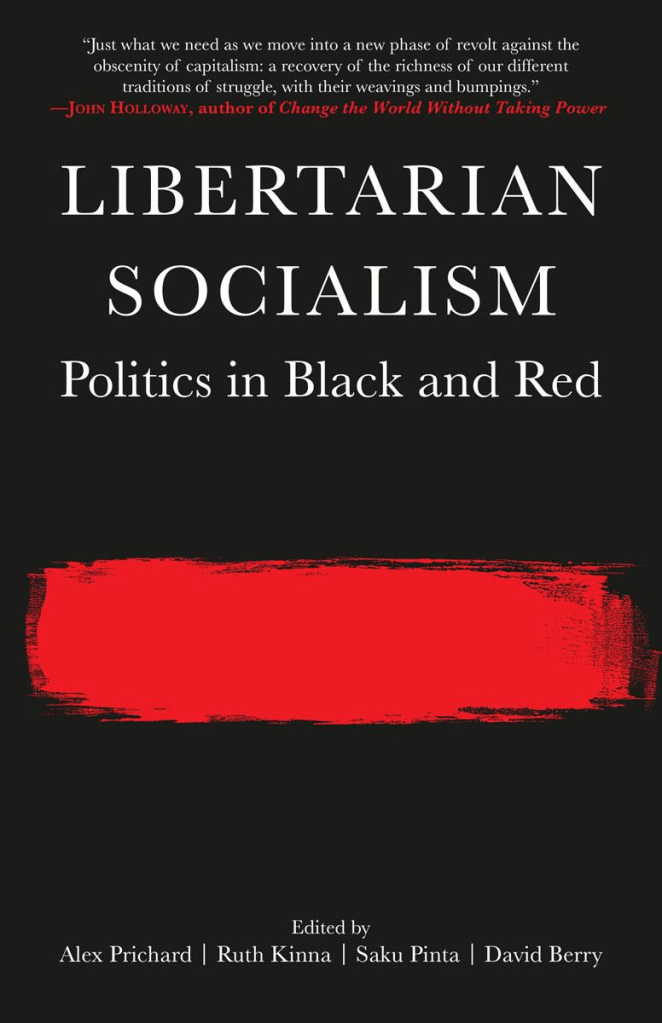
Libertarian Socialism – Politics in Black and Red – Edited by Alex Prichard, Ruth Kinna, Saku Pinta, David Berry – (2012, 2017) via 289 pf kindle version from anarchist library [https://theanarchistlibrary.org/library/edited-by-alex-prichard-ruth-kinna-saku-pinta-david-berry-libertarian-socialism]
notes/quotes:
john holloway – change world w/o taking power
11
Once the Soviet Communist Party had established itself as the authoritative voice of world socialism, virtually everyone who identified with the Left was obliged to position themselves in relation to it: anarchists and Marxists, reformists and revolutionaries alike. As the British libertarian communist journal Aufheben noted:
deeper.. since forever.. everyone obliged to position selves in relation to sea world
Ever since the Russian Revolution in 1917, all points along the political spectrum have had to define themselves in terms of the USSR, and in doing so they have necessarily had to define what the USSR was. This has been particularly true for those on the ‘left’ who have sought in some way to challenge capitalism. In so far as the USSR was able to present itself as ‘an actually existing socialist system,’ as a viable alternative to the ‘market capitalism of the West,’ it came to define what socialism was.
The intellectual domination of Marxism over anarchism in political and academic debate has created barriers to dialogue and exchange, and these continue to resonate, as the recent discussion between Simon Springer and David Harvey demonstrates.
Although there is considerable disagreement about the proper labelling of the axes separating Marxism from anarchism, there is also a discernible pattern in the prevailing shorthand: Marxism’s head to anarchism’s heart, Marxism’s theory to anarchism’s practice, Marxism’s science to anarchism’s utopianism, Marxism’s modernism to anarchism’s primitivism are some of the most potent and deeply rooted oppositions. A more recent variation, rehearsed in the recent Critchley-Žižek debate, which mostly rumbled on after Libertarian Socialism was first published, compares Marxism’s strategy to anarchism’s ethics, perhaps picking up on the post-anarchist strategy-tactics distinction.
12
Viewed as a tension and not a breach, the relationship between the black and the red — the red of communism, the black of anarchism — reveals a creative dynamic and a space for the articulation of libertarian socialism. Contributors to this volume illustrate the *obstacles to its development — the misunderstandings, deliberate distortions, and misrepresentations of ideas — as well as the potential for its expression, by looking at late-nineteenth and twentieth-century, primarily European, socialist thought.
*if want to get to root of problem.. any form of m\a\p is an obstacle ..aka: cancerous distraction
legit freedom will only happen if it’s all of us.. and in order to be all of us.. has to be sans any form of measuring, accounting, people telling other people what to do
13
The Movement for a Democratic Society (Tev-Dem) in Rojava supports a political programme that is informed by the work of Murray Bookchin: a non-statist vision of networked, self-governing communities as an alternative to the nation-state, or what has been termed democratic confederalism by its imprisoned figurehead Abdullah Ocalan
rojava’s third way.. i see any form of democratic admin as cancerous distraction (aka: obstacle)
murray bookchin et al
14
As the inter-imperialist conflict continues to play out through highly complex, often contradictory and shifting alliances, it seems that the real choice before us is the one Rosa Luxemburg outlined: socialism or barbarism. Perhaps there’s some consolation in thinking that as the memory of the Bolshevik coup dims and new traditions of libertarian socialist resistance become established, Marxists and anarchists will stop fighting each other and look to commonalities and mutual strategies for realignment and renewal. The chapters in this volume should give historical context and pause for reflection in the context of calls for a new left party, or for a fully automated luxury communism. The future demands debate and engagement, and on the basis of sound historical understanding.
15
1. Introduction
Ruth Kinna and Alex Prichard
This book is about two currents of ideas, anarchism and Marxism. It examines their complex interrelationship and mutual borrowings in history, theory and practice and it probes the limits and possibilities of co-operation by looking at the institutional and social contexts in which both heretical and orthodox expressions of these movements have operated. In presenting this collection, we have not attempted to fix the ideological content of either of these two currents but to show instead how this content has itself been shaped by a process of engagement, theoretical debate and political activity. *To begin with definitions is to restart the long and wearisome tradition of demarcating difference and establishing doctrinal purity. This tradition has dominated in the past and its historical significance can hardly be underestimated, and we discuss it by way of introduction in order to contextualise the aims of the collection. But its practical effect has been to establish exclusive boundaries and to encourage a view that a politics of black and red is impossible, impractical or dangerous. The essays in this book suggest that such a politics might well be problematic, but that it nevertheless provides a welcome counter to sectarianism.
anarchism.. marx, anarchism, and rev of the everyday.. et al
*naming the colour ness et al
16
A second influential story of the relationship is the account promoted by Lenin and it consists of the view that the differences between Marxists and anarchists have been overstated: *both groups of socialists are committed to the realisation of a common end, they disagree only about the means of transformation.
*need a sabbatical ish transition.. for (blank)’s sake
Hobsbawm’s elaboration of the apparent dovetailing of Marxist and anarchist positions points to a line of division that many anarchists have wanted to highlight — a third account of difference. This turns on the relationship between the means and ends of revolutionary struggle and the anarchist rejection of the idea that the transition from capitalism to socialism requires a period of transition in which state power is captured and used as an instrument of change, before ‘withering away.’[21] For anarchists, the adoption of such means necessarily compromises the ends of the revolution and it points to a model of socialist organisation that most have rejected. Although he passed over the theoretical grounds of the anarchist complaints, Hobsbawm pinpointed precisely the nature of the concern: Marxists not only accepted the ‘withering away’ thesis they also adopted a ‘firm belief in the superiority of centralization to decentralization or federalism and (especially in the Leninist version), to a belief in the indispensability of leadership, organization and discipline and the inadequacy of any movement based on mere “spontaneity.”’ From an apparent agreement about the ends of the revolution, Hobsbawm identified a combined package of ideas that was antithetical to anarchist thought and which, in parts and in whole, many self-identifying Marxists also rejected
in adequacy? .. or maybe what we need most – carhart-harris entropy law et al
what the world needs most: the energy of 8b alive people
so.. humanity needs a leap.. to get back/to simultaneous spontaneity .. simultaneous fittingness.. everyone in sync.. the dance
endnote 21: This is not to imply that all anarchists accepted the idea of violent revolution: Proudhon is a notable exception and others, including Stirner and Tolstoy, also rejected revolution on this model. However, both the idea of prefiguration — that the means of struggle are inextricably linked to its ends — and the rejection of state-led transformation are also common themes in non-revolutionary anarchist writing.
seems to assume only 2 options: wither or violent.. oooof
17
Bookchin’s evaluation is not untypical. As *Graeber and Grubacic note, anarchism’s most distinctive contribution to socialism is often identified with revolutionary commitment. It is the passionate, idealistic heart to Marxism’s sober and realistic head. In a discussion of ‘small-a anarchists’ they note: **‘Marxism … has tended to be a theoretical or analytical discourse about revolutionary strategy. Anarchism has tended to be an ethical discourse about revolutionary practice … where Marxism has produced brilliant theories of praxis, it’s mostly been anarchists who have been working on the praxis itself.’ ..The danger of ‘turns’ is that they reinforce existing, often caricatured, assumptions of difference and ossify identity. The reality is that the terms of debate have evolved and resist easy pigeon-holing, as the chapters in this volume testify.
**on the ground ness et al
18
The dominance of Marxism over anarchism might be explained in a number of ways. The tendency to read a utopian prehistory back into scientific socialism and to tie revolutionary socialism tightly to the rise of an urban, industrialised working-class movement has undoubtedly played a role in sealing Marxism’s good reputation. The sense that anarchism was attractive to predominantly rural populations — though itself contestable — has encouraged a view that it was irrelevant to the modern world and attractive only to an uneducated and therefore theoretically unsophisticated audience. The inspiration that Marxism has provided for a range of socialist regimes and political parties also helps explain why anarchism has often been seen as Marxism’s poor relation. The working assumption of Donald Sassoon’s seminal study of European socialism was that the only socialist organisations to alter the trajectory of European society were the ‘traditional socialist parties’ (Communist and Social Democratic) which emerged from 1889. This blotted all sorts of revolutionary organisations out of socialist history, especially the anarchists, even though, as Tony Judt noted, the fringe groups that fell under Sassoon’s radar nevertheless exerted a significant (albeit unwelcome in his view) influence on socialist thought. Moreover, as recent research has confirmed, other mass movements — notably the syndicalist — occupied a pivotal place in many parts of the world
19
The inability of the anarchists to stand up to Hitler, Stalin, Franco and Mussolini — practically alone — is judged as a weakness of ideology rather than of material capability. Admittedly, in the aftermath of 1968 Woodcock suggested that this had been an overly pessimistic judgement. However, its implication, which he accepted, was that anarchism was a mere tendency, a current of thought that was likely to receive only sporadic expression for it lacked institutional longevity.
rather.. because it didn’t/doesn’t (as nothing has to date) get to the root of problem
20
graeber’s direct action
In mining it, this collection has three main aims that have been hinted at above but are worth stating clearly. The first is to challenge conventional accounts of socialist interrelations and reopen analysis of the relationship of Marxism to anarchism. … A second aim is ..to begin to map a more contemporary history of the Left. The third aim is to delve into areas of the relatively neglected history of the socialist movement to show both how socialist ideas have played out at specific times and in particular locations and how the borrowings and mutual critiques of well-known activists — Morris, Sorel, C.L.R James, Castoriadis — who refused to adopt orthodox positions, were importantly shaped through engagement in particular struggles.
ugh to history ness
21
This volume proceeds from the view that politics without history is directionless and that attempts to renegotiate an alignment between red and black would benefit from a sense of historical precedent rather than more theory.
again.. oi to history ness.. the whac-a-mole-ing ness of history in sea world et al.. read rest of book or no?
22
Blackledge sees a potential for dialogue with some forms of anarchism, but argues that the *commitment to liberal individualism (here identified with Stirner) leaves anarchists without the practical means of revolutionary organisation and **results in failure to develop a plausible theory of democracy.
*perhaps to date.. but now have means to facil that dance
**ie of one of the reasons (cancerous distractions) we haven’t yet done it (gotten to global equity.. to the dance)
oi
23
The struggle for autonomy and self-management in Durham is a microcosm of wider struggles elsewhere at that time and bears careful reading precisely for the light it sheds on the *lived attempts to realise communal ends through individual initiative and revolutionary commitment.
ooof.. *nothing to date were legit attempts.. the thing we’ve not yet tried/seen: the unconditional part of left to own devices ness
[‘in an undisturbed ecosystem ..the individual left to its own devices.. serves the whole’ –dana meadows]
there’s a legit use of tech (nonjudgmental exponential labeling) to facil the seeming chaos of a global detox leap/dance.. to facil the thing we’ve not yet tried: the unconditional part of left-to-own-devices ness.. for (blank)’s sake.
25
Historical versions of Marxism and anarchism are both redundant, he argues. Today, ‘black and red’ means ‘the multiplicity of real social alternatives, avoiding hierarchy and the rule of the commodity’
Many will recognise some aspect of Boraman’s detailed picture and doubtless agree that with the collapse brought about by factional disputes it is likely that the moniker ‘libertarian socialism’ — understood here as ‘a many-sided struggle to change not only work, but also everyday life’ — will supersede those that went before (p. 470).
Bates brings our collection up to date with the most recent and perhaps the most famous rearticulation of contemporary socialist politics: Michael Hardt and Antonio Negri’s work. . Hardt and Negri are without doubt original; the questions Bates raises are in relation to what, and at what cost?
26
The potential for revolutionary change continues to rest on the possibility of convergence rooted in social struggles, because it is here that affinities are forged and mutual dialogue takes place.
rather.. struggle ness as cancerous distraction.. need a way that’s about life over survival ness
To bring this introduction to a close, it is important to emphasise that this book is simply a collection of reflections on the antecedents and emergent hybrids of contemporary socialist thought. Many will recognise the pictures painted here and many others will disagree with particular inflections, interpretations and biases. *This would be to engage with precisely the historical recovery and rearticulation this book seeks to defend and would be a necessary first step towards developing alternatives. Ideas do not spring ready-formed from our minds, but emerge out of the confluence of quiet reflection **and the tumult of social struggle. That is what these chapters show and they undoubtedly suggest that political agency and ideological morphology are born of and live through specific times and places. The past might not hold lessons, but ***a better appreciation of history provides a counterweight to presentism, expands the terms of political praxis and checks political myopia. In this respect, this book is for those who seek to realise new possibilities from within the shell of the old.
*again.. oooof to history ness..
**cancerous distraction.. just trumped itch-in-the-soul et al
***rather.. another cancerous distraction
27
2. Freedom and Democracy: Marxism, Anarchism and the Problem of Human Nature
Paul Blackledge
Further, I argue that classical Marxism offers tools by which to overcome this problem and suggest that Marx is best understood not as the statist other to libertarian socialism, but as the most coherent exponent of human emancipation. I conclude that anarchists would do well to re-engage with his critique of liberalism to help move beyond the politics of perpetual opposition.
but still opposing.. still re ness.. so same song
28
So, whereas Rudolf Rocker, in his oft-repeated claim that anarchism represents the ‘confluence of … socialism and liberalism,’ implied that anarchism had forged a synthesis from the best of modern political and economic theory, I argue that far from working a synthesis of these two traditions, anarchism’s inheritance from liberalism acts as a barrier to the full realisation of the revolutionary implications of its socialist side. I therefore suggest that if anarchism is to move beyond the politics of resistance to point to an adequate revolutionary alternative to capitalism it needs to reassess the liberal side of its heritage.
will just keep it playing same song.. need to let go and try something legit diff.. something not yet tried/seen
Marx..His was a historical model of human essence that underpinned a historical model of human freedom.
yet nothing to date legit alt/free.. et al.. so not a model.. but again.. rather a cancerous distraction
29
I suggest that if the potential of the democratic impulse behind class-struggle anarchism is to be realised, anarchism needs to address underlying ontological assumptions about human nature.
yeah.. no doubt.. aka: whales ness et al
Marx’s critique of anarchism: Human nature and democracy
Stirner argued that all political systems lead in practice to the authoritarian suppression of the individual ego. Even revolutions, by claiming to be in the common interest, lead to the suppression of individual egoism. *Consequently, he conceived ‘self-liberation’ to be possible through an act of rebellion rather than through revolution.
*again.. any form of re ness as cancerous distraction
*Stirner embraced an absolute model of freedom, according to which ‘freedom can only be the whole of freedom, a piece of freedom is not freedom.’ From this perspective, **he concluded that all moral approaches, because they preached self-sacrifice in the name of some metaphysical notion — god, man, the state, class, nation and so on — were the enemies of freedom. ..***For Stirner, therefore, there exists a fundamental opposition between individual ego and society, which could not be overcome by any form of social organisation. Indeed, he believed that communism (‘social liberalism’) was not so much a radical alternative to the status quo as it was its latest moralistic variant
*part\ial ness et al.. none of us are free ness et al
***non legit.. aka: whalespeak
31
According to David Morland, Proudhon, Bakunin and Kropotkin *all embraced models of human nature that included transhistorical conceptions of both egoism and sociality, and which consequently tended to conceptualise history as an ‘everlasting battle in human nature between good and evil.’ Proudhon, he argues, wrote that ‘man is essentially and previous to all education an egoistic creature, ferocious beast, and venomous reptile … **only transformed by education,’ while Bakunin insisted that man is ‘not only the most individual being on earth — he is also the most social being.’ Even Kropotkin, who is by far social anarchism’s most sophisticated spokesperson, was only able to make sense of the evils of modern society by embedding a transhistorical conception of egoism as the necessary counterweight to the idea of mutual aid within his model of human nature. ..Moreland concludes that social anarchism ‘rests on the twin pillars of egoism and sociability.’ Consequently, and despite social anarchism’s attempts to articulate ***a social vision in which society is ‘perceived as an organic whole within which individual freedom is mediated through some notion of communal individuality,’ in practice the attempt to forge a creative synthesis of socialism and liberalism results in an ‘irresolvable stalemate over the question of human nature.’ From this we might conclude that although social anarchists reject Stirner’s extreme individualism they tend not to make a root and branch critique of egoism but rather reify it as an important facet of human essence.
**ooof.. supposed to’s of school/work et al
***only because all we’ve ever known/tried has been whalespeak.. aka: same song
This ambiguous relationship to the idea of a real democratic alternative to capitalism seems evident elsewhere in anarchism and is perhaps best expressed by Malatesta, who, despite writing that the worst democracy is preferable to the best dictatorship, remained of the opinion that ‘democracy is a lie, it is oppression and is in reality, oligarchy.’ Arguments such as this open the door to George Woodcock’s claim that *‘no conception of anarchism is farther from the truth than that which regards it as an extreme form of democracy.’ Similarly, Uri Gordon has recently asserted that anarchism’s defence of the absolute rights of the individual against the state means that, despite its congruence with certain aspects of democratic social movements, it is best understood as ‘not “democratic” at all.’
*any form of democratic admin et al
32
Ruth Kinna’s discussion of the relationship between anarchism and democracy goes further in registering this problem. She points out that while anarchists are drawn towards democratic politics, *they have had little of substance to say about democracy beyond a desire for consensus decision-making. And as she acknowledges, this approach is open to the famous criticism levelled by Jo Freeman at the North American anarcha-feminist movement in the 1960s. What she called The Tyranny of Structurelessness, or the ability of the most articulate (usually middle class) members of structureless groups to hold de facto power within them.
ooof .. cancerous distractions: any form of democratic admin; consensus; decision making
legit freedom will only happen if it’s all of us.. and in order to be all of us.. has to be sans any form of measuring, accounting, people telling other people what to do
how we gather in a space is huge.. need to try spaces of permission where people have nothing to prove to facil curiosity over decision making.. because the finite set of choices of decision making is unmooring us.. keeping us from us..
ie: imagine if we listen to the itch-in-8b-souls 1st thing everyday & use that data to connect us (tech as it could be.. ai as augmenting interconnectedness)
again.. the thing we’ve not yet tried/seen: the unconditional part of left to own devices ness via tech (nonjudgmental exponential labeling) to facil the seeming chaos of a global detox
**if so.. then not legit structureless.. (ie: people not legit free).. freeman structure law (?) et al
33
By contrast, a minority of anarchist critics of Lenin accept that it was through the concept of the dictatorship of the proletariat that *Marx sought ‘a method of achieving the liberty that neither falls into chaos nor into state authority.’ I think that this argument is, in essence, correct. However, to fully grasp Marx’s arguments **we need to engage with his historical conception of human essence. This is because his perspective is so alien to the liberal tradition from which anarchism borrows that without making these ontological assumptions explicit anarchists and Marxists are inclined to talk past each other.
*ie: a nother way
**if historical (ie: history ness of whales).. then not legit essence..
34
Marx’s concept of human essence
In sharp contrast to even social anarchism’s naturalisation of one or other aspect of modern egoism, we have noted that one of Marx’s great contributions to social theory was to outline *the first historical account of human essence, on which he built his political theory. In the Grundrisse he developed arguments he had first suggested in the 1840s in his critique of Stirner. He pointed out that the further one looks back into history **‘the more does the individual … appear as dependent, as belonging to a greater whole.’ Through prehistory and on through pre-capitalist modes of production, the individual’s sense of self was mediated through familial and clan units. Conversely, it is only with the rise of capitalism that social relations between people ‘confront the individual as mere means towards his private purposes, as external necessity.’ ***The ‘private interests’ assumed to be natural by liberals are in fact a product of history. They are ‘already a socially determined interest, which can be achieved only within the conditions laid down by society and with the means provided by society.’ Alasdair MacIntyre comments that whereas in pre-capitalist societies individuals conceive themselves through mutual relations involving obligations, liberalism reflects the way that in modern capitalist society individuals appear ‘unconstrained by any social bonds.’
*again.. couldn’t really.. since none to date.. need hari rat park law et al
**if that’s true.. still .. ‘more’ is not enough for the dance to dance
***aka: black science of people/whales law; wilde not-us law; hari present in society law; et al
If Marx therefore historicises what liberalism takes as its universal ontological starting point — the egoistic individual — his political opposition to liberalism is similarly rooted in a historical conception of emergent forms of solidarity and association. He claimed that though the division of labour separated and fragmented the ‘new fangled’ working class, this class’s struggle for freedom takes a new form as a *growing need and desire for association. Against any romantic notion of a natural human solidarity, he claimed that ‘individuals cannot gain mastery over their own social interconnections before they have created them.’ If ‘in earlier stages of development the single individual seems to have developed more fully,’ this was only because these individuals had not yet fully worked out their mutual ‘relationships.’ Because modern capitalism greatly deepens our mutual interconnections, it creates the potential for us to flourish as much richer social individuals. The problem Marx addresses is not whether workers have the capacity to recreate some pristine humanity out of their alienated existence. Rather, he criticises the existing social order from the point of view of real struggles against it, judging that workers’ struggles point towards a fuller realisation of human freedom.
Beyond the development of the forces of production, Marx’s political project is predicated upon the emergence of new social relations which underpin novel forms of solidarity and community. It is for this reason that, he argues, the existence of the modern proletariat is a necessary prerequisite for socialism, and that its emergent unity through struggle is the process through which this potential is realised in history.
to me.. struggle ness et al is a form of re ness.. and so a cancerous distraction
35
The novelty of Marx’s model of revolution was based upon his recognition that workers’ unity could only be won through the process of class struggle. ..From this perspective, revolutionary activity is not merely system changing, it is also individually transformative: it is the necessary means through which workers may come to realise in consciousness their emergent needs, first, for solidarity and then for a new socialised mode of production.
well 1 out of 2.. if by solidarity (missing piece #2) we mean nationality: human and none of us are free.. but missing piece #1 (authenticity) is the other.. not more modes.. not more production.. et al
36
For the purposes of this essay the significance of the Paris Commune lies in the light it casts on Marx’s and Bakunin’s conceptions of socialism. For though both wholeheartedly embraced the Commune, they interpreted it in very different ways: while Bakunin argued that it amounted to the abolition of politics, Marx conceived it as the transcendence of politics. This difference reflected their very different conceptions of human nature.
but not different enough.. both actually same song if still in sea world
37
In place of the state, Proudhon envisioned a social contract which was the opposite of Rousseau’s statism because it was to be freely entered into by independent producers
not legit free if any form of contract ness.. oi
42
3. Anarchism, Individualism and Communism: William Morris’s Critique of Anarcho-communism
Ruth Kinna
46
n a future communist society, *Morris anticipated duty and obligation transformed. As masters, individuals exercised their own will but they did so co-operatively or, as Morris put it, in fellowship. Although he did not pinpoint precisely what he meant by this concept, he captured the essence of the social relations he desired in his discussions of art. His principle assumption was that the democratisation of art in communism would free individuals by transforming work. **As artists, individuals would meet their essential needs by engaging in productive leisure. Working voluntarily, they would no longer perceive labour as compulsion but instead as pleasure. However, ***the freedom they experienced as artists would meet a communal as well as an individual need. As Morris explained to James Tochatti in 1894, in communism artists ‘will work for the benefit of … the whole people: whereas now they work for the masters, the rich class, that lives on the labour of others.’ Free to do what they willed, individuals would produce things that were thought to be ‘beautiful and pleasant’ and which they hoped would give pleasure to others. They would have full scope for creative expression — mastership — but would find meaning for their art in fellowship. In the true sense, Morris argued, art was impossible,
*can’t transform them.. just need to let them go (if want legit freedom)
**art (by day/light) and sleep (by night/dark) as global re\set.. to fittingness (undisturbed ecosystem)
***aka: the dance
except by means of the co-operation of labour *that produces the ordinary wares of life; and that co-operation again they cannot have as long as the workmen are dependent on the will of a master. They must co-operate consciously and willingly for the expression of individual character and gifts which we call art.
*once we grok what those are (via global detox leap).. aka: life over survival ness
left off top 54
actually going to stop reading now.. barely in.. 289 pgs.. but either repeat info (for me) or cancerous distraction
______
_____
_____
_____
- anarch\ism(64)
- accidental anarchist
- anaculture
- anarchism and christianity
- anarchism and markets
- anarchism and other essays
- anarchism & cybernetics of self-org systems
- anarchism as theory of org
- anarchism of other person
- anarchism or rev movement
- anarchist communism
- anarchist critique of relations of power
- anarchist library
- anarchist seeds beneath snow
- anarchists against democracy
- anarchists in rojova
- anarcho blackness
- anarcho transcreation
- anarchy
- anarchy after leftism
- anarchy and democracy
- anarchy in action
- anarchy in manner of speaking
- anarchy of everyday life
- anarchy works
- annotated bib of anarchism
- are you an anarchist
- art of not being governed
- at the café
- bad anarchism
- billionaire and anarchists
- breaking the chains
- buffy the post-anarchist vampire slayer
- christian anarchism
- colin ward and art of everyday anarchism
- constructive anarchism
- david on anarchism ness
- don’t fear invoke anarchy
- empowering anarchy
- enlightened anarchy
- errico on anarchism
- everyday anarchism
- fragments of an anarchist anthropology
- freedom and anarchy
- goal and strategy for anarchy
- graeber anarchism law
- insurgent anarchism
- inventing anarchy
- is anarchism impossible
- kevin on anarchism w/o adj
- krishnamurti for anarchy
- libertarian socialism
- means and ends
- mobilisations of philippine anarchisms
- new anarchists
- nika on anarchism
- on anarchism
- post anarchism: a reader
- post anarchism & radical politics today
- post scarcity anarchism
- social anarchism – gustav on socialism
- sophie on anarchism
- spiritualizing anarchism
- that holy anarchist
- two cheers for anarchism
_____
____
_____
_____





 be you.
