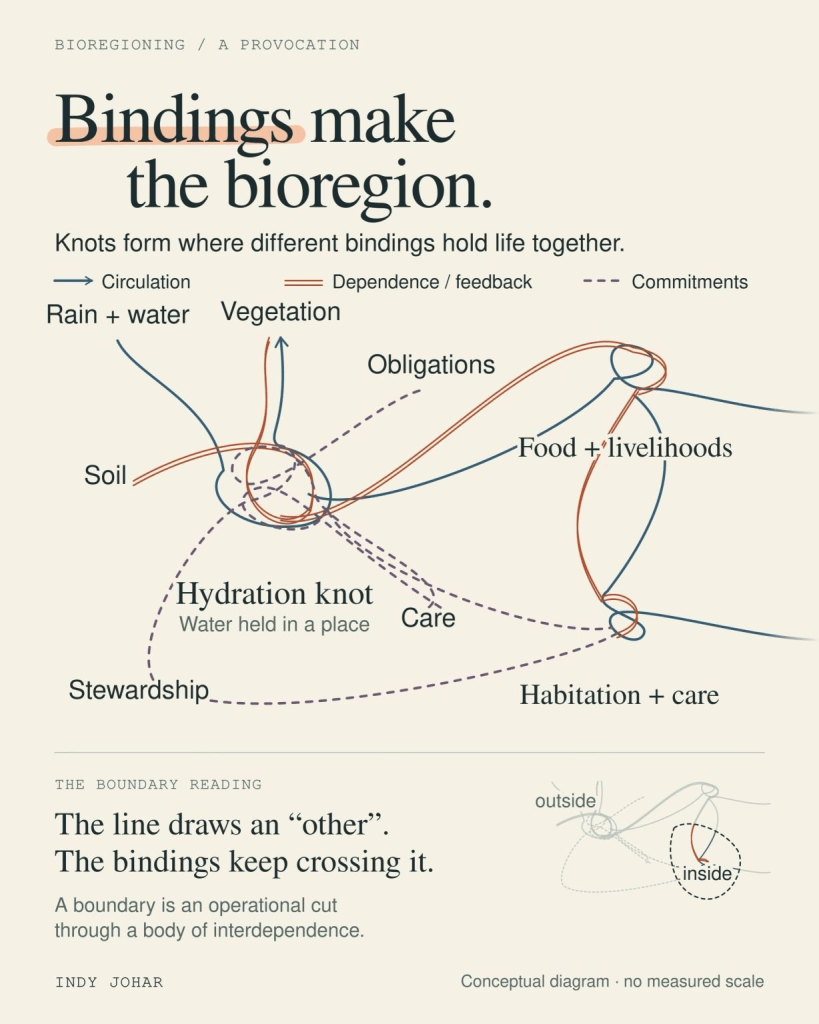
“We risk turning bioregions into the next generation of borders. The reflex might be familiar: draw a larger territory, name its ecological character, define who and what belongs within it. An inside. An outside. A new “other”.
Yet the life of that region is held through relationships that keep crossing the line. Atmospheric rivers, Water, soil and vegetation are bound into food, livelihoods and habitation. *Care, stewardship and obligations sustain those relations. **Knots emerge where different bindings hold a shared condition of life. The relationships between these knots constitute the bioregional body.
This quick piece proposes a shift in the foundations of organising: from defining a perimeter to recognising and holding the interdependencies through which life remains viable.
Bioregioning through Bindings and Knots – Beyond Boundaries – indy – oct 5 2026
This piece is written to challenge the tendency to imagine bioregions as new territorial geographies: larger than cities and more ecologically informed, *yet still defined by boundaries of operation. When the boundary remains the primary organising principle, changing the scale reproduces an inside and an outside, and with them a new form of “other” to whom consequences can be displaced. This obscures the ecological interdependence through which a bioregion lives and mistakes a change in geographic scale for a change in organising logic. **The proposition developed here is that a bioregion should be understood as a living relational body, ***constituted through bindings and the multiplicity of knots in which ecological processes, livelihoods, infrastructures and institutions shape one another. The purpose of this piece is to establish ****why these bindings, their knots and their changing relationships must become the foundation of bioregioning, so that organising begins with the relationships that sustain life rather than the boundaries that enclose it.
A bioregion takes form through the *bindings that make life possible in a place. These bindings gather into knots where ecological processes, human lives and institutions become consequential to one another. The proposition is that bioregioning should begin here, with the relationships through which a place persists and changes. Boundaries can help us **describe and act within that field. They cannot be its founding theory.
**if still describing & ‘acting’ from describing.. already its ‘founding’ .. aka: already a cancerous distraction to the dance
Beginning with a boundary establishes an inside and an outside. When that distinction becomes the basis of ownership and responsibility, consequences beyond the line become easier to treat as someone else’s problem. The relationships continue, but our account of obligation stops. Even a boundary drawn from ecological knowledge can reproduce this failure if it turns a living field into an enclosed object to be managed. A more accurate perimeter does not, by itself, produce a more adequate politics.
*A binding is more than a connection. It is a relationship through which the condition of one participant matters to the viability, agency or future possibilities of another. **Such bindings are material and infrastructural, but also social, legal and temporal. A settlement is bound to the water that sustains it, to the work and care through which it continues, and to decisions made long before its current inhabitants arrived. Its apparent independence is composed through these dependencies.
ie: 2 legit essentials.. not based on ie: material, legal, temporal, .. not based on any form of m\a\p
*The knot gives this proposition greater precision.A knot is a configuration in which multiple bindings shape one another. **Its participants are changed by their relationships, and together produce conditions that none can sustain alone. A farm, a forest or a town becomes intelligible through this composition. The knot holds difference and tension; ***it does not require its participants to merge into a single identity. Nor does it pre-exist the relationships as a container waiting to be filled.
Bioregioning is consequently an ongoing inquiry. Its maps must remain revisable as bindings shift and previously unseen consequences become legible. Sensing and machine assistance can extend that inquiry, alongside situated knowledge, memory and lived experience. Greater visibility matters when it strengthens the ability to interpret, contest and act. A complete map is neither available nor a precondition for responsibility.
to me.. if still interpreting, contesting, acting off ‘visibility’ ness.. et al.. not legit free.. not the legit dance
again.. otherwise we’ll keep perpetuating the same song..
What would it mean to begin our institutions here, with the bindings through which life continues and the knots through which its possibilities are composed? We would have to learn to hold a place through relationships that exceed our ownership, outlast our decisions and involve lives we do not control. Bioregioning begins when those *relationships become the basis of our commitments to one another and to the **continuing possibility of the place itself.