money as linguistic
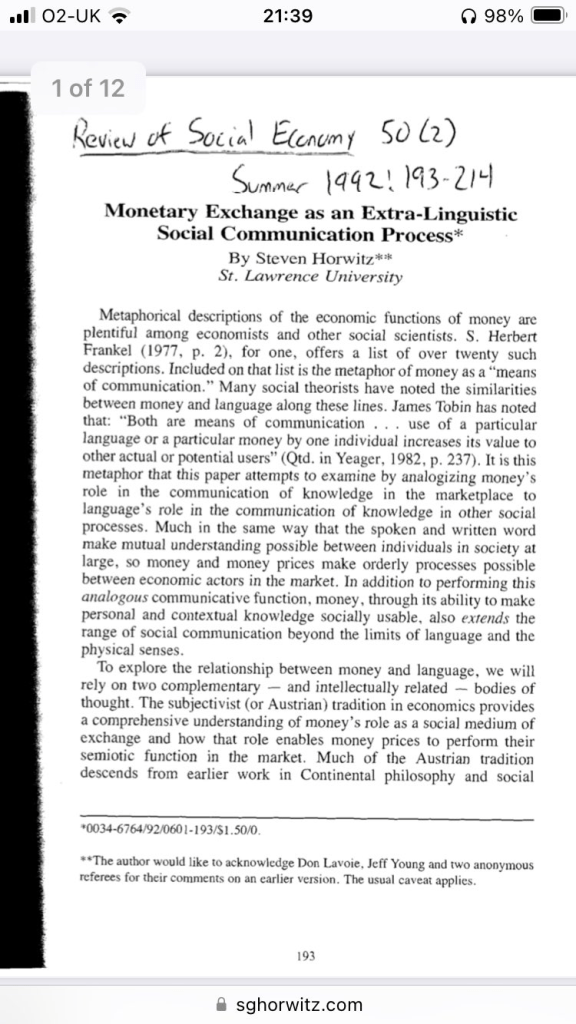
via tweet [https://x.com/PaulLew16394851/status/1831794858526151162]:
I still like this example of hermeneutics-informed Austrian economics by Steve Horwitz. https://sghorwitz.com/papers/Monetary%20Exchange%20RSE%201992.pdf
notes/quotes from 12 pg pdf:
1
Monetary Exchange as an Extra-LinguisticSocial Communication Process*
By Steven Horwitz*lK St. Lawrence University 1992
Metaphorical descriptions of the economic functions of money are plentiful among economists and other social scientists. S. Herbert Frankel (1977, p. 2), for one, offers a list of over twenty such descriptions. Included on that list is the metaphor of *money as a “means of communication.”..t Many social theorists have noted the **similarities between money and language along these lines ..tJames Tobin has noted that: “Both are ***means of communication . . . use of a particular language or a particular money by one individual increases its value to other actual or potential users”..t (Qtd. in Yeager, 1982, p. 237).
*right.. communication is in the form of people telling other people what to do
**both as enslavement.. enclosure/control.. et al
***rather.. a means of perpetuating structural violence/spiritual violence
It is this metaphor that this paper attempts to examine by analogizing *money’s role in the communication of knowledge in the marketplace to language’s role in the communication of knowledge in other social processes. Much in the same way that the spoken and written word
**make mutual understanding possible between individuals in society at large, so money and money prices make ***orderly processes possible between economic actors in the market. In addition to performing this analogous communicative function, ****money, through its ability to make personal and colltextual knowledge socially usable, also extends the range of social communication beyond the limits of language and the physical senses.
*role = dehumanization.. ie: 10-day-care-center\ness et al
**again.. rather.. make enslavement.. enclosure/control.. et al
***aka: violence in sea world
****rather.. deadens communication (shaw communication law et al)
To explore the relationship between money and language, we will rely on two complementary – *and intellectually related – bodies of thought. The subjectivist (or Austrian) tradition in economics provides
a comprehensive understarlding of money’s role as a **social medium of exchange and how that role ***enables money prices to perform their semiotic function in the market.
*intellectness as cancerous distraction
**marsh exchange law et al
***again.. structural violence/spiritual violence
2
it is from this Continental tradition, specifically Hans-Georg Gadamer’s phenomenological hermeneutics, that we get a theory of the *communicative role of language and its relationship to human understanding.
rather.. dehumanization role of language and its control/enclosure of the dance
4
A crucial aspect of *money’s role in society is how it brings people into the social process by “facilitat[ing] the development of an ever widening circle of economic interdependence based on the dispersion of trust” t (Frankel, 1977, p. 14). **In short, money socializes us by enabling us to utilize the contextual knowledge of others through the trust embodied in monetary exchange. ..For Simmel, virtually all social relationships involve trust due to the ***difficulty in acting “entirely on what is known with certainty about another person” (Simmel, 1978, p. 179). Simmel continues: “very few relationships would endure if trust were not as strong as, or stronger than rational proof or personal observation. In the same way, money transactions would collapse without trust.” ****The trust element here is the belief that others equally accept the money commodity as a medium of exchange.1° Menger’s
explanation of money arising out of intersubjectively held values explains how this trust is generated. *****It is money’s saleability that creates the trust that we can get non-money goods whenever we please. ******The “absoluteness” of this saleability permits the value of money to transcend the personal and achieve a social acceptance and trust.
*rather.. role in violence (graeber violence/quantification law) based on dispelling of trust
**rather.. money controls us by intoxicating us with a false image (like whales in sea world) of others.. bleeding all trust in the guise of exchange
***difficulty comes w/relationship being built on/around money.. rather than love (aka: trust)
paul know\love law: you can never know anyone as completely as you want.. but that’s okay, love is better. – Caroline Paul
****marsh exchange law.. graeber exchange law.. not about trust.. about fear at best
*****ha.. and how’s that trust holding up?
******the absolute brainwashing ability of this cope\ing mess
hari present in society law et al
need to try/code money (any form of measuring/accounting/people telling other people what to do) as the planned obsolescence .. where legit needs are met w/o money.. till people forget about measuring..ie: sabbatical ish transition
5
*trust or mistrust takes its place precisely because such an assessment cannot easily be made, or because it is too costly or time-consuming to do so. It **enters where more exact knowledge is not available . . . ***Individuals and societies are dependent on countless symbols, myths, beliefs, and institutions which function as indicators of trustworthiness or the opposite. That is why trust has been described as a means of reducing complexity and a form of social communication . . . [it] spans the
problems of time and uncertainty (1977. pp. 36-37). Simmel came to a similar conclusion. ****”To ‘believe in someone’, without adding or even conceiving what it is that one believes about him, is to employ a very subtle and profound idiom” (1978, p. 179, emphasis added). We use trust to build social bonds because we cannot have detailed knowledge of the people or institutions in question. Hayek says of money that with it: we reach the climax of the progressive replacement of the perceivable and concrete by abstract concepts shaping rules guiding activity: money and its institutions seem to lie beyond the boundary of the laudable and understandable physical efforts of creation, in a realm where the comprehension of the concrete ceases and incomprehensible abstractions rule (1989, p. 102). When denied knowledge of the particulars, trust can serve as an effective substitute. *****The trust aspect of monetary exchange also expands the circle of social relationships beyond that which can be achieved through face-to-face contact.
*if assessing.. if any form of m\a\p (ie: money, measuring things, accounting for things).. not about trust.. about judge\ment.. about people telling other people what to do because they don’t trust other people enough to let them be (the unconditional part of left to own devices ness)
**aka: all the time if people are legit alive.. ie: graeber unpredictability/surprise law et al
***rather,.. addicted to all the forms of measuring things
****if only.. ie: if it were about love (paul know\love law et al).. but it’s about control.. so not about believing in a person.. about manufacturing consent in them.. it’s about maintaining voluntary compliance in them.. nothing to do with freedom or love or love
*****again.. social relationships it expands are of docile/obedient whales in sea world
6
Language, Thought and the Process of Understanding
Hayek argues that: We learn to classify objects chiefly through language. with which we not merely label known kinds of objects but specify what il,e are to regard as objects or events of the same or different kinds
yeah.. so to categorizing/classifying ness.. marsh label law and naming the colour ness
The language opens up the way for a person of exchanging thoughts with all those who use it; *he can influence receive influence from them . . . Of particular importance is Gadarner’s (1985) theory of **”language as the medium of experience.”
*aka: language as control/enclosure
As is frequently noted, the important aspect of a language is that it represents shared understandings – a coherence – between its users.
rather shared/coerce misunderstanding.. of whales in sea world
7
The search for truth and understanding is a social process of communication, and that communication must take place in language.
rather the search is a symptom of whales in sea world
8
Money as the Language of the Market Process
aka: whalespeak
The point of departure for the analogy between money and language is to recognize that both mediate social processes; money is the “medium of exchange” for Menger and many others, while language is
the “medium of experience” for Gadamer and others in the Continental
philosophical tradition.
neither makes any diff.. as long as still whales in sea world.. where experience is faux living perpetuated by the violence of exchange ness.. graeber exchange law.. graeber violence/quantification law.. et al
hari rat park law et al..
As there are no real communicated thoughts outside of language, so there are no real market-relevant wants outside of their expression in terms of money. .t
there it is.. the bold myth (or intellectness – whatever you want to call it) that we can’t seem to let go of
graeber make it diff law et al
The purpose of such institutions is to reveal the ultimate constituents of these mental
processes.
processes of whales in sea world
9
in such a way that the idea of “thoughts without language” is a contradiction in terms. Communication in language is not a veil for reality; it is reality.
for whales in sea world.. not for legit free people
rumi words law.. gibran talking law.. et al
10
Monetary Exchange and the Model of the Text
The preceding argument has a number of methodological implications. In a fascinating paper, Paul Ricoeur argued that the concept of a text could serve as a model for all human action and social institutions.
11
Conclusion
In contexts outside of the market, humans face an analogous problem. Spoken and written language have evolved as ways to overcome the barriers to social communication posed by the limited scope of our physical senses. Though less recognized, money also enables us to go beyond our senses even further..*at least in the context of economic decision-making by enabling us to surpass the limits of language. It provides us with a means of communication that enables us to make our, admittedly fragmentary and uncertain, **knowledge of our preferences and abilities available in a form that is socially accessible. ***In the absence of monetary exchange, we would lack a means of communication necessary – but not sufficient – for our ability to form creative, complex and coordinated social orders..t In our attempts to analyze and understand money’s role in economic and social action, viewing it as an analogy to, and extension of, linguistic communication can provide us with a ****deeper appreciation of what money makes possible and where its limits might lie.
*how we gather in a space is huge.. need to try spaces of permission where people have nothing to prove to facil curiosity over decision making.. because the finite set of choices of decision making is unmooring us.. keeping us from us.. ie: whatever for a year.. a legit sabbatical ish transition
there’s a legit use of tech (nonjudgmental expo labeling).. to facil a legit global detox leap.. for (blank)’s sake.. and we’re missing it
ie: imagine if we listened to the itch-in-8b-souls 1st thing everyday & used that data to connect us (tech as it could be.. ai as augmenting interconnectedness)
**rather voluntary complianced preferences/abilities (aka: not itch-in-the-soul)
***communication for order ness of sea world..
10-day-care-center\ness et al
kills the dance
****deeper intoxication that money perpetuates
_______
_______
- money – grammer money love law
- money – making up money
- money – the future of money
- money – the money fix (second page of it)
- money – wealth inequality in america video
- money – what if money was no object – alan watts
- money as linguistic
- money bail industry
- money enough – taxes on war
- money heist phenom
- money\less
- money\ness
_______
_______
_______
_______
_______





 be you.