Sound is a powerful force in organizing space; it is sound not visuals that mark dramatic shifts from one world to another in non-linear ways. Sound is capable of simultaneity and non-linearity. It surrounds and immerses us, but above all, it resonates, *allowing things to respond to each other. Acoustic vibrations resonate inside the body, creating different emotions, pleasures or fears. Sound helps to expand our external world – the urban environment, nature and outer space. **Scientists and artists listen to the universe, and radio signals radiate far beyond our planet after transmission.
The opening week of the SwampSchool engaged the audience in acoustic space explorations from radio experiments, to environmental sound recordings, immersiveness of sound, and data sonification.
Gediminas Urbonas | Wet Ontologies of the Swamp – October 7, 2019
Throughout history, the project of architecture was realized by draining swamps, marshes, and wetlands. Dividing the land into a liquid and solid, butchering the territory for agriculture, waterways, and settlements, extracting and parceling it by expelling the indigenous—all are technologies of architecture and colonization. To notice the swamp below our feet is to switch to a nondualist ontology more appropriate to the Anthropocene. Architecture today must embrace the swamp, with its hybridity, complexity, queerness, and paradox, as a way to decolonize and de-school itself.
This presentation will discuss the Swamp as a conceptual character and a window into its own operation through which we can conceive the architecture of the imaginal infrastructure of a swamp. With the short overview of programmatic concepts that employ conceptual, spatial, speculative and aesthetic aspects of a swamp as a laboratory, the focus will be on a Swamp School, as self-organized, open-ended and ever-changing infrastructure that supports collaborative experiments in design, pedagogy, and artistic intelligence for learning and adapting to imminent unknowns.
infinitesimal structures approaching the limit of structureless\ness and/or vice versa .. aka: ginorm/small ness.. but sans intell for learning/adapting ness.. we need to just trust us to dance
‘in undisturbed ecosystem ..the avg individual.. left to its own devices.. behaves in ways that serve/stabilize the whole’ –dana meadows
With a series of events, soundscapes, detours, and time- and site-specific interventions performed and installed across the city of Venice, the investigation of swamp resonates with both the planetary crisis and Venice’s own permeable conditions. “Don’t drain the swamp” is today’s imperative for architecture that wants to decolonize and to reinvent itself as a discipline calling to engage with its own history, modernity, pedagogy, and future. The swamp is uncanny to architecture, thus the Swamp School is a site to learn how to change habits of thought and adapt to the radically changing environments.
Gediminas Urbonas is an artist, educator, and co-founder of the Urbonas Studio (together with Nomeda Urbonas), an interdisciplinary research practice that facilitates exchange amongst diverse nodes of knowledge production and artistic practice in pursuit of projects that transform civic spaces and collective imaginaries. The Urbonas’s work has been exhibited at the São Paulo, Berlin, Moscow, Lyon, and Gwangju, Busan Biennales and Folkestone Triennial; at the Manifesta and Documenta exhibitions; and in solo shows at the Venice Biennale and the MACBA in Barcelona among others. Urbonas co-edited Public Space? Lost and Found (MIT Press, 2017) an examination of the complex interrelations between the creation and uses of public space and the roles that art plays therein. Urbonas 5 year-long research project on Zooetics exploring the potential to connect with the noetics and poetics of non-human life in the context of the planetary ecological imbalance, concluded in 2018 with the symposium at MIT and opened a new research program focusing on sympoiesis. Urbonases curated the “Swamp Pavilion” – future learning environment at the 16th Venice Architecture Biennale 2018. Gediminas Urbonas is an Associate Professor at the MIT Program in Art, Culture and Technology (MIT).
Respondent: Pedro Gadanho, Director of the Museum of Art, Architecture and Technology, Lisbon, Portugal, and 2020 Loeb Fellow at Harvard.
Wet Ontologies of the Swamp | Gediminas Urbonas (October 7, 2019)
(gediminas talks from 7 min to 1:08)
8 min – more than 300 people involved in swamp school.. in 2017.. venice exhibition and we proposed swamp as new learning environ.. unknowable space.. t
9 min – from andrew pickering (swamp ontology) one of contributors.. karl popper quote from book – logic of sci discovery (1935): ‘the empirical basis of objective sci has thus nothing ‘absolute’ about it.. sci does not rest upon solid bedrock.. the bold structure of its theories rises.. above a swamp..t like a building erected on piles.. driven down from above into the swamp’
and gordon pask quote from book – the natural history of network (1960): ‘self org systems lie all around us.. there are quagmires, the fish in the sea, or intractable systems like clouds.. surely we can make these work things out for us, act as our control mechs, or perhaps most importatn of all, we can couple these seemingly uncontrollable entities together so that they can control each other.. why not, ie: couple the traffic chaos in chicago to the traffic chaos of ny in order to obtain an acceptably self org whole? why not associate individual brains to achieve a group intell?’
10 min – so in this essay.. pickering.. trying to argue that in face of climate crisis and anything we’re so clumsily calling anthropocene.. he is suggesting it is a time now to look at these foundations of empirical foundations..
so swamp is (archanic.. uncannny?) architecture.. agriculture produced by draining swamps – 19th cent – move away from that into concept of swamp
12 min – so for us swamp in that sense is the meta concept.. under which we have bogs, marshes, quagmires, et al.. in modernity dividing land into liquid and solid.. butchering the rich of architecture.. colonization.. but swamp is also a refuge.. architecture must embrace swamp as way to decolonize and deschool.. to reinvent self..t pedagogy and future
13 min – escaping communities relying on local environ.. hidden communities of fugitives.. we have dark, rich, muddy concepts of swamp.. this project is to change habits of thought
14 min – (lots of ie’s of studies)
20 min – so to curate pavilion for venice.. important for us to go to that swamp and experience all the instability.. the environment where precisely instability becomes learning space.. t
again.. i’d say living.. rather than learning (just my hang up on our obsession w learning)
21 min – imagining pedagogy as a *choreography.. imagining..t **spaces for engagement for environ that isn’t (slated?).. imagining ***ways we can connect w environ
*choreography as form of people telling other people what to do.. even if it’s just self.. not legit self org if still have curriculum.. steps.. sequence
22 min – so interesting to look into history of venice.. town that emerges from the swamp.. built in the impossible place.. merchants demonstrating their power over nature.. swamp altered not eradicated.. so colonized city from the beginning.. t
23 min – so to engage the swamp it is also the challenge of colonial powers..
24 min – the question for us as curators: how much is relevant the national paviolion in times of radical instability.. is the national pavilion still valid on its platform.. should we go beyond national.. or even human.. that’s why our proposal was a swamp.. borderless.. unruling.. disobeying.. t
26 min – our starting point was to brainstorm idea of possible pavilion.. parasitic on edge.. something not on water.. suspended between land sea as parasite.. function as organism working idea with filtration, penetration, fluid exchange, instability.. should activate sensorial body senses.. also thinking of other ways of knowing.. to suspend perspective rational built sense enlightenment and recognize other ways of knowledge..t
27 min – (on the challenges of doing this.. applications, plans, etc)
29 min – architects could wear their drawings.. and perform.. to show pavilion not just in venice
30 min – whole school org’d in 3 chapters.. 1\ may 2\ mid summer 3\ sept.. 4\ closing event.. had manuals for participants in schools.. not on sale.. but in libraries..
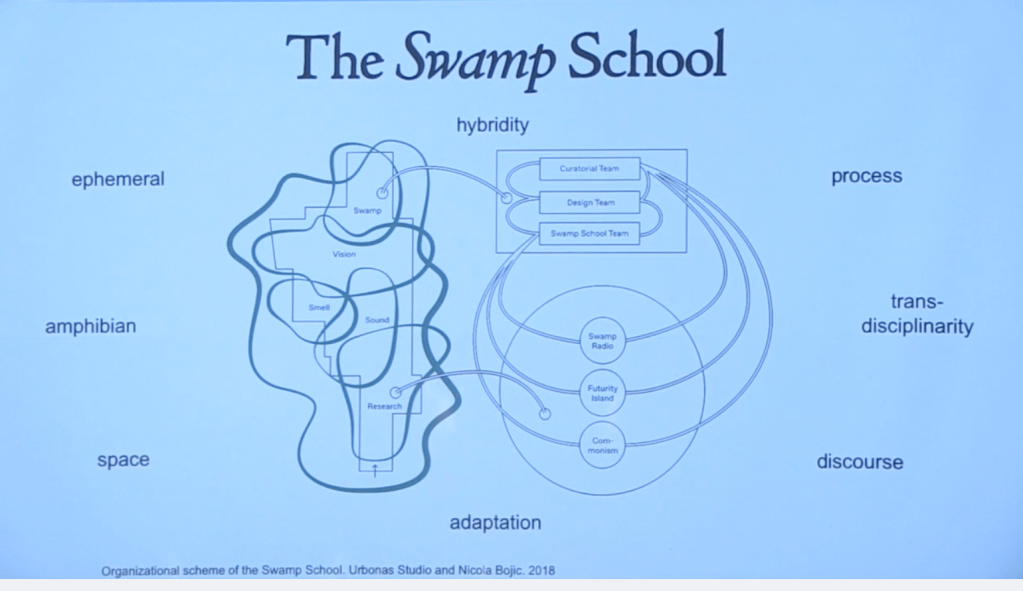
31 min – talked about this chart.. for us to speak about hybridity and adaptation.. 2 important aspects of this effort
32 min – tried to argue that amphibian to replace inter disciplinarily.. org of school inspired by brain via stafford beer.. entangled in interdependencies.. most complex dynamic system .. inspiration from that for commissioned to create super computer for for the country of chile.. *based on fluxes of info to meet needs of survival in fast changing environ.. so this extra brain is needed.. so stafford suggests to collect the swamp brain.. this is central part of the swamp school.. swamp as filtration device.. swamps are kidneys of our planet.. we insert swamp as brain.. t
*oi.. perhaps to continue on in sea world.. but what we need (to get out of sea world.. for global detox.. et al).. is ai as augmenting interconnectedness
35 min – here we have 3 chapters: swamp radio (on transmitting and listening), futurity island (on sympoietics) and commonism (on cohabitation).. swamp manual reflects those 3 chapters
another person from mit.. if think i’m biased.. these were people addressing spatial concerns.. pioneers of spatial critical practices..
40 min – lists and show work of others involved
41 min – i only have 10 min and about 90 slides..
42 min – manuals have inserts.. and each insert functions as a poster..
43 min – tried to bring people from diff national pavilions and record conversations.. trying to feel how wound traveled differently diff times of day (w/radio device).. and also.. as listening thru body.. use body as lab..
44 min – biotricity work utilizes bacteria in mud to produce electrical impulse.. connection between energy and radio.. and seeing swamp as source of energy.. esp if following idea of brain..
45 min – also human insect.. mark wigley.. with all antennas et al.. already operative as insects
53 min – island that emerges out of garbage of venice.. 17-19th cents.. abandoned spot so really wild.. students trying to track relationships there
54 min – homeless people association in venice.. w/ air bnb cost of living in venice crazy.. can’t see homeless but numbers of them are staggering.. so .. how they are surviving in the lagoon
56 min – items.. we tried to consult w the people of how/what future it could have (then local people sharing what they did and their ideas)
57 min – also had children workshop open forum.. oscar hanson.. children would come and build own island
58 min – then last ch.. commonism.. co habitation.. pascal gielen’s book launched there: commonism – a new aesthetics of the real.. had quite a few architects as well..
59 min – then had swamps of kitchen.. nico docks created.. recipes from artists specially made for swamp school.. idea was to forage.. understand what is/isn’t edible..
1:00 – turfiction (image: roof of house is turf).. as like the body.. on house only thing to help people survive on iceland.. concrete buildings not lasting well.. there’s mold et al.. brought piece of fresh turf.. as evidence of it’s livingness by tasting it.. trying to understand what it is that sustains life.. the ‘turf house microbiome’: bacteria (1641 species) and eukaryotes (697 species)
1:02 – we are a collab species.. can’t be singled out of the system.. we are in constant change and constant interdependency..
1:03 – eco commoning in the aftermath: sundews, mangroves and swamp in urgencies idea by maria pulg and dimitris papadopoulos
2\ if we create a way to facil the seeming chaos of 8b legit free people
1:05 – ie: of guy (angelo) squatting land.. bringing swamp to venice from lithuania.. is this the end? no.. it’s a continuation.. angelo is ambassador of swamp school in venice now..
1:06 – we continue to work w science of intell at mit.. building swamp intelligence.. expanding on artificial intelligence.. to interject artistic intell and impose swamp intell.. t
1:07 – how do we think as non humans.. if task of swamp school is to change habits of thought.. beyond a human.. for that we need a swamp brain.. don’t drain the swamp.. more at: swamp.it




 be you.