make capitalism history
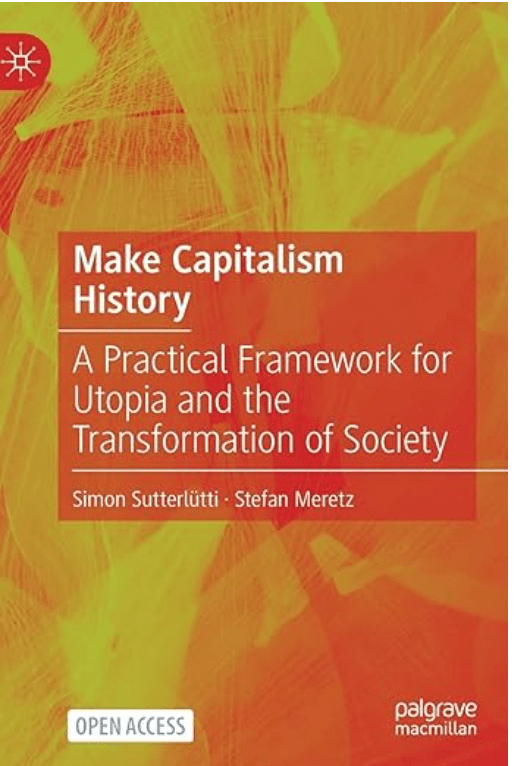
15 min video How to overcome capitalism? – Introduction to ‘Make Capitalism History’ (2023) – [https://www.youtube.com/watch?v=XW5uR1fXuok]:
In our book “Make Capitalism History” (2023) we present an alternative to capitalism and state socialism beyond money, wage labour, patriarchal division of work and centralised state planning. We discuss the left’s need to explore non-capitalist modes of production and the inability of green or socialist market economies to produce real social and ecological change. We discuss pros and cons of the traditional ideas of reform and revolution and develop an approach to societal transformation based on seed forms of commons practices and social movements.
More information and contact options on our website: https://commonism.org/ : Stefan Meretz and Simon Sutterlütti blog on Keimform.de, are active at the Commons-Institut and Network Utopia, and work at the university project ‘society after money’
notes from 15 min video intro to book:
1 min – 3 alts to c (all three start with ‘against’)
re ness as cancerous distraction
3 min – limits to radical reform
makes no diff how limiting.. how radical.. if just reform (aka: same song)
ff
via michel bauwens tweet [https://x.com/mbauwens/status/1809478723802141114]:
* Book: MAKE CAPITALISM HISTORY. From the ‘Commonism’ project. https://commonism.org/make-capitalism-history/#more-14… “In this book we present an *alternative to capitalism and state socialism beyond money, wage labour, patriarchal division of work and centralised state planning. We discuss the left’s need to explore non-capitalist modes of production and the inability of green or socialist market economies to produce real social and ecological change. We discuss pros and cons of the traditional ideas of reform and revolution and develop an approach to societal transformation based on seed forms of commons practices and social movements.”
what presenting in video at least.. is not alt.. but rather .. same song
5 min – reform vs alt.. we talk about commonism..
6 min – for us commonism is a logic of inclusion in the center.. good reason to include others.. to make is suggested.. beyond altruism and egoism
if thinking have to ‘include’.. already/still same song.. invited vs invented et al
7 min – 2 conditions of inclusion: 1\ voluntariness 2\ collective disposal.. for some have to have some kind of ‘rationing systems’.. and who collects garbage et al
rather .. if not sans any form of m\a\p.. voluntary compliance
8 min – how coord such a society.. polycentral.. independency.. decisions made at many places.. collective planning
ie’s of same song..
legit freedom will only happen if it’s all of us.. and in order to be all of us.. has to be sans any form of measuring, accounting, people telling other people what to do
how we gather in a space is huge.. need to try spaces of permission where people have nothing to prove to facil curiosity over decision making.. because the finite set of choices of decision making is unmooring us.. keeping us from us.. ie: whatever for a year.. a legit sabbatical ish transition
there’s a legit use of tech (nonjudgmental expo labeling).. to facil a legit global detox leap.. for (blank)’s sake.. and we’re missing it
ie: imagine if we listened to the itch-in-8b-souls 1st thing everyday & used that data to connect us (tech as it could be.. ai as augmenting interconnectedness)
11 min – transvolution 1\ reform – small steps 2\ revolution – great leap 3\ construction – build alts.. we want to strengthen this 3rd politics in particular
need to build/be alts as great detox leap.. humanity needs a leap.. to get back/to simultaneous spontaneity .. simultaneous fittingness.. everyone in sync.. for (blank)’s sake
we use seed form theory – exchange and markets – change of domination.. restructuring..
13 min – on ‘needs based distribution’
can’t legit have that until we legit know/grok and org around legit needs.. for that.. need global detox leap
14 min – 4 scenarios: 4\ commons movement .. pushing alts forward.. that’s the scenario we think make a lot of sense
not sure if will read pdf.. too much same song.. will see
didn’t use their link.. used [https://library.oapen.org/bitstream/handle/20.500.12657/60838/978-3-031-14645-9.pdf?sequence=1&isAllowed=y] for 242 p pdf
notes/quotes from pdf:
3
by Simon Sutterlütti.. Stefan Meretz – Make Capitalism History – A Practical Framework for Utopia and the Transformation of Society
Simon Sutterlütti is a sociologist and economist, blogger on keimform.de, member of the Commons Institute and the “Utopia Network” and works at the project “Society After Money”
Stefan Meretz is an engineer, computer scientist, co-founder of the Commons Institute, co-founder of the scientific project “Society After Money” and blogger on keimform..lives in Berlin. His publications focus on commons-based peer production and development of a free society beyond market and state.
5
preface
I do not demand voluntarism nor do I preach an automatism; I rather intend to demonstrate the objective possibility of change and its preconditions. I neither want to paint a utopian picture nor forbid utopian thinking; my aim is to unfold well-founded hope. I neither want to be desperately waiting for the better humans nor seal history’s horrors with man’s evil nature; I rather **take humans seriously in their history and their potential. I neither want to waste my life in a never-ending struggle nor bow my head before the overpowering. With confdence in existing potential and certainty of well-founded hope, *I want to realise human possibilities
if *this.. have to let go of **this
To make capitalism history we need an alternative. *We cannot demand the end of capitalism without having at least a vague idea of what a solidary, free society may look like. This book talks about societal alternatives, which we call utopias, and discusses different ways of how we may reach themm. The end of capitalism is a “great transformation” (Polanyi), and **such a societal transformation usually involves three aspects: something comes to an end (abolition), something continues (preservation) and something is raised to a qualitatively new level (development). ie: compulsion to make proft must be abolished, certain production processes can be preserved and the global disposal over our conditions of life should tend to everyone’s needs. The concept of “sublation” contains these three aspects, hence the German title of the book “Sublate Capitalism” (Kapitalismus aufheben). However, as in English, sublation is quite a philosophical and abstract term, the English title emphasises what this book is about: ***abolish capitalism, create a good life for all.
*if demand end (aka: re ness).. won’t get to a legit alt.. just need a way/means every soul already craves
**rather.. 3 aspects of same song
***if abolish ness.. (cancerous distraction) .. will never be for all
6
we now have a wide range of experiences as far as authority, critical practices and knowledge about
forms of domination in many areas are concerned. However, a common perspective on how we can overcome capitalism and where we want to go is largely missing. Maybe the situation is even worse: a *discussion about utopia and transformation is hardly part of our practice. Since the failure of Real Socialism, no replacement has flled the gap. There are a lot of exciting emancipatory projects; however, they are only remotely connected to an overall societal change. This book intends to offer a space in which to rethink and rediscuss the aim of, and path to, a freed society. One that goes beyond—but *learns from—the old concepts of reform and revolution, the planned economy and democratic socialism.
* cancerous distraction.. gibran talking law.. willard talking law.. et al
**intellectness as cancerous distraction we can’t seem to let go of.. there’s a legit use of tech (nonjudgmental expo labeling).. to facil a legit global detox leap.. for (blank)’s sake.. and we’re missing it
As the subheading points out, this book should be a practical framework, an invitation to people who wants to change the world. But how do we intend to perform such *invitation? The book has two parts: in the frst part, we would like to develop a framework for utopian theory and a transformation theory that focuses on the constitution of a new society (transvolution). In the second part, we would like to present our own theory of utopia and transformation. This framework is designed to enable a different perspective and, thus, a different theory on utopia and transformation. Within it, ideas which contradict, improve or surpass ours are possible. We can imagine the theoretical framework as creating a room in which individual theories outline their ideas and place their own furniture. Certain pieces of furniture might not ft the room: they might be too big or better suited for the garden, other items might go well together and yet others might seem not to match. **This book intends to be an invitation, to provide such a room without specifying the furniture but only placing some—particularly nice—items.
*cancerous distraction.. invited vs invented.. dave’s campfire analogy.. et al
**hints at sabbatical ish transition.. but still not
7With this book we do not aspire to proclaiming truths. As you will fnd out, our concepts of utopia and transformation are incomplete. *We do not claim to present comprehensive answers to issues as big as the free society and the path that will lead us there. For that purpose, we need more ideas, thoughts and practical experience so as to deepen, criticise and develop our thinking. This book is intended as an invitation to participate. We can unite in this common search. Before we start, we would like to add some remarks about the book and ourselves. A book is a bridge into the mind of another person. Another person’s ideas follow individual rules and paths which can create a sense of unfamiliarity.
*if only.. need 1st/most: means to undo our hierarchical listening to self/others/nature as global detox/re\set.. so we can org around legit needs.. otherwise just another ie of seat at the table ness et al
We would like to mention some of our mental paths in advance. *We are both passionate about precise terms. Therefore, you will often discover we attempt to clarify terms in order to use them with a precise meaning. A clarifcation necessarily excludes other meanings of the term.
*naming the colour ness as cancerous distraction.. need idiosyncratic jargon ness (and paul know\love law and graeber can’t know law et al) for the dance to dance
Here are some words about the book itself: Quotes from (German) Wikipedia are referred to by the keyword only, while other online sources are referenced in full. We begin the frst part of the book with an introduction (Chap. 1), including a presentation of the relationship between emancipatory movements on the one hand and utopia and transformation on the other. The chapter closes with refections on theory and defnitions, as well as a short criticism of capitalism. After that, we deal with the concepts of reform and revolution (Chap. 2), criticise their mistakes but preserve their insights. This is the basis of our suggestion of a new theoretical framework, transvolution (Chap. 3). We close this section with thoughts on a categorical theory of utopian possibilities (Chap. 4). During the following three chapters, we fll the framework with our concepts. Firstly, we present our theory of the individual and society (Chap. 5). We then develop our utopia of an inclusive society based on the commons (Chap. 6). This is followed by thoughts on transformation, that is, on how to overcome capitalism (Chap. 7).
10
Introduction 1
2 Reform and Revolution 41
3 Transvolution 73
4 Categorical Utopia Theory 89
5 The Individual and Society 109
6 Commonism 141
7 Seed Form Theory 191
Epilogue 23111
Simon Sutterlütti is an economist, sociologist, active at the Commons-Institute and at the Netzwerk Utopie (“Network Utopia”).
Stefan Meretz is an engineer, computer scientist, co-founder of the Commons-Institute and columnist at the Vienna magazine Streifzüge (“Wanderings”).
Both blog on keimform.de and work in the project “Society After Money”.13
ch 1 – intro
skipping for now to ch 3
84 (73)
ch 3 – Transvolution
We do not aspire to present the perfect theory. Our goal is to open up a space for different transvolution theories and to specify “guidelines for transformation,” so to speak. Our concepts and terms try to create a playground for many theories to romp about, criticise each other, and improve. Our own suggestion of a transvolution, the seed-form theory, will be presented in Chap. 7. Why the name transvolution? There are two reasons, one relating to content and the other to tactics. The latter rests on the fact that the term
has hardly been used within the transformation discourse and, therefore, its content is still open. The content-related reason is that transvolution combines notions of transformation and revolution, binding together the importance of process, break, and constitution..Aufhebung” (sublation) is a philosophical concept with three aspects: something comes to an end (elimination), something carries on (conservation), and something is elevated to a qualitatively new level (development). *This is exactly what happens when a qualitative change of the societal form takes place: the break ends certain elements of the old form of society, for example, the →logic of exclusion (p. 17) and the compulsion to valorise. However, the process of change also preserves certain elements (knowledge bases, means
of consumption, some methods of re/production). Yet other elements are elevated to a higher level of development: inclusive relationships turn into a logic of inclusion, voluntary connections of re/production are generalised and their potential is broadened, and so on. But, as philosophically adequate as sublation might be, transvolution seems much more intriguing.
*i don’t think so.. ie: legit change hasn’t yet happened.. black science of people/whales law et al
85
In this chapter, we intend to take a look at the aim and path of transvolution theories: emancipation. We will fnd out that the process of emancipation is necessarily individual, societal, and collective. This classifcation requires that the transformation take a certain form. And, crucially, this new form of society must already be suffciently shaped before the societal break takes place. *Our basic question is: how can the process of constitution of a new societal form begin within capitalist society and, nonetheless, overcome this society and create a free society?..t In this chapter we introduce certain terms—early form, constitutive potential with regard to society, societal generalisation—which help to answer this question. Finally, we intend to present a society-constituting transvolution as a new paradigm of transformation.
*only if org’d around legit needs (2 missing pieces every soul already craves)
we need a problem deep enough to resonate w/8b today.. a mechanism simple enough to be accessible/usable to 8b today.. and an ecosystem open enough to set/keep 8b legit free
ie: org around a problem deep enough (aka: org around legit needs) to resonate w/8bn today.. via a mechanism simple enough (aka: tech as it could be) to be accessible/usable to 8bn today.. and an ecosystem open enough (aka: sans any form of m\a\p) to set/keep 8bn legit free
The aim of transvolution is human emancipation. Transvolution theories start by asking how a free society can evolve from capitalism. However, in order to discuss the path, the aim must be categorically defned..t This is what we intend to do now.
oi.. language as control/enclosure et al.. need a sabbatical ish transition
skipping to ch 4
89 (100)
ch 4 – Categorical Utopia Theory
The term utopia is linked to a number of metaphors: good society, fantasy, hope, freedom, unattainable perfection. The word itself is a creation of the utopian Thomas Morus (1516). He combines “place” (from the Greek topos) with the prefx “not” (from the Greek ou) to create a “non-place”. The concept of utopia also gives birth to the positive “eutopia”—“place” combined with the prefx “good” (from the Greek eu)—and “dystopia”, in its negative expression.. These attractive visions of the future are then often used to motivate and mobilise. But, when presented as mere claims, utopias are unreliable, unfounded and arbitrary. They do not specify a possibility but describe a dream, a “non-possible fantasy”. Often these romantic, wishful utopias go back to ethical demands and describe what should be.
hardt revolution law et al.. sans any form of m\a\p
106
Any given utopia can only put possibility into practise. As a consequence, *we need general classifcations and categories that outline the realm of human possibility. This includes the achievements of the general theory of the individual and the general theory of society. These theories do not deal with historically specifc characteristics of specifc people in a specifc society, but with **general features of people and society throughout history. They do not speak specifcally of a capitalist or feudal society but of societies in general; this is also what links utopia to reality.
*cancerous distraction
skip to ch 5
120 (109)
ch 5 – The Individual and Society
Our theoretical basis rests on two pillars: a theory of the individual and a theory of society. These two
theories are interconnected, for they deal with the same object: the relation of individual and society. Nevertheless, they must be distinguished. They require different methods.
rather.. no methods
how we gather in a space is huge.. need to try spaces of permission where people have nothing to prove to facil curiosity over decision making.. because the finite set of choices of decision making is unmooring us.. keeping us from us.. ie: whatever for a year.. a legit sabbatical ish transition
there’s a legit use of tech (nonjudgmental expo labeling).. to facil a legit global detox leap.. for (blank)’s sake.. and we’re missing it
ie: imagine if we listened to the itch-in-8b-souls 1st thing everyday & used that data to connect us (tech as it could be.. ai as augmenting interconnectedness)
skipping to ch 6
152
ch 6 – Commonism
we claim to build a scientifcally discussible, categorical utopia, developed on the basis of our theories of the individual and of society (cf. Chap. 5). From the epistemological point of view, this utopia cannot be complete given that society is complex and constantly developing. We are part of that development.
Therefore, utopia can only mature in an act of societal transformation. However, we are convinced that we can attain a more profound understanding of commonism—this is the name we want to give to the free society—by way of a common refexion. For that purpose, criticism is important; but not an abstract criticism, one that only rejects and says “no”, but a concrete criticism that is based on arguments. The text below tries to develop the societal conditions which will allow inclusion to be the suggested course of action, at the interpersonal as well as transpersonal level. But we would like to begin by discussing the relation between freedom and inclusion in a free society. Then we will describe the qualities of commonist mediation, based on voluntariness and collective disposal, before suggesting some changes our individuality might experience in a commonist society
oi.. cancerous distractions
153 (142)
we can ask which conditions encourage which actions and make them functional, therefore allowing us to accept the suggestion as well-based. Two questions—one based on the other—are constructive:
- Under what conditions does individual development not mean infringing the individual development of other people?—The point here is: how can we exclude exploitation, suppression and domination?
- Under what conditions does individual development become a precondition for the individual development of other people?—The point here is: how can the logic of inclusion establish itself as a societal principle?
1\ need hari rat park law.. so.. need global detox leap.. so need 1st/most: means to undo our hierarchical listening to self/others/nature as global detox/re\set.. so we can org around legit needs
2\ left to own devices ness and itch-in-the-soul 1st thing everyday ness.. aka: the unconditionality humans can’t (yet?) do/be.. so need tech w/o judgment to facil the seeming chaos of that global detox
Free society is a big concept. We will try to give substance to it. Freedom at the individual level involves possibilities. These possibilities have been coined agency (cf. p. 118) by Critical Psychology. We possess agency when *we are able to get to know our →needs..t (p. 113), unfold them and satisfy them. The more agency we have, the freer we are. As we live together with other people in a context of societal cooperation, our possibilities of satisfaction are linked to those of other people. If **I, for instance, consume agro-industrial food, this might result in other people losing pristine recreational opportunities due to monoculture farming.
*only ‘a possibility’ w global detox leap.. ie: need means (nonjudgmental expo labeling) to undo hierarchical listening as global detox so we can org around legit needs
**oh my.. we have no idea what the dance is about..
155
Voluntariness, that is, acting according to one’s own free will, is located in the relation between necessity and possibilities. .*If I have a lot of alternatives at my disposal, my space of opportunity is large. If the
necessities set the tone, it is small..t **It would be ideal if the voluntarily realised possibilities automatically covered the necessities. In that case, motivation reaches its peak.t In principle, that is possible. No one is forced to produce his/her required items on his/her own, but we deal with provisions universally and share activities in society. That makes individual life much easier, in principle, because it depends on societal organisation. ***If I am forced to contribute to the societal provisions because my life depends on it, my space of possibility is contaminated. If fear dictates my choice of possibility, my voluntariness is deformed or even totally reversed—and motivation hits rock bottom..t Inversely: ****when I not coerced and I am able to choose my possibilities of my own free will, my motivation is much higher..t That is only possible in a free society, which is always a society of secured existence. Voluntariness here is a characteristic of freedom and does not depend on the absolute size of the space of possibility. Conclusion: Voluntariness comprises the unlimited unfolding of our relation of possibility to the world.
*if org around legit needs.. infinite number of alts.. because facil-ing curiosity over finite set of choices
how we gather in a space is huge.. need to try spaces of permission where people have nothing to prove to facil curiosity over decision making.. because the finite set of choices of decision making is unmooring us.. keeping us from us.. ie: whatever for a year.. a legit sabbatical ish transition
**aka: a sabbatical ish transition.. but has nothing to do with motivation ness.. just with listening deep enough
***aka: all of history to date (sea world)
****if still choosing.. then still coercing.. still a form of people telling other people what to do
However, everyday life tells a different story: “A person’s freedom ends where another man’s freedom begins” (attributed to Immanuel Kant). Here the assumption is that possible actions limit each other, that they are mutually exclusive. And this carries some societal truth.
rather.. carries some sea world truth
173
The core element of stigmergy is the decision on which activities are to be carried out. So far, hierarchical or consensus-based decision systems have been opposing each other and marking the arena. In both cases, the individual is the recipient of the decision, while the consensus-based decision
system benefts from increased participation. Commonist-stigmergic decisions rest on voluntariness. The individual plays an active part in the decision by selecting the task he/she wants to fulfl. Self-selection is grounded in local information, such as the information I have regarding the task to be fulflled. For example, if the local waste disposal commons communicates a need for further contributors, I can join. If there are not enough contributors a confict arises which must be rationally solved (cf. Chap. 6, 3.5); this lies outside stigmergic coordination.
oi.. hello stigmergy et al.. again.. we so don’t get the dance.. has nothing to do with finite set of choices
177
conflicts in the inclusive society
ie of red flags ness.. of not left to own devices ness
201
ch 7 – Seed Form Theory
A new society does not fall from the sky but *must emerge from the old society. So, **the point is: how does a new form of society emerge from the old one? To this, the seed form theory answers that the new can already be found in the old but still in the form of a seed, enclosed in the old conditions. And yet, this seed form embodies the quality it can develop into a new society.
*perhaps.. until now.. and since no longer (if ever) true.. **this is a cancerous distraction
need a sabbatical ish transition
infinitesimal structures approaching the limit of structureless\ness and/or vice versa .. aka: ginorm/small ness
common\ing et al
in skimming ch 7 – ‘tax for’.. ‘need for cash’
218
Traditional commons could survive when they drew clear lines and developed a system of domination, sanction and →confict (p. 146) solution for the internal organisation. Or, in Ostrom’s words: “In all selforganized systems, we found that users had created boundary rules for determining who could use the resource, choice rules related to the allocation of the fow of resource units, and active forms of monitoring and local sanctioning of rule breakers”
to me.. no legit common\ing to date.. ostrom 8 et al as cancerous distraction
241
epilogue
242
We need each other to answer such diffcult questions.
rather.. need to let go of the questions of sea world and need to listen deep to the itch-in-8b-souls
aka: a nother way
ff
_____
______
______
______
______
_______
______




 be you.