Jon Husband on wirearchy, web weaving, the relational economy, and drift diving (AC Ep41)
Jon: ..started paying attention to knowledge work and work in orgs and so on as I changed careers in my early 30s, moving from banking, where I was in management, into management consulting. I ended up working for a large global HR consulting firm ..they do what’s called job evaluation.
What job evaluation does is put a size or a measure or a weight to a job, which then basically places it on the organization chart. I spent quite a few years writing thousands of job descriptions and helping streamline workflows and so on and so forth.
So, when the internet came along,..I was reading all of these books, and all of the books were about the coming Information Age.
..I quit my job in the consulting firm because I had begun to feel very uneasy about the work I was doing. If I was made a partner, your job becomes basically selling larger projects to keep the younger consultants employed. I realized that I would be selling methods that I had come to not believe in anymore, and the reason for that is that all of the job evaluation methods sold by all the major consulting companies are all versions of generic Taylorism.
There has been now, what, 15 or 20 years..about collaboration and cooperation and better knowledge management and sharing and transfer of knowledge, ..you realize that no amount of talking about doing things differently is going to make much difference.
Ross Dawson: Used to describe it as a job as a box.
Jon: Well, sure, and that’s where that term “think outside the box” comes from. I wrote an article about this at one point in time—oh, I can’t remember the title, so it doesn’t matter—but about the semantic statements essentially becoming semantic straightjackets, because they put limits around what you do.
Now, that was 25 years ago. What we’ve seen since is, of course, what you know—one umbrella term I could apply to much of what’s going on outside of organizations is the “enshittification” of the web. The same thing applies in a lot of ways, I think, to people doing work, sitting behind screens in organizations.
There were many failed attempts at effective knowledge management because of the idea that it’s still just good search, find documents, retrieval, without really paying any attention to the connections between people and how they work together, and so on.
Ross Dawson: ..So where does that take us today, in this humans-plus—essentially wirearchy—pulled into where AI plays a role within those networks?
Jon: Well, it’s a fascinating question for which I don’t have an answer. I have some responses, I suppose. The notion of wirearchy came, as you pointed out, out of everybody being wired, everybody being networked—the organization as a network.
What I’m really interested in and fascinated about is that, as AI penetrates and spreads throughout the workplace and gets placed into or integrated into workflows, the first thing that happens is that people in the mix are going to have to learn how to use AI and learn why to use AI when they do. Often, it’s very soft at the beginning because it’s reminders, or “did you want to do that,” or “do you want to say that,” and so on. Increasingly, the AI, I think, will have more and more coaching built into it. But what I’m interested in is how, as we learn from the mistakes that are made in integration, and also learn from the successes that are made from integration, is that going to decompose a knowledge worker’s work and eventually capture most of their tacit knowledge and ways of working to reduce the cost of doing that kind of work?
Then, on a larger scale, what is the active decomposition of types of work through the influence and integration of AI? How is that going to change the fundamental assumptions about work design? My belief is that the work of Dave Snowden and others with respect to complex adaptive systems is what is going to become—and this is a poorly connected parallel or analogy—but I think something like the Cynefin framework, or a unified approach to complex adaptive systems, will become the Taylorism of the 21st century.
Jon: ..I think it relates to the paper I shared with you a couple of days ago about what the author is calling “weaving the web.” There is an enormous amount of human input and activity, combined with the AI, that doesn’t get measured and is not seen in our currently technocratic, generic Taylorist worldview. That’s not seen, not captured, and it arguably is the kind of human input, work, and knowledge that is going to make this whole new era operate fairly well. That’s this notion of exchanges of value.
Once that code is cracked, in terms of how to understand it, surface it, see it, measure it, this is going to lead to more and more of what Nvidia’s Jensen Huang is doing with respect to tokenization. There are some people who say tokenization will become the replacement for money in some cases, or even many cases in another, let’s say, 10 years or so. It’s kind of hard to imagine, but if you come back to the paper that you and I first connected on—Alex Imas’s review of the structural changes to the economy—if you can see the logic of his argument, he says there’s going to be a lot more work, but it’s going to be relational economy work, which ties directly into value exchange and surfacing how that exchange of value operates, say, between two people at work, or a group and a person, or two groups, and so on.
to me.. not legit relational (ie: of legit free people) as long as marsh exchange law et al
This notion of value exchange is going to ground a lot of the conceptual and abstract issues that we talk about when we talk about, you know, why is making effective collaboration so hard? Why is it hard to de-silo an organization? All of those kinds of things are going to, I believe, eventually be washed away in this continuous flow of information. So we have to look for new concepts and new ways to measure what’s being created, the value that’s being created.
Ross Dawson: Well, that’s—I mean, this is really interesting. As long as you do not recall, in “Living Networks,” I was actually laying out a quite similar thesis around value creation and network structures, and I did quite a bit of work with Verna Allee on value networks. We ran some workshops together, and we’re essentially—a lot as laid out in the paper you described, and as you’re saying now—a lot of it is saying, how do you look at the non-financial or intangible exchanges of value, which sometimes are apparent and sometimes less apparent? There are all sorts of these structures where, as you say, there is an exchange of value. Sometimes it involves money, oftentimes it doesn’t. To understand the landscape, you do need to understand all of these non-financial structures.
But are you suggesting that in this tokenization or other structures, there is a way then of being able to, I suppose, capture some of these non-financial values, which does imply there needs to be some kind of measurement, or at least a mutual agreement or assessment on what that value is?
Jon: Yes, the paper that I sent you, and the tool that I’m interested in and think is important, is called VEMapper—Value Exchange Mapper—which has some sophisticated capabilities with respect to AI, mainly by calling the main AI engines into the conversation. There’s a process set out whereby, in a dialogue that’s captured both by recording and by typing, there’s a record of a conversation or a dialogue about value exchange.
I’ve carried out a few of them. I recommend trying it, because it’s quite remarkable. *You really just tell your story, but it surfaces the tacit knowledge often that you’ve put to work in the creation and exchange of the value. **The tool is also quite sophisticated today in terms of its databases and other components.
*to me.. need global detox in order to ‘tell’ ,,live.. whatever.. our legit stories.. otherwise just ongoing whalespeak
..following the logic, the reasoning, and the innovations that were introduced by Vint Cerf long ago in terms of how knowledge would work, whether there would be things like knowbots, which are agents, and so on. So it stores all of this, and then there’s a process whereby you enter into a dialogue. The AI coach helps you clarify, elaborate, and so on, and then you revisit this process. What this does is it builds and scaffolds trust between people and between groups or whomever is working on a problem.
Ross Dawson: ..change, they’ll be able to apply human expertise to people in situations and organizations. So perhaps, if we just marry those two, what do you see might happen if we move into both a relational economy with the potential to surface more of the nature of how value is exchanged?
note: on survival ness: survival is a means to survive things as they are.. so to me.. not a legit alt.. it’s triage.. perpetuating survival triage.. so a temp band aide per se.. that will /can help now.. but only for short term.. because it still doesn’t get to the root of the problem.. so it won’t offer/lead-to legit change/life/freedom.. et al.. so.. to me.. it’s still a cancerous distraction to the dance
Jon: Wow, that’s quite a question. I think it’s one of those things where there’s likely to be a very large and durable polarity emerge. I think that the polarity is that there will be some people—probably younger, I’m guessing under 45-ish—that will take to the new environment like ducks to water. They’re already living it in many ways. Their work is much more precarious. They operate in networks that are often networks of support and help, and so on.
I think the other end of the polarity is that there will be lots of people who are—I sent you another piece about a week ago called *“Artificial Intelligence and Sleeping Humans,” which was about the fact that many of us are, whether we like it or not, not all that much awake when we’re walking around every day, particularly after we’ve been working for 10 or 15 or 20 years, and, you know, kids, busy life, and so on. As AI moves through the workplace, different industries, different natures of work, and brings up issues of relation and so on, **I think that relational work will always be AI-aided and supported.
to me.. the thing tech can do that we can’t seem to do is key: tech w/o judgment et al
Ross Dawson: Yeah, yes, it does. I think most people can relate to what you’re saying. So, you were just saying before we started the podcast, you’ve, in a way, come back to your work. You’ve been reinvigorated by seeing some interesting shifts in the world. So, what are the next years for you? What do you think we should be thinking about? What should we be focusing on? What should we be creating to enable, as much as possible, all of this to go in a positive direction?
Jon: Again, a tough question. It’s so hard because these conditions are all swirling around us. But for me, 10 years—10 years, I’ll be in my early 80s. I don’t like to play golf. I like to swim, so I’ll probably still be swimming. I think we’ll see more and more evidence of the relational economy, with respect to wirearchy and my implication.
I’m going, in about a week, to Cambridge to start a creative residency there that involves a number of components. I’ll meet people with the Digital Futures Institute at the University of Bristol, some people at Cambridge.
What I’m going to be doing with this creative residency is paying attention to and learning about improvisational facilitation.
I think what’s going to happen, what I’m seeing happen everywhere, is shifts in what will be brought to work around the integration of AI.
I think the evolution of wirearchy, which implies a different kind of leadership and power, will mean there will just be more and more—how do I want to say it? What I’m noticing is that there’s an enormous amount of talk on LinkedIn and other places where people are wondering about similar things to what we’re talking about.
They’re emphasizing the ability to listen, the ability to suspend judgment, the ability to allow the time and the space for emergence—
a very, very different mindset than the predict, plan, execute, control, linear types of work.
This will be more circular. Many of the elements are already there. We’ve already seen in the last 10 years: develop fast, push versions out fast, fail faster—sort of recursive feedback loops. We’ll all be operating in recursive feedback loops, probably forever more.
2\ if we create a way to facil the seeming chaos of 8b legit free people
Jon: Okay, I participated in one once, and it was really fascinating. At certain places, there are coral reefs where, I guess because of the topography, the current moves past it quite quickly—more quickly than you can swim against or manage yourself in. So if you go on a drift dive, the dive masters take you out, drop you in somewhere. They know how fast the water is moving, they know how much air you have, they know where you’re going to come up, so they meet you when you come up. But while you’re in the drift dive, what you do is essentially drift along the coral reef, watching the reef vertically because you can’t really swim.
..I think we’re all going to be living in a big drift dive for the next forever—well, certainly for the rest of my life. It’s really interesting to think about things in that way. It relates particularly poignantly to my quitting my job as a management consultant, where I learned all of the method with the generic Taylorism.
and coaches are going to be very happy in this new era.
Coaching is really interesting. From what I’ve used—Claude, you know, a bit as a personal coach, haven’t tried the others—but I’m really impressed with what they’re going to be able to do, or already can do. Where *coaching is going to become critical is at the higher levels, the top of the organization, because all of what we’ve been talking about—**sensing, listening, allowing for emergence. The phrase I used to replace “command and control” was “champion and channel”: champion ideas, channel resources. See what happens. Does the node light up? Does the node wither? Does the node connect to other nodes, and so on. This is the world where I think we’re going to be living in, and coaches will be operating at the higher levels to help executives—who have typically been hard-charging and with mindsets they learned 20 or 30 or 40 years ago—helping them adapt, which will be critical.
Authority is migrating from hierarchical position to networked competence, but the governance systems, accountability structures, and judgment pipelines that made hierarchy functional have not yet migrated with it.
Jon Husband coined “wirearchy” in 1999 to name something he saw forming: a world where power and authority would flow through networks of knowledge, trust, and credibility rather than through chains of command. Twenty-seven years later, the theory is being stress-tested at scales Husband never imagined. Bayer, a 160-year-old pharmaceutical company with 100,000 employees, has cut its management layers from thirteen to seven and pushed 95% of decisions to autonomous teams. Haier, a $40 billion Chinese appliance manufacturer, has operated as 4,000 self-managing microenterprises for two decades. And AI agents are beginning to bypass the org chart entirely, making decisions without human authorization at a pace that neither hierarchy nor wirearchy anticipated.
The pattern across this week’s coverage is a three-layered story. The flattening is real and accelerating – 41% of companies have already reduced managerial layers, and enterprises with over 100,000 employees are implementing decentralized models, not merely piloting them. But the systems that made hierarchy functional – accountability, governance, judgment development – have not migrated outward with authority. Centralized governance frameworks cannot survive decentralized operations, and only 23% of AI pilots successfully scale into production. The contested edge runs through middle management: simultaneously the obstacle to organizational agility and the essential tissue that produces institutional judgment. Neither elimination nor preservation is cleanly right.
[since to me.. any form of m\a\p.. aka: if still business ness.. is a cancerous distraction .. just skimmed titles and key concepts as hopefully a summary ish.. highlighting in red some of the red flags]
The Bosses Bayer Didn’t Replace – A 160-year-old pharmaceutical giant with 100,000 employees is dismantling its hierarchy. Two-thirds of its workforce is not yet convinced.
Haier’s 20-Year Head Start – Before Bayer began its experiment, a Chinese appliance maker had already proved that 80,000 people could operate without a traditional hierarchy.
In 2000, Haier Group CEO Zhang Ruimin attended the World Economic Forum in Davos and returned to his white goods factory in Qingdao with a conviction: the future belonged to network economies. Five years later, he formalized that conviction into RenDanHeYi – three Chinese words meaning the alignment of employee value (Ren) with user value (Dan) through tight integration (HeYi). The organizational pyramid was replaced by a network of more than 4,000 microenterprises, each employing ten to fifteen people with full decision-making autonomy over strategy, hiring, and compensation. No approval chains. Each microenterprise operates as an independent startup with its own profit-and-loss accountability.
to me.. still/already ‘approval/accountability’ ing.. will end up with same song
The Org Chart Nobody Drew – Five new roles that exist on no traditional hierarchy – and a maturity model that shows most organizations are two levels behind where they think they are.
The Judgment Gap – Forty-one percent of companies have already cut managerial layers. The question is what they cut with them.
by end of 2026, 20% of organizations will use AI to eliminate more than half their middle management positions.
rather.. why still have them at all
Governance at the Speed of Agents – Fewer than one in four AI pilots scale into production. The problem is not technology. It is enforcement.
key concepts
WirearchyCONCEPT
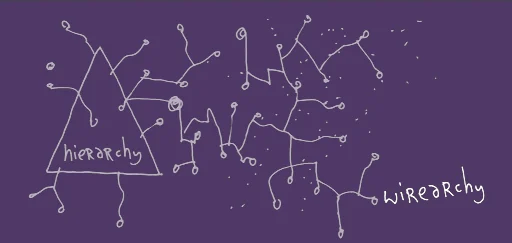
Think of hierarchy as a ladder where authority travels up and down. Wirearchy is a web where authority travels along the connections between people who have knowledge, credibility, and results. Coined by Jon Husband in 1999 to describe how networked technology reshapes power in organizations.
RenDanHeYiMODEL
Haier’s organizational operating system, named from three Chinese words: Ren (employee), Dan (user value), HeYi (alignment between the two). If traditional management aligns employees to bosses, RenDanHeYi aligns employees directly to customers – and cuts out every layer in between.
Dynamic Shared OwnershipMODEL
Bayer’s framework for decentralized operations. “Dynamic” means 90-day adaptive cycles instead of annual plans. “Shared” means teams own decisions collectively rather than waiting for managerial approval. “Ownership” means direct accountability for outcomes at the team level.
Haier’s basic building block: an autonomous team of 10-15 people with full control over strategy, hiring, and compensation. Think of a startup embedded inside a corporation – except there are 4,000 of them, and the underperformers face dissolution.
Agentic AITECHNOLOGY
AI systems that do not wait for instructions. Unlike a chatbot that responds to prompts, an agentic AI sets goals, plans steps, and executes tasks autonomously. The organizational question is not whether it works but who it reports to – and who is accountable when it is wrong.
The systematic elimination of middle management layers, accelerated by AI’s ability to automate reporting, forecasting, and coordination. Like removing load-bearing walls from a building: the space opens up, but only if something else is holding up the roof.
Geoffrey Moore’s model for how innovations move from enthusiasts to mainstream. The “chasm” is the gap where promising ideas die because pragmatic buyers need proven results, not inspiring vision. Corporate Rebels argues decentralized organizations are crossing it in 2026.
90-Day CyclePRACTICE
The adaptive planning rhythm replacing annual budgets at companies like Bayer. Teams set outcomes, execute in weekly sprints, hold retrospectives, and adjust. Not faster planning – a fundamentally different relationship with uncertainty.
to me.. not legit uncertainty if ie: setting outcomes, executing ness.. adjusting ness..
AgentOpsDISCIPLINE
The management of AI agent lifecycles from prototype to production, including monitoring decision quality and controlling costs. The organizational equivalent of DevOps, but for autonomous agents instead of software deployments.
Human-Agent RatioMETRIC
The emerging measure of organizational capacity: how many AI agents operate per human worker across a function. The metric that may eventually replace “span of control” as the primary unit of organizational design.
more of jon on wierarchy ness.. via jon’s fb post.. via claude ai:
A friend helped me build this (below) using his skills with and knowledge of Claude.ai.
It’s pretty cool from my POV.
I’m wondering about whether and how to use it. Where are the right places to put it online if anyone wants to find, access and use it ?
Obviously on my web site and on LinkedIn, but there might be other places / ways for it to be useful to someone.
************************************
Wirearchy Fieldnotes
A Claude skill that gives any conversation 25 years of Jon Husband’s thinking on power, authority, and networks — instantly, accurately, and in his actual voice.
The pitch
Jon Husband coined wirearchy in 1999 and has spent twenty-five years refusing to turn it into a packaged method. That’s a feature, not a bug — but it makes the concept hard to reference quickly when you need it.
Wirearchy Fieldnotes is a Claude skill that loads, on demand, into any Claude conversation: the canonical definition, the origin story, the four pillars (knowledge, trust, credibility, focus on results), the champion-and-channel contrast with command-and-control, the network of thinkers around the concept of wirearchy (Jarche, Krebs, Boyd, Semple, Pollard, MacLeod, Pontefract, McConnell, Schillinger), the major critiques and responses, and the 2025 framings against return-to-office and generative AI.
It also includes twelve workflows — diagnostic patterns for the kinds of questions that come up around wirearchy, from “brief me on wirearchy” to “we’re debating return-to-office” to the carefully-handled “how do I implement this?”
Drop it into Claude. Ask anything in the territory. Get answers grounded in the actual concept, not paraphrase or hallucination. >>