Erica has been working on this book in one form or another for as long as I’ve known her. At first her motivation seemed impenetrably esoteric to me: Why would anyone want to trace the tangled roots of modern left-wing thought back to their origin in distinctly “irrational,” even mystical, ways of thinking? Gradually, I began to see the deeper question here: What kind of authorities do we listen to and who do we ignore? What makes one kind of person credible and another dismissable? In modern Western culture, the accepted authorities have tended to be white males with extensive formal educations. Hence the female indigenous health worker introduced early on here barely gets a hearing from Erica’s male anarchist comrades, because, as a religious person, she is not “rational.” And clearly she is not male.
6
But just because so many conspiracy theories are right-wing lies doesn’t mean that there are no possible conspiracies that we ought to take seriously. The combined efforts of foreign policy experts, journalists, and politicians to promote the notion that Saddam Hussein possessed weapons of mass destruction may be counted as a “conspiracy.” So too, perhaps, can the events leading up to George W. Bush’s dodgy election in 1999. When I talked to a noted political scientist about the role of conspiracies in history, she was silent for a moment, and then said that she wished she had heard this years ago, because there are so many events that hint at possible conspiracies—like the serial assassinations of liberal and radical leaders in the sixties (the Kennedy brothers, Martin Luther King, and Malcolm X.) But she knew that that line of thought had been closed to respectable academics.
Be warned: this is a challenging book, one that sent me off to Google page after page. But it’s been worth every bit of the effort. There are no boundaries here between academic disciplines or, when you reflect on it, even between centuries. Like my social scientist friend, I found it powerfully disinhibiting, inviting me to think in ways I had always rejected and toward conclusions I had never imagined. You will have a similar experience. Young as she is, Erica Lagalisse has given us an exhilarating lesson in how to think and a what a politically involved person should think about.
8
intro
9
I realized I was conducting an (auto)ethnographic research project, being at once the viewer of YouTube videos and the viewer of my own and others’ YouTube viewing: Why did people find some videos more seductive than others? What were the narrative and cinematographic devices that effectively appealed to my own (racialized, gendered, classed) subjectivities? I found John Anthony West’s series on Magical Egypt amusing, but why?
11
Was it wise, I wondered, to highlight the association of anarchism with charged topics like Freemasonry, given all of the intrigue I had recently witnessed on YouTube about “secret societies” and their role in contemporary politics? Besides, I was already a rather isolated feminist in my academic department, quickly becoming known as “the anarchist” as well (in spite of the fact that my scholarly work is critical of “anarchism”), and was also somewhat stigmatized among my peers due to my working-class background. If it were to become known that I was studying Freemasonry alongside all of that, I might lose my tenuous grasp on respectability.
12
The neofascist (“alt-right”) movements in the United States do enjoy a significant amount of support from persons who enjoy theories of global power involving Freemasons, Illuminati, and Jews, all popularly referred to as “conspiracy theory.” Precisely on account of so much disinformation regarding the revolutionary fraternity in popular culture and its real-world effects, it may be politically useful to clarify the record on these topics—an ambitious project, to which this little book is but a modest contribution. I do hope readers make use of this essay in such a practical way.
13
Put bluntly, “conspiracy theorists” may sometimes be stubborn white men, but then again so are anarchists, who may be attached to some frustrating ideas about power as well.
14
Any study of “conspiracy theories” raises questions of epistemology, in which all ideas stigmatized as “conspiracy theories” are not equal; some fail reasonable tests of rationality, others do not. ..The Illuminati is not in control of world government, nor are Jews in control of the banking system, yet is it also wrong to posit the ruling class as a “conspiring” to destroy us? Does the U.S. Food and Drug Agency really have the public’s interests at heart? Are people really wrong to suspect the government and its agencies of conscious malevolence? Bourgeois professional associations arguably constitute a class-based and class making conspiracy in and of themselves. The fact is that all politics involves “conspiracy,” whether “from above” or “from below.”
For practical pedagogical purposes such as these, I have explicated my sources very clearly. At times my lengthy footnotes may appear eccentric, yet given how both the internet and published print are saturated with sensationalized accounts of “secret societies” and related intrigue, which makes it difficult for either lay or academic researchers to penetrate the historical record surrounding these phenomena, I purposefully present this work as a bibliographic essay of sorts, useful for the student who wishes to investigate further. The reader will notice that I often offer multiple sources in reference to a given point, sometimes explaining briefly the character, approach, or historical context of each one, as well as the non-English sources to which the authors refer to in turn: much of the relevant primary material and reliable scholarly secondary sources with respect to the clandestine revolutionary fraternities is not in English. According to my own skill set, I have not reviewed the German and Italian sources as much as I have the French- and Spanish-language works, yet in the course of my essay I do make an effort to provide the reader with a non-exhaustive list of important non-English-language sources and clearly indicate the relatively scarce English-language scholarship on the topic of Freemasonry and other clandestine fraternities and the historical relation of these to classical anarchism.
15
Strangely, or perhaps not so strangely, the particular metaphysics of modern anarchism and its relation to social and historical context has not so far received the attention it deserves. This is no doubt partially due to the bias of many anarchists against religion, and the bias of many scholars against anarchism, but is perhaps also because the topic requires delving into the relationship between anarchism, occult philosophy, and “secret societies”—all charged topics, even independently. As explained above, at first I resisted engaging the subject, yet I was increasingly called upon to try. May my readers approach the work generously and forgive certain necessary gaps within such a short, accessible book about such a large, inaccessible topic.
20
*Pythagoras himself developed his timeless geometrical theorems by way of his mystical explorations. Nicolaus Copernicus .. Réné Descartes .. Johannes Kepler .. Newton’s ..in the language of science…The conceptual vocabulary of his physics (e.g., “attraction,” “repulsion”) was adopted from the Hermeticist Jakob Böhme via famous alchemist Henry More.
*of math and men ness et al.. but interesting .. all the connections to magic.. that is ok for academian maths and science scientifically et al.. but not intuition maths..
beyond the connections briefly outlined above, the coevolution of Hermetic philosophy with the Classical tradition of the “art of memory” also had much to do with the development of calculus and what came to be known as the “scientific method.”
Briefly put, in the Classical periods of Greek and Roman history, the “art of memory” was a method used by rhetoricians: one was to find natural or man-made architecture where there is internal differentiation and associate parts of a speech with mental images to be imprinted on the spaces offered by the architecture. It was understood that words are easier to remember when associated with images, and that the images that are easiest to remember are ones that are wondrous, personify, and involve action or unfamiliar combinations. As Yates recounts, in the Aristotelian tradition the art was merely instrumental (whether chosen images possessed any meaningful correspondence to words was irrelevant), yet in the Platonic tradition, mnemonic images should be expressive of the transcendental reality. Throughout the Middle Ages, the art of memory was used largely as a way of remembering (Christian) vices and virtues (spiritual concepts were to be remembered by way of emotion-arousing images), yet in the Renaissance, Hermetic philosophy influenced growing Neoplatonic applications: the art was to provide memory of divine, universal knowledge—just as the Egyptians infused statues with cosmic power, so would Ficino’s talismans draw down celestial insights. *It was precisely because man is a microcosm, divine in his origin, that in the work of both Fludd and Bruno (and beyond) he may come to “remember” the divine knowledge he contains. Archetypal images exist in a confused chaos, yet properly inspired mnemonic techniques will find their proper order and thus restore to man his full complement of divine powers
At this juncture we do well to begin considering the question of gender in relation to the “public sphere” and worldly operation broadly speaking. After all, as “magic” itself was gaining respect in certain elite quarters, women were being persecuted as witches precisely for practicing “magic,” wherein we may observe that the perceived danger was not “magic” itself but the gender of its practitioner. While men’s “operation” on the world was sanctioned, women’s equivalent “operation” was increasingly targeted as heresy. As Barbara Ehrenreich and Deirdre English first pointed out in their feminist reappraisal of the witch hunts, “witches” were generally no more than lay healers, “wise women,” and midwives—indeed, proper empiricists who had “developed an extensive understanding of bones and muscles, herbs and drugs” while those who have gone down in history as the “fathers of science” were still “trying to turn lead into gold.” More than a persecution of “magic” broadly put, the witch hunts were a gendered class war wherein elite males forcibly took over both the conceptual and practical realm of healing from peasant women; as the fifteenth-century Malleus Maleficarum explains, “If a woman dare to cure without having studied she is a witch and must die.”
Ehrenreich and English therefore anticipate Silvia Federici’s more recently acclaimed work undertaken within the Marxist tradition, which articulates the witch hunt as a phenomenon of “primitive accumulation”: just as land, air, and water must first be enclosed as “resources” before the capitalist may profit from the commodities they are then used to produce, so were women enclosed as (reduced to) mere bodies by way of the witch hunts. The persecution of “magic” among “witches” throughout the peasantry was, in fact, a disciplinary measure directed specifically at poor women insofar as it served to enforce the logic of private property, wage work, and the transformation of women into (re)producers of labor. Whereas a common popular misconception of the witch hunts is that they were instigated by peasant men who had not yet discovered “rationality,” they were in fact specifically organized by the Church and modernizing European state, wherein many decades of propagandizing were necessary before reliable complicity among peasant men was achieved. Of course, the fear-mongering by authorities that inspired the witch hunts focused obsessively on baby killing, and women’s traditional knowledge of birth control (“magic”) was indeed being put to good use at the time: the poor dispossessed by the enclosure of the commons could no longer afford to raise children. Fears around a declining population (workforce) and the reproductive autonomy of lower-class women (practicing birth control) was ultimately what distinguished the witch from the Renaissance magician, who demonologists consistently passed over. In fact, the devilish activities of the “baby-killing” witch were often plagiarized from the High Magical repertoire
27
Fig. 4. “The Mystical Compass,” Robert Fludd (1617).
29
Fig. 6. The compass is again associated with power, here in a certain geometrical and gendered arrangement, by William Blake in “The Ancient of Days,” in Europe: A Prophecy (1794)—“When he sets a compass upon the face of the deep” (Proverbs 8:27).
30
Unlike the millenarian and heretic movements before them, these more “modern” social movements consisted of literate radicals more so than peasants and were decisively masculine public spheres. Women’s power within the peasant and heretic movements was ambiguous and never unchallenged, but women were certainly actively involved, partially because the renovated and syncretic Christian cosmologies crafted during the Crusades granted them new footholds, and partially because women had the most to lose in the privatization of the commons. Freemasonry, on the other hand, is what social movements look like after the witch hunts: just as alchemists played at the creation of life while arresting feminine control over biological creation, speculative Masonry emerges in which elite males worship the “Grand Architect” upon the ashes of artisans’ guilds, while real builders are starving. By the time of the Grand Lodge’s establishment in London in 1717, the trade secrets of operative masons had become the spiritual secrets of speculative ones, lodge membership now thoroughly replaced by literate men lured by the ceremony, ritual, and a secret magical history supposedly dating back to the time of King Solomon and the Grand Architect of his temple, Hiram Abiff—Freemasonry itself has always involved a fantastic pastiche of Hermetic and cabalistic lore.(We may also observe a possible influence of the Classical art of memory within the Freemasonic penchant for columns and arches in its symbolism, as well as in its reverence for the “Divine Architect.”
32
What is of particular interest to our discussion is that Freemasonic society was decidedly anticlerical, yet espoused a pantheism that infused its social levelling project with sacred purpose.
The Traité des Trois Imposteurs that Masons circulated clandestinely during the eighteenth century refers to Moses, Jesus, and Mohammed as the three “Imposters” in question, yet the coterie who printed it included Toland, who in his Pantheisticon (1720) elaborated a new ritual that claimed to combine the traditions of Druids and ancient Egyptians and included the following call and response: “Keep off the prophane People / The Coast is clear, the Doors are shut, all’s safe/All things in the world are one, And one in All in all things / What’s all in All Things is God, Eternal and Immense / Let us sing a Hymn Upon the Nature of the Universe.” Masons imagined themselves simultaneously the creators of a new egalitarian social order and the protagonists of cosmic regeneration, all articulated in the language of sacred architecture. Theirs was a pyramidal initiatic society of rising degrees and reserved secrets, but one in which all men met “upon the level.”
The Masonic levelling project was not altogether radical. It is true that Masonic lodges were frequented by elite men who instrumentalized them to further consolidate their power, and that the Masonic project was one of limited reforms, one to which Jews, women, servants, and manual laborers were denied entry. It is also true that the Masonic ideal of merit as the only fair distinction allowed room to critique the tension between formal ideals and actual practice, and that Masonic lodges were the *first formal public association in eighteenth-century Britain to take up the cause of the “workers’ question”—albeit on a purely philanthropic level—by founding hospices, schools, and assistance centers for proletarian workers. In prerevolutionary France, lodges first began accepting small artisans, then proletarian workers as well, lowering fees and abolishing the literacy requirement for entrance to this end. By 1789, there were between twenty thousand and fifty thousand members in over six hundred lodges, and it was no longer possible for participants to reasonably claim they were manifesting an egalitarian social order by merely gathering to discuss literature, science, and the cultivation of Masonic wisdom
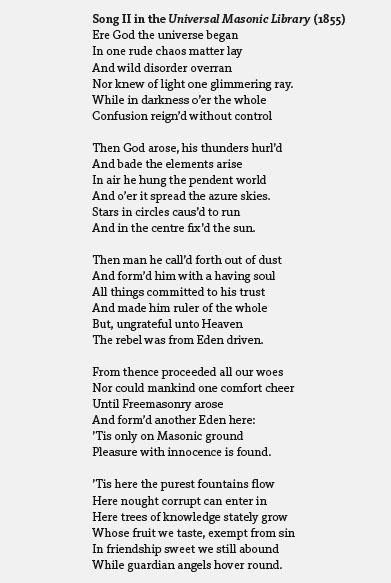
Fig. 7. Song found in William Preston, The Universal Masonic Library, vol. 3
last 2 stanzas.. oi.. until freemasonry arose.. here trees of knowldge stately grow.. whose fruit we taste, exempt from sin.. oooof
35
On the other hand, it is true that many revolutionaries who were not necessarily Masons made use of the lodges’ existing infrastructure and social networks to further their cause.
The specific organization and ritualization of all this revolutionary activity clearly had other functions as well: the brotherhoods affirmed and unified the aspirations of illuminated men whose purpose it was to steer mankind toward achieving perfection on (this) earth.Bakunin, 32nd degree Mason himself, appeared to feel the same calling when he founded his own secret “International Brotherhood” in Florence in 1864, which mirrored Weishaupt’s vision almost exactly one hundred years later. The main difference between the two was that Bakunin’s Brotherhood was meant to infiltrate the First International and wrest it from the authoritarian socialists’ control, as opposed to infiltrating Masonic lodges in order to wrest them from liberals’ control. This is far from the only way in which Masonry and the International Workingman’s Association (IWA) coincide.
By the mid-nineteenth century many members of Masonic society had come to feel the proletarian struggle coincided with their greater cause, and the use of Masonic organizations as a cover for revolutionary activity was by then a long tradition, as was the tendency to use Masonic rites, customs, and icons to emblematically symbolize the values of equality, solidarity, fraternity, and work. Pierre-Joseph Proudhon, a Mason who lived to see the formation of the International Workingman’s Association (IWA), wrote that “The Masonic God is neither Substance, Cause, Soul, Monad, Creator, Father, Logos, Love, Paraclete, Redeemer…. God is the personification of universal equilibrium.” In Proudhon’s day, the British lodges were admitting increasing numbers of proletarian members—particularly skilled and literate workers—and had come to support the workers’ struggle to the extent that the first preparatory meeting of the IWA on the August 5, 1862, attended by Karl Marx among others, was held in the Free Masons Tavern. Many of those in attendance were “socialist Freemasons,” a phrase applied at the time to the members of the small lodges founded in 1850 and 1858 in London by exiled French republicans, and which involved many members of diverse national backgrounds—these were named “Memphite” lodges, after the sacred Egyptian burial ground. *The immediate objectives of the Memphite program were twofold: the struggle against ignorance through education and helping the proletarians in their struggle for emancipation by way of Proudhonian mutual aid associations.
Communist and anarchist symbolism, such as the red star and the circle-A, date back to this period and also have Masonic origins. The star, which hosts an endless charge of esoteric meanings in both the Hermetic and Pythagorean traditions, had been adopted in the eighteenth century (some say seventeenth) by Freemasons to symbolize the second degree of membership in their association—that of Comrade (Compañero and Camarade in my sources). Among socialists, it was first used by members of the Memphite lodges and then the IWA. Regarding the circle-A, early versions like the nineteenth-century logo of the Spanish locale of the IWA are clearly composed of the compass, level, and plumb line of Masonic iconography, the only innovation being that the compass and level are arranged to form the letter A inside of a circle
Over time these symbols have developed a new complement of meanings—many twenty-first-century anarchists don’t even know that the star used by communists, anarchists, and Zapatistas alike is the pagan pentagram. They are not reminded of the mathematical perfection of cosmogony when they behold it, or of Giordano Bruno’s geometric arts of memory, nor do they necessarily realize there is a genealogical link between the (neo)pagan May Day celebration and today’s anarchist May Day marches. Nowadays the May Day march is taken to commemorate the Haymarket massacre (1886), yet it is no coincidence that there was much upheaval in Chicago that day, because revolutionaries had been honoring May Day since before the time of the Illuminati, which was also founded on this symbolic day. In the nineteenth century, these symbolic associations were well known by those involved, however, and their adoption reflected how much they resonated with mystical and historical weight. Even Bakunin, while he rejected the personal God of his Russian Orthodox childhood, put forward a pantheistic revolutionism. In a letter to his sister (1836), he wrote, “Let religion become the basis and reality of your life and your actions, but let it be the pure and single-minded religion of divine reason and divine love…. [I]f religion and an inner life appear in us, then we become conscious of our strength, for we feel that God is within us, that same God who creates a new world, a world of absolute freedom and absolute love … that is our aim.”
Bakunin is much better known among anarchists living today for his reversal of Voltaire’s famous aphorism—“If God really existed, it would be necessary to abolish him.” Throughout the nineteenth century, however, the only people involved in the revolutionary scene who were consistently annoyed by this sort of mysticism were Marx and Engels. Proudhon’s ramblings about God as Universal Equilibrium were the sort of thing Marx and Engels objected to and contrasted with their own brand of “scientific socialism”—“the French reject philosophy and perpetuate religion by dragging it over with themselves into the projected new state of society.” Bakunin and Marx differed on this point and a number of others, the most famous being the role of the state. Whereas Marx considered a state dictatorship of the proletariat to be a necessary moment in his historical dialectic, *Bakunin espoused the notion of a secret revolutionary organization that would “help the people toward self-determination, without the least interference from any sort of domination, even if it be temporary or transitional.” Bakunin also wrote that he saw our “only salvation in a revolutionary anarchy directed by a secret collective force”—the only sort of power that he would accept—“because it is the only one compatible with the spontaneity and the energy of the revolutionary movement”; “We must direct the people as invisible pilots, not by means of any visible power, but rather through a dictatorship without ostentation, without titles, without official right, which in not having the appearance of power will therefore be more powerful.”
The “dictatorial power” of this secret organization only represents a paradox if we do not recognize the long tradition and larger cosmology within which Bakunin is working. *Revolution may be “immanent” in the people, but the guidance of illuminated men working in the “occult” was necessary to guide them in the right direction. Members of his International Brotherhood were to act “as lightning rods to electrify them with the current of revolution” precisely **to ensure “that this movement and this organization should never be able to constitute any authorities.”
Saint-Simonians aimed at reforming existing institutions, but Fourierists and Owenites rejected the existing system altogether. *Rather than a mere “changing of the guard,” they advocated the creation of new forms of independent organization within the existing system; hence their “precursor” status to anarchism, perennially defined by the notion of building a new world within the shell of the old, whether via “networks,” communes, or syndicates, as well as by a rejection of state power.
Meanwhile, Darwin’s treatise on evolution lent itself to theories of social change that dovetailed with revolutionary thought—a distinction between evolution and revolution in nineteenth-century utopian socialism would be rather forced. . Anarchist natural philosophers of the nineteenth century read Darwin differently. Anarchist patriarch Peter Kropotkin posited “mutual aid” as a prime “factor of evolution” (1914), which we ourselves may manifest as we lead civilization toward egalitarian harmony. It is also worth noting that Kropotkin’s key contribution to anarchist theory was heavily influenced by Mechnikov, who was in turn inspired by a long stint in revolutionary Japan, and who had written of the world being divided into three spheres—inorganic, biological, and sociological—each governed by its own set of laws but with enough correspondences between them that human society could be read as a continuously evolving expression of a unified whole.
..I could go on but do not have the space to treat so many complex stories of diverse colonial encounters with the attention to specificity they deserve. I merely present these few suggestive examples to remind us that the cross pollinations of diverse cosmologies underlying modern revolutionism does not necessarily stop, and perhaps find only their latest expression in present-day anarchists’ selective fascination with indigenous cultures and cosmologies
45
Not every anarchist was a theosophist or enamored with the occult. Emma Goldman, for example, wrote an entirely scathing account of Krishnamurti’s arrival in America as the supposed theosophical avatar. However, the fact that Goldman’s Mother Earth and a variety of other anarchist periodicals bothered to criticize theosophy at all should tell us something—nothing is forbidden unless enough people are doing it in the first place.Even the skeptics often grudgingly recognized that they were kindred spirits. As anarchist C.L. James wrote in 1902: “However ill we may think of [Swedenborgian] dogmas, their influence is not to be despised. They have insured, for one thing, a wide diffusion of tendencies ripe for Anarchistic use. Scratch a Spiritualist, and you will find an anarchist.”
56
Anarchists have always considered themselves purveyors of particular insight and continue to join social movements and the general fray to steer it all in a more revolutionary direction. To offer just one contemporary example, anarchists participated in the Occupy movement (2011–2012), despite its observed “reformist” aspects, to prevent it veering in a racist and nationalist direction and to steer it toward a liberatory politics. My point here is not to criticize such a practice, but to suggest that its disavowal and dissimulation within discourses of mere “solidarity” may be disingenuous (if also, at times, tactically reasonable). Similarly, while anarchists today carefully skirt the phrase “consciousness raising” (it sounds too Marxist), their various workshops on “anti-oppression” appear to have precisely such a purpose.
59
It is not simply sexist reading habits that marginalize indigenous women scholars’ work but also the fact that their words, insofar as they draw links between politics and cosmology, are less easily recuperated within the European anarchist tradition, which has already decided that religion is bad, and whose model of oppressive power is the state. For the indigenous women in Andrea Smith’s study, for example, “sovereignty” is “an active, living process within this knot of human, material, and spiritual relationships bound together by mutual responsibilities and obligations.” Audra Simpson, for her part, points out the “critical language game” involved here: indigenous mobilizations of “sovereignty” are useful to signal “processes and intents to others in ways that are understandable.” These remarks certainly sound different than the definitions of “sovereignty” advanced by Schmitt, described by Agamben, and critiqued by many anarchists, wherein sovereignty is always an (unmarked, yet male) fantasy of absolute power via the state apparatus (and the practical project of consolidating this power as much as possible). But then again, why should Agamben or Schmitt be granted sovereign jurisdiction over the (power of ) the Word? Indigenous women’s mobilizations of “sovereignty” are not necessarily rhetorical, but even when they are, this is where the (performative) magic happens. Following their lead could teach us all something about “sovereignty” that Schmitt, Agamben, and their anarchist readers fail to notice: European “sovereignty” has always involved subsuming women and children as property of male citizens, whereas it is male citizens that are subsumed by the sovereign. Furthermore, the male philosophy slip between (legal) person and human being is also preserved in the (dialectical) anarchist response—“autonomy.”
Perhaps it should be no surprise that indigenous women’s imaginations of sovereignty do not line up neatly with either the “sovereignty” or “autonomy” of the modern right and left or that anarchist academics ask me to authorize my texts by citing Carl Schmitt—they do want me to be accepted into the club and kindly offer me the password. Nor should it be a surprise that reviewers suggest consecrating my work with the latest exegetical ruminations on St. Paul by Simon Critchley, whereas it is possible to get through ten years of doctoral studies regarding the social history of the left and only find out about Rosa Luxemburg afterward because of a book that happens to be lying on Barbara Ehrenreich’s kitchen table: anarchism has always been a gendered and racialized domain authorized by speculative elites as much as real builders. .. It seems all “earthly perspectives” are bound to be incomplete after all—including my own.
62
My “politicized” and academic peers look down on the uneducated and uncouth subject who falls prey to the “conspiracy theory.”
The people who use “conspiracy theory” and its derivations as epithets proceed as if there exists a set of criteria by which “conspiracy theory” may be defined. Presumably “conspiracy theories” rely on errant data. They attribute too much agency to high-ranking individuals or government agencies. Their adherents proceed in poor faith by lending more weight to information that corroborates their existing theories than information that calls their ideas into question. Contradictory evidence is taken merely as more proof of conspiracy. And so on. Yet if these were effective criteria, then the theory that Saddam Hussein possessed weapons of mass destruction (WMD), which served to justify the United States waging war on Iraq at the turn of the millennium, would be considered a “conspiracy theory,” and generally speaking it is not. In fact, there is no single (monothetic) principle by which “conspiracy theory” may be defined. Insofar as the phrase “conspiracy theory” has meaning, it resides in its function as a phrase used specifically to refer to popular (subaltern) ideas for the purpose of disqualifying them from respectable consideration. Theories of conspiracy that are communicated by those “above” are not labelled “conspiracy theories,” even if they are false and involve fantastic or incredible premises, whereas theories of conspiracy expounded by those “below” can rarely shake the “conspiracy theory” label once it has been publicly applied. We will return to this question.
64
It may be inaccurate to state that the survivors of a given high school massacre are merely “crisis actors”; on the other hand, working people are not entirely wrong in their general suspicion that the professional class is trying to kill them. Perhaps social scientists might grant more often that “conspiracy theories” happen precisely because the public notices that secretive government institutions are continually lying.
Instead, by both social scientists and activists widely applying the label “conspiracy theorist” and thus dismissing the rationality of diverse popular theorists a priori, no attempt is made to distinguish between theories that arguably involve valid lines of questioning (“Is it possible my child is sick because of the vaccine she recently received?”) and those which are more obviously misguided (“Is the world banking system run by Jewish lizards or aliens or both?”). This is unfortunate, as it would seem that failure to intervene in the indiscriminate application of the “conspiracy theory” label to diverse theories arguably serves to foster a defensive identity among those ridiculed as “conspiracy theorists,” encouraging empathy, solidarity, and exchange of ideas among those so labelled, such that persons who at one point merely stated that the CIA was involved in drug trafficking come to also believe in Jewish lizard bankers as well.
68
It may very well be that the phrase “conspiracy theory” itself has come to function as euphemism justifying class exclusion within anarchist social movements. It is arguably no coincidence that as a university professor I may respectably discuss Central Intelligence Agency involvement in drug trafficking, yet a truck driver who says the same thing is often tossed off as a “crazy conspiracy theorist.” And perhaps it is likewise no coincidence that wealthy white activists mobilize concepts of “intersectionality” and “safe space” against working-class participants who betray adherence to “conspiracy theories” with ironic reference to the importance of “inclusive” spaces, while allowing elite white anti-Semites to freely sound off. Surely it is significant that the working-class “conspiracy theorist” is nominally unsafe due precisely to his racism, and yet “anti-vaxxers” and “truthers” (persons concerned with national vaccine programs or investigating 9/11 as an “inside job”), who do not necessarily impute malice to Jews or other racialized people, are more quickly ridiculed and shunned from movement spaces than are elites who manifest racism in comparatively “respectable” ways.
Of course, it may still be argued that it is unpleasant to have meeting time consumed by discussions with theorists of conspiracy who are convinced the world is controlled by lizards from outer space. Yet shaming and evicting persons who betray an interest in a “conspiracy theory” from social movement spaces is also arguably problematic in the long run. Many measures suggest that there are more people in North America who believe in one or another “conspiracy theory” than there are readers of anarchist theory. Are anarchists truly interested in mobilizing people and their discontent into resistance movements? Or is the priority among activists to distinguish one’s self as having “good politics” and protect their small, safe, social enclave?
With respect to this question, and beyond the aforementioned dynamics of bourgeois “good politics” as a partial explanation, I am here tempted to advance a further tentative hypothesis: perhaps theories of “conspiracy” are rapidly dismissed by intellectual elites precisely because they uncomfortably highlight disavowed agency among persons of the professional class. Maybe members of the ruling class simply don’t want to think about the fact that they do enjoy more power to affect institutional affairs than the janitor does, because then they would have to feel partially responsible for the workings of global capitalism (instead of blaming a sexist, racist, homophobic janitor). After all, only to the elite observer should it be surprising that persons in oppressed groups find the activity of dominant groups “suffused with intentionality” that elites cannot see or, to use the phrase of Pierre Bourdieu, “misrecognize.” Any orthodox historian is capable of illustrating that social elites only enjoy the power they do because they conspire to retain and accrue it, just as the institutional elites involved in the Holy Alliance or “Conspiracy of Kings” did at the turn of the nineteenth century. There is no politics without conspiracy. The question is simply “who” is conspiring to do “what
74
Of course, it is here that a true conspiracy may exist. Indeed it would be irresponsible to discuss the topic of the “conspiracy theory” as much as I have without attending to the fact that the Central Intelligence Agency of the United States has specifically worked to promote the category in the media—this fact having been duly researched and established in peer reviewed academic literature, something I feel I must mention, lest I be tarnished as a “conspiracy theorist” myself. The fact that the CIA has promoted the concept of the “conspiracy theory” and potentially contributed to its media content does not mean, following a certain misguided logic often attributed to “conspiracy theory,” that the CIA “invented” the conspiracy theory or is the sole or primary “cause” of the “conspiracy theory,” which is the outcome of diverse and combined historical and cultural forces. The Protocols of the Elders of Zion was published at the turn of the twentieth century, and various books that associated left politics with a secret world government were published around the same time, long before the CIA existed. Yet every social scientist is capable of understanding that a government agency may have a vested interest in promoting existing ideas that distract from true government corruption and violence, including those of the increasingly global oligarchy currently enforcing neoliberal austerity programs (predatory capitalist extraction) throughout the world.





 be you.