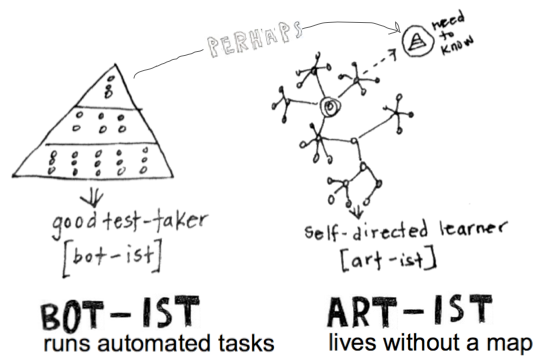
A hierarchy (from the Greek hierarkhia, “rule of a high priest”, from hierarkhes, “president of sacred rites”) is an arrangement of items (objects, names, values, categories, etc.) in which the items are represented as being “above”, “below”, or “at the same level as” one another. Hierarchy is an important concept in a wide variety of fields, such as philosophy, mathematics, computer science, organizational theory, systems theory, and the social sciences (especially political philosophy).
A hierarchy can link entities either directly or indirectly, and either vertically or diagonally. The only direct links in a hierarchy, insofar as they are hierarchical, are to one’s immediate superior or to one of one’s subordinates, although a system that is largely hierarchical can also incorporate alternative hierarchies. Hierarchical links can extend “vertically” upwards or downwards via multiple links in the same direction, following a path. All parts of the hierarchy which are not linked vertically to one another nevertheless can be “horizontally” linked through a path by traveling up the hierarchy to find a common direct or indirect superior, and then down again. This is akin to two co-workers or colleagues; each reports to a common superior, but they have the same relative amount of authority. Organizational forms exist that are both alternative and complementary to hierarchy. Heterarchy is one such form.
it seems there’s no talk of hierarchy w/o manmade/manufactured terminology/ideology.. ie: president; fields; subordinates; co-workers; superiors; authority; teacher/trainer; student; .. et al (all red flags we’re doing it/life wrong)
freeman structure law (?) – not about no structure.. but about who’s crafting it (has to be everybody) and when (has to be ongoing)
perhaps what we need most is a mech to facil a non hierarchical listening to every voice everyday.. ie: tech as it could be (we’ve still got that hierarchical form of listening to each human.. everyday)
undisturbed ecosystem: ‘in undisturbed ecosystems ..the average individual, species, or population, left to its own devices, behaves in ways that serve and stabilize the whole..’ –Dana Meadows
we are not completely separable, and cooperation is the default starting point. Cooperation is precisely what we should expect. The challenge is to explain deviations from cooperation, or breakdowns and therefore conflict, rather than the other way around..t
Nassim Nicholas Taleb’s Wisdom (@TalebWisdom) tweeted at 10:36 AM on Mon, Aug 26, 2019: “Contra the prevailing belief, “success” isn’t being on top of a hierarchy, it is standing outside all hierarchies.” – Nassim Nicholas Taleb in The Bed of Procrustes (https://twitter.com/TalebWisdom/status/1166026560677302274?s=03)
__________
David Graeber (@davidgraeber) tweeted at 6:02 AM – 9 Sep 2019 : @wackywheatleys ever read “Hierarchy in the Forest” – it argues that while there is a genetic tendency for that, actually becoming humans with culture etc first meant forming self-conscious mechanisms to counter-act that tendency & create egalitarian social forms (http://twitter.com/davidgraeber/status/1171031090510860289?s=17)
skimmed christopher boehm’s 1999 hierarchy in the forest – the evolution of egalitarian behavior – to me too much was based on data from whales in sea world and apes in the forest.. and referencing as ‘evolved human nature’
a couple quotes:
3
.. egalitarianism in in effect a bizarre type of political hierarchy: the weak combine forces to actively dominate the strong.. my thesis is that they must continue such domination if they are to remain autonomous and equal.. we’ll see they appear to have done so very predictably as long as hunting bands remained mobile
mobility perhaps good piece of equity.. but.. here i’m sensing his thoughts on egalitarianism.. aren’t jiving w what i see as equity (everyone getting a go everyday) in an undisturbed ecosystem.. ‘in undisturbed ecosystems ..the average individual, species, or population, left to its own devices, behaves in ways that serve and stabilize the whole..’ –Dana Meadows
this is why i’m skimming.. basis of book.. and to me.. it’s all describing situations that aren’t ie: everyone getting a go everyday.. but rather an already clouded view of human nature
5
the subject – of this book – is power in groups – how it is allocated and esp how it s regulated
perhaps thinking we need to allocate/regulate are red flags we’re doing it wrong
10
i believe if a stable egalitarian hierarchy is to be achieved, the basic flow of power in society must be reversed definitively, i also believe it takes considerable effort to maintain that condition.. thus.. egalitarianism does not just happen
perhaps effort.. is also a red flag we’re doing it wrong.. that lack of trust.. that lack of letting go enough.. as cancer.. kills us and keeps us from the dance/undisturbed ecosystem..
13
hunter gatherers.. when they remain mobile are uniformly egalitarian.. these people (tribesmen) domesticated plants and animals and *most of them remained egalitarian in a fashion **similar to that of their foraging predecessors.. product of constant vigilance
perhaps the mobility.. but domestication.. vigilance.. red flag..
sci anthropology emerged in 19th cent as a robust but tiny discipline that faced the enormous task of explaining nonliterate cultures and their natural history to a world of urban literates..
thinking this is still our problem.. that hierarchy ness that comes with tech that limit access.. ie: language/written-word/et-al
154
the critical question of hierarchy – was the common ancestor hierarchical or not
but also with thinking that we have no idea what we’re capable of in an undisturbed ecosystem because we keep clouding human nature by thinking we can define/draw-a-line of ie: hierarchical or not.. then we observe our observed selves (no longer legit human nature).. and called that human nature or the evolution of human nature
187
morality is inextricably entangled w langue..
begs idio-jargon and a means to listen to every voice.. every day (non hierarch).. something we’ve not yet had before ie: tech as it could be..
239
perhaps best ethnographic data on human ambivalence come form public decision meetings.. as groups struggle sot fin a consensus.. (this in chapter on human nature)
see.. i think once we’re in a group like that and talking consensus (public consensus always oppresses someone.. and decision making (over curiosity).. we’re no longer talking legit human nature
and to go w comment on 187.. this is hierarchical language again adding the hierarchy
I added a little note to the ‘P2P Hierarchy Theory’ section in our wiki, which has reached near 9k views since re-instating our counter last month:
“Three perspectives
To understand power and hierarchy in its historical development, there are at least the following perspectives that can be helpful:
the perspective of the ‘mode of production’ which helps to see the structural organization in society, and how class is determined by the place in that structure; this is what the French historians and later the marxist tradition brought to bear; it is still vital to look at material interests and how this influences the mode of consciousness of the participants in societal struggles
the perspective of the ‘mode of exchange’ shows that each mode of exchange, i.e. commoning, the gift economy, redistribution and market pricing, has its own peculiar logics and mentalities (even if expressed differently across time and space); this perspective can be found in the relational grammar of Alan Page Fiske, and has been shown in its historical development by the synthesis of Kojin Karatani.
the perspective of the ‘mode of power’, as expressed by Jonathan Nitzan and Shimshon Bichler, in their landmark, ‘Capital as Power‘
This idea that “everyone follows and everyone leads” is powerful because it captures the understanding that we are co-producers of our social realities. It is a reflection of the systemic nature of human relations: fluid, dynamic, reciprocal. – – Kathia Laszlo
in undisturbed ecosystems ..the average individual, species, or population, left to its own devices, behaves in ways that serve and stabilize the whole..’ –Dana Meadows
The possibility for the real community, the one based on interpersonal relationships and affections, to be an efficient productive unit is something radically new, and its potential to empower is far from having been developed. – David de Ugarte
this intro’s another complication to problem of giving gifts to superior.. there is always the danger that it will be treated as a precedent.. added to web of custom and therefore considered obligatory thereafter..
2277
once relations based on ‘custom’ only way to demo one has a duty/obligation to do something is to show that one has done it before.. often such arrangements can turn into a logic of caste.. ie: come to be known as fishermen or barbers..
this last point can’t be overemphasized because it brings home another truth regularly overlooked: that the logic of id is, always and everywhere, entangled in the logic of hierarchy..t
‘the logic of identity is, always and everywhere, entangled in the logic of hierarchy.‘.. t
it is only when certain people are placed above others, or where everyone is being ranked in relation to the king, high priest, et al.. that one begins to speak of people bound by their essential nature: about fundamentally diff kinds of human being.. ideologies of caste or race are just extreme ie’s.. it happens whenever one group is seen as raising selves above/below others.. in a way that *ordinary standards of fair dealing no longer apply
Trying to reduce the complexity of human relations under one individual’s mind is just the worst way to deal with it, and this not because of a moral judgement upon hierarchy, but because of the simple fact that it doesn’t work #Spinoza Tractatus Politicus VI,5 https://t.co/mc5PZYz5sJ Original Tweet: https://twitter.com/sonmi451it/status/1471952174557114373
corollarium: complexity doesn’t require hierarchy, and doesn’t necessarily lead to hierarchy (#TheDawnOfEverything, Full Circle)