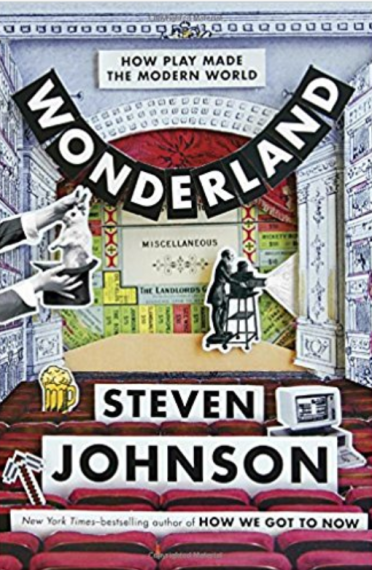
wonderland
_________
notes/quotes:
intro
11
this book is an extended argument for that kind of clue: a folly, dismissed by many as a mindless amusement, that turns out to be a kind of artifact from the future.. this is a history of play,.t a history of the pastimes that human beings have concocted to amuse themselves as an escape from the daily grind of subsistence.. this is a history of what we do for fun.. one measure of human progress is how much recreational time many of us now have, and the immensely varied ways we have of enjoying it..
?
13
this history is an account of less utilitarian pleasure; habits and customs and environ s that came into being for no apparent reason other than the fact that they seemed amusing or surprising. (in a sense, it is a history that follows brian eno’s defn of culture as ‘all the things we don’t have to do’).. t
brian.. supposed to‘s
there are a thousand books written about the history of innovations that came out of our survival instincts. this is a book about a diff kind of innovation: the new ideas and techs and social spaces that emerged once some of us escaped from the compulsory labor of subsistence..t
imagine if all of us had that luxury
no more earning a living .. et al
15
but if you are trying to figure out what’s coming next, you are often better off exploring the margins of play: the hobbies and curiosity pieces and subcultures of human beings devising new ways to have fun..
more often than not those dreams do not unfold w/in the grown up world of work or war or governance. instead, they emerge from a diff kind of space: a space of wonder and delight where the normal rules have been suspended, where people are free to explore the spontaneous , unpredictable, and immensely creative work of play.. you will find the future wherever people are having the most fun..
so.. let’s do this w everyone.. imagine that
ie: hlb via 2 convos that io dance.. as the day..[aka: not part\ial.. for (blank)’s sake…].. a nother way
1 – fashion and shopping
21
(on the color purple – no one needs the color purple) – the financial gains or status symbols were secondary effects; the initial fixation w purple was the prime mover. take away the purely aesthetic response to the tyrian dye, and the whole chain of exploration , invention, and profit falls apart. this turns out to be a recurring pattern in the history of play.. because delightful things are valuable, they often attract commercial speculation, .. when we look back at that process, we tend to talk about it in terms of the money and markets or the vanity of the ruling elite driving the new ideas. but he money has its own masters, and in many cases the dominant one is the human appetite for surprise and novelty and beauty.. somehow the story gets cast in the retelling as a tale of heroic inventors or efficient capital markets or brutal exploitation.. that initial moment of delight becomes an afterthought a footnote to the master narrative..
32
(on cotton for clothes) – at its core is the question of why big changes in society happen. are they driven exclusively by new tools, and cultural practices that satisfy existential needs, like nutrition, shelter, or sexual reproduction? or ae they also driven by more mercurial appetites? .. strongly suggests that the conventional narrative of industrialization is flawed both in terms of the sequence of events and the key participants.. those dyers tinkering w calico prints on the coromandel coast, creating new designs for the sheer beauty of it; those english women enjoying the agreeable amusements’ of shopping on ludgate hill .. these were all active shapers of the modern reality of industrialization, as important, in a way, as the james watts and eli whitney of conventional history
33
account is necessarily murky because so few contemporaries found it necessary to take note of these new shopfronts until the calico craze had threatened to decimate the english economy.. but w perfect hindsight, … you couldn’t have found a better crystal ball than those calico shops in london
34
the story of calico and chintz is a chilling reminder that the amusements of life have often triggered some of the worst atrocities in history.. the sensual delight of these new fabrics inspired a wave of entrepreneur/tech activity/ingenuity, but it also unleashed some of the most destructive forces.. ie: slavery; child labor; pollution; ..
36
one can make argument that the desire for cotton was the single worst thing to happen to the planet between 1700 and 1900 .. that it provoked more suffering than any other new development in that period..
38
raymond williams: it is often said that our society is too materialist and that advertising reflects this.. but it seems to me that in this respect that our society is quite evidently not materialist enough, and that this , paradoxically is the result of a failure in social meaning, values, and ideals.. if we were sensibly materialist, .. we should find most advertising to be of an insane irrelevanc.e beer would be enough for us, w/o the additional promise that in drinking it we show ourselves to be ie: manly..
40
for braudel, fashion was both a symptom and a cause of a certain social restlessness, a willing ness to challenge existing conventions..
46
women were at the epicenter of this new industry (shopping malls -flaneur ness), as they had been during the dawn of the cotton revolution two centuries before..
48
(on women shoplifting) – because the syndrome only emerged w the new environ of the department store and because the culprits themselves were so obviously of ‘good breeding’ lacassagne argued, the roots of the disease must be environmental..
the root cause of the disorder was to be found somewhere else (besides bio deformity or lesion of the will): in the lived history of social and economic change.. modern life itself could make you sick
w/in decade, freud reroute psych back toward the eternal truths of eros and thanatos.. the pleasure principle.. we now assume, correctly or not, that every new media experience is rewiring our brains in some fundamental way; today’s disorders – add, autism, teen violence – are regularly chalked up to he sensory overload of tv, video games, sm.. .. brain shaped by built environ.. that way of seeing mind .. first came into view w the unlikely criminals of the department store disease..
58
(on first mall and epcot disney) – disney: it will be a community of tomorrow that will never be completed, but will always be introducing/testing/demo ing new materials and new systems.. and epcot will always be a showcase to the world of the ingenuity and imagination of american free enterprise.. finding solutions to the problems of our cities..
like gruen’s original plan for northdale, it was going to be an entire community oriented around a mall.. sans cars.. et al
61
mall environ .. ended up being its fatal flaw.. avenues of sameness.. when play is driven by surprise and novelty..
the fact that jane jacobs .. saw merit in the gruen model should tell us something..
62
these are all provocative ideas that have been explored separately in many communities around the world.. but to this day, no one has built a true progress city, which means we have no real idea how transformative it might be to see all these ideas deployed simultaneously.. perhaps its time we tried..t
indeed.. begs we leap.. partial ness is killing us
2 – music
67
bone flutes are among the oldest known artifacts of human technological ingenuity.. 33 000 bce..aeons before early humans started to imaging writing or agri, they were crafting tools for making music..
particularly puzzling because music is the most abstract of the arts.. paintings rep eyes naturally perceive.. architecture gives us shelter.. stories follow arc of events.. it sounds diff from unstructured noise of the natural world..what sounds like music is much closer to the abstracted symmetries of math than any experience a hunter gatherer would have had a hundred thousand years ago..
68
today the avg 7th grader knows pythagoras for his triangles, but his ratios are the cornerstone of every pop song on spotify.. the study of musical ratios marked one of he very first moments in the history of knowledge where mathematical descriptions productively explained natural phenom..
78
we should not overlook the strange nature of the technological history here: for 800 yrs, humans had possessed the protean resource of programmability, and over that time they had used that resource exclusively to generate pleasing patterns of sound waves in the air.. t
79
for almost 1000 yrs, we had the meta tool in our collective toolbox, and we did nothing w it other than play music
then to weaving silk.. then to babbage.. calculating engine
88
babbage borrowed a tool designed to weave colorful patterns of fabric, which was itself borrowed from a tool for generating patterns of musical notes, and put it to work doing a new kind of labor: mechanical calculation..
when his collaborator ada lovelace famously observed that babbage’s analytical engine could be used not just for math but potentially for ‘composing elaborate.. pieces of music’ she was, knowingly or not, bringing babbage’s machine back to its roots, back to the ‘instrument which plays by itself’..
83
fittingly punch cards were replaced as input devices by keyboards, and as storage devices by magnetic tape: both techs .. originally designed to play or record music..
when you step back and look at the history from a wider angle.. you can’t help noticing how long the idea of a programmable machine was kept in circulation by the propulsive force of delight and not industrial ambition…t the entrepreneurs and industrialists may have turned the idea of programmability into big business, but it was the artists and the illusionists who brought the idea into the world in the first place..
90
first writing machine 1850ish – referred to as writing harpsichord.. had means before.. just more interest in using keyboard for music..the typewriter keyboard was poised to reinvent the way humans communicate.. but the idea for this now indispensable tool began in song
91
why did music play such an important role in our tech history? one likely reason is that music naturally lends itself toward the creation of codes, more than any other human activity other than language and mathematics..
once again.. music appears to leap ahead of where it should logically be on the hierarchy of needs. in 2000 bc, most human settlements around the world hadn’t invented a notation system for language yet. and yet somehow the ancient sumerians were already composing scores..t
106
the first true p2p networks for sharing info were designed specifically for the swapping of musical files..
107
music was among the first activities to be encoded/automated/programmed/digitized (as commercial product)/distributed (via p2p networks).. there is something undeniably pleasing about that litany, something hopeful..
cool that music is being noted.. musicophilia et al.. but for being.. automated.. programmed.. digitized as commercial product..? sounds abusive
too often we hear the old bromide that innovation invariably follow the lead of the warriors (military tech).. but it turns out the minstrels and the maestros led us to their fair share of break thrus as well.. particularly w tech that involves some kind of code.. yes. the dept of defense helped build the internet. but the pinned cylinders of the music boxes gave us software..
when it comes to generating new tools of sharing and processing info, the instruments of destruction have nothing on the instruments of song..
dawn – musical instrument as tech as it could be
less about coding.. programming..automating.. more about an interface.. a means of expression.. which is random.. and not predictably random.. very idio..
3 – taste
top spice (huge in trading) – pepper
125
vanilla – suspend beans from hook on wall for house deodorant..
126
beans in hair, perfuming it .. ground up pods to take edge off bitter taste of chocolate drinks. pods often used to pay taxes
131
the real question is why human beings were willing to pay so much money for such frivolous tastes.. modern day equiv.. our current appetite for oil.. just like quest for spices, the quest for oil has compelled humans to redraw political borders, launch devastating wars, make brilliant scientific and tech break thrus, and create some of most profitable co’s in history.. but at least fossil fuels, for all their faults are actually necessary given the energy req’s of our lifestyles.. but conquering the world in the name of flavor? where is the sense in that..
?
conventional explanation – basic nutrition.. ie: disguising the flavor of meat that had begun to spoil.. though european aristocracy had no shortage of fresh meant.. spice was a craving not a necessity
132
the spicer was somewhere between a pharmacist and a lifestyle coach.. there to advise the royal fam on the daily rhythms of their health spices were primary means of altering or preserving those rhythms
133
pepper considered remedy for everything from cancer to toothache to heart disease.. vanilla: better urine flow.. cause abortion.. strengthen stomach.. strength to mind…. heal female troubles.. fight cold poisons.. and bites of venomous animals.. aphrod
136
all this before sci method.. on some basic level.. med properties of spices were pure fantasy.. but placebo…. but were a trial run for the modern pharma and drug co, offering imaginary cures.. we figured out the form for maintaining a healthy lifestyle before we invented a method for scientifically testing the content..
because modern pharma isn’t offering imaginary cures..? scientifically proven (aka: gray research law.. used to feed the money machine) imaginary cures.. sicko et al
137
turned out had it exactly wrong about spices.. weren’t protection against black death.. they were reason black death came to europe in first place.. via black rat
138
no wonder there was something magical about experiencing these flavor: you couldn’t see the orient in photos or tv .. couldn’t even point to it on a map.. but you could taste it
141
the taste for those spices compelled human beings to invent new forms of cartography and navigation, new ships, new corp structure, not to mention new forms of exploitation.. all in the service of shrinking the globe so that pepper raised in sumatra might more efficiently be delivered to the kitchens of london or amsterdam.. those strange new flavors propelled human beings around the globe like nothing that had ever come before.. today’s global village has its roots in the frivolity of spice..
144
what makes humans human is, in part, their ability to expand the boundaries of what it means to be human.. the exploratory need for new experiences new desires, and new tastes is , more often than not the force behind that expansion..
4 – illusion
154
capitalism, to marx, was not just a form of economic oppression but, crucially, an economic system in which the objects produced were wrapped in a kind of ghostly illusion, and unreality that kept its participants from recognizing the truth of their oppression.. he drew upon popular entertainment, not phenomenology, to convey his meaning.. new ideas need new metaphors and in marx’s case the new metaphor came from a spook show
capitalism .. marx..
157
what brought them (classes) together was the strange unpredictable pleasure of being fooled..
brewster: the eye.. is the most fertile source of mental illusions.. the principal seat of the supernatural
the eye detects something that is quite literally not there.. almost impossible to un see
159
but the human ear is not easily fooled by speech simulations: even today, w all our computational power, a child can tell the diff between siri and a human voice.. and the other senses – touch, smell, taste – are even less prone to being tricked the way our eyes are tricked by the necker cube.. if you want to deceive the senses of another human being, your best bet is to do it thru their eyes
there is something paradoxical about this vulnerability. the human sense of sight is generally considered to be the most developed.. some estimates suggest that 85% of the info we take in arrives thru our visual system.. why strongest most vulnerable?
% of your visual field that you actually perceive in focused ‘high definition’ is shockingly small. what makes eyes so perceptive likes in way brain interprets the info it receive thru optic nerve.. in a sense, the brain has evolved series of cheats that enable it to detect things like edges or motion or 3d relationships between objects.. filling in missing info on the fly..
160
technically speaking, linear perspective is nothing more than an optical illusion, but it is rightfully considered one of the most transformative innovations of the renaissance..
163
barker’s panorama suggested a higher purpose (dickens: the more man knows of man, the better for the common brotherhood among us all).. for the illusionists.. could also serve an almost journalistic function, reporting on current events..
165
barker and maelzel had stumbled across an appetite in their audiences that would later be slated by modern media’s endless recycling of disaster footage, from the hindenburg to 9/11. (nonnarrative immersive simulations of famous catastrophes may well have an renaissance if vr becomes a mainstream pastime)
hoping dawn ness – much more than renaissancing catastrophes.. renaissancing us..
169
all those moving panoramas and magic lantern shows were wiped off the map by a single new tech: the cinema
in a sense, the temples of illusion helped created the tech that ultimately destroyed them..
170
did help solidify a new convention: that human beings would pay money to crowd together in a room and lose themselves in immersive, illuminated images.. in 1820 limited to a tiny portion of planet’s population.. but it would soon become a worldwide phenom..
a cluster of innovations emerges, all experimenting w diff variation on a single theme, unit lone specific solution arises that reaches critical mass and kills off its rivals.. think of the ecosystem of computer networks in the early 1990s: proprietary services: aol, compuserve; filesharing protocols: fetch, gopher; bulletin-board communities: the well, echo; hypertext experiments: storyspace, hypercard
behind all these marginal new platforms, a shared consensus was visible; people were going to start consuming and sharing news, docs, person info, and other media thru hypertextual networks. but it was unclear whether a single platform would unite all these disparate activities, until the www became the de facto standard in the mid 90s. . underlying pattern: early experiments, followed by explosive diversity, followed by radical consolidation
the innovation that triumphs at the end of this sequence is often inferior in many ways to its rivals: remember that cinema, for all tis advantages, lacked color for its first fifty yrs.. and even in age of 3-d imax, movies lack the 360 degree vista of the panorama..
175
the artists’ vision demands new tools to realize that vision, and every now and then the artist turns out to be a toolmaker as well. when those skills overlap in a single person, things move fast..t
mostly/hopefully because less compromise.. no..?
181
in just nine years, disney and his team had transformed a quaint illusion – the dancing mouse is whistling – into an expressive form so vivid and realistic that it could bring people to tears (snow white)
182
those weeping spectators at the snow white premier signaled a fundamental change in the relationship between human beings and the illusions concocted to amuse them.. complexity theorist have a term for this: *phase transitions.. at a certain threshold point.. a fundamental shift happens.. something altogether different.. ie: still images came to life
see p 231
the phase transition of twelve framers per second intro’d a class of people virtually unknown until the 20th cent: celebrities
184
twelve frames a second tricks the brain into feeling that same level of intimacy aw people we will never meet in person, what inglis calls ‘knowability combined w distance’
185
may be.. some kind of voice only assistant, a descendant of software like alexa or siri – only .. w such fluid convo skills and growing knowledge of our own individual needs/habit that we will find ourselves compelled to think of them as more than machines, just as we were compelled to think of those first movie stars as more than just flickering lights on a fabric screen.. once we pass that threshold, a bizarre new world may open up.. a world where our lives are accompanied by simulated friends.. in a strange way, these virtual companions might be more authentic than the simulated friends of reality tv.. ie: engage directly w your shifting emotional states.. the ghost makers.. of 18th cent.. first tapped the power of illusion to terrify/amuse us; their descendants in the 21st cent may draw on the same tools to conjure up other feelings: sympathy, companionship, even love..
thinking tech could do this (help us detox.. and get back to a natural state of love et al).. but don’t know if it will come thru believing tech is human/loving.. rather.. more from techs ability to not be human.. ie: to listen and sort
5 – games
192
we commonly think of chess as the most intellectual of games, but in a way its greatest claim to fame may be its allegorical power.. became a kind of shorthand way of thinking about intelligence itself. both in functioning of brain and in emerging field of computer science.. that aimed to mimic that intelligence in digital machines..
huge mistake.. no..?
193
very root of modern investigation into ai are grounded in game of chess
oy
turing – origin point for two parallel paths: building intelligence into computers by teaching them to play chess, and studying humans playing chess as a way of understanding our intelligence..
194
but the prominence of chess in the first fifty years of both cog and computer science also produced a distorted vision of intelligence itself.. it helped cement the brain as computer metaphor.. but human intelligence turns out to be a much more complex beast than chess playing suggests
indeed
196
(on beginnings of game of life and monopoly) – ironically, the game that became an emblem of sporty capitalist competition was originally designed as a critique of unfettered market econ.. magie’s version actually had two variations of game play, one .. players competed to capture as much real estate and cash as possible, as in the official monopoly, and one in which the point of the game was to share the wealth as equitably as possible.. either way you played it.. agenda was same: teaching children how modern capitalism works, warts and all..
198
magie wrote: .. there are no fairer minded beings in the world than our own little american children.. ‘no fair’.. let the children once see clearly the gross injustice of our present land system and when they grow up, *if they are allowed to develop naturally, the evil will soon be remedied
*see p 231
200
(on charles darrow.. claiming monopoly and becoming millionaire) – invention stories like that of abner doubleday and the cow pasture so often fall apart w games because almost tw/o exception our most cherished games have been the product of collective invention.. usually involving collabs that span national borders.. baseball for ie, turns out to have a complicated lineage that includes rounders and cricket an dan earlier game called stoolball. citizens of britain, ireland, france and the netherlands, as well as the us, played a role in the evolution of the game..
201
we may not take our games as seriously as we do our forms of governance or our legal codes or our literary novels, but for some reason games have a wonderful ability to cross borders.. and when games cross borders, they almost inevitably tighten the bonds between diff nations rather than introducing conflict.. ie: football.. minecraft..
? football..?
thinking marsh label law
203
if looking for clues about future of invention and commerce.. a good place to start would be by studying the games people were playing for fun, and the evolution of the rules that governed those games
true.. but i don’t see that here.. or many places.. i think that’s why our modern world is so messed up (ineq wise)
208
when we think about legacy of cardano and pascal and fermat.. one question comes to mind: what took us so long..?.. none of the ancients were able to make the leap from chance to probability.. what held them back..?
answer seemed to lie in die itself.. each individual die would have its own idiosyncrasies..
209
seeing patterns behind game of chance required random generators that were predictable in their randomness.. the unpredictable nature of the physical object made it harder to perceive the underlying patterns of probability
so.. not human
by the time cardano picked up the game, dice had become standardized in their design..
ironically.. making the object of the die itself more uniform ultimately enable popele like juygens and halley to analyze the decidedly nonuniform experience of human mortality (life expectancy) using the new tools of probability theory. no longer mere playthings, the dice had become, against all odds, tools for thinking..
? – automation et al.. messing with us..
210
invariably the tools end up transforming the tool makers..
exactly.. and not (in our case) in a good way.. ie: predictable dice teaching us to play along rather than to play.. to be/become fragile rather than antifragile..
consider one of humans original techs: the ball.. balls are the jellyfish of gaming evolution.. at once ancient and yet sill ubiquitous in the modern world..
the olmecs, aztecs, and mayans all failed to invent the wheel, but the ball was central to the culture of all three societies..
213
the aztec ballplayers had been essentially kidnapped by cortes (first time to see balls bounce because of rubber), so we should be wary of making light of their appearance in the spanish court, but their performance before charles did mark the beginning of a practice that would become commonplace in modern age: athletes imported form one part of the world to another thanks to their agility at playing w rubber balls..
compromising the tool makers.. leads to the compromised tool transforming us to ie: football as an ill rather than play
214
18th cent scientists began experimenting w rubber.. including.. that material also suited for erasing.. rubbing out.. thus coining name ‘rubber’.. today rubber industry is massive
good for us..? for living things on earth..?
215
bias: assumption that important innovations come out of ‘serious’ research like goodyear’s .. but long before.. the mesoamericans took the opposite path, driven not by industrial ambition but rather by delight and wonder..
important innovations like cars..?
219
spacewar was one of the first programs that successfully engaged the user in real time.. but perhaps most fundamental revolution set in motion was: the game made it clear that these massive, unwieldy, bureaucratic machines could be hijacked by the pursuit of fun.. for all their brilliance.. none of the early visionaries of computing – from turing to von neumann to vannevar bush – imagined that a million dollar machine might also be useful for blowing up an opponent’s space ship.. w imaginary torpedoes for sheer amusement.. programming a computer to play games just for the sake of playing games..would have seemed like a colossal waste of resources.. like hiring a symphony orchestra to play ‘chopsticks’ .. but spacewar developers (mit students in 61) saw a diff future, one where computers had a more personal touch.. or .. developing spacewar helped them see that future more clearly
220
in spacewar, brand saw ‘a flawless crystal ball of things to come in computer science and computer use’.. brand recognized .. that these seemingly austere machines.. would inevitably be domesticated and brought into the sphere of everyday life.. shortly after.. enter.. steve jobs.. working on atari
in rolling stone piece, brand alluded to an important distinction between ‘low rent’ and ‘high rent’ forms of research.. high: official business.. funded by corp/govt grants, reviewed by supervisors.. the world of games however is low rent.. new ideas bubble up from below.. after hours.. people experiment for the love of it.. they share their experiments because they have none of the usual corp restrictions that protect intellectual property.. by sharing, they allow those new ideas to be improved by others.. the ideas evolve in a low rent world, but they often end up transforming the classier neighborhoods along the way
226
it might have looked like two men goofing off and trying to beat the house at roulette (computer size of card deck and tapping toes at start stop to calculate velocity) .. but it was also something much more profound. an entire family tree of devices – ipods, android phones, apple watches, fitbits – descend directly from that roulette hack
228
(on watson) – there is something lovely about the idea of the world’s most advanced thinking machine learning about the world by *browsing a crowdsourced encyclopedia.. from data sources.. watson developed a nuanced understanding of linguistic structure s that let it parse and engage in less rigid convos w humans..
imagine if *machine’s data is self talk.. from 7 bn people.. everyday
230
*watson is being employed to recommend cancer treatment plans… but still, watson’s roots are worth remembering: **arguably the most advanced form of ai on the planet received its education by training for a game show
**would reconcile with us assuming cancer.. and *cancer treatments.. rather than getting to the root of the problem/healing..
230
of all the field of human knowledge, ony a handful – primarily mathematics, logic and electrical engineering – *have been more important to the invention of modern computers than game play (**chess, roulette)..
**that depend on predictable random ness.. which humans can only exhibit if intoxicated (manufactured-consent/voluntary-compliance)
*this is huge.. why we haven’t yet gotten to tech as it could be
231
computers have long had a rep for being sober, mathematical machines.. but history of both music and games.. make it clear that the modern digital computer has a long tradition of play and amusement in its family tree..
i don’t know.. more calculated than your..wonder and delight
that may explain in part why computers have become so ubiquitous in modern life. the abacus and the calculator were good at math too, but they didn’t have the knack for wonder and delight that computers possess..
? i’m thinking computers as we’re using them now.. are not yet *phase transitions from p 182.. they are not something diff than ie: abacus/calc.. just more accessible.. not tech as it could be
why were games so important to the history of computing? i suspect the answer is partially that *games offer a clearly defined yardstick or score by which progress can be measured..
i’m thinking *this is precisely why it’s not wonder and delight enough for phase transition.. or rev of everyday life.. whatever you want to call… the world we could have.. betterness for 100% of us..
measuring things is killing us.. let’s try something diff..
beating the house or jeopardy.. gives the scientists and inventors a definitive goal that helps *clarify and direct research..
again.. so not my take on wonder and delight..
and a perfect recipe to *bias research
a more important principle is also visible in the long alliance between *games and computation.. playing rule governed games is one of those rare properties of human behavior that seems to belong to us alone as a species..
*i think this combo comes from intoxicated/not-us ness – our intoxication (aka: lacking basic needs) induced addiction to measuring things
so many other forms of human interaction and cognition have analogs in other creatures: song, architecture, war, language, love, family. *rule-governed game play is both ancient and uniquely human.
ugh.. i don’t see this as human.. manufactured human.. ok.. but.. it’s a great ie of (*p 198): the intoxication from kids playing monopoly but not free to see its demise
rule governed game play is both ancient and uniquely human.. it’s also one of the few activities beyond the essential like eating sleeping and talking that 3 yr olds and 93 yr olds will all happily embrace.. but unlike those essentials, there is no clear evolutionary purpose for *game play..t
*i think this is key.. if you just say play.. i think you’re spot on.. if it’s game play – w no exit.. no changing rules.. et al.. it’s not wonder and delight.. my thinking is that if it was.. then the world would be changed for better by now.. ie: we haven’t yet let go of that control ness by adding the word/idea.. game
it does not provide carbs to burn or help us reproduce our genes, yet somehow our minds are *drawn compulsively to the challenge and unpredictability of games
i disagree.. i think that’s an escape/coping mech for the world .. in which we live.. i think if talking about 7 bn people.. something deep enough for 7 bn people to be interested in.. to be *drawn to.. naturally.. that would just be curiosity.. not some pre made game..
and so it *seems fitting that when those minds finally got **smart enough to think about building an artificial mind, one of the first challenges we set for ourselves was creating a machine that could ***play along.. t
perhaps *more fitting and why we haven’t gotten to global equity yet.. our **intoxication addicts us to **playing along .. rather than following the whimsy/curiosity/play of the free mind .. the wonder and delight .. of a ie: a 5 yr old..
perhaps more apt title.. how playing along or playing games ..made the modern world.. aka: ineq world.. (thinking it’s not in the shape it could be if it were play that made the modern world)
6 – public space
238
the birth of the drinking house also marked the origins of a new kind of space: a structure designed explicitly for the casual pleasures of *leisure time.. not a space of work, worship.. home.. it existed somewhere else on the grid of social possibility.. a place you went just for the fun of it..
*rather escape time.. i’m thinking if it were truly leisure/luxury time.. and accessible to all.. we’d have global equity by now..
240
pub – publican or public house
ian gately.. called convo in pub ‘a fresh ethos’ – pubs were run by the people, for the people, places.. talk w candor about their rulers.. common people enjoyed a freedom of speech and action .. that was denied to them elsewhere, and these institutions became the nucleus of a popular culture..
245
a space originally intended for play and leisure became, improbably enough, a hotbed of dangerous new ideas..
before this point, people alluded to ‘the world’ or ‘mankind’ when talking about a general audience or crowd. but the idea of a public implied that there was a body of opinion and taste that possessed its own force and influence in society, potentially rivaling that of the monarchies and clergy..
246
for habermas, the public sphere had a profoundly egalitarian bias, creating ‘a kind of social intercourse that, far from presupposing equality of status, disregarded status altogether..
for habermas, the revolutionary ideas fo the 18th cent were ultimately dependent not on the beer/wine of tavern culture, but on another drug that had just arrived in the cities of europe: coffee..
247
from beginning coffee walked a fine line between medicine (improved memory) and recreational drug..
when read accounts of europeans firs encountering coffee in 16th cent it’s hard to find a single person who enjoyed the beverage for its taste
249
coffee made europeans more alert and improved their recollection, but the coffeehouse gave them a new compound, built by social connections instead of enzymes..
252
however useless it was as a legal intervention, the language of the proclamation made it clear that the real challenge to authority that the coffeehouse presented had little to do w the drug itself and everything to do w the social space that the coffeehouse intro’d to english society.. by early 1700s london neighborhoods featured more than a thousand coffeehouses, farm more than any city in the world.. amstersdam at that point.. only rival .. had 32..
257
woodsworth was capturing a sensibility that was enjoyed, during his day, by a tiny slice of the population, (collecting eclectic things – from eclecticness of people in coffeehouses.. to encyclopedia), but that would become far more mainstream in the years to come: the idea of *college as a time of intellectual play , a time to experiment, to dabble in eclectic interests and attitudes..
*leisure ness.. but not working out that way
258
coffeehouse didn’t welcome women or poor.. but by standards of 18th cent, it was, almost certainly , the most egalitarian room that modern europeans had ever experienced..
259
the coffeehouse may have looked like a space of indulgence and lethargy, where men went to *escape lawful calling and affairs.. but that escape turned out to be *enormously productive.. escaping.. your official rank and status in society – not only created a new kind of leisure, it also created new ideas, ideas that couldn’t emerge in the more stratified gathering places of commerce or religion or domestic life..
key that this was *escape rather than leisure.. perhaps why were able to turn art into productivity **as in made money..
265
nature tourism emerged as a leisure pastime..
268
to zoos (w exhibitions of people ‘savages in their natural state’).. inspiring darwin.. then them parks..
274
the modern world is now brimming w ‘pleasuring grounds’ .. starbucks.. disney..
276
today we take these environs for granted and rarely celebrate the visionaries that helped bring them into being.. today that connected world is just down the street from us.. reading the paper on a park bench or grilling hot dogs: *at peace w itself and at play
*? missing a vast majority of the world in that description..
i attribute it (the in-equity) on the game ness vs the play ness..
conclusion
280
how odd it is that slacking off on one’s ‘lawful calling and affairs’ would set off so many commercial and scientific aftershocks. the pleasure of play is understandable. *the productivity of play is harder to explain
maybe because *that’s not the point.. maybe it/equity hasn’t yet worked.. because productivity is not the point.. of ie: eudaimoniative surplus ness.. if it were explainable.. it wouldn’t work equitably.. which is what we’re experiencing right now. (ineq) .. because we think we can explain it.. and we’re playing that explanation ness out rather than the playing..
making sense of this mystery requires that we peer into the inner workings of the human brain drawing on recent research in neuroscience and cognitive psychology – research that, *fittingly, began by studying games..
i think not *fittingly.. rather .. harmingly..
the line of inquiry led so self learning algos (computer learning to play checkers).. for more complicated games like chess and backgammon.. but more importantly it led to a model of learning that has come to shape our *understanding of the human mind itself.
perhaps.. *mis understanding..
beneath these distinction,.. the model suggests a common principle: humans – and other organisms – evolved neural mechanism that promote learning when they have experiences that confound their expectation. when the world surprises us w something, our brains are wired to pay attention..
281
over time, it (the computer) learned by paying careful attention to the difference between its predictions and the actual outcome.. in a way the ai researchers had programmed an appetite for surprise into the software..
surprise..? appetite..?
psychologists have long understood that this appetite is an integral part of the human mind. countless studies of newborn infants have shown that before we can crawl or grasp or communicate, we seek out surprising phenomena in our environment..
? i think that’s a huge compromise of curiosity and of appetite.. to call this iteration difference one in the same.. ie: one can be boring.. the other can never be
wasn’t until 1990s that scientists first recognized that the surprise instinct is heavily regulated by ten neurotransmitter dopamine.. because drugs like cocaine and nicotine activate the dopamine system as well.. popular accounts of the neurotransmitter often make the mistake of referring to it as the brains’ pleasure drug but this shorthand description is misleading: dopamine on its own doesn’t trigger feelings fo pleasure the way, for instance, endorphins do.. rather, dopamine seems to help steer the attention and motivation systems of the brain.. a new theory proposed that dopamine release creates a ‘novelty bonus’ that accompanies the perception of some new phenom or fact about the external world. by heightening your mental faculties, making you more alert and engaged, the ‘novelty bonus’ encourages you to learn from new experiences..
ugh.. i don’t get this.. i think this is describing the science of people.. who are currently not themselves.. so need hits.. incentives.. et al.. i
(the computer scientist jurgen schmidhuber developed a similar process of machine learning that used a ‘curiosity reward’ that encouraged the software to explore data w surprising results and ignore predictable regions.)
i think.. curiosity needs no reward..
282
the surge of dopamine that accompanies a novel event sends out a kind of internal alarm in our mind that says: pay attention. something interesting is happening here
it is in our nature to seek out things that surprise us. but the ‘surprise instinct’ also helps us answer a more complicated riddle: the innovative power of play, the way in which play compelled us to new cultural institution that had little to do w our biological drives. a long tradition exists of .. nature vs nurture.. but an appetite for surprise complicates those easy oppositions. genes tend to steer us toward predictable goals, or away from predictable threats..
283
one reason darwinian interpretation .. tend to be less enlightening; .. genetic drives are conservative.. they steer us back to predictable patterns; family, shelter, food.
but the surprise instinct propels us in the opposite direction.. its object is by defn undefined.. it rewards you not for finding a mate or bonding w your child or consuming energy rich food – it rewards you for having a new experience
reward..?
it rewards you for breaking out of your usual habits..
this is the strange paradox of play and its capacity for innovation: play leads us away from our instincts and nature in part because of our instincts and nature..
?
because new things are strange and not immediately applicable to life’s most pressing issues, they are not taken seriously. but we underestimate their ultimate significance at our peril.. the drive for novelty puts us into unexpected situations..
284
once exposed, we end up using those spaces and those devices as platforms for the ideas and revolutions of traditional history..
?is that what we want..?
toys and games. as charles eames said, are the prelude to serious ideas..
toys.. ? and games..? i think after reading all this.. i would prefer play.. ie: toys and games of today.. are programmed with a market/civilization/whatever mindset..
so many of the wonderlands of history offered a glimpse of future developments because those were the spaces where the new found its way into everyday life: first as an *escape from our ‘lawful calling and affairs’ and then as a key element in those affairs..
see.. this seems a scary premise.. it’s not a wonderland if it’s an *escape..

and more to today.. since we have the means for 7 bn to leap to a nother way to live…. why would we go back to those lawful calling and affairs..
today we worry about dystopian futures.. where machines take over.. perhaps.. we have been wrong to worry about what will happen when machines start thinking for themselves. what we should be really worried about is what will happen when they start to play
oy.. worse.. we’ve already used machines enough to iterate on us.. making us creatures that play along..
what we should be spending our energy on .. is setting people free.. and trusting that/us..
ie: hlb via 2 convos that io dance.. as the day..[aka: not part\ial.. for (blank)’s sake…].. a nother way
________
so .. great man/insight (the seeming premise that we need play and leisure is spot on).. but dangerous/frustrating book.. because it’s perpetuating the broken feedback loop.. of not us.. mostly by mis rep ing the ideas of play and leisure (which could get us to global equity).. with playing along and escape
maybe if more forthright on title.. (ie: how playing along made the modern world)..and more forthright on defn’s.. or.. if more forthright on modern world.. being sick/intoxicated/ineq
________
_________
_________





 be you.