Once upon a time, in the heyday of social prognostication, many Americans believed that gadget-related knowledge would surely yield immeasurable leaps forward in the progress of the human species. Yet as David Graeber argued in his Baffler essay “Of Flying Cars and the Declining Rate of Profit,” Information Age capitalism has mainly given us better ways to shop—and handed the government unprecedented opportunities to watch. Was the gilded promise of innovation a con game all along? What does Peter Thiel, the renowned Silicon Valley author and investor, think about the reality of technological progress? How do Thiel’s libertarian principles stand in relation to Graeber’s revolutionary anarchism? Come, see the future vanish—and possibly reconstitute itself—before your very eyes!
what happened to the second half of the 20th century
not just the bureaucratization of research – but a shift in the nature of b in the 70s… a corperatization of b..
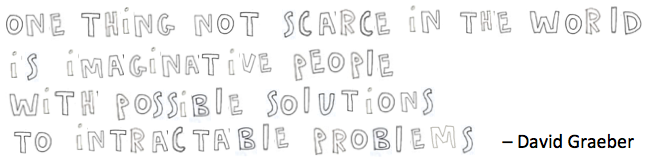
8 min – any functional society has something to do with brilliant, imaginative, but extremely impractical people.. we don’t know what to do with them anymore.. we used to put them in academia – but not academia is all about self- marketing
to max unexpected breakthroughs: get a bunch of people – give them resources they need.. leave them alone… most will end up with nothing, but a few will come up with something that will even surprise themselves
to min unexpected breakthroughs: take same people – tell them they won’t get any resources at all unless they spend the majority of their time competing with one another to prove to you that they already know what they’re going to create..
music in england has slowed – because ran out of money..
basic income would leave it up to people on the broad scale – would be a much more effective in creating the conditions where all of us want to see this happen. ..at the moment the system we have is very much about tying people down..
‘in undisturbed ecosystem ..the avg individual.. left to its own devices.. behaves in ways that serve/stabilize the whole’ –dana meadows
10 min – Peter – heavy on bits low on atoms… we could be doing so much more – like 40 yrs of stagnation – more than – why did this happen – what should be done now
what does it mean to be an anarchist – start thinking as if you are already free
starting paypal – didn’t hire any lawyers for first year because we knew they would tell us we couldn’t do it.. broke alot of rules.. in order to do..
i think – convincing a small # of people that a future could look really different – rather than trying to get a collective move.
we’re not going to get to mars by having endless debates.. an urgency to solving these problems.. not willing to wait for some mass movement.. just want to get going on it right now
how mars?
end of Peter
a cultural revolution w/o a social revolution
16 min – back to David – you don’t need to change people’s minds.. you change people’s minds by doing something..
20 min – – culture of stagnation a result of a culture of power
2o min – Peter – the people nimble in the art of writing for grants are displacing the idiosyncratic thinkers.. so screwed up b… so where should we be applying our energies.. i used to believe – all sorts of lobbying for internal change.. i concluded much more effective encouraging people to leave.. yes there are problems… but they are not where i want to put the focus of change…
22 min – David – to what degree can you work inside existing institutions… central question – what are most people going to do
24 min – Peter – where i disagree – is i get the sense that your idea is always a bigger thing – that will be more complicated in the long run – i think that is always what’s being underestimated
26 min – David – people don’t mostly understand is decentralization
Peter – things i like about that politically, but i’d like get back to the tech.. could you get people to the moon with a radically decentralized chaotic system
David – not exactly chaotic.. frankly.. creating very large scale is that hard. it’s really hard to create tiny structures. i totally agree on doing things now.
Peter – i’m not aware of any tech start up or research project that came about in this style. (radically decentralized) .. i think one’s that work are hierarchical.. start up is really far from democracy – people don’t get to vote on them
David – problem is we grow up being told we are in a democratic society.. a problem both of us.. it remains true that govt is source of most basic research (56%) corporate (16%), rest is unis and non profit. so start up is a nice model for certain things.. but i don’t think we have to assume that’s the only way for break throughs..
Peter – i think there’s very much broken in our society.. i can’t imagine a straight forward way to change these things from within. how do we get to mars? change the nasa funding.. very hard to do.
David – determination – nasa did pretty well getting to the moon. i agree it would be great to have somebody working on these things. but i also like to see a society where everyone is working on it. there has to be somebody who has an idea that neither one of us have thought of. the problem is those people are being told to shut up.. if we could unleash that..
32 min – David – there’s people out there that could solve these problems.. but they’re sitting around trying to figure out how to pay their bills..
33 min – Peter – all you have to do is go out the front door. i want to push back on the idea that people could do more. there are a lot of ways for people to do things. we’re not going to start by changing b at nasa or govt
35 min – Peter – i would define myself as a political atheist
David – so many know that so much are based on false premises
Peter – i’ll disagree with the money… i do think there is such a thing as an economy .. there is such a thing as scarcity – so you have a very complicated way of allocating things.. and it’s true we could print money – that’s not a solution to scarcity. when you print more money you don’t understand the underlying nature of the real goods.. i think the real problem is the problem of scarcity.. we need all sorts of new tech to enable that to happen. economics was the science of how to economize
David – i’m not saying we should print money – i’m saying we should ask what it means. money isn’t just measuring the value of stuff, it’s measuring action value.. creativity value…
39 min – David – basic income – leave it up to people – to create the conditions that both of us want to see happen. people think of ed not as creative expression.. but as a means to job.
Peter – scarcity is a major problem
42 min – David – if we don’t consciously act in ways to not reinforce the system.. we actually reinforce it. it’s great that there are pockets of people
Peter – i don’t think this is the most constructive thing to be doing. (the larger picture)
David – this is still largely in the financial sector
Peter – google has displaced goldman sacs.. there are problems in silicon .. but i think it’s the place that is mostly trying to do things..
David – is silicon valley actually posing a solution to that larger structure
Peter – no – but i would argue again.. we’re not going to change the structures.. a lot of things look like they are too small initially… in politics you have to convince too many people..
David –
Peter – i think there are huge problems to solve – spacex – and military
?
Peter – all the mass movements… didn’t get us to where we want.. there’s something to be said to figure out ways to stop another attack. there was no tech to stop terrorism in 2001





 be you.