dgi – nika & alastair at ccc – 12 29 25
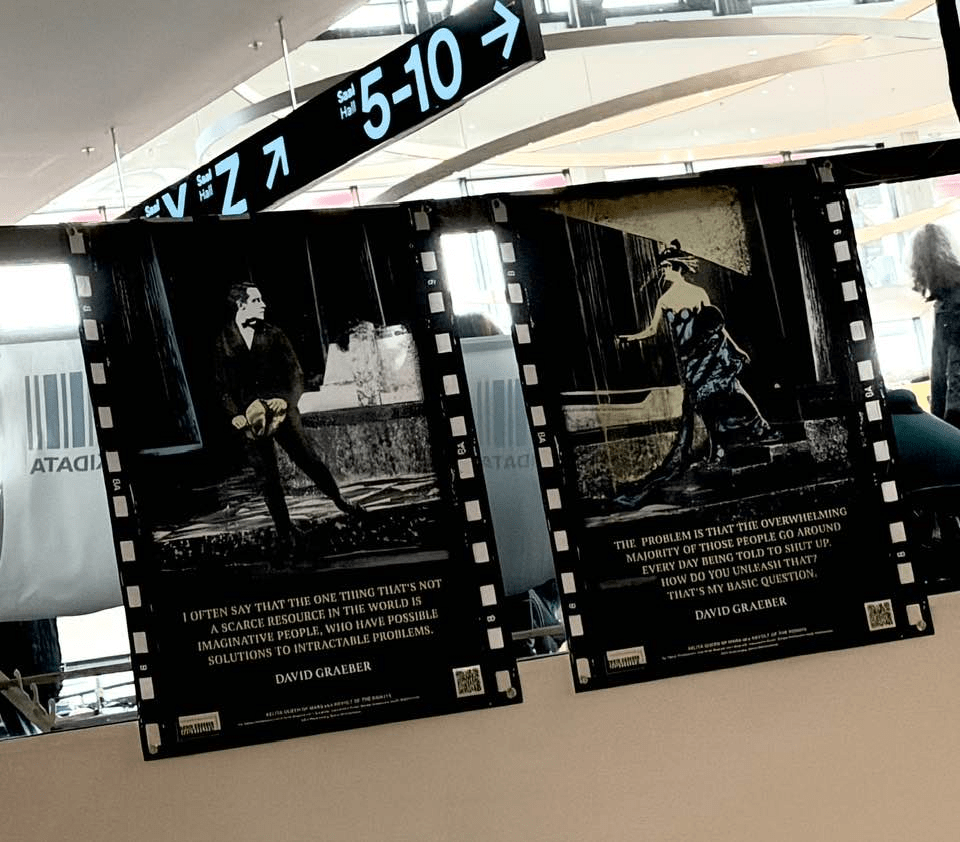
via nika tweet [https://x.com/nikadubrovsky/status/2005931144567476566?s=20] and fb post [https://www.facebook.com/photo/?fbid=10163516096648959&set=a.40039648958]:
All the dreams of a Soviet child come true at the Chaos Computer Club congress. No bureaucracy — solid poetic technology. Gather 30,000 wired (weirdos) in one huge space, where for a few days you have a completely own world without a state, with a pretty strict face control, because congress is hard to get to. You can definitely see what the world could be like if we built it ourselves.
And the best place in the world to hold a Visual Assembly. Unfortunately, you can’t only take pictures because there are a lot of real hackers in Congress who are not very happy about their pictures being made public.
nika dubrovsky at 39th chaos communications congress (ccc) dec 2025
nika on alastair.. nika on poetic techs.. et al
via ccc site [https://events.ccc.de/congress/2025/hub/en/event/detail/the-museum-of-care-open-source-survival-kit-collection]:
The Museum of Care: Open-Source Survival Kit Collection
The talk is about the ideas behind setting up the David Graeber Institute and the Museum of Care. The Survival Kit Collection brings together collectives developing open source “social technologies” —spirulina farms, self-replicating 3D printers, modular housing, low-cost water systems, and … art and education. In 2019, together with David Graeber, we held the first workshop about the Museum of Care at CCC to reimagine the relation between freedom, technology and value. Over these 6 years, the Museum of Care and the David Graeber Institute have experimented with various projects: the survival collection, Visual Assembly, and creating an open space for horizontal knowledge production—something we hope to develop into an actual University.
We think humanity could already be living in a society of abundance and communal luxury. We have the technologies to produce enough for everyone to have everything. The issue isn’t technological but social. This is why we need a Museum (of Care): museums are among the few places that create, distribute, and preserve what a society values.
What will be at the session: We’ll tell in more detail about the concept of the Museum of Care on abandoned ships (of which, according to Maritime Foundation data, there are more than 4,500 in the world). We’ll talk about the halls of our museum: the Hall of Giants and other emerging spaces. Projects we’re building—spirulina farms, 3D printers—in Saint Vincent (Caribbean) and Kibera Art District, Nairobi Kenya, Playground designed that communities can construct with nearly no resources. Can we actually build a nomadic museum proud not of its unique exhibits but of how easily they spread and get replicated?
Then we will move to an open conversation about what poetic technologies are and how they differ from bureaucratic ones. Some people may have read David Graeber’s book The Utopia of Rules; here you can download his other texts that are less widely known or not yet published. We would very much like to explore the question of poetic and bureaucratic technologies together with you. To facilitate this discussion, the David Graeber Institute has invited Alistair Parvin, creator of the Wiki House project, to join Nika Dubrovsky in conversation.
alastair parvin.. nika on alastair
The discussion continues in the format of a Visual Assembly—focused on building a distributed, non-hierarchical, genuinely open University with different ideas of funding and knowledge production. This is the very beginning of the process so all input is very much welcome. We’d welcome any ideas, critiques, or proposals for collaboration.
via dgi site [https://davidgraeber.institute/dgi-at-at-39c3/]:
Poetic technologies can be dark, brutal, dangerous—and that’s fine. Freedom isn’t safe. Bureaucratic technologies promise safety through perfect, eternal rules. They deliver gulags, surveillance states, bureaucratic nightmares. Without exception.
Speaking at #39C3 about the Museum of Care and the David Graeber Institute — survival kit collections, abandoned ships as museums and DGU Uni in East Africa. But most importantly, discussing with Cory Doctorow and Alastair Parvin (WikiHouse) what a university built around poetic technologies could look like. Poetic technologies aren’t gentle or beautiful—they can be dark, dangerous. But that’s what freedom looks like. Bureaucratic technologies promise salvation through “correct rules once and for all.” Always ends the same way.
The talk and dialogue will be available to watch online.
notes/quotes from livestream – missed live.. 37 video recording.. [https://media.ccc.de/v/39c3-the-museum-of-care-open-source-survival-kit-collection]:
via youtube days later [https://www.youtube.com/watch?v=PXzzV02pZGw]
nika: how dgi was born and what we’re doing now.. also connected to cybernetics.. learning and development from social interactions.. ways people make and remake their world.. close to chomsky ideas.. ways to explore what people actually do imagine and do together..
2 min – m of care created out of carnival.. in many places.. london, new zealand, berlin, all around world.. last one in london 2025.. next will be in narobi.. the two books he took dotestky and bhakin.. set up m of care based on connections made at carnival..
4 min – also from essay david and i wrote.. another art world.. produce/reproduce value system.. a system of knowledge production that needs to be replaced.. what m of c is trying to do.. david: ‘humans are riddle created beings.. so need symbols.. ‘
6 min – on creating museums on ships.. our idea is to create a collection in a museum that anybody can come/copy/take with them.. reproduction of life rather than projects.. so we have self rep rap.. open source food.. started to work in st vincent in prison.. a non commercial space.. also have people who want to learn and have a lot of free time.. (museum of care survival kit collection).. spurlina farm, playground
8 min – on poetic and bureaucratic techs.. very important to david.. he coined term of poetic tech.. built on open model.. for survival people.. not only need food, shelter, water.. also need freedom..t so this survival kit collection not like ngo project where we save people from something.. reproduction of human life based on play.. so very diff.. a kind of utopian thinking.. techno optimist vision.. utopia place that didn’t exist.. from city of the son 1602 – society org’d.. marriage arranged by state.. seeing which organs fit best..
something we’ve not yet tried/seen.. ie: life (freedom) over survival ness
ie: legit freedom will only happen if it’s all of us.. and in order to be all of us.. has to be sans any form of measuring, accounting, people telling other people what to do
12 min – alastair @AlastairParvin: to talk about playground.. i’m a designer.. not an architect.. founder of open systems lab.. working on design of systems.. most of the time i’m working on things like wiki house.. so this is a bit of a departure.. so i ask why it’s important.. specifically about ed.. unis.. not going to try and get into many corrupted functions of ed.. labor market supply et al.. we know ed is infinitely more important than that.. ed is how you are allowed to start again.. if strip that away.. dangerous.. ed structure is in trouble.. cost going up.. value going down and down..
16 min – alastair: uk at worst end of lots of these problems.. housing uni et al.. fees, rents, incomes.. new system of debt.. typical student burdened w debt upon graduation.. psych impact that has on people.. the choices that it then drives people to make.. institution turns out to do exact opp of what intended to do .. intended to free people up..
18 min – alastair: landlords are making the money from ed.. almost double the unis.. going to break.. history tells us it always breaks.. david wrote about this in debt..
19 min – alastair: exciting thing about this.. as david said.. we can remake it.. people getting such a bad deal.. good opp.. people will vote with their feet.. leaving old system and joining new one.. big unis aren’t going anywhere.. but rest is starting to decline.. what are the phases of emergence of new practices of what ed could look like.. ie: from 3-4 yrs to life long; debt driven to experimentation; knowledge models from gatekeep to open source;
22 min – alastair: what’s the infra of this?.. going back to rent.. if you can disrupt that.. where people not in just one place.. but many.. ie: finding old abandoned farm buildings.. part of network communities.. residential component..
23 min – alastair: idea nika is exploring.. using existing shared spaces in cities.. intertwining of ed w rest of life.. just having space to gather.. t
city sketchup ness et al
how we gather in a space is huge.. need to try spaces of permission where people have nothing to prove to facil curiosity over decision making.. because the finite set of choices of decision making is unmooring us.. keeping us from us..
24 min – alastair: what are the basic design principles for this.. like wiki house.. essentially making buildings more like good software.. sharing.. this is what we’ve begun to do.. a kind of idea.. some org’s come forward and say ‘we’ve got this space’.. ie: tent ness as more adaptable.. no need of complex bureaucracy.. commons.. public space w infra.. treating it more like art/playground.. sits outside fin/reg systems..
27 min – nika: this is visual assembly we want to put in middle of playground.. idea david and i came up with together.. people trained to be public speakers is confining.. so if open up to ie: drawing (rather than just speaking in official language).. all people can join.. playground same as abandoned ship.. idea of playground .. there is no one best playground.. supposed to be many of them.. alastair and i want to invite you to think about ed spaces instead of just playgrounds.. so come at 530 .. cory will join us.. to imagine space.. we want to hear how we can build this space together..
30 min – q&a
nika: in east africa.. going to purchase piece of land or building and start to build these ed spaces w public lectures.. hope to get a license for 2 yr master program.. and have diff ideas of how to fund it.. so not from students.. it’s a big deal.. want to have these spaces for free.. weird if come to playground and have to purchase tickets..
32 min – alastair: to me that’s the least difficult/interesting part.. i would say what is the hardware for this space.. what is the protocol.. t
tech as nonjudgmental expo labeling
legit freedom will only happen if it’s all of us.. and in order to be all of us.. has to be sans any form of measuring, accounting, people telling other people what to do
how we gather in a space is huge.. need to try spaces of permission where people have nothing to prove to facil curiosity over decision making.. because the finite set of choices of decision making is unmooring us.. keeping us from us..
ie: imagine if we listen to the itch-in-8b-souls 1st thing everyday & use that data to connect us (tech as it could be.. ai as augmenting interconnectedness)
the thing we’ve not yet tried/seen: the unconditional part of left to own devices ness
[‘in an undisturbed ecosystem ..the individual left to its own devices.. serves the whole’ –dana meadows]
there’s a legit use of tech (nonjudgmental exponential labeling) to facil the seeming chaos of a global detox leap/dance.. for (blank)’s sake..
ie: whatever for a year.. a legit sabbatical ish transition
otherwise we’ll keep perpetuating the same song.. the whac-a-mole-ing ness of sea world.. of not-us ness.. of part\ial ness.. [again].. for (blank)’s sake..
33 min – nika: crucial part is that it’s not an ideal uni.. but part of a network.. people always ask how to fund it..
q: what are the conditions you see
alastair: i don’t know.. on the software.. so many amazing people in big unis.. but when i speak to people.. they tell similar versions.. ‘hard to get into .. costs a lot of money.. then when get in there.. lots of cruddy behavior’.. so models that seriously get rid of those models.. might go beyond just being respectful.. ie: whether work out puts are public goods..et al
35 min – nika: david was hoping he could quit his job and work in open uni.. lectures online for free.. very view join.. need rules to be playful
?
36 min – q: do you have any partners in e africa
nika: working now with one of biggest slums in nairobi.. but would love to connect with you..
______
____
_____
______
_____
______
______





 be you.