legibility and control
Legibility & Control: Themes in the Work of James C. Scott
(2011) by Kevin A. Carson via 38 pg pdf from center for stateless society site [https://c4ss.org/wp-content/uploads/2011/05/James-Scott.pdf]
legible ness and control ness and social control ness and james c scott and kevin carson
adding page while also reading james c scott‘s against the grain
intro’d to this paper (as noted on top of james c scott page):
adding page while reading two cheers for anarchism.. and after reading ie: art of not being governed and also kevin carson refs scott a lot ie from communism of everyday life
notes/quotes:
3
Opacity and Legibility.
In Seeing Like a State, Scott develops the central theme of “legibility,” which will be involved in most of our lines of analysis below. It refers to
*a state’s attempt to make society legible, to arrange the population in ways that simplified the classic state functions of taxation, conscription, and prevention of rebellion..t Having begun to think in these terms, I began to see legibility as a central problem in statecraft. The premodern state was, in many crucial respects, partially blind; it knew precious little about its subjects, their wealth, their landholdings and yields, their location, their very identity. It lacked anything like a detailed “map” of its terrain and its people. **It lacked, for the most part, a measure, a metric, that would allow it to “translate” what it knew into a common standard necessary for a synoptic view..t ***As a result, its interventions were often crude and self-defeating..t
*legible ness huge red flag we’re doing it wrong.. so as cancerous distraction.. lit & num as colonialism et al
**the common standard we need is to let go (of all the order ness – carhart-harris entropy law et al) enough to see/try the unconditional part of left to own devices ness..
***until we get to the root of problem.. all is ‘self-defeating’.. perpetuating the whac-a-mole-ing ness of sea world
….How did the state gradually get a handle on its subjects and their environment? Suddenly, processes as disparate as the creation of permanent last names, the standardization of weights and measures, the establishment of cadastral surveys and population registers, the invention of freehold tenure, the standardization of language and legal discourse, the design of cities, and the organization of transportation seemed comprehensible as attempts at legibility and simplification. In each case, officials took exceptionally complex, illegible, and local social practices, such as land tenure customs or naming customs, and created a standard grid whereby it could be centrally recorded and monitored….1
inspectors of inspectors ness et al.. any form of measuring, accounting, people telling other people what to do
How were the agents of the state to begin measuring and codifying, throughout each region of an entire
kingdom, its population, their landholdings, their harvests, their wealth, the volume of commerce, and so on?
…
Each undertaking… exemplified a pattern of relations between local knowledge and practices on one
hand and state administrative routines on the other…. In each case, local practices of measurement and
landholding were “illegible” to the state in their raw form. They exhibited a diversity and intricacy that
reflected a great variety of purely local, not state, interests. That is to say, they could not be assimilated into an administrative grid without being either transformed or reduced to a convenient, if partly fictional, shorthand. The logic behind the required shorthand was provided… by the pressing material requirements of rulers: fiscal receipts, military manpower, and state security. In turn, this shorthand functioned… as not just a description, however inadequate. Backed by state power through records, courts, and ultimately coercion, these state fictions transformed the reality they presumed to observe, although never so thoroughly as to precisely fit the grid..t.2
What is new in high modernism, I believe, is not so much the aspiration for comprehensive planning. Many imperial and absolutist states have had similar aspirations. What are new are the administrative technology and social knowledge that make it plausible to imagine organizing an entire society in ways that only the barracks or the monastery had been organized before. In this respect, Michel Foucault’s argument in Discipline and Punish… is persuasive.3
we need to try a nother way.. one that no one has yet tried/seen
In any case, Foucault’s analysis in some passages is almost a word-for-word anticipation of Scott, to the
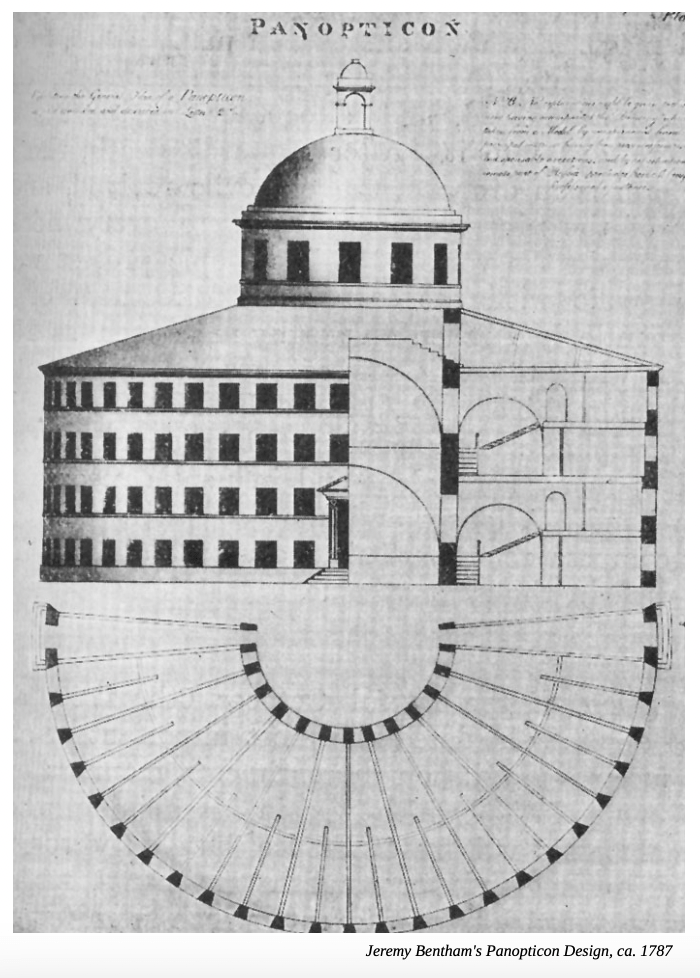
Bentham’s Panopticon, as described by Foucault, is just one example of an institution4
architecturally designed to render its inmates as legible as possible to those in authority. Foucault
applies the same panoptic principle of legibility to monasteries, military formations and camps,
hospitals, asylums, schools and factories. In every case the basic principle is partitioning, in order to
eliminate ambiguity and organize the institution—or society—on the basis of “Each individual has his
own place; and each place its individual.”..t
Avoid distributions in groups; break up collective dispositions; analyse confused, massive or transient
pluralities. Disciplinary space tends to be divided into as many sections as there are bodies or elements to be distributed. One must eliminate the effects of imprecise distributions, the uncontrolled disappearance of individuals, their diffuse circulation, their unusable and dangerous coagulation; it was a tactic of antidesertion, anti-vagabondage, anti-concentration. Its aim was to establish presences and absences, to know where and how to locate individuals, to set up useful communications, to interrupt others, to be able at each moment to supervise the conduct of each individual, to assess it, to judge it, to calculate its qualities or merits..t4
In every case the institution was an “observatory” in which power and discipline resulted from the
ability to see:..t5
“The perfect disciplinary apparatus,” in short, “would make it possible for a single gaze to see
everything constantly.”9 That was, essentially, the purpose of Bentham’s Panopticon: “to induce in the
inmate a state of conscious and permanent visibility that assures the automatic functioning of power.”10
This principle applied above all to the relationship between the state and the citizenry in society at large. The Fourierist journal La Phalange, with deliberate irony, described the implicit philosophy behind a judge’s remarks to a vagrant prosecuted in his court:..In short, one should have a master, be caught up and situated within a hierarchy; one exists only when fixed in definite relations of domination….11..t
In all these ways—by the division of labour; the supervision of labour; fines; bells and clocks; money incentives; preachings and schoolings; the suppression of fairs and sports—new labour habits were formed, and a new time-discipline was imposed.16
6
This should sound familiar to any student of Friedrich Hayek. In his classic essay “The Use of
Knowledge in Society,” Hayek wrote of “distributed knowledge”:
If we possess all the relevant information, if we can start out from a given system of preferences, and if we command complete knowledge of available means, the problem which remains is purely one of logic. That is, the answer to the question of what is the best use of the available means is implicit in our assumptions. The conditions which the solution of this optimum problem must satisfy have been fully worked out and can be stated best in mathematical form: put at their briefest, they are that the marginal rates of substitution between any two commodities or factors must be the same in all their different uses. [Which amounts to a fair summary of the neoclassical view of the firm as a “black box” guided by a production function which is given.—K.C.]
This, however, is emphatically not the economic problem which society faces….
The peculiar character of the problem of a rational economic order is determined precisely by the fact
that the knowledge of the circumstances of which we must make use never exists in concentrated or
integrated form but solely as the dispersed bits of incomplete and frequently contradictory knowledge which all the separate individuals possess. The economic problem of society is thus not merely a problem of how to allocate “given” resources—if “given” is taken to mean given a single mind which deliberately solves the problem set by these “data.” It is rather a problem of how to secure the best use of resources known to any of the members of society, for ends whose relative importance only these individuals know. Or, to put it briefly, it is a problem of the utilization of knowledge which is not given to anyone in its totality.227
Today it is almost heresy to suggest that scientific knowledge is not the sum of all knowledge.
ultimate decisions must be left to the people who are familiar with the circumstances, who know directly of the relevant changes and of the resources immediately available to meet them. We cannot expect that this problem will be solved by first communicating all this knowledge to a central board which, after integrating all knowledge, issues its orders.24
Mētis overlaps to a considerable extent with what Michael Polanyi calls “tacit knowledge”: skills
acquired through muscle memory or otherwise through practice, that can only with difficulty (or not at
all) be reduced to a verbal formula and conveyed in the form of spoken or written instruction.25 Scott
gives the example of “trying to write down explicit instructions on how to ride a bike….”26 Hence
“most crafts and trades requiring a touch or fee for implements and materials have traditionally been
taught by long apprenticeships to master craftsmen.”27
Alex Pouget suggests one reason that so much situational knowledge resists reduction to a verbal
formula. Some neurologists believe the brain functions as a Bayesian calculating device, “taking
various bits of probability information, weighing their relative worth, and coming to a good conclusion
quickly”:
…[I]f we want to do something, such as jump over a stream, we need to extract data that is not inherently part of that information. We need to process all the variables we see, including how wide the stream appears, what the consequences of falling in might be, and how far we know we can jump. Each neuron responds to a particular variable and the brain will decide on a conclusion about the whole set of variables using Bayesian inference.
As you reach your decision, you’d have a lot of trouble articulating most of the variables your brain just
processed for you. Similarly, intuition may be less a burst of insight than a rough consensus among your
neurons.28
democratic admin – ie: decision making.. consensus.. cancerous distractions.. that finite set of choices is keeping us from us
9
But nearly the opposite is often true. As Hayek suggested (see below in the section “Seeing Like a
Boss and the Art of Not Being Managed”), and as is borne out in empirical evidence presented by such
writers as Harvey Leibenstein and Barry Stein,37tweaks and changes in the configuration of existing
machinery, and more efficient organization of production with existing plant and equipment—things
which cost little in the way of new investment, and which workers are usually best equipped to
determine—can result in greater productivity increases than the introduction of a new generation of
machinery. A large share of technical innovation consists of creative mashups of existing off-the-shelf
building block technologies. And a disproportionate amount typically comes out of small skunk works
which attempt to replicate the small shop within a corporate bureaucracy.
we don’t need greater productivity (norton productivity law et al)
10.
A civilization based on authority-and-submission is a civilization without the means of self-correction.
Effective communication flows only one way: from master-group to servile-group. Any cyberneticist knows that such a one-way communication channel lacks feedback and cannot behave “intelligently.”
The epitome of authority-and-submission is the Army, and the control-and-communication network of
the Army has every defect a cyberneticist’s nightmare could conjure.
One-way communication creates opacity from above; two-way communication creates horizontal
legibility. To quote Michel Bauwens:
The capacity to cooperate is verified in the process of cooperation itself. Thus, projects are open to all
comers provided they have the necessary skills to contribute to a project. These skills are verified, and
communally validated, in the process of production itself. This is apparent in open publishing projects such as citizen journalism: anyone can post and anyone can verify the veracity of the articles. Reputation
systems are used for communal validation. The filtering is a posteriori, not a priori. Anti-credentialism is
therefore to be contrasted to traditional peer review, where credentials are an essential prerequisite to participate.
you’re still talking about essential prereq’s.. so still cancerous distraction
legit freedom will only happen if it’s all of us.. and in order to be all of us.. has to be sans any form of measuring, accounting, people telling other people what to do
how we gather in a space is huge.. need to try spaces of permission where people have nothing to prove to facil curiosity over decision making.. because the finite set of choices of decision making is unmooring us.. keeping us from us..
ie: imagine if we listened to the itch-in-8b-souls 1st thing everyday & used that data to connect us (tech as it could be.. ai as augmenting interconnectedness)
need to try the unconditional part of left to own devices ness..
there’s a legit use of tech (nonjudgmental exponential labeling) to facil the seeming chaos of a global detox leap/dance.. the unconditional part of left-to-own-devices ness.. for (blank)’s sake.. and we’re missing it
ie: whatever for a year.. a legit sabbatical ish transition
P2P projects are characterized by holoptism. Holoptism is the implied capacity and design of peer to
[peer] processes that allows participants *free access to all the information about the other participants; not in terms of privacy, but in terms of their existence and contributions (i.e. horizontal information) and **access to the aims, metrics and documentation of the project as a whole (i.e. the vertical dimension). This can be contrasted to the panoptism which is characteristic of hierarchical projects: processes are designed to reserve ‘total’ knowledge for an elite, while participants only have access on a ‘need to know’ basis. However, with P2P projects, communication is not top-down and based on strictly defined reporting rules, but feedback is systemic, integrated in the protocol of the cooperative system.43
*makes no diff how free it is.. we need a different kind (to date just been using non legit data.. like data from whales in sea world).. need to try the unconditional part of left to own devices ness via ie: self-talk as data.. that imagine if we ness above..
**i don’ think that’s how legit free people would dance.. just how we’ve been engrained to ‘dance’
[probably won’t keep reading]
_______
_______
______
______
_____
______





 be you.