devansh on snowmoon ness
via random quote tweet [https://x.com/devanshmehta/status/2109551398480224736?s=20]:
After reading millie’s tweet i was fascinated enough to clear up last weekend to fully read all 32 chapters of snowmoon end to end
I remember vitalik’s point from a talk earlier that too many crypto bros fantasize about having their own country but not enough think about what would actually be different in it
or they do.. but it’s not legit diff.. ie: sans any form of m\a\p
snowmoon is his answer to that question
actually not.. if want legit diff..
findings (aka: the things i can’t unsee) from on the ground ness deep dive and why we need tech w/o judgment
ie: the dance won’t dance unless/until it’s 1\ all of us 2\ legit free
nothing to date (ever since that day) has gotten to that root of problem
legit freedom will only happen if it’s all of us.. and in order to be all of us.. has to be sans any form of measuring, accounting, people telling other people what to do
The geopolitical setting of the novel is three primary groups: the arctic empire (a mix of russian expansionism with american exceptionalism), veridia (european equality with a cryptographic bureaucracy) and dzego (ukrainian resistance with asian ingenuity).
i see a *large impact of his novel as hyperstitioning the world we should create with the tech we’ve developed, so the rest of the post (spoilers ahead) **summarizes the technology, institutions and ideology strands in his narrative
*rather.. we could create if we tried/used tech/ai for the thing we can’t seem to do – rather than for perpetuating same song (aka: not diff).. ie: need means (nonjudgmental expo labeling) to undo hierarchical listening – so we can hear what’s already on each heart as global detox in order to org around legit needs
**this is why we need tech w/o judgment.. making ie: institutions/ideology/whatever else irrelevant s from the get go
A. Technology
1. Warfare has shifted almost entirely to drones. We get introduced to our Dzego protagonist zei when he is competing at a game that secretly doubles up as military recruitment strategy After all, war is just computer screens with human handlers like zei working with AI to wipe out enemy dots (drones) on the screen using their own dots
2. Zk, zk everywhere: A stranger walks up to Seila, the wife of Veridian protagonist Gladias, and says he works with her husband. Naturally suspicious, she asks for evidence and he gives a zk proof showing that he spends a lot of time in proximity to him. The book is rife with zk proliferation, for example entering some buildings simply requires a zk proof of a certain reputation score the best one was the freetown economics institute, where you are charged the square root of every minute you are in the building, but the price per minute is cheaper if your academic reputation score is high
3. Voice AI and personal agents feature prominently in the book. Any character can access LLMs at any time by simply moving throat muscles in a barely audible whisper. AIs are also linked to people, so when the Veridian protagonists wife calls him in an agitated state, the call shows up in red to indicate her emotional mood at the time of calling
4. Defi gets a mention as the protagonist forgets to transfer funds into his wallet, so he simply takes out a loan against his reputation score to pay the vendor To secure a meeting with senators, characters sometimes burn zipcoin to show that they wont waste the persons time
5. There are 2 social media platforms in snowmoon, bluewhale which is proprietary and silverchat which is fully cryptographic. Civic technology is much more advanced in his world, so towards the end they run a cryptographic poll on silverchat asking what the citizens of Veridia desire as a response to the arctic empires encroachment of their territory, with results used to establish legitimacy for declaring a military emergency. The AI bots on silverchat access confidential military information and provide forecasts on likelihood of success for each option to inform voters on likely consequences of their vote
The technology theme in the book is a useful guide for us, as we now just need to work backwards from snowmoon to work at their integration in daily life
if working backwards from tech gets you to institutions and ideology.. tech is still doing same things.. perpetuating the same song.. the whac-a-mole-ing ness of sea world.. of not-us ness.. of part\ial ness.. perpetuating survival triage.. for (blank)’s sake..
B. Institutions This segment is really interesting in how Vitalik sees cryptographic institutions (called the steering) operating in the world. far from replacing parliament and other democratic structures, they instead work in parallel. The Steering has primarily 5 bureaucratic roles;
1. keepers design rubrics that incentivize certain behaviors or actions. for example, if a music concert has violent themes, they fit into a category that pays a greater tax almost nothing is banned in veridia, it is simply taxed more or less depending on how good it is for society
2. sentinels enforce these rubrics, performing spot checks by going to the concert and assigning a tax category to it One of the other great examples was on how land tax is assessed, where citizens walking down the road may be randomly polled to give their rating on the aesthetics of a building, which determines its band hilariously, citizens in veridia end up choosing the highest tax slab on plum harbor for reasons other than aesthetics as they dont like its ideology
3. Next up are acolytes who train to be sentinels or keepers. their exam is performing the same spot checks as sentinels and getting judged on how closely their own assessments match with the sentinels All 3 of the organs above are anons, with a bounty paid to any citizen who uncovers the identity of steering members & the job they are working on Becoming part of the steering from an acolyte requires confirmation by parliament
4. Heralds are members of the steering that have relinquished all their responsibility so that they can be a public face of the steering its interesting that a public presence is perceived as incompatible with impartially carrying out duties
5. finally, the funding organs are quadratic funding and graph funding. QF is attacked in the book by closed social media giant bluewhale (and later the arctic empire) by paying out extra money to donors for giving money to a bad project. their goal is simply ensuring the matching funds do not go to genuine good projects that threaten their dominance. Graph funding is the more interesting organ, where some money may be allocated to a category like “airborne disease resistance”. the category then divides into nodes such as air quality, detection, prevention, treatment, etc each category has a cryptographic committee that sets a % split and removes or adds nodes. however, committees can easily separate the good from the bad but not the great from the good, so the top 10% all having equal chance of selection Another interesting tradeoff discussed is between randomized spot checkers who have less knowledge about an issue vs expert committee members who have abiliy to assess but special interests can end up capturing the other interesting point was how lower down talent needs accountability to perform well while the top ones should have freedom from optimizing for the game Overall this segment read like a blueprint for how bureaucracy should be reformed today, without having to overthrow existing institutions. Maybe the main idea was the tradeoff between accountability and transparency, as the steering turns out to be less corruptible by the arctic empire than democratic structures since their identities are secret and it is difficult to threaten or cajole them (although an attempt is made). after all, accountability also means accountability to powerful interest groups who push on the weakest link, so some privacy in public affairs is required for its effective functioning
C. Ideology This was maybe my favorite part of the book, what i loved was how the strongest version of arguments were presented instead of a strawman
1. the arctic empire argues for maximization of economic growth over all other objectives. the reason? other goals keep changing according to the winds of preferences, but compounding economic growth is a base that helps in pursuit of anything else which becomes the fashion of the day. so stop accelerating things that go in circles and focus on increasing economic output in my view none of the counters offered in the book invalidate the argument; a. health and education make people more productive and are also compounding across generations, so focusing on that is equally important b. in reality, people do not want to maximize economic output so much as increase their relative growth. in the novel, the arctic empire suppresses other countries science and technology, which goes against the ideology of increasing economic growth c. technological dominance can close off entire paths to humanity, so maximization of economic growth can lock us in to a certain path for decades. for eg becoming richer while reducing freedom thru lock into global imperial rule via mass surveillance and robots is negative
2. the other big strand was veridia’s belief in equality of all and love unconditional on achievement the arctic empire argues against this belief by showing that it goes against the very idea of self improvement for example, if you are a better version today than you were yesterday, then surely equality is impossible? the counters here are; a. rewarding excellence usually ends up protecting hierarchy of supposedly superior people In the novel, a character defects to the arctic empire. however she soon loses her enthusiasm for their meritocratic ideals after being thrown in detention for challenging the instructor b. excellence can come from curiosity more than it does from greed for appreciation or resentment at others. the winner of the national game zei is motivated by curiousity, compared to the runner up that cared about the achievement c. affection when someone is struggling helps them thrive more than condemnation upon failure and adulation upon success so being countercyclical in our encouragements brings out the best, in one instance a hug to Gladias made the difference in giving him the motivation to continue at the same time, there is a concession that Veridia needs more ambition and recognition of achievement in their society my favorite moment in the book was when the dzegoban protagonist zei has a game against a girl he has grown up with, bai she asks whether they should spend the day at the mall instead of practicing drills. He goes on a long thought around game theory and how if they both dont practice neither has an advantage over the other, so its a good idea, while she simply replies that she’d like the economic surplus of spending time with him
overall definitely worth the weekend read, hope we see printed copies of it soon!
Maybe the biggest underexplored theme in the book which i’d have liked to see more of was around how the future of work changes in a world of LLMs
oi
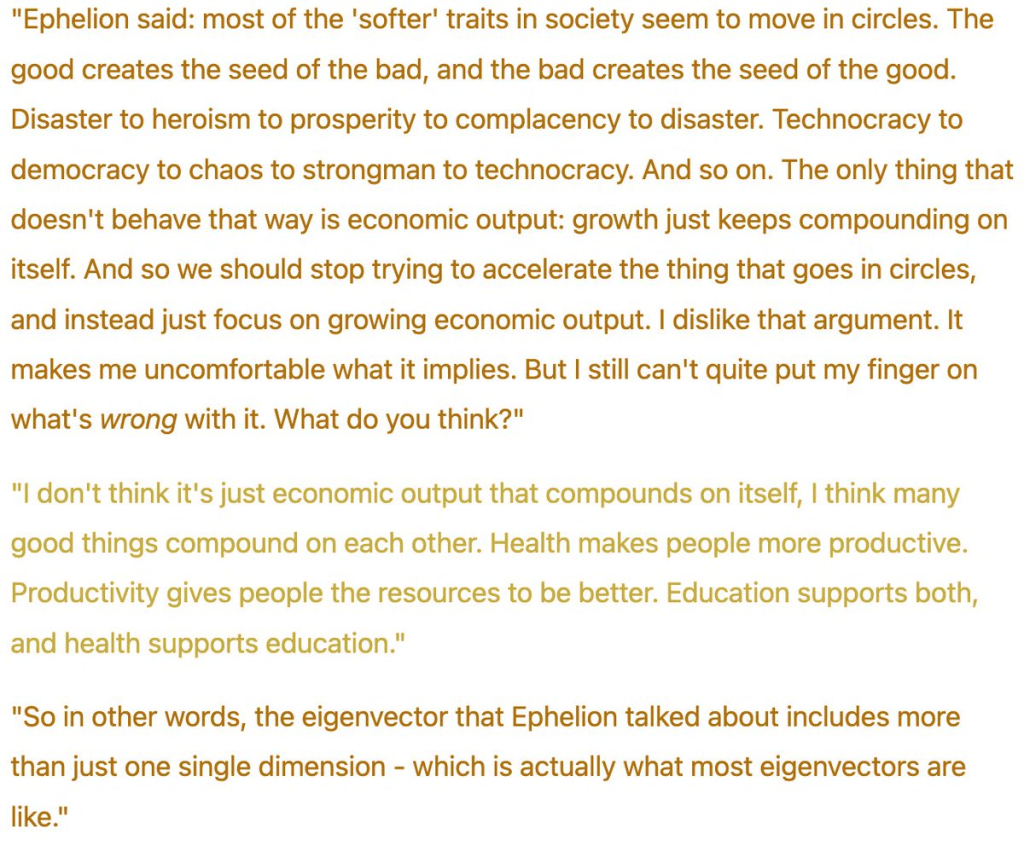
yeah.. we should stop trying to accelerate the thing that goes in circles.. ie: any form of m\a\p; econ output ness; productivity ness; et al
good bye cycle – aka: good bye any form of m\a\p
devansh was quote tweeting this tweet [https://x.com/llamaonthebrink/status/2106211141282357258?s=20]:
Last Sunday, Vitalik released the full version of Snowmoon.
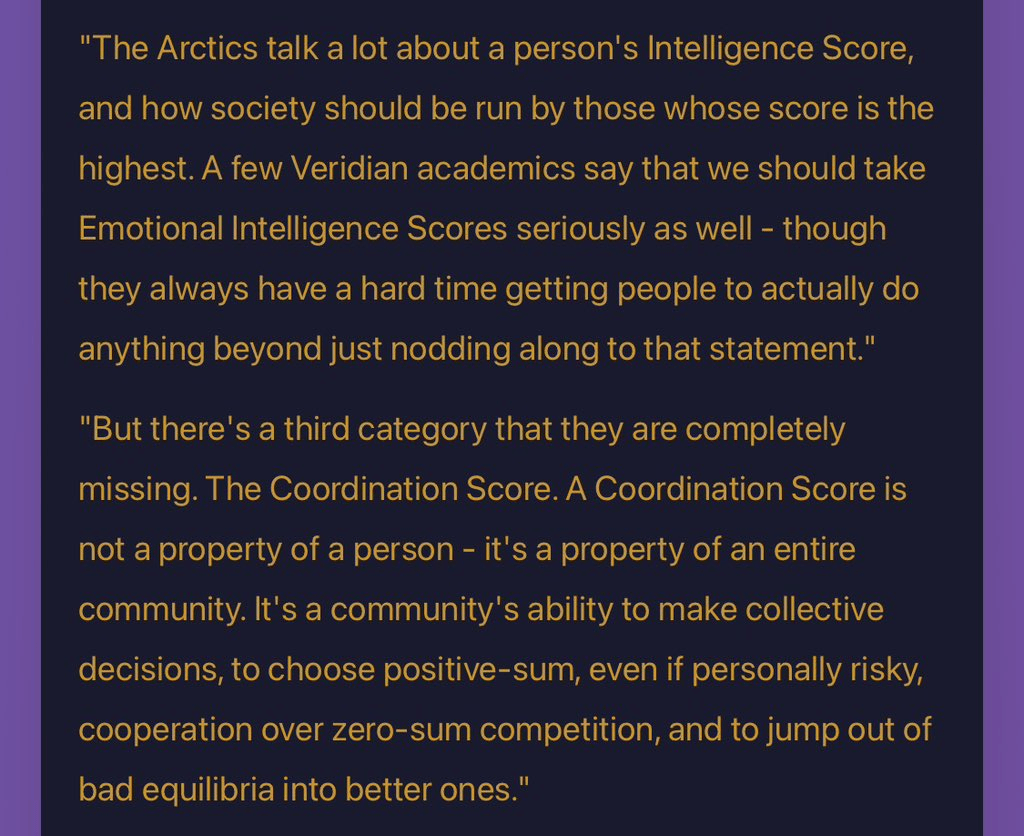
An underpinning concept to many of the ideas in the story is something V calls “Coordination Quotient.”
Coordination Quotient is his invention, there’s no pre-existing literature on that exact idea!
In simple terms, CQ is a cure for the prisoner’s dilemma or tragedy of the commons.
myth of tragedy and lord.. only ‘cured’ if we let go enough to try the thing we’ve not yet tried/seen: the unconditional part of left to own devices ness
[‘in an undisturbed ecosystem ..the individual left to its own devices.. serves the whole’ –dana meadows]
there’s a legit use of tech (nonjudgmental exponential labeling) to facil the seeming chaos of a global detox leap/dance
ie: whatever for a year.. a legit sabbatical ish transition
otherwise we’ll keep perpetuating the same song.. the whac-a-mole-ing ness of sea world.. of not-us ness.. of part\ial ness.. perpetuating survival triage.. for (blank)’s sake..
A community with high CQ is capable of defying its respective social or economic nash equilibrium.
aka: how to cope/live/perpetuate sea world
High CQ basically says that even if we are individually incentivized to act selfishly, we are effective at choosing to act in the collective interest without external forces pressuring us to.
how we gather in a space is huge.. need to try spaces of permission where people have nothing to prove to facil curiosity over decision making.. because the finite set of choices of decision making is unmooring us.. keeping us from us..
My personal analogy is that a society with a perfect Coordination Quotient wouldn’t need formal laws or a governing body to function at scale because it would be so good at acting in good faith and achieving sophisticated positive-sum goals.
rather.. wouldn’t need them because cq is same song as them
and millie was quote tweeting this tweet from vitalik buterin [https://x.com/VitalikButerin/status/2104216824258932907?s=20]:
Also this thing is done now https://vitalik.eth.limo/snowmoon/
______
_____
______
_____
_____
_____
____