time
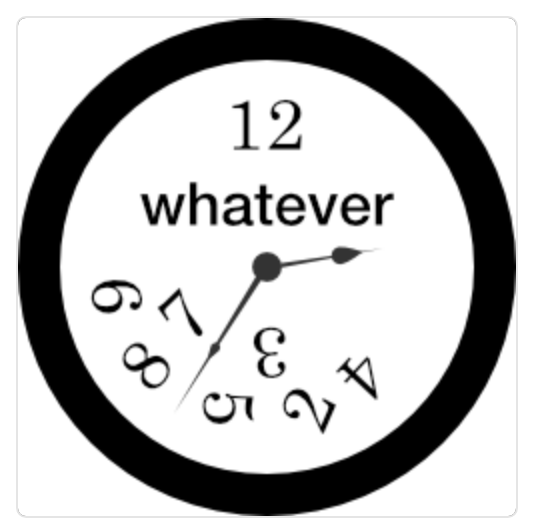
[image via david graeber‘s twitter pic.. story is below.. tweet linked to image above]
_________________
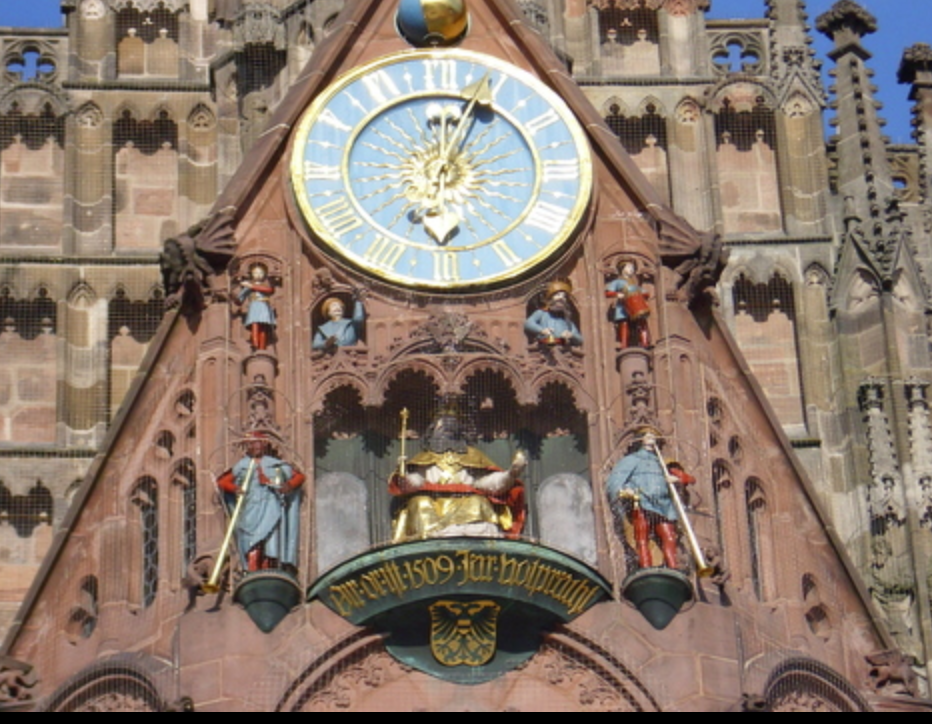
One of the most notable features of the church is the Männleinlaufen, a mechanical clock that commemorates the *Golden Bull of 1356.
*The Golden Bull of 1356 (German: Goldene Bulle, Latin: Bulla Aurea) was a decree issued by the Imperial Diet at Nuremberg and Metz (Diet of Metz (1356/57)) headed by the Emperor Charles IV which fixed, for a period of more than four hundred years, important aspects of the constitutional structure of the Holy Roman Empire. It was named the Golden Bull for the golden seal it carried [..] Besides regulating the election process, the chapters of the Golden Bull contained many minor decrees. For instance, it also defined the order of marching when the emperor was present, both with and without his insignia
The clock was installed in the church in 1506. The Holy Roman Emperor is shown seated with the prince-electors surrounding him.
The clock mechanism is activated at midday, when a bell is rung to start the sequence and is followed by the trumpeters and drummer. Then there is a procession of the electors around the figure of the Holy Roman Emperor.
running of men/boys – männleinlaufen
________
adding page while reading Erich Fromm‘s escape from freedom:
58
significant changes in the psychological atmosphere accompanied the economic development of capitalism. a spirit of restlessness began to pervade life toward the end of the middle ages. the concept of time in the modern sense began to develop. minutes became valuable; a symptom of this new sense of time is the fact that in nurnberg the clocks have been striking the quarter hours since the 16th cent..
too many holidays began to appear as a misfortune. time was so valuable that one felt one should never spend it for any purpose which was not useful.. work became increasingly a supreme value..
ie: we now celebrate (holidays for) fathers, black lives, children, the earth, whatever.. one day a year.. because we’re so busy w ie: work/school(seat time)/efficiency/supposed-to‘s.. the rest of the time/day
tweet while reading just now
Love humanity’s optimism (or sex drive). Couple making out on the floor of the airport at 6:00am. Love knows no time.
Original Tweet: https://twitter.com/gsiemens/status/988881259559452672
the idea of efficiency assumed the role of one of the highest moral virtues.. at the same time, the desire for wealth and material success became the all absorbing passion..
efficiency et al.. because.. now every minute must matter to commerce/power/hubris
_______
from David Graeber‘s bs jobs:
88
from.. .better to keep slaves busy .. no time on hands to plot to flee or revolt.. to.. you’re on my time.. idleness not so much dangerous.. but theft.. ..this is important because the idea that one person’ time can belong to someone else is actually quite peculiar..
as moses finley observes, any such notion would have to involve two conceptual leaps.. first.. to think of potter’s capacity to work, his ‘labor power’ as a thing that was distinct from the potter himself (buy him as slave understandable.. buy his time not).. and second, to devise some way tot o]our that capacity out.. into uniform temporal containers – hours, days, work shifts.. that could then be purchased using cash.. how could you buy time..?
89
so how did we get to the situation we see today, when it’s considered perfectly natural for free citizens of democratic counties to rent themselves out in this way.. or for a boss to become indignant if employees are not working every moment of ‘his’ time
first had to involve a change in the common conception of what time actually was
time ness
90
in places w/o clocks time is measured by actions rather than action being measured by time.. (ie: distance to village.. two cookings of pot of rice)
edward evan evans pritchard speaking of the neur, a pastoral people of east africa: the neur have no expression equivalent to ‘time’ in our language, and they cannot, therefore as we can speak of time as though it were something actual, which passes, can be wasted, can be saved, and so forth.. i do not think that they ever experience the same feeling of fighting against time or having to coordinate activities w an abstract passage of time, because their points of reference are mainly the activities themselves, which are generally of a leisurely character. events follow a logical order, but they are not controlled by an abstract system, there being no autonomous points of reference to which activities have to conform w precision. neur are fortunate..
time is not a grid against which work can be measured, because the work its the measure itself
seat time.. but also.. stop measuring things..
let’s go for ongoing fittingness.. ie: eudaimonia
________
AJ Juliani (@ajjuliani) tweeted at 4:39 AM – 15 Jul 2018 :
Seneca on The Shortness of Time https://t.co/lnz4vQkZlM via @farnamstreet (http://twitter.com/ajjuliani/status/1018445061804167168?s=17)Unlike the predictable reaction we have to someone throwing away money (they’re crazy), we fail to think of the person who wastes time as crazy. And yet time is a truly finite, expendable resource: The amount we get is uncertain but surely limited. It’s even more insane to waste than money — we can’t make any more when it runs out!
The Roman philosopher Seneca said it well in a letter to Paulinus:
It is not that we have a short space of time, but that we waste much of it. Life is long enough, and it has been given in sufficiently generous measure to allow the accomplishment of the very greatest things if the whole of it is well invested. But when it is squandered in luxury and carelessness, when it is devoted to no good end, forced at last by the ultimate necessity we perceive that it has passed away before we were aware that it was passing. So it is—the life we receive is not short, but we make it so, nor do we have any lack of it, but are wasteful of it.
________
Maria Popova (@brainpicker) tweeted at 6:01 AM – 17 Jul 2018 :
“The sense of deep time brings a deep peace with it, a detachment from the timescale, the urgencies, of daily life… a profound sense of being at home, a sort of companionship with the earth.” Gorgeous @OliverSacks read: https://t.co/vpV99VLoHZ (http://twitter.com/brainpicker/status/1019190232258891779?s=17)
_______
whole thread:
Sleepymachine (@dreamysleeper) tweeted at 5:54 AM – 6 Sep 2018 :
Then I went to uni library—surprised: I read & understood decent portions of a few books (totally diff) in 1 sitting! Many hours passed: no ticking clock says I must absolutely be elsewhere. Maybe @davidgraeber’s clock logo’s clear now: in a good day, most hours fall away https://t.co/LgTbBidH5b (http://twitter.com/dreamysleeper/status/1037670363273019393?s=17)
on the need for 7bn people to have the luxury to do whatever they want.. so that we gain (tap into) the energy of 7bn alive people
__________
from David Wengrow‘s what makes civilization:
84
sacred commodities: the meso origins of product branding
a primary application of the writing system lay in distinguishing between subclasses of products on the basis of their constituent materials, ingredients and labour. labour was itself quantified in standard, commoditized units of timekeeping, from which our own sixty minute hour is ultimately derived
_______
Russell Brand (@rustyrockets) tweeted at 3:32 PM on Sun, Mar 31, 2019:
The clocks changing is such a blatant example of our willingness to be subjugated. I’ve literally just put myself to bed like an obedient little citizen.
(https://twitter.com/rustyrockets/status/1112467738470084615?s=03)
________
Seneca on time via Maria:
https://www.brainpickings.org/2019/04/17/seneca-letter-1-time/
What man can you show me who places any value on his time, who reckons the worth of each day, who understands that he is dying daily? For we are mistaken when we look forward to death; the major portion of death has already passed. Whatever years lie behind us are in death’s hands.
While we are postponing, life speeds by.
on hold ness
________
Michel Bauwens (@mbauwens) tweeted at 7:14 AM on Mon, Sep 30, 2019:
something very radical has happened to the financial system, please listen at least to the first five minutes
https://t.co/VZy9GRcJcH
(https://twitter.com/mbauwens/status/1178659422484213774?s=03)
25 min video – Keiser Report: Time No Longer Has a Price (E1442)
1 min – stacy: negative interest rates are poison – kohler
2 min – max: interest rate model is dead.. can’t make any diff between diff time values of money.. so this is the end game of monetization and neolib.. we get to watch in our lifetime.. social fall out will be spectacular.. we already see uprisings all over the world getting ready for the global insurrection against banker occupation..
3 min – reading from keiser report: historically banks made money out of time.. if time no longer has a price, because there is no more interest.. t.. nothing can be earned – moneymaven.io.. stacy: so time no longer has value
earn a living ness
4 min – max: so we’re entering a new post time.. not even post capitalism.. it’s post time.. we’re living in the twilight zone of banking.. time doesn’t exist..t
perfect opp/time – to get back to ie: circadian rhythm of an undisturbed ecosystem
‘in undisturbed ecosystems ..the average individual, species, or population, left to its own devices, behaves in ways that serve and stabilize the whole..’ –Dana Meadows
6 min – max: everything has been securitized and sold forward 20 yrs.. and everything has been consumed.. so now we’re in a dead planet – everything on planet earth is dead because it’s been securitized and we’ve consumed it all ..t
perfect opp/time to try something different.. new/old thinking on the global situation ie: a nother way for 8b people to live
stacy: time did have value.. but we cashed it all in for the next 40 years
not the value humanity needed.. we need to let go of money (any form of measuring/accounting) .. make that our planned obsolescence.. ie: ubi as temp placebo..
the rest goes into neg rates and current money market and bitcoin et al specifics – not deep enough
__________
via maria.. alan lightman’s einstein’s dreams: https://www.brainpickings.org/2021/08/28/alan-lightman-einsteins-dreams/
Long ago, before the Great Clock, time was measured by changes in heavenly bodies: the slow sweep of stars across the night sky, the arc of the sun and variation in light, the waxing and waning of the moon, tides, seasons. Time was measured also by heartbeats, the rhythms of drowsiness and sleep, the recurrence of hunger, the menstrual cycles of women, the duration of loneliness. Then, in a small town in Italy, the first mechanical clock was built. People were spellbound. Later they were horrified. Here was a human invention that quantified the passage of time, that laid ruler and compass to the span of desire, that measured out exactly the moments of a life. It was magical, it was unbearable, it was outside natural law. Yet the clock could not be ignored. It would have to be worshipped. The inventor was persuaded to build the Great Clock. Afterwards, he was killed and all other clocks were destroyed. Then the pilgrimages began.
rhythm of love.. circadian rhythm.. et al
________
from jiddu krishnamurti‘s freedom from the known:
58
chapter 9
[time – sorry – death]
We think that changes in ourselves can come about in time, that order in ourselves can be built up little by little, added to day by day. But time doesn’t bring order or peace, so we must stop thinking in terms of gradualness. This means that there is no tomorrow for us to be peaceful in. We have to be orderly on the instant
part\ial ness et al
When there is real danger time disappears, doesn’t it? There is immediate action. But we do not see the danger of many of our problems and therefore we invent time as a means of overcoming them. Time is a deceiver as it doesn’t do a thing to help us bring about a change in ourselves. Time is a movement which man has divided into past, present and future, and as long as he divides it he will always be in conflict.
Is learning a matter of time? We have not learnt after all these thousands of years that there is a better way to live than by hating and killing each other. The problem of time is a very important one to understand if we are to resolve this life which we have helped to make as monstrous and meaningless as it is.
huge
59
The first thing to understand is that we can look at time only with that freshness and innocency of mind which we have already been into. We are confused about our many problems and lost in that confusion. Now if one is lost in a wood, what is the first thing one does? One stops, doesn’t one? One stops and looks round. But the more we are confused and lost in life the more we chase around, searching, asking, demanding, begging. So the first thing, if I may suggest it, is that you completely stop inwardly. And when you do stop inwardly, psychologically, your mind becomes very peaceful, very clear. Then you can
really look at this question of time.
norton productivity law et al
Problems exist only in time, that is when we meet an issue incompletely. This incomplete coming together with the issue creates the problem. When we meet a challenge partially, fragmentarily, or try to escape from it – that is, when we meet it without complete attention – we bring about a problem. And the problem continues so long as we continue to give it incomplete attention, so long as we hope to solve it one of these days.
Do you know what time is? Not by the watch, not chronological time, but psychological time? It is the interval between idea and action. An idea is for self protection obviously; it is the idea of being secure. Action is always immediate; it is not of the past or of the future; to act must always be in the present, but action is so dangerous, so uncertain, that we conform to an idea which we hope will give us a certain safety
60
Now we are asking, can we put a stop to time? Can we live so completely that there is no tomorrow for thought to think about? Because time is sorrow. That is, yesterday or a thousand yesterday’s ago, you loved, or you had a companion who has gone, and that memory remains and you are thinking about that
pleasure and that pain – you are looking back, wishing, hoping, regretting, so thought, going over it again and again, breeds this thing we call sorrow and gives continuity to time.
graeber unpredictability/surprise law et al.. on hold ness et al
So long as there is this interval of time which has been bred by thought, there must be sorrow, there must be continuity of fear.
Time is the interval between the observer and the observed. That is, the observer, you, is afraid to meet this thing called death. You don’t know what it means; you have all kinds of hopes and theories about it; you believe in reincarnation or resurrection, or in something called the soul, the atman, a spiritual entity which is timeless and which you call by different names.. To discover that nothing is permanent is of tremendous importance for only then is the mind free, then you can look, and in that there is great joy.
61
We have separated living from dying, and the interval between the living and the dying is fear. That interval, that time, is created by fear. Living is our daily torture, daily insult, sorrow and confusion, with occasional opening of a window over enchanted seas. That is what we call living, and we are afraid to die, which is to end this misery. We would rather cling to the known than face the unknown – the known being our house, our furniture, our family, our character, our work, our knowledge, our fame, our loneliness, our gods – that little thing that moves around incessantly within itself with its own limited pattern of embittered existence.
62
Butdeath is extraordinarily like life when we know how to live. You cannot live without dying. You cannot live if you do not die psychologically every minute. This is not an intellectual paradox. To live completely, wholly, every day as if it were a new loveliness, there must be dying to everything of yesterday, otherwise you live mechanically, and a mechanical mind can never know what love is or what freedom is.
rowson mechanical law
_______
_______
________
________
________
time and space – needed
on hold ness
time/talent/share – sing for gas
timelines:
- level – decentralizing
- education – busting myths – what is ridiculous
- the zoom dance
________





 be you.