“If the word ‘revolutionary’ has been neutralized to the point of being used in advertising to describe the slightest change in an ever-changing commodity production, this is because the possibilities of a fundamentally *desirable* change are no longer expressed anywhere.”
If it seems somewhat ridiculous to talk of revolution, this is obviously because the organized revolutionary movement has long since disappeared from the modern countries where the possibilities of a decisive social transformation are concentrated. But *all the alternatives are even more ridiculous, since they imply accepting the existing order in one way or another. If the word “revolutionary” has been neutralized to the point of being used in advertising to describe the slightest change in an ever-changing commodity production, this is because the possibilities of a central desirable change are no longer expressed anywhere. Today the revolutionary project stands accused before the tribunal of history — accused of having failed, of having simply engendered a new form of alienation. This amounts to recognizing that the ruling society has proved capable of defending itself, on all levels of reality, much better than revolutionaries expected. Not that it has become more tolerable. The point is simply that revolution has to be reinvented.
*adding page(s) because of this.. on the cancerous distraction ness of not letting go enough to get away from same song ness
all the alternatives are even more ridiculous, since they imply accepting the existing order in one way or another
This poses a number of problems that will have to be theoretically and practically overcome in the next few years. We can briefly mention a few points that it is urgent to understand and resolve.
The Situationist International (SI) is an organization of revolutionary theorists, strategists, and activists operating in the cultural, artistic, political, and social fields who seek to put an end to class society and the “dictatorship of the commodity.” Its founders defined themselves, in the first issue of their journal in 1958, as those “who work to construct situations,” a “constructed situation” being a “moment of life, concretely and deliberately constructed by the collective organization of a unitary atmosphere and a set of events
It is originally the expression of a desire to go beyond the revolutionary attempts of the artistic avant-gardes of the first half of the 20th century , namely Dadaism , Surrealism and Lettrism .
Formally created inJuly 1957 At the unification conference of Cosio di Arroscia , the Situationist International was born from the coming together of an international group of avant-garde movements, including the Lettrist International (itself the result of a break with Isidore Isou ‘s Lettrism ), the International Movement for an Imaginist Bauhaus , the Psychogeographic Committee of London and a group of Italian painters . Its founding document, Report on the Construction of Situations…, was written by Guy Debord in 1957 . In this programmatic text, Debord posed the demand to “change the world” and envisaged the surpassing of all artistic forms by “a unitary use of all means of upheaval of daily life”. The surpassing of art was at the heart of his original project.
At first, the Situationists made a name for themselves through their use of puns as a critical weapon, deriding contemporary art to demonstrate the futility and superficiality of a so-called bourgeois culture.
Then the Situationist International quickly moved towards a critique of what they called the society of the spectacle , or “spectacular-market” society, and a denunciation of the “reign of survival ” accompanied by an objective of social revolution . The year 1962 saw the split between “artists” and “revolutionaries” and the exclusion of the former.
One of the main goals of the Situationist International became “the fulfillment of the promises contained in the development of the contemporary production apparatus and the liberation from historical conditions through a reappropriation of reality, and this, in all areas of life . “
It is a continuation of the anarchist and libertarian theses and actions of the past, in the lineage of different currents that appeared at the beginning of the 20th, notably the Marxist thoughts of Anton Pannekoek and Rosa Luxemburg , of council communism , the thought of the young Georg Lukács linked to his work History and Class Consciousness , as well as the work of the Socialism or Barbarism group ( Claude Lefort , Cornelius Castoriadis in particular) in the 1950s . In this sense, it can be related to an ultra-left group .
From an organizational point of view, the Situationist International maintains the Marxist position of a theoretical party aiming to represent “the highest level of revolutionary consciousness” . The theorization of this position only occurs quite late, in the Definition of Revolutionary Organizations (SI No. 11), adopted by the 7th Conference of the SI in 1967 and which will be in France one of the references of councilism after 1968 , and in 1969 in the Preliminaries on councils and councilist organization.
The Situationist International dissolved itself in 1972 after the publication of The Real Split in the International – Public Circular of the Situationist International .
The situationist project is based on:
Council communism : revolutionary struggle for the abolition of states and capitalism and the establishment of generalized self-management through the power of workers’ councils ( direct democracy ). The situationists fight above all for an egalitarian society freed from market relations, that is to say for communism in libertarian Marxism or anarchism .
the revolution of daily life, a libertarian and hedonistic project that could be summed up by this slogan: “ Live without downtime, enjoy without constraints ”.
The revolution of daily life can only be achieved within the framework of generalized self-management , on egalitarian bases, and by eliminating market relations. It is based on several ideas:
the abolition of the spectacle as a social relationship;
the participation of individuals (refusal of immutable representations);
communication (refusal of mediations as separate );
the realization and development of the individual (as opposed to his alienation ): the free use of oneself is one aspect of this development, but overall, the radical subjectivity of each person is supposed to develop in the refusal of the constraints of profitability, and this, in all areas, while retaining responsibility for one’s actions;
the abolition of work as alienation and an activity separate from life, which is summed up by a slogan, which Guy Debord attributes to himself, written in chalk on a wall of the quay leading to the Seine on the rue de Seine in 1952 (in Paris ): ” Never work “;
the refusal of any activity separated from the rest of daily life: the situationists fight for the abolition of contemplative art, of leisure as separate from everyday life, of the University and for the reunification of all human activities: the end of the division of labor and of the separations between the different sciences. They intend to take up the thread of a project stemming from Marx ‘s thought : communist self-management allows the activity of production to no longer be work and to merge with all other human activities in an artistic and poetic form . Thus, the activity of production is no longer separated from individual achievement, from leisure and from sexuality. More generally, the situationist project aspires to all human activities taking a poetic form (in the original sense of the ancient Greekποίησις, poíêsis : “action of doing, creation”): that of the free creation of situations by individuals.
To describe the modern stage of capitalism, Guy Debord explains and names the concept of “spectacle” approached by Marx. This concept has several meanings. The spectacle is above all the propaganda apparatus of capitalist power, but it is also “a social relationship between people mediated by images” . For Debord, the spectacle is the “material reconstruction of the religious illusion” . In this sense, the spectacle does not put an end to religion, but by anchoring the religious illusion on earth instead of rejecting it into the sky, it makes earthly life opaque and unbreathable.
This form of spectacle appeared with the consumer society , in the 1930s . Guy Debord distinguishes three forms of spectacle, the last of which succeeds the other two:
the concentrated spectacle of totalitarian societies ( state capitalism );
the diffuse spectacle of liberal societies;
the integrated show , which is the fusion of the first two in the course of history.
Guy Debord observes that in the 1980s the two forms of spectacle merged in the form of the “integrated spectacular”: henceforth, the spectacle is no longer only in the commodity, the social relations to which it predisposes or in the simple propaganda of power, “henceforth, the spectacle is present everywhere.”] It governs everything in the relations between people. Henceforth *all social relations tend to become market relations everywhere. They are no longer anything but relations of signifiers, in other words of simulacra . They are themselves simulacra.
**simulacra: an appearance that does not refer to any underlying reality
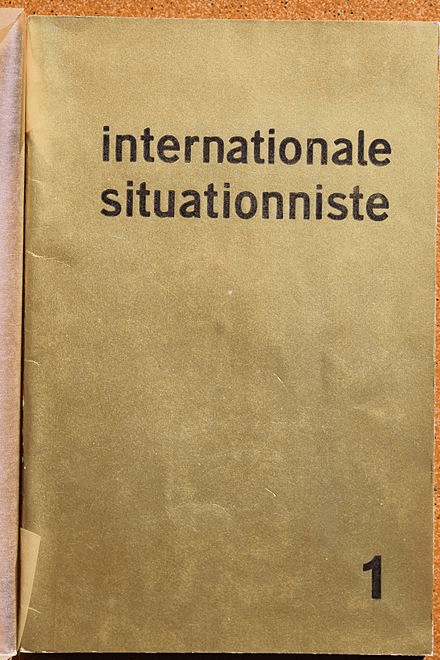
The Situationist International produced its theoretical works in its journal Internationale situationniste and especially in two books: Traité de savoir vivre à l’usage des jeunes générations ( 1967 ), by Raoul Vaneigem , and La société du spectacle ( 1967 ), by Guy Debord .
While being above all a group of theorists, the Situationist International distinguished itself in a concrete way on two occasions:
In Strasbourg, in 1967 , a year before the general strike in France, by “taking power” in the local section of the UNEF , and using it to publish ” On poverty in the student environmentconsidered under its economic, political, psychological, sexual, and notably intellectual aspects and some means to remedy it ” which was subsequently to be reprinted multiple times.
Before the outbreak of the general strike of May 1968 , through their direct influence on students, particularly in Nantes and at the University of Nanterre, where at the beginning ofFebruary 1968the group ” les Enragés “. These ” Enragés ”
In May 68 , the Situationist International expanded through the Comité Enragés-Situationnistes and especially then in the Council for the Maintenance of Occupations (CMDO), which would give birth to different “pro-situ” groups. When the CMDO dissolved – the factories were no longer occupied – the Situationist International reconstituted itself as such (group of theorists), before self-dissolving in the middle of an internal crisis, after a series of exclusions which reduced it to its simplest expression. Several of its ex-members, starting with Guy Debord, would play a major role in the appearance of the Champ Libre editions .
The fundamental positions developed in the Situationist International can be summed up by this extract from the Minimum Definition of Revolutionary Organizations, adopted by the conference of the Situationist International and reproduced in issue 11 of the journal:
“Considering that the sole aim of a revolutionary organisation is the abolition of existing classes by a path which *does not lead to a new division of society, we call revolutionary any organisation which consistently pursues the international realisation of the absolute power of the Workers’ Councils as outlined by the experience of the proletarian revolutions of this century… It (the organisation) radically criticises all ideology as a power separated from ideas and ideas of separate power.”
— Situationist International
*if workers councils et al.. then divisions et al
Self-dissolved in 1972 , the Situationist International remains today a little or poorly studied movement, particularly in view of its significant place in the history of political thought and in the history of artistic theories as well as the topicality of its critical discourse. The Situationists also do not recognize intellectual property . According to the formula that appears on the second cover of each issue of the journal: “All texts published in Situationist International may be freely reproduced, translated or adapted, even without indication of origin.”
In this sense, anyone can call themselves a situationist (or at least appropriate and use situationist ideas theoretically and practically, or ideologically), on the paradoxical condition of criticizing the Situationist International. Indeed, a situationist who does not criticize the situationists is not one: therein lies the difference between the situationists and those they themselves denounced under the term “pro-situs” (the followers of the ideology frozen in “situationism”). Indeed, the concept of “situationism” has always been denounced by the situationists, insofar as it would imply the existence of a situationist ideology with its dogmas and doctrine . Situationist theory, on the contrary, is based on permanent criticism and surpassing. In 1972 , the Situationist International became an outdated form of organization, but above all one to be surpassed , because according to it, it had completed its historical role. The members of the Situationist International therefore decided to dissolve their organization that year. In 1974 and later, former members excluded from the Situationist International then created the Situationist Antinational , the Nexialists , etc.
According to the synthesis of different analyses carried out by the researcher Jean-Christophe Angaut , situationist thought in 1968 was no longer simply characterised, as in 1965-1966, by the “rejection of trade union bureaucracies” and “the myriad of leftist groups” which duplicated them, but also by the emphasis placed on “demands in favour of self-management and direct democracy” .
The Situationists, for whom “living without downtime, enjoying without hindrance”, with its variations, was the main slogan, nevertheless played only a minor role during the month of May 68 , because “throughout the fateful month, Debord and his followers found themselves marginalized and relegated to the wings” , recalls Christophe Bourseiller . Very attentive to the form of its messages, due to the role of artists in its emergence, the Situationist International had however been weakened by the exclusion of artists from 1960, which explains its audience and modest numbers in the years preceding 1968 . Present at “the Sorbonne only from May 14 to 17, 1968, just three days” , the situationists were then, paradoxically, expelled from this cauldron of student action while they “only call themselves this because they want to construct favorable situations” , adds Christophe Bourseiller
From the early 1950s , the Situationists began to critique the market society in its very modernity. Unlike some Third World thinkers of the time, they placed the class struggle at the center of a subversive movement whose epicentre was in developed countries. By developing the programme of an insurrection that seeks its causes and its point of application at the very heart of the lives lived by their contemporaries, they proposed to update the programme set out in the Communist Manifesto (1848) by Karl Marx and Friedrich Engels , understood as the erasure of work in favour of a new type of free activity, the end of historical misfortune , generalised self-management, the advent of a society of masters without slaves, the realisation of art.
The Situationist International proclaimed itself anti-hierarchical and presented itself as an example of a critical community whose members were supposed to appropriate equally the unitary critique of all aspects of life. By posing this requirement of coherence between the life actually lived and the ideas proclaimed, it claimed to bring the subversive design of innovative artists back to the heart of the revolutionary project.
Criticizing the new poverty hidden under the abundance of goods, she advocated the decolonization of daily life, the present misery of which she thought she had identified as the principal result of the poor use of the technical means accumulated by modern capitalism: “the technical society with the imagination of what can be done with it”.
legit freedom will only happen if it’s all of us.. and in order to be all of us.. has to be sans any form of m\a\p
Also attacking ideology, specialized politics and specialists in general, denouncing militancy as an alienated activity, rejoicing in the dislocation of families and “the disappearance of the minimum of common conventions between people, and even more so between generations”, *identifying “with the deepest desire that exists in all, giving it full license (…) the sole desire to break all the constraints of life”, finally anxious to “transmit the aggressiveness of the black jackets to the level of ideas”, the situationists claimed to inaugurate a lifestyle, a condition of participation in the avant-garde.
In developing their program of re-ironing life, they were aware that they were advancing on the ground of their enemies, the managers, modernizers and advertisers of the market society. But they hoped to outpace them and see the practical forces of the new insurrection come to them.
Situationist Criticism(s)
A radical partisan against alienated (and alienating) work and the spectacle as a social relationship mediated by images, the IS refused any alienation of the individual and was a group advocating the liberation of the latter. Its members refused *any formal proposals that could direct it, which was strongly criticized by other movements such as Maoism .







 be you.