Pub date: November 19, 2024.. Publisher: The MIT Press.. 120 p
Full of playful graphics, provocative questions, and curious facts, this book asks what makes a city and how we might make them differently.
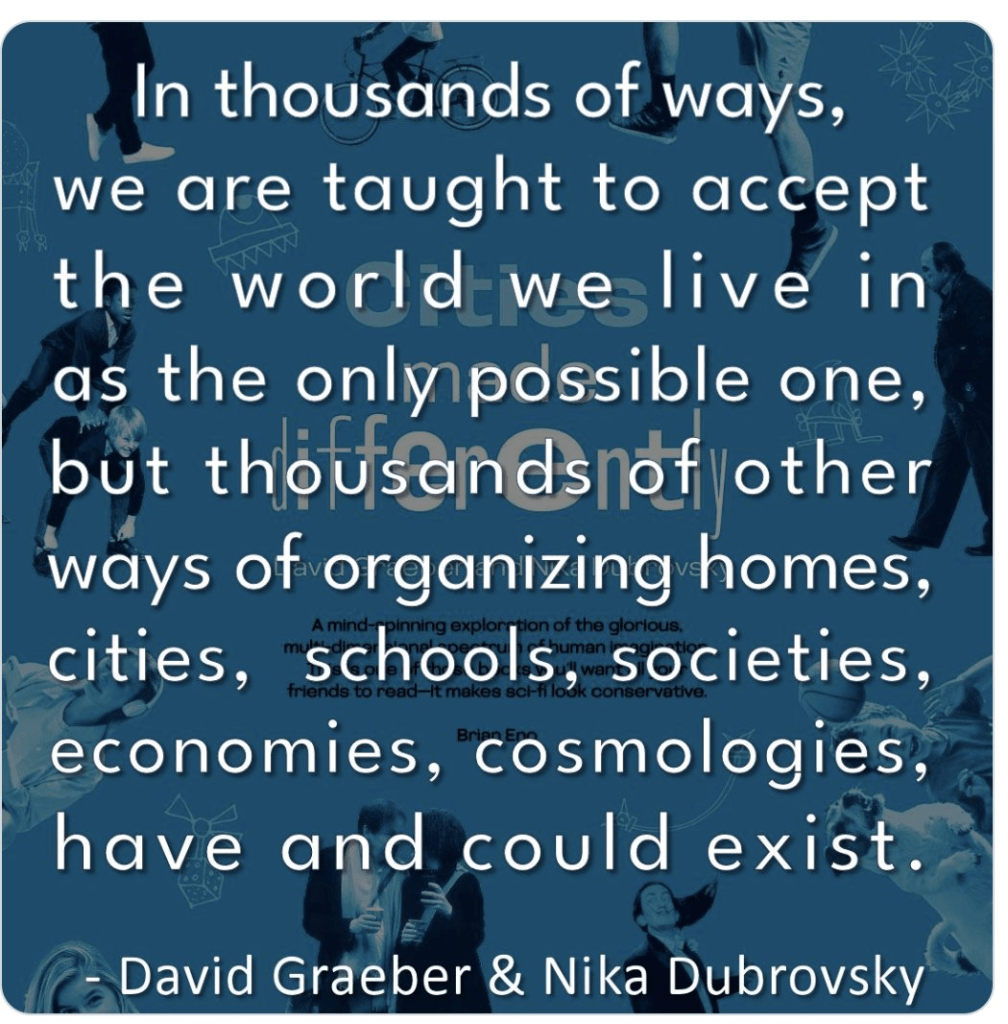
What makes a city a city? Who says? Drafted over decades out of a dialogue between artist and author Nika Dubrovsky, the late anthropologist David Graeber, and Nika’s then four-year-old son, this delightful and provocative book Cities Made Differently opens a space for invention and collaboration. Fusing anthropology, literature, play, and drawing, the book is essentially a visual essay that asks us to reconsider our ideas about cities and the people who inhabit them. Drawing us into a world of history and myth, science and imagination, Graeber and Dubrovsky invite us to rethink the worlds we inhabit—because we can, and nothing is too strange or too wonderful to be true.
With inspired pictures and prompts, Cities Made Differently asks what a city is, or could be, or once was. Sleeping at the bottom of the ocean? Buried in lava? What were those cities of long ago, and what will the cities of the future be? They might be virtual, ruled by AI, or islands of beautiful architecture afloat in seas of greenery. They might be utopian places of refuge or refugee camps as far as the eye can see. On land, underground or aloft, excavated or imagined, cities, this book tells us in provocative and funny ways, can be anything we want them to be—and what we want them to be can tell us something about who we are, what it is to be human, and what’s possible when we make way for wonder.
Cities Made Differently exists in two versions, one for reading and thinking, the other, downloadable at a4kids.org, for drawing and dreaming.
Cities Made Differently is a series of books, public art projects and conversations each full of pictures and stories about what it means to be a human.
For more than 15 years, we’ve been working on this project, and we have so much to share. Be part of it—download our doodle books, get our “Made Differently” and “A4kids” books, create a Visual Assembly, rewrite, redraw, and make it all your own!
Probably everyone would agree that the basis of any human coexistence is the ability to get together regularly to come up with common plans, discuss and find solutions to shared problems, sort out disagreements, and come up with fabulous ideas for festivities.
But what if you’re a child, a migrant, or someone who hasn’t studied at a university? What if public speaking isn’t your strong suit? Or what if you’re just a bit shy? Then you’ll have a hard time speaking at the most Citizen Assemblies! However, a 5-year-old is likely to draw better than almost any adult, and a most teenagers can come up with incredible ideas if given a safe place to express and develop them.
This is what Visual Assemblies is here for: to facilitate dialogue between people.
Yet how to make such dialogues an everyday reality? Over the past few decades, many of our societies have reduced or privatized their public spaces. Even the existence of citizens’ assemblies requires permits, funding, and the consent of the authorities. And what to say about organizing regular activities for children and teenagers? This usually requires the participation of specially trained adults, space, and materials.
Probably this is why it does not happen very often.
So we figured it makes sense to set up spaces that might provide a place for groups of children and teens to gather on a regular basis – in libraries, schools, museums, art centers where kids already spend time.
We have created large stickers, that are durable and resilient – one can walk over them, can draw on them with with pens and chalk and it can be washed and reused.
and they look great!
More importantly, around these panels, people can gather to draw, write with colored pencils and chalk, erase, and create together.
This isn’t an artist-led workshop that requires constant presence of the artist; it’s a piece of public art that residents themselves continually create and reshape.
Imagine replacing traditional public art—statues, mosaics, murals—with art we make together, art that serves as a tool for dialogue among people without the need for intermediaries like artists or governments.
We would love to install these panels in your university, hospital, museum, art center, school (or any other public place), where you can gather regularly with neighbours, friends, and passers-by to discuss current issues and collaboratively imagine and plan both real and imaginary social situations






 be you.