a4kids
from about page:
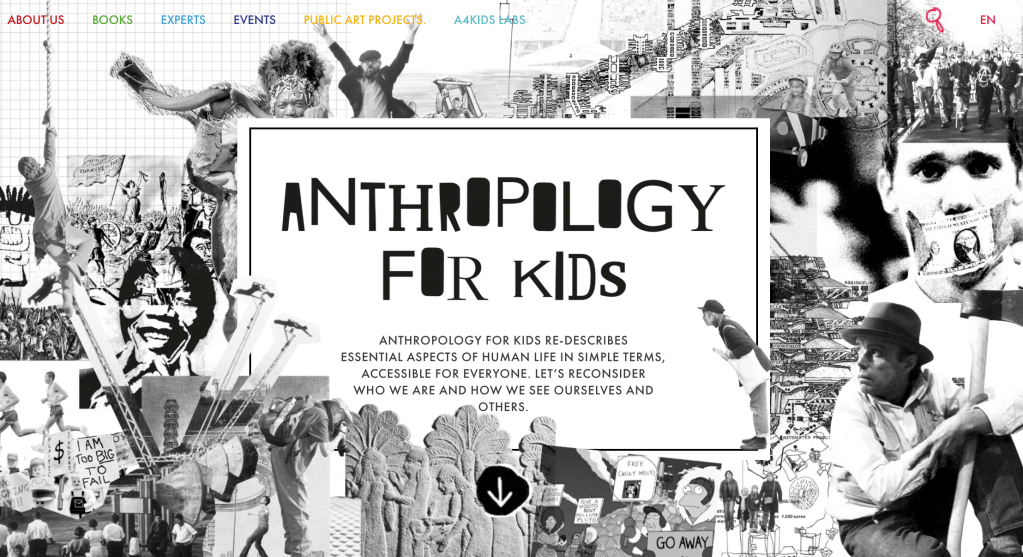
ANTHROPOLOGY FOR KIDS IS A SERIES OF BOOKS, WORKSHOPS AND CONVERSATIONS EACH FULL OF PICTURES AND STORIES ABOUT WHAT IT MEANS TO BE A HUMAN.
WHAT ARE WE DOING
The promise of anthropology is one of opening up our sense of human possibility. In a thousand ways we are taught to lower our expectation, to accept that the world we live in is the only possible world. But thousands of other ways of organizing homes, cities, schools, societies, economies, cosmologies, have and could exist..t The series is designed – in the spirit of Borges, Eco or Lem – to play with possibility, to overcome the suspicion, subtly inculcated in every day, that life is necessarily limited, miserable, and boring.
This series is spinning the anthropological history of every continent, helping us to discover both the points of diversity and unity in how people have lived around the globe and throughout the times.
Pointing on examples coming from the wide spectrum of different cultures it researches the existential and universal question of what it means to be human – as a kid and as an adult – in order to discover the huge diversity of how differently people live around the globe and throughout the times.
WHO WE ARE
We are Nika Dubrovsky (artist) David Graeber (anthropologist). producing politically challenging children’s books for adults (children too). We have discovered something interesting: no one will publish books like that. Even if you’re a famous author, great artist, etc.. But we want to change the culture. And the culture needs to change.
nika dubrovsky and david graeber
_______
adding page this day – via museum of care fb share:
notes/quotes to come:
intro to a4kids (22nd): https://allegralaboratory.net/aisforanthropology-introduction/
In Nika’s words, the project “started partly by way of in-between conversations – emails mostly – and Skype talks with David [Graeber] (…) It bridges two worlds: academia, and children. We are not supposed to talk to children about the questions accademia asks itself – such as what death is, what money is, or just even what is family. Rather, the parents tell their children what these things are, hence reproducing their own models. But anthropology is about something else.”.. t
maté parenting law.. graeber parent/care law
Through children’s workbooks and workshops, A4Kids provides a framework for children to think through what Dostoevsky’s calls the ‘cursed questions’ (проклятыевопросы) – questions about life and its meaning we all ask ourselves during our lifetime. We all come to form our own understandings of wealth, death, sovereignty, nations – and more often than not, these are shaped by the cultural biases we inherit.
begs we get back/to itch-in-the-soul ness.. rather than whalespeak
The aim is twofold: to show children that the value systems we inherit are far from natural, and to encourage them to jointly reflect over values – and dare to come up with alternatives..t
convo w nika dubrovsky (23rd): https://allegralaboratory.net/aisforanthropology-in-conversation-with-nika-dubrovski-i/
Consider this book that we did with David about kings. It’s like an offspring of his book with Marshall Sahlins, On kings. And so it contains really, really complex questions, you know, like “what is sovereignty?”.
on kings.. sovereignty..
As any academic subject, anthropology is limited because it’s designed not to be public. It’s very rare that people like Graeber exist, who is at the same time a very serious scientist and produces content that is accessible for many. And children’s literature is a really good framework for being public because if you can explain something to a 7-year-old, you can explain it to a 55-year-old as well
nowadays anthropology is the most emancipated discipline. It’s just showing us very clearly that whatever we think is just because our value system is ourvalue system, and many other societies could think very differently from us.
Education is political. Especially now, it’s important because we live in times of climate change, which necessitates us to come together. And it’s only solvable if we are able to talk to each other. We don’t have a good way of talking because, our educational systems stem from the 19th century, from these industrial times when kids were trained to become either workers on the assembly line or somebody who manages the assembly line. It’s not that useful now, but something else is very much needed.
what we need is a means to undo our hierarchical listening.. to self/others/nature.. and embrace an idiosyncratic jargon of sorts as language.. ie: self-talk as data
David is famous, very famous. And he was working with top literary agents and publishing houses. And none of them would help us. None. It’s always started the same. They would say, ‘Oh my god, this is such a great idea. It’s amazing. Oh, I know so many people who would love it … blah, blah, blah’; and then, they would say, ‘Oh, yes, it’s so good. But you know, children’s literature is very, very regulated territory.
Children’s books are basically censored. Everybody’s censoring them. Government, businesses, parents themselves, you know. So that’s an almost impossible task for this for this project, to survive.
how it all got started (24th): https://allegralaboratory.net/aisforanthropology-how-did-it-all-start/
My husband, who is an anthropologist, once told me that he thinks that all immigrants are anthropologists. After all, our work is much the same as that of the anthropological fieldworker: to study an alien culture through immersion, to decode new cultural concepts, and learn new languages. But where fieldworkers try to gain knowledge for academic purposes, for immigrants the stakes are higher – they have to recreate a life in a new place. A failed adaptation can end tragically.
Anthropology for Kids feels like a natural extension of what I have been doing all my life. Originally, it was born out of an attempt to find books for my 6-year-old son that would be accessible and clear in broaching the “grown-up” issues which truly interested him, such as power and servitude, death and immortality, beauty and ugliness.
Children’s literature in the West (at the time I was living in New York) is the most regimented and censored area in publishing.
Kids are, in a way, the radical Others that we compare ourselves to as adults. Children embody the very possibility of another world and another future for all of us – a future in which almost anything is possible: a world of peace, flying cars, interstellar travel and a long, happy life for everybody – that is, if only they manage to accomplish it when they grow up.. Children are our yet unrealized Utopia..
not yet scrambled ness
Living in an expat paradise – the Dominican Republic – I understood how complex colonialism is, how it destroys us from within. And how it begins with cultural appropriation, which nowadays manifests itself to a large extent in children’s literature.
lit & num as colonialism.. supposed to’s of school/work.. killing us
Anthropology for Kids is one of many projects experimenting with a new set of educational tools that attempt to change the status quo in education and the way it shapes our society.
what we need is cure ios city..
imagine if we just focused on listening to the itch-in-8b-souls.. first thing.. everyday.. and used that data to augment our interconnectedness.. we might just get to a more antifragile, healthy, thriving world.. the ecosystem we keep longing for..
what the world needs most is the energy of 8b alive people
space for experimentation (25th): https://allegralaboratory.net/aisforanthropology-workbooks-and-workshops/
After all, isn’t this what anthropology promises us, demonstrating how people in different countries and times can live in radically different ways while remaining humans?
but.. we’ve all been programmed into whales.. so all demos are really modeling sea world (aka: tragedy of the non common)
Here’s how it worked. First, we prepared city plans in advance on large (2×2 meters) sheets of paper. The plans were intentionally unfinished. As with the books, there was plenty of space for kids to draw and write.
city sketchup ness
Many participants were genuinely shocked. We had to devote a considerable amount of the time allotted for our workshops to un-schooling them. We first had to ensure the kids truly believed us when we reassured them that we genuinely were interested in learning what they thought and weren’t using the exercise as a trick to test them in some way.
spaces of permission.. .. with nothing to prove.. also to self.. ie: finding the bravery to change your mind.. everday
fittingness.. brown belonging law.. et al
_______
via museum of care tweet [https://twitter.com/museumofcare/status/1714015630507061359?s=20]:
Nika Dubrovsky talks about a workshop at the conference “Challenging Capitalist Modernity,” dedicated to the book series CITIES MADE DIFFERENTLY Read the full text here: https://artsoftheworkingclass.org/text/cities-made-differently
notes/quotes:
In the following interview, Vera Mey and Nika Dubrovsky discuss their shared experiences as part of the conference series “Challenging Capitalist Modernity,” in which Dubrovsky had taken part on behalf of her organization, Anthropology for Kids. This conversation reflects on Dubrovsky’s experience at the workshop in collaboration with Kurdish activists, touching on themes of urbanism, community, and imagination. The conference took place in Hamburg, Germany, from April 7-9, 2023, and under the title We Want Our World Back, focused on the arts, education, and construction of democratic confederalism
I began A4Kids 15 years ago after meeting my late husband, David Graeber. Since he’s the one who actually introduced me to the discipline of anthropology, in a sense, I learned anthropology like a child learning about the world from an adult. Eventually, the project grew out of that relationship
Throughout its existence, A4Kids has taken different forms, including interactive books and an in-person workshop series. But the purpose has always remained the same: introducing people – as I was introduced myself – to the various ways in which essential social institutions such as Family, City, Museum, and so on, have been perceived in different cultures and at different times. A4Kids invites people to imagine new ways of organizing society around the values they hold dear.. t
Originally, I imagined the project as being less of a product and more of a community-oriented educational tool. I thought I would create “doodle books” – notebooks, or some sort of collective drawing practice. Something that can be easily integrated into the everyday life of a parent taking care of their kids; that would look like play, without requiring lots of resources – something equivalent to singing songs together. However, that was proven to be very difficult to pitch to publishing houses, and so David and I began adapting the project from doodle books to more traditional educational books. (The doodle designs are still available for download from our website, https://a4kids.org/.)
city sketchup ness
Another project born out of the initial idea was the City of Care Assembly, which David and I designed together during lockdown in London. This time, we were working with our adult friends from the art group and environmental movement Extinction Rebellion. We drew on the pavement with chalk, collectively visualizing urban social alternatives by literally drawing onto the city.
Ever since, lots of international A4Kids workshops have been organized with people of all ages from different cultural, economic, and social backgrounds: 6 and 7-year-old kids from Havana, teens from central London, homeless 18 and 20-year-olds from Berlin, and Romanian teens from Timișoara have all taken part in it. Even though the groups have been very diverse, one aspect that has remained the same throughout has been the gender dynamic: despite being from very different backgrounds, they have shown a similar behavior pattern of assuming gender roles. The moment when children start to invent social scenarios, boys in almost every country start building robot factories to kill their enemies. They fantasize about taking over the city, building roads in a way that would either cut off supplies from one part of the city or protect the city from future attacks. While the boys were engaged in warfare with each other from start to finish, the girls would look for ways to provide care. Girls would say, “Looks like it will be a war. There will probably be wounded people. Let’s build a hospital.” Or, “We should make a community garden and a school for our future kids.” If they were to build a factory, it would be something like a toy factory. Only in Iceland, a country with an inspiring feminist history, did the girls choose to take over a part of the city and state, not to adapt to the rules created by boys, but to make their own
Anthropology promises an incredible opportunity to examine our society through the prism of others organized in different times and by different cultures. A4Kids came about as an attempt to create and spread non-academic and egalitarian knowledge with links to practice – meaning, learning by doing. Gradually, the A4kids project changed its audience from kids to adults. A similar process happened with the A4kids book series. They are now being published by MIT Press under the title …Made Differently. The reference to children has been removed from the title
The invitation to participate in the conference was very personal, as David and I were friends with the organizers. David was doing everything he could to help the most important revolution since the Spanish War: the Rojava Revolution. David was an anarchist like his father, Kenneth Graeber, who, as a young American anarchist, went to fight in the International Brigades during the Spanish Civil War. Just before I left for the conference, I learned that the administration of the University of Hamburg had refused to hold the event. The preparation of an international conference with more than 1,000 guests takes a long time. It is almost impossible to coordinate infrastructure and logistics at the last minute. The conference would have to be canceled.
The interference of the administrative powers in the affairs of an independent university caused outrage among activists and students in Hamburg and around the world. Amazingly, through a collective effort, organizers managed to get the conference going within just a few days.
My experience of delivering the A4Kids workshop at the “Challenging Capitalist Modernity” conference was unlike any other I have had in the 15 years of running this project.
I brought a large piece of paper containing initial outlines of Hamburg and proposed the joint planning of a new city to the 20-some people who had signed up for the session.
Participants were from all over the world: there were Kurds, Germans, Brits, Indians, Romanians, and people from the Balkans. Despite coming from different places, they shared a lot; it felt like they already had a common language and had known each other for a long time. Thus, it was easy to collaborate. People supported each other in developing ideas. Having come to the conference about “different modernity,” they were already geared up to collaborate on building an alternative world. My workshop simply provided a place where they could discuss the details of this world with each other.
An important detail that stood out to me about the workshop in Hamburg was how the participants approached the concept of security. David admired how, in Rojava, collective safety became an integral part of the society, rather than the mission of an outside force set up to police society itself. David recounted how, in his visit to Rojava, there were almost no traffic police. It seemed like adults were just making sure that kids would not attempt to drive cars. The street traffic was pretty safe.
Interestingly for me, at the workshop in Hamburg, participants began creating their city by building a river. When it was time to think about the police, they suggested that the police would be a group of citizens who always float on the river, constantly going from one neighborhood to another. When the police were absent from a neighborhood, they were replaced by local members of the community. This way, the population would remain in control, and the police would only exist for society’s protection. I thought that was a brilliantly smart and well-thought-through city design. There were numerous other clever ideas; for example, a girl from India combined a food cooperative with an art space for women. So many brilliant ideas were born about how to build a world where very different people could live freely, respecting each other and the world around them, that it would be hard to recount them all here, but I felt like I had taken part in an incredible сrash course in the making of the Rojava revolution.
Even though I was supposed to run this workshop, I didn’t actively participate; I simply observed the group as they collaborated on designing this city of freedom and care. Some might describe what I saw as utopian, but I don’t think so. Indeed, in my experience taking part in the workshops over many years, when people have lacked ideas for crafting a solution, they tend to create dystopias based on dark fantasies. Many people get a bit lost when asked to join in planning social spaces together since it’s not something they’ve done much in their lives. There was no confusion among the participants at the Hamburg conference, only a cheerful confidence in their ability to build something beautiful together. They were both highly practical and meticulous while thinking most of all about social justice. I couldn’t help but imagine how fortunate I would be to have such people nearby when the inevitable catastrophes, environmental or otherwise, hit our part of the world.
This impressive, solutions-focused way of thinking was also present in the approach of the conference’s organizers. When the venue canceled the event, it came as a total shock. Despite being faced with this massive problem, the organizers of the conference were results-oriented, just like the way participants in my workshop approached building a city.
The organizers spread the workshops and panel discussions across several venues in Hamburg, so everything went as originally planned: without a hitch!
It looked magical. As if they were being helped by magical fairies or superheroes. But the secret was the solidarity of a large network of activists and sympathizers, ready to react in unusual situations towards a common cause.
The University of Hamburg administration surely didn’t anticipate this amazing unity and vibrant spirit from the conference organizers and participants. I wish to think that the Anthropology for Kids project will at least partly follow this example.
________
________
________




 be you.