plants as designers
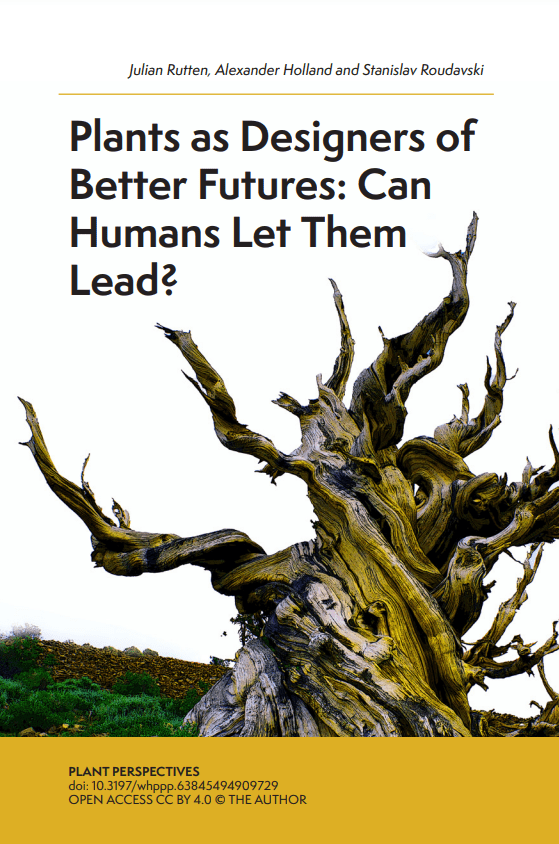
via tweet [https://x.com/Plant_Init/status/1822399681114095973]:
Plant Perspectives Journal
@plantpjournal has recently published a research article by Julian Rutten, Alexander Holland, & Stanislav Roudavski: Plants as Designers of Better Futures: Can Humans Let Them Lead? Accessible for free download. “It argues that plants have unique and valuable capabilities for creating and caring for their environments.” https://doi.org/10.3197/whppp.63845494909729
links to 48 pg pdf [https://www.whp-journals.co.uk/PP/article/view/1006/767]
notes/quotes:
Plants as Designers of Better Futures: Can Humans Let Them Lead?Julian Rutten, Alexander Holland and Stanislav Roudavski
2
ABSTRACT
This research explores the idea of plants as designers and discusses approaches that humans can use to support plant’s *productive agencies. It argues that plants have unique and valuable capabilities for creating and caring for their environments. **Human inter-ventions often overlook or constrain such capabilities. In response, the article proposes to use ***numerical modelling to better understand plants better while challenging the anthropocentric assumptions that are common in design. It focuses on large old trees in Tasmania as examples of outstanding plant-designers that need more recognition and protection. The article also raises open questions for further research on the ethical, ecological, and aesthetic implications of vegetal design
*? – norton productivity law et al
**ie: * and ***
intro
Plants constitute an important part of earth’s biodi-versity, which is now facing large-scale, existential threats due to human activity.1 *In addition to major harms such as land use change and clearcutting, hu-mans oppress tree lives in cities, gardens and on farmed land. They kill unwanted specimens, force trees to have shorter lives, lop off their branches, poison them, pre-vent their propagation, and press them into biologically uniform communities that are susceptible to parasites.2 Many humans act to protect plants **but do it in ways that exclude them from deci-sion making because dominant ***worldviews do not consider nonhuman beings to be intelligent, goal-oriented, and innovating organisms that act as moral agents, knowledge holders and members of multispecies polities.3 As a result, many humans resist acknowledging the roles of nonhuman beings by deploying ontological and epistemic violences when they characterise more-than-human ontologies as metaphorical or anthropomorphic. ****The consequence of these attitudes is a pervasive ‘plant blindness’.4 Multispecies societies become deprived of contribu-tions that plants can make, and the resulting anthropocentric goals and approaches are corrupting the notions of justice in the society of all life and are empirically damaging at catastrophic levels.
**if still dm.. still hari present in society law.. how we gather in a space is huge.. need to try spaces of permission where people have nothing to prove to facil curiosity over decision making.. because the finite set of choices of decision making is unmooring us.. keeping us from us.. ie: whatever for a year.. a legit sabbatical ish transition
***that would/could be why we need them as models.. ie: intell, goal, et al cancerous distractions
****rather.. all the naming the colour ness does that
3
This article aims to provide a robust account of plants as designers of better futures. We challenge three narrow assumptions about the failure of humans to protect plants, and point to distinct examples of design, creativity, and care provided by large old trees. *The first assumption we challenge is that plants are not creative, decision-making agents. This assumption is based on anthropocentric presumptions that are short-sighted, exclusionary and poorly informed, as demonstrated by the repeatedly unexpected and negative consequences of human attempts at managing biotic systems.5 In contrast, we argue that plants, like other nonhuman beings, are active agents whom humans should treat with respect and appreciation. The second assumption we challenge is that plants do not contribute to design. Biomimetic designs already challenge this assumption but tend to prioritise human needs; we depart from bi-omimetic approaches by asking how design actions taken by nonhuman beings can contribute to all stakeholders in multispecies communities.6The third assumption is that the inclusion of contributions by plants is impossible or impracticable.7 This is an extension of an argument that nonhuman minds or ways of being are inaccessible, especially in the case of evolutionarily distant kin, including vegetal beings. In contrast, we examine whether humans can reorient existing practices and tech-nologies to empower nonhuman agents. **We use numerical modelling as an example that demonstrates one way to incorporate design contribu-tions of nonhuman beings such as plants.
*oi.. again.. decision making is unmooring us law
**again.. ooof.. any form of m\a\p
4
An exploration of what humans can do to help plants help them-selves as well as many other living beings requires novel methods. We draw on our expertise as researchers within a school of design8 who collaborate with scholars from fields including biology, engineer-ing, computer science, philosophy, political science, animal studies, geography, law, anthropology and Indigenous studies. We see human traditional or scientific learning as generative of practical pathways for moral advances but are also conscious of its biases and limitations. For example, technical achievements in numerical modelling, artificial in-telligence and sensing fail to benefit nonhuman beings if they progress solely in response to human interests and commercial funding.9 In con-trast, this article provides an example of lidar scanning and numerical modelling as one of many ways to empower plants as political and inno-vating agents.Our article is situated within a developing narrative that seeks to acknowledge, understand and empower capabilities, cultures and creative contributions by nonhuman living beings in the context of interspecies or more-than-human design.
oi.. people telling other people/plants what to do ness.. cancerous distraction.. schooling the world ness
help\ing ness et al.. graeber violence in care law et al
5
The following Section 2 of this article outlines the limitations of cur-rent approaches in a concrete design challenge. We describe the need for bird habitats, such as tree hollows, and the limitations of common knowledge systems that fail to adequately include solutions already de-veloped by trees. Next, in Section 3, the article offers a theory of plants as empowered designers, defining agency, design, care and empowerment in ways that are deliberately non-anthropocentric. . In our conclusion, we highlight benefits and limita-tions of this approach as well as directions for further research and show how design in more-than-human terms can lead to pragmatic benefits and just relationships within multispecies communities
25
The next challenge is finding traces of meaning in the obtained infor-mation. For this to be possible, the raw data requires curation. A typical sample of 500 million points is too large for practical use with current computers. We can reduce samples by selecting points that appear suf-ficient for spatial analysis. Next, algorithms recognise groups of points that belong to individual trees based on the distance from their neigh-bours.67 This approach is quick but can miscategorise dense foliage or overlapping branches (see Figure 6). The subsequent step recognises trunk, branch and leaves by clustering points based on the similarity of their neighbours. In this case, we used a dataset of Red Tingle trees in the Southwestern part of Australia to develop a Gaussian Mixture Model measuring neighbourhood linearity, planarity, sphericality, and variation for each point. We then label clusters as tree organs.68 With a shift of perspective, we can interpret this operation as one group of trees helping humans understand another. The difference between the Red Tingle trees and Styx trees lea
it’s like – nice idea/title – hiding all the maths/cancers
there’s a legit use of tech (nonjudgmental expo labeling).. to facil a legit global detox leap.. for (blank)’s sake.. and we’re missing it
legit freedom will only happen if it’s all of us.. and in order to be all of us.. has to be sans any form of m\a\p
32
7. CONCLUSION
In this article, we asked: why do human actions fail plants and other living beings? What can humans do to help plants help themselves and many others? Our response to these questions is twofold. Firstly, we ar-gued that even best-intentioned human practices will fall short without the inclusion of all stakeholders that can stand or benefit from their im-pact. This logic is similar to the convincing arguments already advanced by other emancipatory movements with their slogan of ‘nothing about us without us’.81 Secondly, we suggested that the scepticism regarding communication with and the involvement of nonhuman beings, includ-ing plants, exaggerates the barriers between forms of life on Earth. To illustrate a possible path for collaborative designing that included trees, we referred to numerical analyses of scanned data and their potential use in design. Many forms of existing learning in sciences and manage-ment already contribute to this objective but more is possible if trees, plants and other nonhuman stakeholders are supported in taking lead-ership roles to define new studies and experimental projects.
oi
34
To support this narrative, we first described plants as decision-mak-ing agents with behaviours and actions. Secondly, we discussed plants as participants in design collectives that involve other nonhuman be-ings as well as humans. Thirdly, we categorised beneficial outcomes of design and as essentially supportive practices of care and indicated constraints that anthropogenic management imposes on plant capa-bilities. Fourthly, we demonstrated numerical imaging and modelling techniques that can strengthen plants’ capabilities but also simplify and misrepresent plant lives.
The audience for this article includes all humans who triage their attention, finances, and efforts by selecting what to study, manage, modify or support. Relevant parties include researchers in ecology and conservation science, environmental managers, designers and planners working in business or city councils, as well as experts in politics and law who oversee frameworks for the protection of biological life. Recent science and practice in combination with Indigenous and traditional worldviews challenge habitual Western opinions about agency, inno-vation and care in application to plants and many other beings. We hope that this article helps to advance the ongoing conversation by pro-viding convincing justification and practical detail. It aligns with other interdisciplinary and collaborative work that includes artificial habitat-structures, manufactured replacements for disappearing old trees, smart systems to minimise environmental light pollution, urban surfaces for mosses and coastal habitats co-designed with mangroves
35
Further work in this direction is important to demonstrate that bottom-up approaches that follow living agents can interrogate and re-sist top-down methods of governance that entitle humans to decide what ecosystems need, which species should survive, where and how. *The history of oppression across domains demonstrates that top-down paternalisms do not result in beneficial, just or sustainable outcomes and highlights the need for alternative approaches amid the increas-ingly acute environmental crises.
*oppression if any form of m\a\p (ie’d thru out article)
Our work shows that humans can ‘listen’ to vegetal political voices and use found meanings to recognise significant contributions that would otherwise remain unnoticed, unstudied, unappreciated and will soon disappear. This approach recognises trees not as objects, resources, or helpless patients dependent on human support, but as competent ac-tive agents, knowledge holders, innovators, and designers. This stance is different both from metaphorical appreciation of trees in human cultures as well as from biomimetic engineering that sets out to copy without compensation or acknowledgement for human use, often with harm. We hope that future research will experiment with the implications of this narrative, adjust its framing to suit the emerging evidence and formulate novel design experiments that will test and expand creative capabilities of more-than-human collectives to act – and to act with care.
need 1st/most: means to undo our hierarchical listening to self/others/nature as global detox/re\set.. so we can org around legit needs
need the unconditional ness of left to own devices ness for that dance to dance
______
______
______
_______
______
_____




 be you.