mikhail bakunin
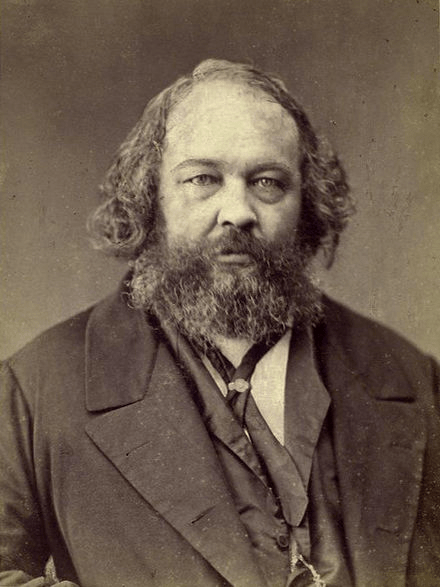
intro’d to him time and again thru all the anarchist library (like don’t fear invoke anarchy et al) readings et al.. and at least one of his writings ie: god and state
bakunin legit free law.. (even though his ideas were part\ial ness)
________
Mikhail Alexandrovich Bakunin (/bəˈkuːnɪn/ bə-KOO-nin; 30 May 1814 – 1 July 1876) was a Russian revolutionary anarchist. He is among the most influential figures of anarchism and a major figure in the revolutionary socialist, social anarchist, and collectivist anarchist traditions. Bakunin’s prestige as a revolutionary also made him one of the most famous ideologues in Europe, gaining substantial influence among radicals throughout Russia and Europe.
Bakunin grew up in Pryamukhino, a family estate in Tver Governorate. From 1840, he studied in Moscow, then in Berlin hoping to enter academia. Later in Paris, he met Karl Marx and Pierre-Joseph Proudhon, who deeply influenced him. Bakunin’s increasing radicalism ended hopes of a professorial career. He was expelled from France for opposing the Russian Empire’s occupation of Poland. After participating in the 1848 Prague and 1849 Dresden uprisings, Bakunin was imprisoned, tried, sentenced to death, and extradited multiple times. Finally exiled to Siberia in 1857, he escaped via Japan to the United States and then to London, where he worked with Alexander Herzen on the journal Kolokol (The Bell). In 1863, Bakunin left to join the insurrection in Poland, but he failed to reach it and instead spent time in Switzerland and Italy.
From 1870 until his death in 1876, Bakunin wrote his longer works such as Statism and Anarchy and God and the State, but he continued to directly participate in European worker and peasant movements. In 1870, he was involved in an insurrection in Lyon, France. Bakunin sought to take part in an anarchist insurrection in Bologna, Italy, but his declining health forced him to return to Switzerland in disguise.
Bakunin has had a significant influence on thinkers such as Peter Kropotkin, Errico Malatesta, Herbert Marcuse, E. P. Thompson, Neil Postman and A. S. Neill as well as syndicalist organizations such as the Wobblies, the anarchists in the Spanish Civil War and contemporary anarchists involved in the modern-day anti-globalization movement.
pëtr kropotkin.. malatesta conditions law from at the café.. a s neill
Much of Bakunin’s writings on anarchism centers on antipathy for the state and “political organization itself as the source of oppression and exploitation”. *His revolutionary solutions focus on undoing the state and hierarchical religious, social, and economic institutions, to be replaced by a system of freely federated communes organized “from below upward” with voluntary associations of economic producers, starting locally but ostensibly organizing internationally. These thoughts were first published in his unfinished 1871 ‘’The Knouto-Germanic Empire and the Social Revolution’’, expanded by a second part published in his 1908 ‘’Oeuvres’’, and again elaborated a fragment found and published posthumously as ‘’God and the State’’ (1882). The latter was his most famous work, translated widely. It appeals to cast off both the state and religion to realize man’s inborn freedom.
*imagine if we listened to the itch-in-8b-souls 1st thing everyday & used that data to connect us (tech as it could be.. ai as augmenting interconnectedness as nonjudgmental expo labeling)
Bakunin’s political beliefs rejected statist and hierarchical systems of power in every name and shape, from the idea of God downwards, and every form of hierarchical authority, whether emanating from the will of a sovereign or even from a state that allowed universal suffrage. He wrote in God and the State that “[t]he liberty of man consists solely in this, that he obeys the laws of nature because he has himself recognized them as such, and not because they have been imposed upon him externally by any foreign will whatsoever, human or divine, collective or individual”.
any form of m\a\p
Bakunin similarly rejected the notion of any privileged position or class, since the social and economic inequality implied by class systems were incompatible with individual freedom. Whereas liberalism insisted that free markets and constitutional governments enabled individual freedom, Bakunin insisted that both capitalism and the state in any form were incompatible with the individual freedom of the working class and peasantry, stating that “it is the peculiarity of privilege and of every privileged position to kill the intellect and heart of man. The privileged man, whether he be privileged politically or economically, is a man depraved in intellect and heart”. Bakunin’s political beliefs were based on several interrelated concepts: (1) liberty; (2) socialism; (3) federalism; (4) anti-theism; and (5) materialism. He also developed a critique of Marxism, predicting that if the Marxists were successful in seizing power, they would create a party dictatorship “all the more dangerous because it appears as a sham expression of the people’s will”, adding that “[w]hen the people are being beaten with a stick, they are not much happier if it is called ‘the People’s Stick'”.
Bakunin’s socialism was known as “collectivist anarchism”, where “socially: it seeks the confirmation of political equality by economic equality. This is not the removal of natural individual differences, but equality in the social rights of every individual from birth; in particular, equal means of subsistence, support, education, and opportunity for every child, boy or girl, until maturity, and equal resources and facilities in adulthood to create his own well-being by his own labor.”
rather.. need global equity – everyone getting a go everyday
________
________
________
_______
- anarch\ism
- accidental anarchist
- anarchism and other essays
- anarchism or rev movement
- anarchist communism
- anarchist library
- anarchists against democracy
- anarchy after leftism
- anarchy in manner of speaking
- anarchy works
- art of not being governed
- at the café
- billionaire and anarchists
- david on anarchism ness
- enlightened anarchy
- fragments of an anarchist anthropology
- freedom and anarchy
- graeber anarchism law
- inventing anarchy
- is anarchism impossible
- kevin on anarchism w/o adj
- nika on anarchism
- on anarchism
- post scarcity anarchism
- two cheers for anarchism
________
________
_______
_______





 be you.