have\need
image revision (2019):
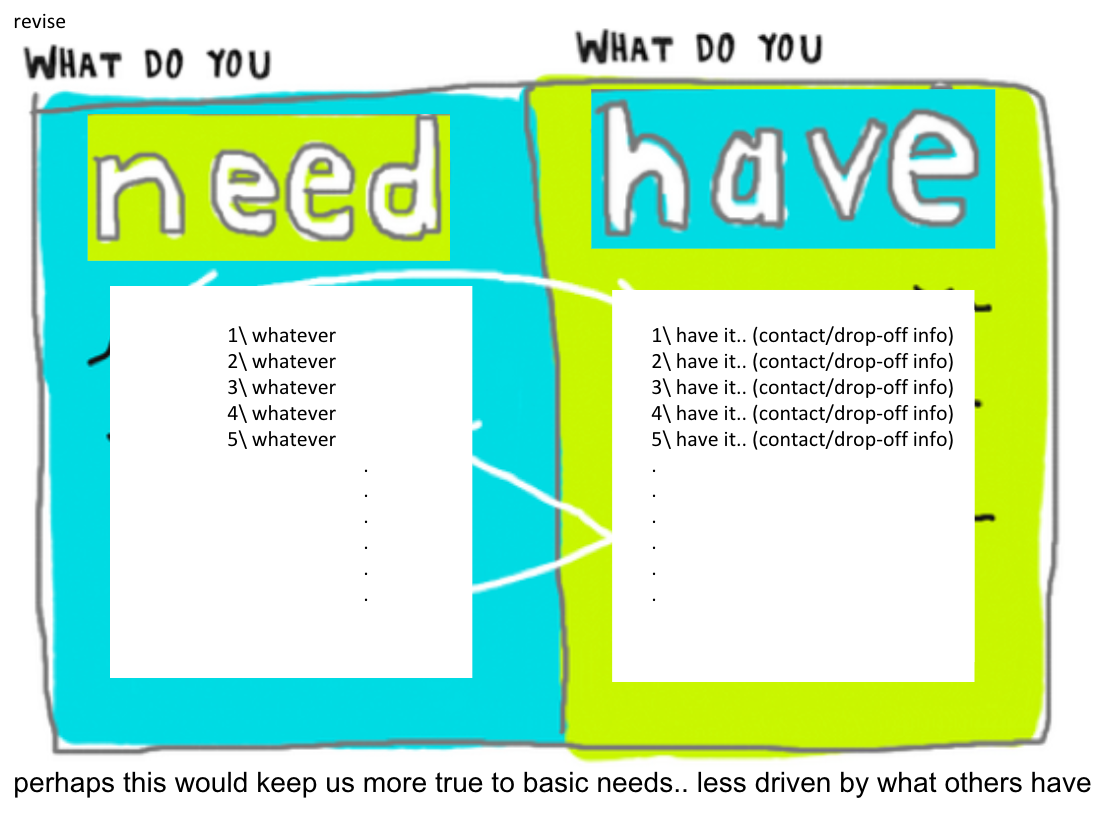
perhaps if we focus more on augmenting our interconnectedness.. we’ll find we truly need/crave less/different.. that means we need everyone of us to be thinking for/from ourselves.. everyday.. and so.. begs a mech to listen to every voice everyday ie: tech as it could be..
_______
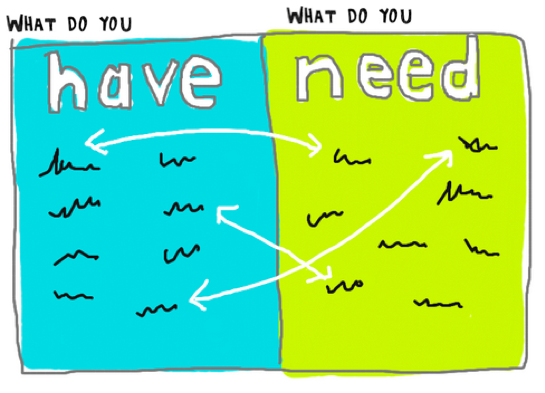
perhaps tech helping reduce the improbability of … coincidence of wants

time/talent/share ing ourselves back to us (day care center ness)..even to the point of us finding out – that we pretty much have all we need.. right in front of/within us..
one ness
________
________
perched in London (@cityeyrie) tweeted at 2:15 AM – 29 Jan 2018 :
Like money, housing in the UK is a distribution, and *not* a scarcity problem https://t.co/AqWIdmy8QS (http://twitter.com/cityeyrie/status/957905072603762688?s=17)
__________
from Sarah Manguso’s ongoingness:
70
i’m watching my little son change, though, from day to day and minute to minute.. it’s terrifying and beautiful..
(on rainbows being common where her husband grew up) they are no less amazing for their prevalence.. ditto birds, trees, stars, clouds, children, and so on.. to the laws of supply and demand the real world is immune
have\need ness working out just fine (ie: we have all we need) if we just get back/to an undisturbed ecosystem.. ‘in undisturbed ecosystems ..the average individual, species, or population, left to its own devices, behaves in ways that serve and stabilize the whole..’ –Dana Meadows
________
________
from market ness page:
4 min – jm: one of central notions of econ – how to bring supply and demand into equilibrium..
the equilib we need is in getting back/to an undisturbed ecosystem ‘in undisturbed ecosystems ..the average individual, species, or population, left to its own devices, behaves in ways that serve and stabilize the whole..’ –Dana Meadows
________
So
socially beneficial use of the data stream our online meanderings leave behind,
as opposed to current use to advertise to us?I could get behind that.
Original Tweet: https://twitter.com/klaitner/status/1222713412636950528
[whole thread on coincidence of wants page]
_________
from Erich Fromm‘s the sane society:
87
if the wealth of society corresponded to the actual needs of all its members, there would be no problem of distributing it; each member could take from the social product as much as he likes, or needs, and there would be no need of regulation , except in the purely technical sense of distribution.. but aside from primitive societies, this condition has never existed up to now in human history.. t
common ing via 2 convers as infra
the needs were always greater than the sum total of the social product, and therefore regulation had to be made on how to distribute it.. in most highly developed societies of the past, this decision was made essentially by force.. often implemented by social/religious tradition.. which constituted such a strong psychic force w/in people that it often made the threat of physical force unnecessary..
________
have/need ness and getting back/to enough ness
Jason Hickel (@jasonhickel) tweeted at 3:50 AM on Wed, Jun 03, 2020:
Capitalism structurally compels us to work and produce beyond society’s actual needs. And the more we produce, the more we have to consume, to mop up overproduction. Consumption becomes a structural imperative – a form of labour in itself. The consumer is not sovereign, but serf.
(https://twitter.com/jasonhickel/status/1268117727979454464?s=03)
_________
from murray bookchin‘s ecology of freedom:
41
but primary to both of these seemingly contrasting relationships is the practice of usufruct, the freedom of individuals in a community to appropriate resources merely by virtue of the fact that they are using them.. such resources belong to the user as long as they are being used.. function, in effect, replaces our hallowed concept of possession.. not merely as a loan or even ‘mutual aid’.. but as an unconscious emphasis on use itself.. on need that is free of psychological entanglements w proprietorship, work and even reciprocity.. t
huge.. sans all the red flags
communal property, once property itself has become a category of consciousness, already marks the first step toward private property.. just as reciprocity, once it too becomes a category of consciousness, marks the first step toward exchange..
wilde property law, reciprocity, graeber exchange law, marsh exchange law, et al
there may have been a period in humanity’s early development when interest had not yet emerged to replace complementarity, the disinterested willingness to pool needed things and needed services.. there was a time .. wandering into remote reaches of arctic.. encounter ‘the pure, true eskimos.. the eskimos who knew not how to lie’.. and hence to manipulate, to calculate, to project a private interest beyond social need.. here, community attained a completeness to exquisite and artless that needed things and services fit together in a lovely mosaic w a haunting personality of its own
have\need ness.. ‘in undisturbed ecosystems ..the average individual, species, or population, left to its own devices, behaves in ways that serve and stabilize the whole..’ –Dana Meadows
if we would just let go enough.. trust enough.. to org around legit needs
we should not disdain these almost utopian glimpses of humanity’s potentialities.. pre lit peoples that still lack an ‘i’ w which to replace a ‘we’ are not deficient in individuality as much as they are rich in community.. coop.. is more than just a cement between members of the group; it is an organic melding of id’s that w/o losing individual uniqueness, retains and foster the unity of consociation.. contract, forced into this wholeness, serves merely to subvert it turning an unthinking sense of responsibility into a calculating nexus of aid and an unconscious sense of collectivity into a preening sense of mutuality.. as for reciprocity, so often cited as the highest evocation fo collectivity, we shall see that it is more significant in forming alliances between groups than in fostering internal solidarity w/in them..
usufruct in short, differs qualitatively from the quid pro quo of reciprocity, exchange and mutual aid.. all of which are trapped w/in history’s demeaning account books w their ‘just’ ratios and their ‘honest’ balance sheets.. t
42
caught in this limited sphere of calc, consociation is always tainted by the rationality of arithmetic.. the human spirit can never transcend a quantitative world of ‘fair dealing’ between canny egos whose ideology of interest barely conceals a mean spirited proclivity for acquisition.. to be sure, social forces were to fracture the human collectivity by introducing contractual ties and cultivating the ego’s most acquisitive impulses..
of math and men et al
insofar as the guileless peoples of organic societies held to the values of usufruct in an unconscious manner, they remained terribly vulnerable to the lure, often the harsh imposition, of an emerging contractual world.. rarely is history notable for its capacity to select/preserve the most virtuous traits of humanity.. but there is still no reason why hope, reinforced by consciousness and redolent w ancestral memories, may not linger w/in us as an awareness of what humanity has been in the past and what it can become in the future..
huge
rather.. what is already on each heart..
let’s org around that
this development (men hunt/hierarchy women gather/integrity) as we shall see, was to come from a male envy that must be carefully unravelled
________
from david graeber‘s foreword to stone age econ:
4
Sahlins has never been one to shirk from intellectual combat and most of the essays assembled in this volume were written, in one way or another, in response to such Formalist positions. *The “Original Affluent Society” was, of course, a direct challenge to the very notion of “scarce resources.” Scarcity, after all, exists only in relation to felt need. It is hard to find a snow-plow in Brazil, but you can’t really speak of a scarcity of them, any more than you can say public spaces in California suffer from a scarcity of spittoons or the International Space Station is lacking in fishing equipment. This might seem self-evident, but it’s the kind of self-evident truth whose implications most people never seriously consider. Sahlins has spent much of his intellectual life working out the implications. How, he has effectively asked, is it we come to define our world around what we think it lacks, around the degree to which we find it inadequate to the fulfillment of our material desires? Once framed that way there is only one possible answer: there is something wrong with our desires, or at least what we believe our desires to be. (This is actually a further complicating factor: in much of history, even when most people were convinced humans were incorrigible creatures, very few actually acted that way.) Why did we come to abandon Paleolithic affluence and actually create a world in which most of us actually do live lives of scarcity?
*need to org around legit needs.. so we grok graeber stop at enough law et al
have\need ness and the garden-enough ness of org-ing around legit needs
_______
________
______
_________






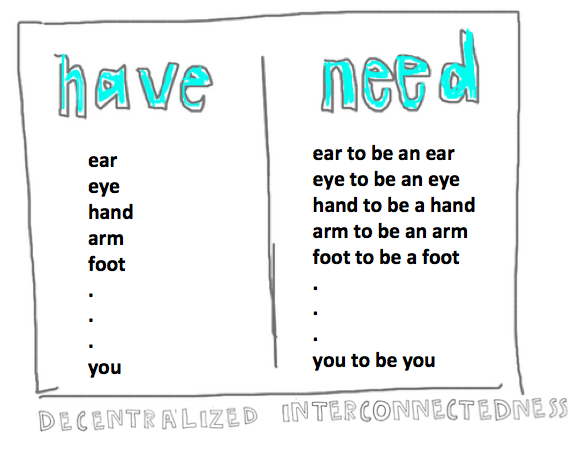
 be you.