disruptive sustainability
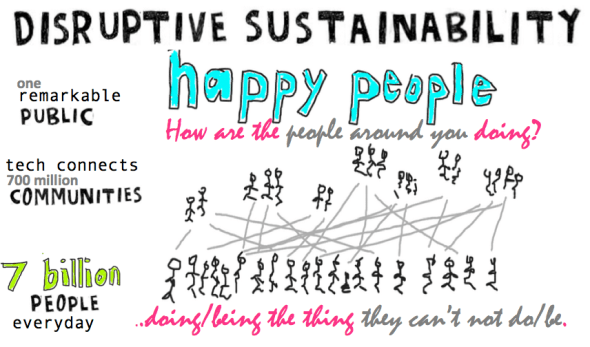
imagine, if our sustainability comes from 8 billion people taking charge of their day.
every day.
that’s it.
how we gather in a space is huge.. need to try spaces of permission where people have nothing to prove to facil curiosity over decision making.. because the finite set of choices of decision making is unmooring us.. keeping us from us..
ie: whatever for a year.. a legit sabbatical ish transition
there’s a legit use of tech (nonjudgmental expo labeling).. to facil a legit global detox leap.. for (blank)’s sake.. and we’re missing it
the unconditionality ness that makes the dance dance
ie: imagine if we listened to the itch-in-8b-souls 1st thing everyday & used that data to connect us (tech as it could be.. ai as augmenting interconnectedness)
__________________________________________________________________________
first intro’d to term here:
why-disruptive-sustainability-new-leadership-framework
Another Harvard professor, Clayton Christensen, is also pushing back against the business-as-usual mindset of “measure what you manage and manage what you measure,” which has also infiltrated the CSR and ESG vernacular. Christensen has said “[T]he way they designed the world, data is only about the past. And when we teach people that they should be data-driven and fact-based and analytical as they look into the future, in many ways we condemn them to take action when the game is over.”
And when Michael Porter replaces his Five Forces framework with Creating Shared Value — maybe that, too, is disruptive sustainability.In the final analysis, management is prediction. Data can inform, but it alone cannot predict. As Christensen once observed, ”The only way you can look into the future — there’s no data — so you have to have a good theory. We don’t think about it but every time we take an action it is predicated upon a theory. And so by teaching managers to look through the lens of the theory into the future, you can actually see the future very clearly. I think that’s what the theory of disruption has done.”My advice to CSR or ESG professionals: Don’t look to a 30-year-old framework from Harvard Business School to show relevance; formulate a good theory — a compelling, credible, disruptive theory — and make your case based on that.





 be you.