uses of disorder
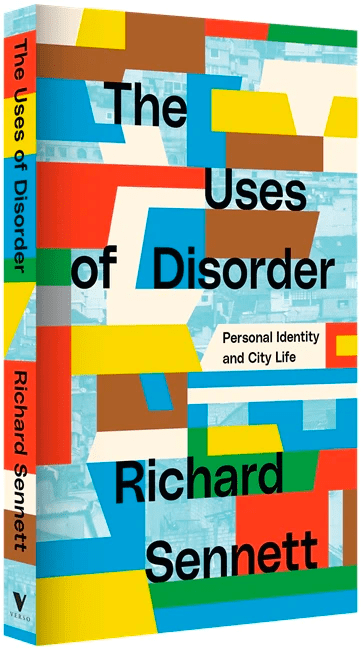
uses of disorder (1970) by richard sennett
[https://en.wikipedia.org/wiki/The_Uses_of_Disorder]:
The Uses of Disorder: Personal Identity and City Life is a 1970 book on the virtues of diversified communities written by Richard Sennett and published by Knopf. It was Sennett’s first book, and is divided into two parts: the first analyzes the causes of stagnant and over-ordered communities, while the second contains Sennett’s proposed solution.
The Uses of Disorder analyzes human development at the personal and collective level in wealthy cities, presenting the thesis that such cities are excessively ordered and thereby enable residents to avoid personal growth or change. Instead of relying on prescriptive plans and rigid self-conceptions, Sennett argues, people should remain open to difference and disorder while city life ought to be more disorderly and decentralized. The book is divided into two parts, with the first analyzing the causes of over-ordered and stagnant communities, and the second containing Sennett’s proposed solution.
aziz let go law.. carhart-harris entropy law.. iwan baan ness.. et al
In the first part of the book, Sennett states that *adolescents are pressured to make major decisions about their lives without sufficient life experience. Because of this, he argues, they mentally construct a simplified version of the world and base their decision on that conceptual model. When they carry out these plans in the real world, **they attempt to shape reality to fit their past decisions rather than making decisions based on reality. While poor people have insufficient power to actually do this, Sennett writes that the American middle class is able to carry out these changes to the real world, and has done so by creating purified, orderly communities. In the process, they have stifled deviance and thereby eliminated the need for personal growth.
*rather.. deeper issue.. khan filling the gaps law
**oi.. decision making is unmooring us law.. we have no idea what ‘reality’ is.. all whalespeak to date.. oi
In the book’s latter section, Sennett shares his solution to the problem he has described. He calls for the abolition of the purified communities, which he states is only possible in urban areas with a dense and diverse population. He additionally states that the population must be actively prevented from self-segregating into orderly communities within the urban setting, and that this can only be made possible through a radical change in the organization and structure of cities. The objective of this change would be to create urban environments where conflict and disorder are ongoing but can be expressed without violence, and where community life is engaging rather than boring or alienating. He specifically suggests creating “survival communities”, in which confrontations between people at the individual level are part of the societal structure, by eliminating policing along with “any other form of central control, of schooling, zoning, renewal, or city activities that could be performed through common community action”.
*rather.. hari rat park law et al.. via city sketchup ness et al.. in the city.. as the day ness..
_________
intro’d while reading colin ward‘s anarchy in action p 49
________
________
_________
________
________
________
_________
________





 be you.