m of care – sept 2 24
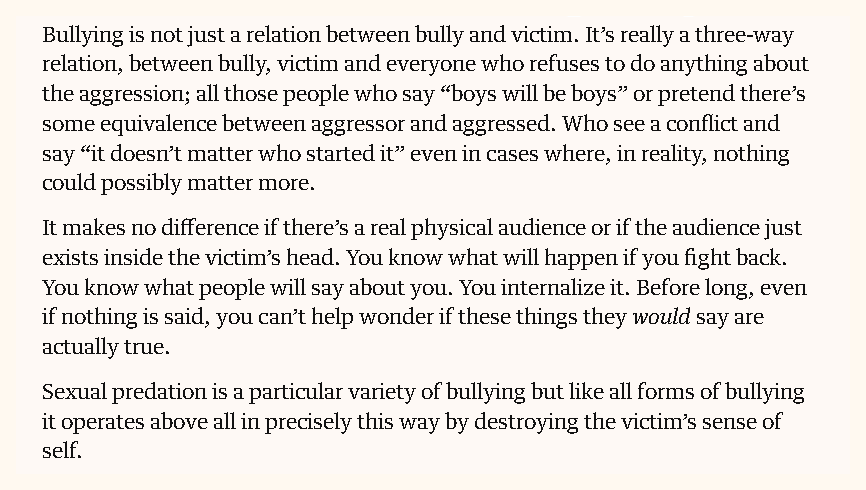
like all forms of bullying it operates above all in precisely this way by destroying the victims’ sense of self
david graeber on david on rape.. david on bullying.. slaves losing self .. et al
via another nika dubrovsky tweet [https://x.com/nikadubrovsky/status/1830512976425631857]:
Today marks four years since David’s passing. Every day, he becomes more and more important, not just to me but to many others as well. He would definitely be happy to know that.
We will meet at 8 PM (London time), together with his friend, journalist Dyan Neary, to talk about the most important person in David’s life—his mother, Ruth Rubenstein. Ruth was born in the Russian Empire and moved to New York when she was 10 years old.
@dyanneary
Here is a photo from the Broadway musical where she played the lead role: Sing Me a Song of Social Significance
“I Didn’t Understand How Widespread Rape Was. Then the Penny Dropped”: discussion with Dyan Neary Sep 2, 2024
As part of The Ultimate Hidden Truth of the World is … reading group DGI organising a series of talks.
part of ultimate hidden truth talks
On September 2nd, we will meet to discuss David Graeber’s essay I Didn’t Understand How Widespread Rape Was. Then the Penny Dropped. We will be joined by Dyan Neary, a writer, journalist, academic and documentary filmmaker.
Though the focus of this essay are the power sturctures which shape the partriarchal society and sanction male violence, this text also offers a very personal insight into David’s life, or, more precisely, the life of his mother, Ruth Rubinstein. Dyan Neary was a close friend of David’s for more than 20 years, and she and her daughter used to share David’s family apartment in Chelsea and knew his mom. On this day, David Graeber’s death anniversary, we want to come together to remember his life and work.
The Ultimate Hidden Truth of the World is … reading group will be meeting throughout 2024-2025. The first three meetings will revolve around the opening essay in this collection, There Was Never a West. We will be joined by curators of the Museum of Care and guest speakers; and each of the following meetings will be dedicated to one of David’s essays featured in the collection.
Dyan Neary is a writer, journalist, academic and documentary filmmaker whose feature stories and essays appeared in New York Magazine, Elle, The New York Times, the New York Review of Books, Writer’s Digest, The Nation, the Florida Trident, and elsewhere. Dyan is a professor of journalism at West Chester University of Pennsylvania.
Cover image: The finale of the first act of “Pins & Needles,” at the Labor Stage in New York
notes/quotes from meeting:
dyan: if we don’t talk about class/power.. losing a huge element.. for david this was about the power/imbalance/dehumanization.. the word that struck david was belittling..t
harwood smaller law.. graeber violence in care law.. et al
dyan: a lot of david’s work reenforced by work in madagascar.. still one of my fav of david’s books: lost people.. he always told me it was his fav
told twitter too.. lost people
dyan: lost people on everyday.. don’t make a scene ness.. important implications for any theory of power.. ie: diff between men/women work.. this was a movement not just about gender but about power/class.. ie: it wasn’t all women winning these battles.. not as much attention to women ie: working in factories
dyan: david was a critical thinker w a nuanced perspective.. unwilling to jump on a bandwagon..t
marsh label law et al
dyan: fragments: ‘violence has always been the favored recourse of the stupid: it is the one form of stupidity to which it is almost impossible to come up w an intelligent response’.. t
fragments of an anarchist anthropology
dyan: also violent to dehumanize each other for tiny things everyday.. t
spiritual violence et al
dyan: i volunteered in women’s prisons.. published on torture/abuse by correction officers.. i’ve seem beautiful forms of restorative justice
dyan: david in a text to me: ‘how can people who claim to be anti-cop think that the pursuit of human liberation largely consists of acting like one’.. t
dyan: one of my fav things about david is that he wasn’t hopeless.. we need to make sure we don’t become the oppressors we seek to overturn.. provide communities of grace .. david: ‘what gets me is the’ lack of human sympathy.. i become uncomfortable when unfeeling is awarded.. dividing line between those who believe possible to change world for better and those who don’t want to admit they’ve given up’.. t
dyan: david ‘i don’t know if it wil be possible for humans to exist in a just society, but i choose to believe that.. so that’s an act of faith’.. t
devijver assume good law et al
dyan: incarcerated people nearly always victims themselves.. only way to transform that is to model better behavior.. more open minded ness is key.. so going to be people who aren’t remorseful.. just don’t want them to have power over me.. taking up space in my head.. i don’t know if david would agree w that.. but he definitely believed people had capacity to change.. i just don’t want anyone to have that much power over me
dyan: gender based violence so common.. and gets ignored.. people so afraid to speak out.. if we don’t talk about class.. missing so much about why so much of this exists..
dyan: david thought that broke something in his mom.. seeing the limited ways she could get ahead..
dyan: q: ‘is the inability to forgive same as inability to grapple w contradiction’ t.. yes
dyan: i found that when i let things go .. i reclaim power.. restorative justice has to work w prosecutors.. ie: they can be all about their conviction rate.. still incentivized to punish innocents.. in restorative justice still work w prosecutors.. restores something to the victim.. they ask victim.. what is it you want done that would restore you ie: that they won’t ever do it again.. so prisoner not isolated from the harms they’ve done; i want him to teach me self defense; ..
dyan: q: ‘is it possible to ascend to high power and not lose ability for remorse’.. as anarchists.. we don’t seek that power.. can’t rely on institutions of power.. so i think you do lose some of that remorse.. so trick is not falling for delusion that we’re more powerful/better than anyone else..t
dyan: so much of this comes down to movements of people as opposed to relying on institutional power for sense of safety in world
dyan.neary@gmail.com
ahmed mansy in chat: In egypt we’re living under a militarian dictatorship, i agree with most of the points you and david share, but the violence we see everyday affects our imagination, we can’t imagine any challenge to this kind of power expect in a very violent way, what can we do about that?.. t And also did you have any conversations with david about any links between the egyptian revolution 25 January and the occupy movements?
khan filling the gaps law et al
dyan: not just about victim and perpetrator.. but audience too.. a triad.. to believe in a better future and hold people to account and hoping we can change the world in best possible way
stas: why does it make it worse to force people to interfere.. turns this inclusion of audience.. by force.. you reenforce repetition of actions.. it’s a trade off.. interfering contributes to bullying over another person.. create next one in future.. t
yeah.. any form of people telling other people what to do
_______
______
nika & silvia on divorce et al
_______
_______
_______
________
________
_______





 be you.