Neo-liberalism is build on myths. One such myth is that their laissez-faire and “free market” policies will reduce bureaucracy.
notes/quotes from article:
Nobody thinks much about bureaucracy anymore. But in the middle of the twentieth century, particularly in the late Sixties and early Seventies, the word was everywhere. ..Everyone seemed to feel that the foibles and absurdities of bureaucratic life were among the defining features of modern existence and, as such, worth discussing.
Today, the subject rarely comes up; .When we do discuss bureaucracy, we still use terms established in the Sixties and Seventies. ..the gray functionalism of both state-capitalist and state-socialist regimes, the soul-destroying conformity of the postwar welfare states. In the face of social control, Sixties rebels stood for individual expression and spontaneous conviviality.
..the right has adopted the language of anti-bureaucratic individualism, insisting on “market solutions” to every social problem, the mainstream left has limited itself to salvaging remnants of the old welfare state. ..The result has been political catastrophe.
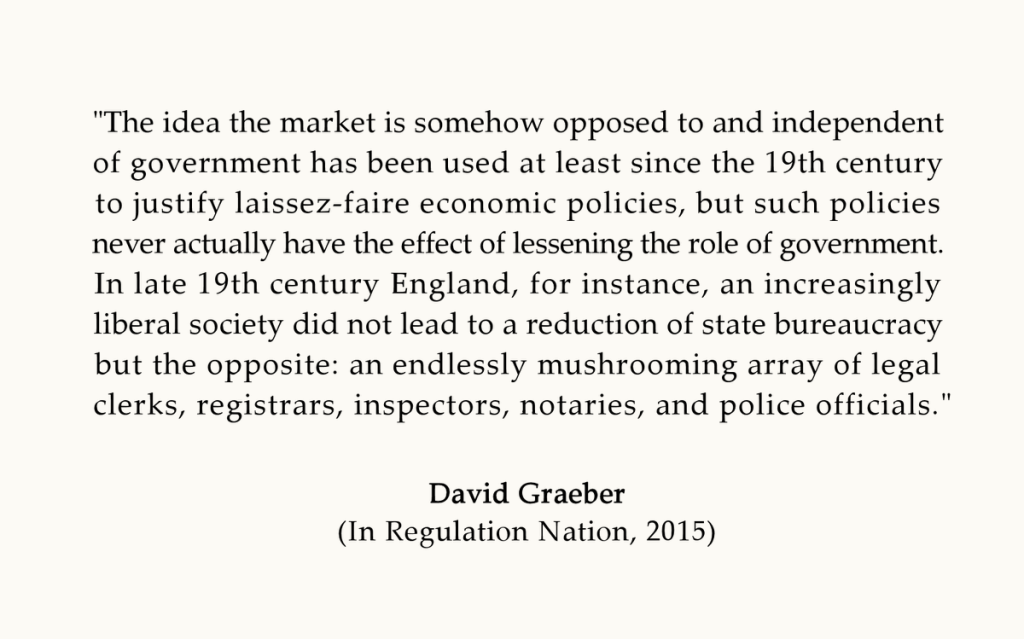
The idea that the market is somehow opposed to and independent of government has been used at least since the nineteenth century to justify laissez-faire economic policies, but such policies never actually have the effect of lessening the role of government. ..turned out that maintaining a free-market economy required considerably more paperwork
Let’s call it the Iron Law of Liberalism: Any market reform or government initiative intended to reduce red tape and promote market forces will ultimately increase the number of regulations and bureaucrats, as well as the amount of paperwork, that the government employs.
The right-wing argument tends to assume a kind of tacit alliance between a parasitic poor ..and equally parasitic self-righteous officials who subsidize the poor using other people’s money.
In America — and increasingly in the rest of the world — the only alternative to “bureaucracy” is now “the market.” Sometimes this is taken to mean that the government should be run more like a business, other times that we should get bureaucrats out of the way and let the magic of the marketplace provide its own solutions. “Democracy” has become a synonym for “the market,” just as “bureaucracy” has become one for “government interference.”
It wasn’t always so. .. rise of a distinctly American form: corporate — that is to say, bureaucratic — capitalism..modern corp emerged when public bureaucratic techniques were applied to private sector — techniques that were thought to be necessities when operating on a large scale, since they were more efficient than the networks of personal or informal connections through which family firms operated.
Americans often seem embarrassed by the fact that, on the whole, we’re really quite good at bureaucracy. It doesn’t fit our American self-image. We’re supposed to be self-reliant individualists. But it’s impossible to deny that for well over a century the United States has been a profoundly bureaucratic society. ..The Americans attempted to administer everything and everyone.
Bureaucratic structures and techniques first began to intervene conspicuously in ordinary people’s lives in the Thirties, through programs like Social Security and the Works Progress Administration. The idea that “bureaucrat” could be assumed to be a synonym for “civil servant” can be traced back to this time. ..As the United States shifted to a war footing in the Forties, so did the gargantuan bureaucracy of the U.S. military. The need to preserve or develop certain domestic industries for military purposes created an alliance between military and corporate bureaucrats that has allowed the U.S. government to engage in Soviet-style industrial planning without having to admit that it’s doing so.
to me.. zoom out enough.. and the.. since forever.. since any form of m\a\p
Consider the maze of rules one must navigate if something goes even slightly awry with a bank account. ..The same story is behind credit ratings, insurance premiums, mortgage applications, and even the process of buying an airline ticket. The vast majority of the paperwork we do exists in just this sort of in-between zone: though ostensibly private, it adheres to a legal framework and mode of enforcement that is shaped entirely by a government that works closely with private concerns to ensure that the results will guarantee a certain rate of private profit.
The language we use to talk about this state of affairs — derived as it is from the right-wing critique of bureaucracy — tells us nothing about what is actually going on. Consider the word “deregulation.” In today’s political discourse, deregulation — like “reform” — is almost invariably treated as a good thing. Deregulation means less bureaucratic meddling, and fewer rules and regulations to stifle innovation and commerce. This ideologically inflected usage puts those on the left in an awkward position, since opposing deregulation seems to imply a desire for more rules and regulations, and therefore more men in gray suits standing in the way of freedom.
But this debate is based on false premises..The government regulates everything from a bank’s reserve requirements to its hours of operation; .. and pretty much everything else.
So what are people referring to when they talk about deregulation? In ordinary usage, the word seems to mean “changing the regulatory structure in a way that I like.”
I’m going to give this process — the gradual fusion of public and private power, which becomes rife with rules and regulations whose ultimate purpose is to extract wealth in the form of profits — a name: “total bureaucratization.” The process is a result of the growing power of financial institutions over a deeply bureaucratized postwar America, and it defines the age we live in. investor class and the executive class became almost indistinguishable.
..a broader cultural transformation. Bureaucratic techniques developed in financial and corporate circles (performance reviews, focus groups, time-allocation surveys, and so on) spread throughout the rest of society, to education, science, and government. ..Much of it originated from “self-actualization” movements ..But it quickly became a language unto itself, engulfing any meeting where any number of people gather to discuss the allocation of any kind of resources.
As anyone who has been to graduate school knows, it’s precisely the children of the professional-managerial classes, those whose family resources make them the least in need of financial support, who best know how to navigate the paperwork required to get this support. For everyone else, the main result of years of professional training is an enormous burden of student debt,..t which requires its holders to bureaucratize ever-increasing dimensions of their own lives, and to manage themselves as if they were each a tiny corporation.
Sociologists since Weber have often noted that one of the defining features of a bureaucracy is that its employees are selected by formal criteria — most often some kind of written test — but everyone knows how compromised the idea of bureaucracy as a meritocratic system is. The first criterion of loyalty to any organization is therefore complicity. Career advancement is not based on merit but on a willingness to play along with the fiction that career advancement is based on merit, or with the fiction that rules and regulations apply to everyone equally, when in fact they are often deployed as an instrument of arbitrary personal power..t





 be you.