david (w) on another world
david wengrow jul 2025 essay – seeds of another world
via tweet [https://x.com/davidwengrow/status/1942248572491124895]:
New essay, out today in Eurozine: https://eurozine.com/seeds-of-another-world/
notes/quotes from essay:
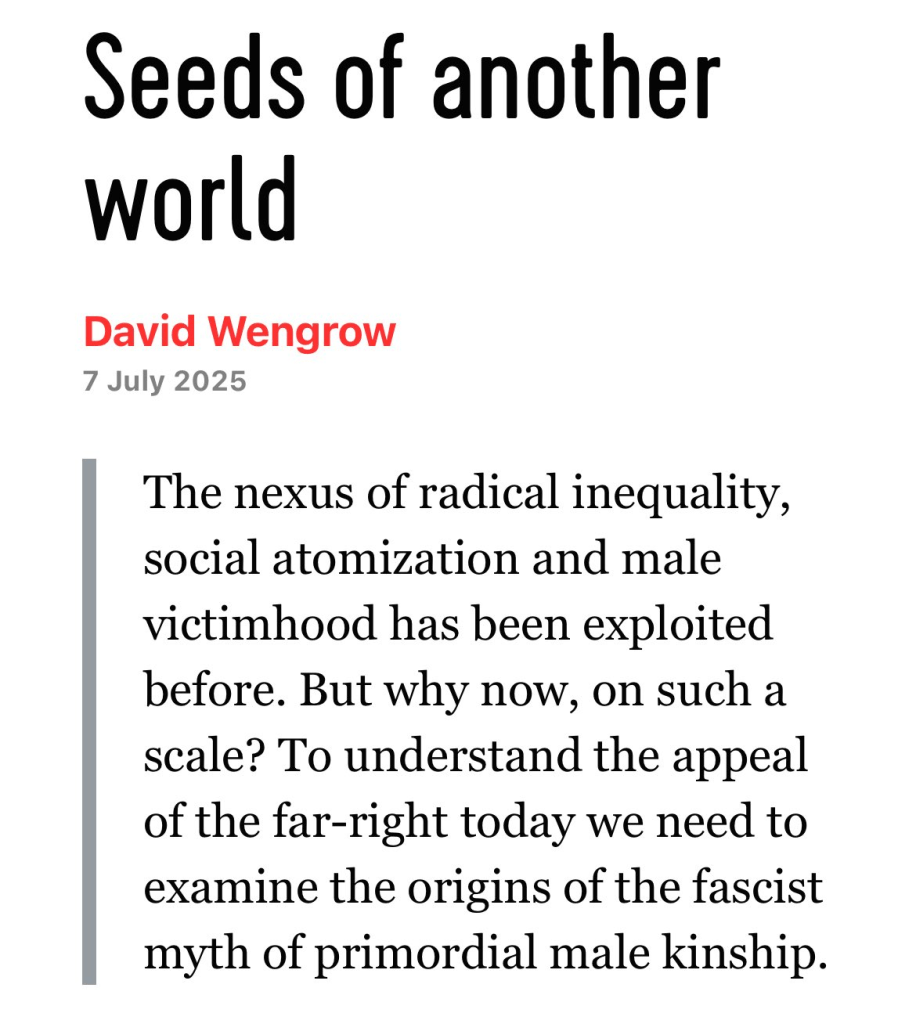
The nexus of radical inequality, social atomization and male victimhood has been exploited before. But why now, on such a scale? To understand the appeal of the far-right today we need to examine the origins of the fascist myth of primordial male kinship.
kinship..
But we might be searching for answers in all the wrong places, or even, perhaps on the wrong plane of reality. What if we shift our gaze from the headlines and try to look inward? What is it that makes millions of ordinary people, every day, embrace and celebrate the new order?..t Why are so many of them men between the ages of 18 and 29? Why is this same pattern being played out in the UK, Germany, The Netherlands, Poland, etc.? What is the void that propagandists are rushing to fill..t with symbols, slogans and watchwords that multiply by the day?
void: missing pieces.. all else is symptom of those missing pieces
khan filling the gaps law et al
An absence of personal security, community and love may find its outlet in the adoration for leaders who demonstrate ‘hardness’ through acts of cruelty, gatekeeping and exclusion. Quite likely this nexus of radical inequality, social atomisation and male victimhood has been exploited in similar ways before. But why now, on such a scale? How are the cultural residues of the past being repurposed in the present? This is much trickier to fathom.
By what sort of mental machinery, he asked, are basic human notions such as ‘freedom’, ‘friendship’, and ‘love’ transformed into symbols of violence and domination? What are the political consequences, when this happens?
structural violence.. graeber violence in care law et al
‘Freedom’, this story goes, began at the dawn of western civilisation in a dim and half-forgotten place. ..Wherever it was, for the first time in human history, men formed political associations based on voluntary oaths of fealty to a great leader. At first, these groups were restricted to virile young warriors, before the age of marriage. Out in the wilderness, they forged a type of bond unknown in other civilisations. Casting off the shackles of family, kinship and custom, they gave ‘the West’ its unique identity and destiny. For the first time, people could freely give their loyalty, even their very lives for an extended community of strangers. They could form the seeds of a true nation.
One might assume this story has deep roots. But in fact it is a modern myth, constructed from ancient materials. Some might consider it to be little more than a strange cul-de-sac in the history of European political thought, something that belongs to the intellectual ‘fringe’ – but it would be foolish to deny that forces of almost unimaginable destructiveness have occasionally erupted from such recesses of the mind. What if, for once, we could bring ourselves to look this history of the nation in the eye? Could we discover something about the beginnings of the path we now find ourselves on again, or even how to get off it and learn to speak a different language of human politics, before it’s too late?..t
or even.. quit looking at (obsessing with) history ness and just try a legit nother way.. a global re\set.. detox leap
graeber model law et al
My position, in what follows, is that neither love nor friendship can exist without freedom, and that none of these terms has any real meaning without truth. For me, there can be only one place to begin making my case, which is here on the ground where I am standing. Not just because I am an archaeologist, and like to go below the surface of things, but also because it was here in Vienna that my ancestors lost their freedom, as well as many of their friends and loved ones.
In February 1937 – at the age of seventeen – my mother’s father helped to organise a public demonstration to mark the third anniversary of the February Uprising, where remnants of the Republican Schutzbund – the Social Democrat militia – made their last stand against the dictatorship of Dollfuß. He was arrested on a charge of ‘endangering the Fatherland’ and put on trial. After his release, upon his father’s advice, he left the country for his safety. So, my mother was born a child of Austrian exiles in Jerusalem, then under British rule. Her mother’s father had served in a Hungarian artillery unit during World War I. He was a Social Democrat, a Jew and a critic of the Zionist movement. After World War II, he and my grandparents returned to Vienna, where my mother grew up. In the ’60s, she emigrated to England, where I was born and raised.
*Language was once a primary medium through which scholars sought to reconstruct the earliest forms of human society..t Within the same family of languages, correspondences among terms found in ancient literature – the Vedas, Avesta or Old Norse sagas, for example – were taken as evidence of foundational social concepts, which came before the written sources if not the invention of writing itself. Where institutions are concerned, the archaeology of language preceded the archaeology of things.
*need to try idiosyncratic jargon as language via tech as nonjudgmental expo labeling (a means for non hierarchical listening)
Questions of this sort have always been more than just matters of intellectual curiosity. For at least the last 150,000 years, language provided a symbolic system through which human beings transmit their internal thoughts to others. The conventional meanings we attach to such symbols, their ‘semantic range’, have a bearing on our collective capacity to imagine new forms of value and social relations. The relationships among words do not come out of thin air, but are constantly evolving, drifting further apart or converging through patterns of use.
language as control/enclosure.. breaking the alphabet.. et al
As my late co-author, the anthropologist David Graeber, liked to point out, ‘freedom’ and ‘friendship’ are connected..t The English word ‘free’ has a Germanic root, meaning ‘friend’. The connection can’t really be understood, however, without also factoring in slavery. Germanic languages are known from early Gothic sources, the oldest of which pre-date the fall of the western Roman Empire in AD 476. As suppliers of captives to that empire, the Germanic tribes of northern Europe were no doubt familiar with Roman slavery and the idea that a human being could be treated as a form of property, a ‘living tool’ to be used in any manner one’s owner saw fit.
In legal terms, to be a slave under the imperium of Rome was to be reduced to a ‘thing’ (Latin: res). For the slave, this meant trying to survive a form of existence in which the body is present but the social person is absent, since all such ties to one’s community were severed at the point of enslavement. An extension of the master’s chattels or belongings, slaves were legally prevented from forming relationships with anyone else..t In practice, of course, victims of Roman chattel slavery found ways to transcend their ascribed status, as people in such situations often do. We could see the connection between ‘freedom’ and ‘friendship’ in this light.
huge to khan filling the gaps law and graeber violence in care law.. because of missing pieces
What might it mean to conceive of these things as being closely related, not just as historical or linguistic facts, but in practice, in the contemporary world? I want to suggest that these two aspects of the problem – the historical and the political – are more closely intertwined than we tend to think. In fact, the moment you start looking more closely at the connection between ‘freedom’ and ‘friendship’ in European languages, something strange, disturbing even, rears its head.
Book I of the seminal Dictionary of Indo-European Concepts and Society, compiled by the French semiotician Émile Benveniste, considers terms for ‘friendship’ under three headings: ‘gift and exchange’, ‘hospitality’ and ‘personal loyalty’. The latter includes a comparison between Old and modern Slavic drugŭ – which signifies ‘friend’ or ‘companion’ – and the Gothic term drauhti, which denotes a ‘soldier’ or member of a ‘warrior troop’. A question immediately arises in connection with ‘freedom’, since in many cultures the term ‘soldier’ is synonymous with slavish obedience and so has just the opposite connotation. A soldier is a person who follows orders.
gift\ness.. graeber exchange law.. marsh exchange law.. et al
all forms of people telling other people what to do
To take an example: discussing the common root of terms for ‘freedom’ and ‘warrior companionship’, ..t Benveniste observed that some such relationship was ‘characteristic of ancient Germanic society’. *Young men from different families would attach themselves of their own free will to a charismatic chief,..t thus forming a retinue. Within such groups, which Tacitus called comites, companions would compete to occupy first place alongside their leader, while leaders competed for the best and most numerous followers. .
*khan filling the gaps law
A relation between German frei (‘free’) and Freund (‘friend’) is addressed in Book III of the Dictionary under ‘The Free Man’, where it leads directly back to the topic of warriors and what Benveniste calls ‘a primitive notion of liberty as belonging to a closed group of those who call one another “friends”, thus distinguishing themselves both from strangers and from slaves’. This primitive connection, he observes a bit mysteriously, ‘is still felt’. Originally, he suggests, such free groups formed an exclusive ‘stock’ or class within their respective societies. Working through terms in Greek, Latin, Slavic and Sanskrit, Benveniste comes full circle to evoke an ancient association between freedom, friendship, and ‘closed fraternities’ forged in battle, rather than by ties of kinship.
What is really going on in these passages of the Dictionary? To answer this question, we must delve into some of the murkier ideas about human freedoms that emerged in Europe around the start of the twentieth century.
Perhaps the best way to start is by relating, in a bit more detail, the origin story I began with. Such was the impact of this story, in the early twentieth century, that its effects on the political imagination reverberate to this day. Viewed from one perspective, it’s a fable about what we might call ‘revolutionary love’. From another, it’s quite the opposite. For ease of the reference, let’s simply call it ‘The Story of the Men-Only Warrior Band’...t
Liberty, this story begins, had its first dawn in archaic systems of male bonding. Deep in Europe’s half-forgotten past, and for the first time ever in human history, political associations formed around what German scholars of feudalism termed Gefolgschaft. To begin with, the bonds between leaders and their followers were voluntary. Followers chose to give their loyalty, and if a leader became weak or failed them in battle, they were free to offer fealty to another lord. In the beginning, these competitive forms of association were restricted to unmarried, adolescent boys. Out in the wilderness – outside the domain of the family and the home – the virile young warriors formed bonds of a type that was alien to ‘Oriental’ civilisation, where politics remained embedded in the city, and in domestic relations among men, women and different generations of the same family.
What gave Europe its unique destiny, the story continues, was that historical moment when it broke away from the shackles of family, kinship and custom – which supposedly remained in place for the rest of humanity. Often, this moment was identified with the fall of the western Roman empire and the rise of the early Christian Church. The former cleared the way for open competition among local leaders, while also leaving behind tools of rational governance; the latter introduced the monogamous nuclear family, and the separation of kinship from politics.
Only after these things had happened, the story tells us, could people freely give their loyalty and even their lives in combat for an extended community of strangers, thus forming a ‘nation’. Only then, it goes on, could true political freedoms become established: everything from democratic assemblies and free cities to competitive markets, craft guilds and universities. Again, supposedly, this marked a fundamental break with everything that had happened before in human history, laying the basis for modern science and civilisation. It all began, however, with the creation of a ritual and political space that was exclusively male: in German, the Männerbund (‘male band’).
not new/diff.. since forever.. and will be until we try a means s any form of measuring, accounting, people telling other people what to do
like opening para.. same song.. just more intense
Certain elements of this narrative have never really gone away. But where, exactly does it come from? The answers turn out to be surprising, not least because they begin in Africa.
To begin with, the identification of the ‘male warrior band’ as a primitive political institution had very little to do with Indo-European studies. It originates with the ethnographic studies undertaken in Germany’s colonial ‘Southwest’ (today’s Namibia) and in ‘German East Africa’ (Tanzania, Burundi and Rwanda). In 1902, an ethnologist called Heinrich Schurtz published a book based on data collected in those countries, drawing comparisons with other ‘primitive’ groups in Australia and the Americas. It was called Altersklassen und Männerbünde (‘Age-Classes and Male Bands’). Its first English translation appeared only recently, in 2023.
Schurtz’s book quickly became a talking point in anthropological circles, discussed and critiqued by luminaries such as Émile Durkheim, Marcel Mauss and Robert Lowie not least for its proposed alternative to ‘primitive matriarchy’ as the original political condition of human societies. Among these so-called ‘natural societies’, its author claimed to have discovered nothing less than the ‘fundamental forms’ of human political association. They lay in ritual coalitions of male youths, of a similar age, but drawn together from different clans and lineages. Such groups formed secret initiation societies: fraternities or ‘men’s houses’, set apart from ordinary living quarters..t
Members of the fraternity spent their time hunting, feasting, reciting heroic tales or training for combat. On festive occasions, they donned the skins of wild animals and launched raids on nearby settlements, bursting in to loot, murder and rape. It was considered legitimate for them to do so, Schurtz noted, since at such times they were neither fully within nor fully outside the bounds of society, but operating in an entirely separate moral field. In such collective rites of passage, masculine values were given free rein away from the influence of ‘innate’ female tendencies – among which, Schurtz counted a preference for staying at home, indulging in flights of fancy, and a constitutional aversion to logic (apparently contradicting his argument that male initiation rites comprised irrational acts of violence, undertaken in an ecstatic state of frenzy).
It is not the family, Schurtz wrote, but ‘the free association of male bands that constitute the progressive and culture-forming foundations of society and are the vehicle of almost all higher cultural developments’.
Berlin in the 1920s was considered a haven of sexual permissiveness and gender emancipation. This was in stark contrast with London, where the trials of Oscar Wilde cast a long shadow. From this heady mix arose a masculinist backlash. ..The architects of this new vision hoped that, by reviving the ethos of the male warrior band, they would create a counterforce to bourgeois politics, which they saw as increasingly wedded to feminine values and impersonal state bureaucracy, for which Jews were also blamed.
In the year that Schurtz’s book was published, the fourteen-year-old Blüher was inducted into the Wandervogel youth movement and at once began to write its history. The result, published ten years later – by which time Blüher had absorbed the works of Sigmund Freud and corresponded with the master himself – was a national best-seller. Entitled The German Wandervogel as an Erotic Phenomenon, its central argument was that a healthy nation should be based both on the rejection of parental authority and city-life, which meant a return to unspoiled nature, as well as on a revolutionary new concept – the ‘love between friends’. What Blüher meant by this was homoerotic companionship, fostered in same-sex groups. Alongside his writing, he campaigned for the decriminalisation of homosexuality, at the same time advocating for the expulsion of women and Jews from German political life.
Given its origins in a rather confused episode of German colonial history, and the catastrophic development under Hitler, which included the violent purging, imprisonment and persecution of gay men, it’s remarkable how tenacious this set of ideas has since turned out to be. One of its striking features is a morbid fascination with male forms of companionship, love, violence and death as an exclusive basis for political association, or even as core symbols of personal liberty..t The persistence, within this ideology, of clichés and formulas such as the ‘wolf pack’ is often taken to indicate something slightly mysterious, and it seems an unavoidable human trait to associate mystery with power, when in fact, we could just as well be dealing with a stunning lack of originality or political creativity on the part of fascists.
Why, then, do such ideas keep coming back?..t
because still missing pieces
Since we’re dealing with a phenomenon that originated in the early twentieth century, it may be useful to turn to a thinker from the same era. In Crowds and Power, Elias Canetti reflected on the strange alchemy that causes a disorganised mass of human beings to become an obedient herd, whether a victorious mob or lambs to the slaughter. To achieve this, Canetti suggests, what you really need is discipline at the centre: a group, usually small in scale, whose individual members are poised to act and absolutely committed to their task. To an outsider they appear as one, unified in their actions, like members of a wolf pack.
jihad (doc) ness et al
Canetti also noted the strange persistence of these social units in history: once in place, they never seem to go away. Even when their political projects fail, the costumed band of warriors shrinks back into spaces of make-believe, gaming and play, awaiting a comeback. But is this too just another illusion of eternity, a mask, or game of political make-believe? Perhaps the reality is more mundane, and tragic. *Surely what’s most damaging about stories of the kind I’ve been telling is how they invert the very meaning of words like ‘freedom’, ‘friendship,’ and ‘love,’ and turn them into violence against others. They speak to the politics of a broken society – a crisis of hopelessness, apathy and isolation – which is why they are being told again now for political gain.
*graeber violence in care law.. steiner care to oppression law.. et al
*The task of undoing this damage is urgent..t One way to begin may be to look with fresh eyes at the meanings and functions we attach to such basic terms. Benveniste himself shows the way. In the Dictionary, you can also find another story of ‘freedom’ and ‘friendship’, which begins with the Greek term xenia and its correspondents in Latin, Gothic, Slavic, Persian and Sanskrit. These are the terms hostis, gasts, gospodĭ, ērmān and atithi. All refer to bonds of friendship, which echo through generations, and begin with **acts of hospitality to those who are otherwise considered strangers or enemies with no rights, protection or means of existence.. ***‘Aryaman’ is the Indo-Iranian god of hospitality who presides over the process of granting asylum and ensures that the one who receives does not become the master of the guest..t
*for (blank)’s sake
**hospitality ness.. constant hospitality law.. et al.. hospitality oikos cosmo et al
***for that.. need a means to try/see the thing we’ve not yet tried/seen: the unconditional part of left to own devices ness.. otherwise still people telling other people what to do
Let the guest, then, be a god, since any stranger may turn out to be a god in disguise. In such small acts of refuge and welcome lie the seeds of another world.
____
____
____
___
_____
_____
_____
____
____





 be you.
