aaron halfaker

intro’d to Aaron via this berkmancenter livestream:
Engineering open production efficiency at scale – wikipedia
https://cyber.law.harvard.edu/events/luncheons/2016/02/Halfaker
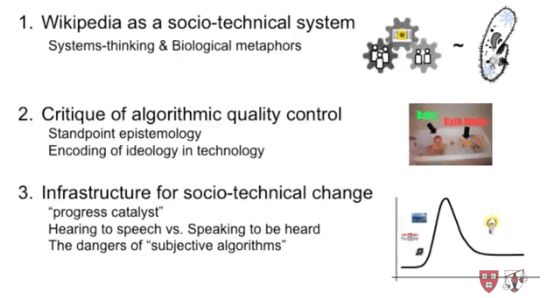
could develop tech that help us solve social problems.. so i see a partial overlap between social/technical… explore idea of a computer mediated space…. effecting everything.. that’s where i think wikipedia operates.. and why i use socio/technicali want to draw between bio and tech…bacterium (simple) and paramecium (very complex)these systems operate at completely diff scales… can show us how diff people can operate…dunbar studied a lot of fishing villages… never grew beyond 150…. something would limit them….when i think about wikipedia.. a collection of people like a fishing village…. but more like paramecium at about 110 000when i think socio and technical.. i’m talking about why you study paramecium as entire thing.. in context.. to make larger system work.. ie: can’t just understand people.. or tech.. for wikipedia.. but have to see how they… dance..wikipedia.. w/ specialized subsystems…one of problems wikipedia has to solve is1\ how to allocate work..
linus’s law… look at enough eyeballs all bugs are shallow –visibility huge to open2\ regulation of behavior.. how to decide how we consistently work in same direction…
i google wikipedia governance…. i see that this is really well studied2 types of norms 1\prescriptive 2\descriptiveverifiability – wikipedia is not verifiable..wikipedia’s governance is inclusionary3\ quality control systemcomparing systems of reverting vandalism.. adaptation.. to immune system… slow..but specific.. but works globally… ie: once vandal is banned.. banned from whole site..about 6000 editing…newcomers a day..reflection and adaptation…on looking at this like a system….the rise and decline2001-4 – not that many people.. mostly new everyone – mostly human infrastructures2004-7 – exponential growth… dealt with scaling by building algo tools… needed fewer people to do quality control…(donna haraway studies – standpoint – view of what’s important/valuable… objectivity – you obstruct models that behavior – not argument about which answer is right… so standpoint in wikipedia – saw wikipedia as fire hose… how to control quality and minimize effort… built into filter tools.. was a massive success… as tech intervention.. but… by 2009 – expo growth not happening any more.. because newcomers aren’t sticking around… (old ones are) – we forgot to design for socializing new comers..)2007 ff – abrupt steady decline…we have to socialize/train newcomers…this new standpoint incorporated in a lot of convos..something that didn’t change.. most dominant quality control… 1\ first sugar – huggle is great… 2\ now medicine – looks like quality control – still not designed for newcomers… so remain marginalized… hammered by quality control for making mistakes.. to not retaining newcomers…why… why if we extended the convo.. why didn’t tech change…3rd part of talk – infrastructure for socio tech change…the machine classifier…as people consider what we can do in space… seems we are getting too much ness… to people give upon need to cross energy threshhold.. but can have a catalyst…. think about where we’d like to go… an activation thresh hold… be great if we could knock that down so people could experiment in space more easily.. so this is system we’re building…
let’s do this first: free art-ists.
now don’t have to go through efforts of building up new learning machine model… it’s just a web address…what i’m hoping this system will do is act of this catalyst… reducing activation threshold by many lines of code…hoping get explosion of ideas to improve type of work we dohow to turn critiques into design…..1\subjective algo’s… zeynep: algo’s .. where no right decision…how to avoid coding racial biasing into algoempowerment vs power of here…. hearing to speech instead of speaking to be heard…ie: how to make others comfortable with my expertise…? reduce barriers so others can experiment in space… w/o expertise…?next project – host bot – make it a machine learning system… to route new comers…
20 min for q&aworking on incentives… metrics that capture productivity…
i would really like that when you apply for tenur track.. you could pull up wikipedia article to show what you’ve done…
i started editing wikipedia by vandalizing wikipedia.. we need to realize.. most are just trying to see how it works.. if we’re welcoming to that… bad faith people are really a small proportion
i’ve describe this as an auto immune disorder wikipedia hasquestion i’d like to ask.. how do biological systems adapt.. what’s the failure that results in auto immune disorder…. this problem of damaging things sometimes come in…..
my methodological home. .behavior…how i can get better questions by looking at broader methodology… and other ie: disciplines…
Wikipedia, largely used as a synecdoche for open production generally, is a large, complex, distributed system that needs to solve a set of “open problems” efficiently in order to thrive. In this talk, I’ll use the metaphor of biology as a “living system” to discuss the relationship between subsystem efficiency and the overall health of Wikipedia. Specifically, I’ll describe Wikipedia’s quality control subsystem and some trade-offs that were made in order to make this system efficient through the introduction of subjective algorithms and human computation. Finally, I’ll use critiques waged by feminist HCI to argue for a new strategy for increasing the adaptive capacity of this subsystem and speak generally about improving the practice of applying subjective algorithms in social spaces.About Aaron
Aaron Halfaker is an American computer scientist who is an employee of the Wikimedia Foundation. Halfaker earned a Ph.D. in computer science from the GroupLens research lab at the University of Minnesota in 2013. He is known for his research on Wikipedia and the decrease in the number of active editors of the site. He has said that Wikipedia began a “decline phase” around 2007 and has continued to decline since then. Halfaker has also studied automated accounts on Wikipedia, known as “bots”, and the way they affect new contributors to the site. He has developed a tool for Wikipedia editing called “Snuggle“, the goal of which is to eliminate vandalism and spam, and to also highlight constructive contributions by new editors. He has also built an artificial intelligence engine for Wikipedia to use to identify vandalism.
Links
These tell a story in order. The talk will cover a bit of each. Read from top to bottom and stop when you get bored or run out of time.
__________
find/follow Aaron:

http://www-users.cs.umn.edu/~halfak/
https://wikimediafoundation.org/wiki/User:Ahalfaker

Aaron Halfaker is an American computer scientist who is an employee of the Wikimedia Foundation. Halfaker earned a Ph.D. in computer science from the GroupLens research lab at the University of Minnesota in 2013. He is known for his research on Wikipedia and the decrease in the number of active editors of the site. He has said that Wikipedia began a “decline phase” around 2007 and has continued to decline since then. Halfaker has also studied automated accounts on Wikipedia, known as “bots”, and the way they affect new contributors to the site. He has developed a tool for Wikipedia editing called “Snuggle”, the goal of which is to eliminate vandalismand spam, and to also highlight constructive contributions by new editors. He has also built an artificial intelligence engine known as “Objective Revision Evaluation Service” (or ORES for short), used to identify vandalism on Wikipedia.
__________
stigmergyness. – ginormous
chip as easy ui/entry (a mechanism simple enough) to leaving trail to/for io dance ness
www ness





 be you.