christine sun kim
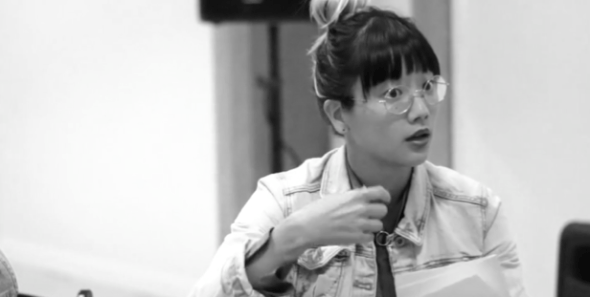
image from video below (& linked above) – a choir of glances
A Choir of Glances
oh my.. so resonating with growing up ..in a playworld underwater..
we had our hearing as taken away as it could be under the circumstances
like we had jumped into a cloud together.. extremely intimate
being attentive to the visual rather than the auditory
none of us had done this before.. made sound with our ears covered
________
intro’d to Christine via her mit talk..
resonating comments:
My definition of silence: the “p” for pianissimo, repeated to infinity – @chrisunkim #MLTalks
sound itself is a big time privilege – @chrisunkim #MLTalks
on tech being both helpful.. but also marginalizing (in its one-way ness to deaf community) – @chrisunkim #MLTalks
if diversity matters – how can we get past our thinking about disability – @chrisunkim#MLTalks
on getting more info than a sound file – @Joi#MLTalks
on facial expression – everyone has that skill – they just don’t use it – @chrisunkim#MLTalks#MLTalks
on eagleman vest – as yet another technology for me (hearing) to talk to you (deaf) – @Joi & @chrisunkim in convo #MLTalks
using an interpreter requires a lot of trust – @chrisunkim#MLTalks
on sign language as a super power.. an elegant communication.. deaf better leveraging that for sure – (audience) #MLTalks
with an interpreter – the two of us become one voice. depending on the scenario – i choose my interpreter – @chrisunkim#MLTalks
on – what is the definition of a song – does it have to be something with words… @chrisunkim#MLTalks
on assistive techs – are they for you (the one to use it) or for me (the one making it) – (audience) #MLTalks
i want something that sounds like an option. not to fix, not to help. just something that’s there. as an option. – @chrisunkim#MLTalks
on reducing stigma in disability. helping people rethink what is normal. (audience) #MLTalks
on reframing idea of disability. my best allies are the interpreters. – @chrisunkim#MLTalks
on media lab’s strategy for disabling disability ness: we don’t like normal – @Joi#MLTalks
on remembering the diversity within cultures.. @chrisunkim #MLTalks
________
interview on ted.com – from fellows friday 2013:
http://blog.ted.com/playing-with-sound-in-silence-fellows-friday-with-christine-sun-kim/
explores ways of transmuting sound and silence to come to terms with her relationship with it.
I knew I was very animated, but that was my language.
All the customs and social norms, all the rules were in my face every day. I’d go into a theater and I knew that I’d have to sit, be quiet and walk slowly. It was learned behavior from people’s reactions around me: it depended on how and if people looked at me. If everyone’s eyes were on me, I knew I was being loud or doing something “wrong.”
on wanting everything turned off – I didn’t like the extra noise floating around me because I wouldn’t know what it was.
As a society, the majority of people hear. And I mirror them. I have to follow what they’re doing. It was not like society gave me a clear, safe place to do whatever I wanted. I had to learn how to integrate to their ways. And the more aware I become of the noises and the norms, the more I play around with that in my artwork. The more experience I had trying to become accustomed to the norms, the more I tried to use that as material for my artwork. And oddly, that made my voice clearer.
In my past work, I was doing a one-to-one translation like sound to vibration, working with sound to create painterly imprints. I don’t know if that really translates. It’s very limited and deals with low frequencies only, and that’s just one aspect of sound. That’s why I let go of the idea of translating it. Now I’m trying to develop my own information system and new theories of what sound should or could be, using new forms.
idiosyncratic jargon ness
Most people who write music have this idea of silence, but they can hear and they use that to define or shape silence, or vice versa. So how can I learn the idea of sound and silence from their perspective? I can’t relate to that. So I’m starting over from scratch with everything. I’m redefining things. It’s not scientific evidence. People always ask me if I use sound waves in my art, but I’m not really interested in that.
revolution – instigating utopia everyday ness
Once a friend of mine, who is a real estate agent, came over and once inside my apartment said, “Oh, it’s so quiet in here. It shouldn’t be wasted on you” — because New York is so noisy, so loud. But I realized I need that too. I used to live in a really crowded area, and I never felt fully rested. But in my home now, I can pass out and sleep for hours; I feel really rested. Noise truly does have an impact on my body.
never nothing going on .. ness
Music and sound are culturally dominant. Everyone lives in the music world and I’m constantly amazed with the way they remember lyrics. For example: if they hear a few words, then they instantly know the song — that’s a very strong cultural aspect of the hearing world. And even artists depend on that. Online videos are cultural connections, but most of them aren’t captioned. Visual sentences and visual language occupy a limited space in comparison to sound.
..one behavior that’s culturally deaf is that, if you grew up with a strong deaf identity, then when you’re sitting at a table and you’re signing, if somebody joins the conversation, people don’t look up. They know you’re there, they continue talking, but they automatically move over to allow somebody else in. There’s no interruption in the conversation. They have very simple rules and ways like that, and it adds up to cultural norms.
Different languages have different sign languages, but the expressions, ideas and concepts are similar. I think it’s easier for deaf people to communicate amongst their different languages than hearing people.
That’s why I think ASL is an unique language. ASL is derived from French Sign Language mixed with home sign language. It’s influenced by those, but has its own formalized grammar. The tone is conveyed through body movement and facial expressions.
It’s not the same as English. It’s spatial, not linear. If you think of a facial expression as one note, then body movement as another note, then speed as another note, hand shape, placement, and so on — all these parts add up to convey the message. When you do it all simultaneously, it becomes a chord.
neil harbisson – i listen to color – 2012 ted:
https://www.youtube.com/watch?v=ygRNoieAnzI
I was amazed, but it also became political because he picked the colors. There is line that is crossed. What if I wanted to decide for myself? The same parallel exists with the Cochlear implant. It’s limited to only a few channels of sound. The human ear has tons of channels, where the Cochlear implant has a very limited number. So the doctors or manufacturers are the ones deciding what hearing-impaired people will benefit from the most. I have a problem with the politics. That’s my question about this technology. I think it’s a great idea to remove language and to have a different way of communicating, but I’m curious how much control I would have.
_________
ted fellows retreat 2015
The enchanting music of sign language
__________
find/follow Christine:

http://www.christinesunkim.com/

Christine Sun Kim is an American sound artist who has been deaf since birth. Based in New York City, she started as a visual artist, but started to be attracted to sound as a medium because of the “rules” society attaches to it and her disconnect from sound as most people experience it. She states her mission as to “unlearn sound etiquette.” Her work has been exhibited at the Museum of Modern Art, the Hull House Museum in Chicago, and Art Basel in Hong Kong. She was named a TED Fellow twice.
to – unlearn sound etiquette
_______
also resonating with Peter et al, and sign ness, and John and Chris et al..
________
via joi ito fb post:
The Henkaku Center at Chiba Tech is honored to announce that sound artist and performer Christine Sun Kim has been awarded the first-ever Radical Transformation Award (変革賞) at the 2025 Symposium on Design and Science!About Radical Transformation Award (変革賞)“Celebrating those who transform the world through radical yet elegant disruption.”Presented by the Henkaku Center at Chiba Tech, the Radical Transformation Award celebrates those who have brought about a positive societal shift (変革) through radical and elegant action. We honor individuals, teams, or initiatives that challenge authority and push us in initially uncomfortable directions, which, in retrospect, are clearly the right direction for our values and aesthetics.The Radical Transformation Award includes a 10 million yen prize, generously funded by Reid Hoffman. It recognizes changemakers across all disciplines who advance human flourishing through masterful interventions at critical leverage points.2025 Winner – Christine Sun KimFor the inaugural Radical Transformation Award at the 2025 Symposium on Design and Science (SDS), we honor sound artist and performer Christine Sun Kim for fundamentally reimagining how society understands sound, language, and power. Her work challenges dominant modes of communication through art and activism.Through musical notation, American Sign Language (ASL), infographics, and humor, Christine creates new interfaces for understanding that expand Disability identity, using it as an advantage while welcoming the audience to join a new kind of design dialogue. She does not merely critique how oral and auditory norms marginalize Deaf communities, but constructs alternative systems.Her work exemplifies elegant disruption by challenging assumptions about communication, access, and belonging. Through drawing, performance, video, and large-scale murals, she generates cultural resonance that transcends disciplines and borders, and inspires new ways of thinking about language.By bridging art and activism, linguistics and technology, personal narrative and systemic critique, Christine embodies what we seek to celebrate with this award.
_______
______
_______
______




 be you.