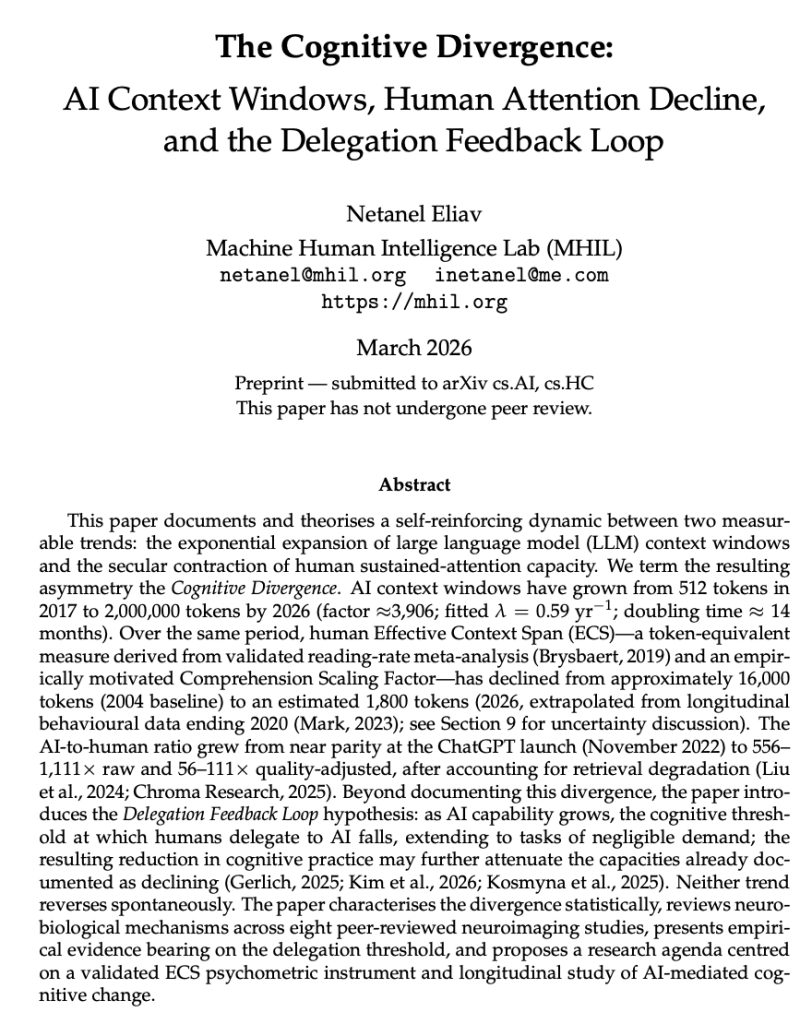
In 2017, AI could hold 512 tokens in its memory. Today, models can hold 2,000,000. It is growing exponentially.
But human “Effective Context Span”, our biological working memory and sustained attention, is moving in the opposite direction.
It has crashed from 16,000 tokens in 2004 to an estimated 1,800 tokens today.
When ChatGPT launched in 2022, humans and AI were roughly at parity.
Today, AI can hold up to 1,100x more context in its “working memory” than you can.
But the paper found something much darker than just two crossing lines.
They call it the Delegation Feedback Loop.
Because AI has become so capable, your brain’s threshold for doing work has plummeted.
You now use AI to draft two-sentence emails that would have taken 30 seconds of effort. You use it to summarize articles you easily could have read.
And that is the trap.
By offloading that basic cognitive load, your brain loses its daily practice. Your attentional muscles atrophy. Your biological context window shrinks further.
Which makes you feel overwhelmed faster.
Which makes you delegate even more to the AI.
The loop is self-reinforcing. And it does not reverse spontaneously.
Every time you ask AI to do the thinking for you, you aren’t just saving time. You are actively conditioning your prefrontal cortex to hold less information.
You are not just outsourcing your tasks. You are outsourcing your working memory.
paper documents/theorises a self reinforcing dynamic between 2 measurable trends: the expo expansion of llm context windows and the secular contractino of human sustained attention capacity.. we term the resulting asymmetry the cognitive divergence..