kids & moms
rather.. kids and primary care giver
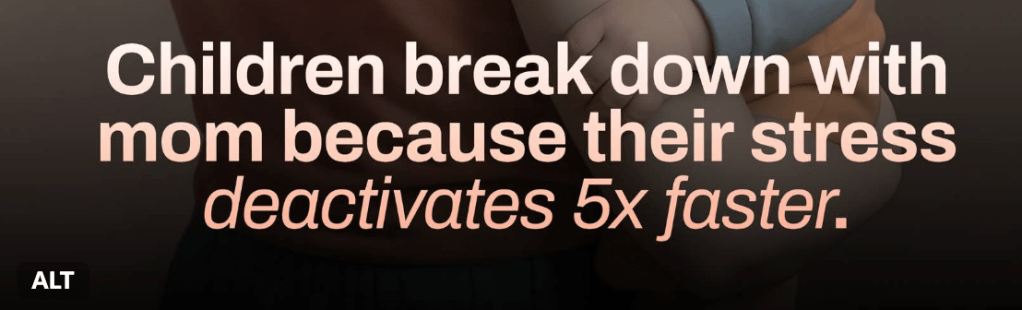
via tweet [https://x.com/ShiningScience/status/2010501985355932040?s=20]:
Children often reserve their most intense emotions for their mothers because they view her as a secure, unconditional “safe base” where they can release stress without fear of rejection. This pattern is strongly supported by attachment theory, which explains that children express their biggest feelings with the caregiver they trust most. Mothers are often that primary attachment figure, so emotional outbursts can actually signal a healthy, secure relationship rather than disrespect or defiance. According to research from the Child Mind Institute, children feel safest expressing overwhelm to the caregiver who provides the most consistent comfort. Understanding this dynamic helps parents respond with empathy and recognize that these big emotions are a sign of deep trust and emotional safety.
parents are the first ness et al
______
via tweet [https://x.com/Rainmaker1973/status/2015779711826235788?s=20]:
A baby’s brain interprets a mother’s absence as a survival threat — triggering a rapid, massive surge in cortisol.
When an infant cannot find or sense their primary caregiver, the response is far more than emotional distress: the brain registers it as an immediate life-threatening emergency.
Studies show that separation activates the infant’s stress response system almost instantly. Within less than 60 seconds, levels of cortisol — the body’s main stress hormone — can spike by 200–300%.
This dramatic physiological reaction is not a learned behavior or a sign of “difficult” temperament. It is a deeply hard-wired, evolutionarily ancient mechanism designed to compel urgent reconnection with the caregiver, ensuring the infant’s survival.
For a developing baby, safety is biologically synonymous with the physical presence of the primary attachment figure. What appears as intense crying or panic is actually a finely tuned neurobiological alarm system that ramps up alertness, mobilizes energy, and drives behaviors aimed at restoring proximity and security.
Recognizing that these powerful responses stem from fundamental biology — rather than personality — highlights just how critical early caregiver connection is for healthy emotional and physiological development.
[Bernard, K., Lee, A. H., & Dozier, M. (2023). “Maternal separation and cortisol response in 12-month-old infants: A longitudinal study.” Developmental Psychobiology, 65(1), e22345.
DOI: 10.1002/dev.22345]
missing piece #2 of missing pieces of maté basic needs
gabor on parenting.. gabor on childhood trauma.. et al
_____
_____
_____
____





 be you.