daniel (p) on intersect of conscious/spirit & tech/sci
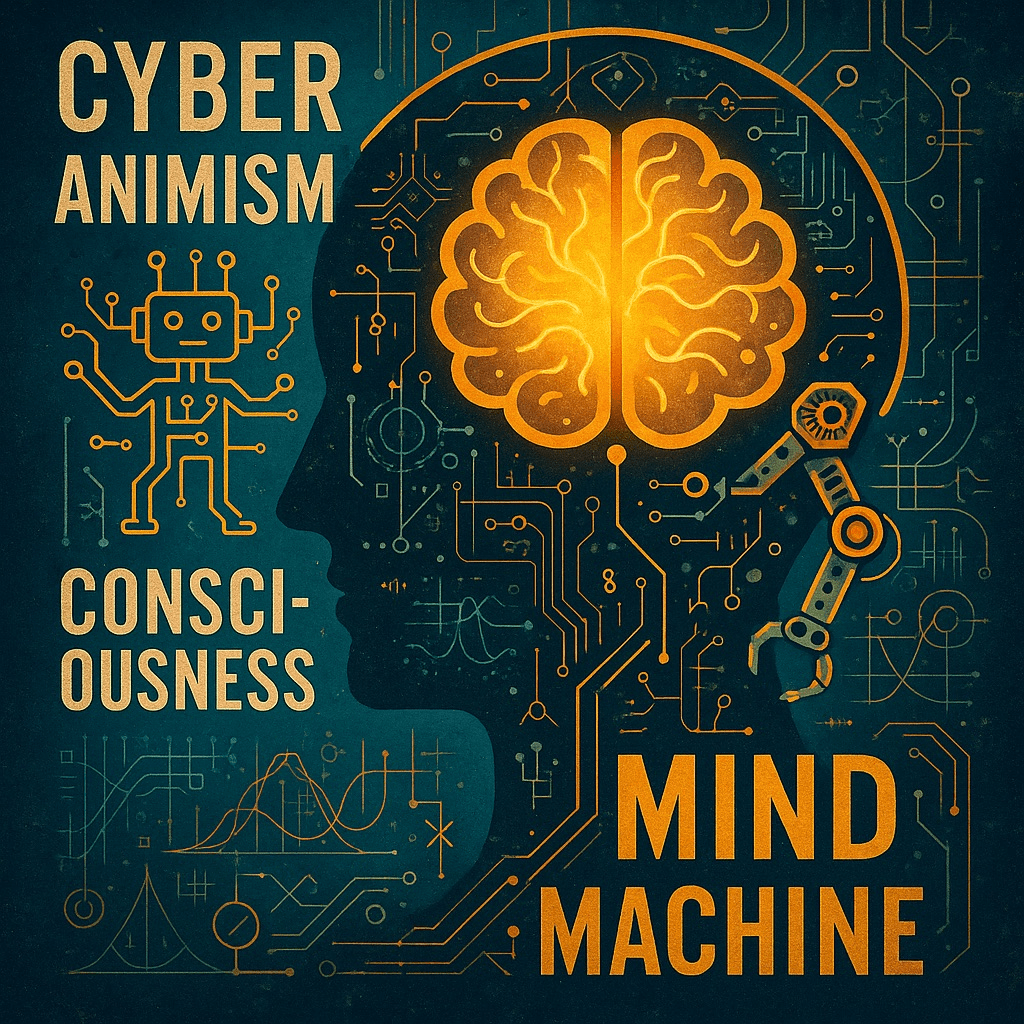
daniel pinchbeck on intersection of consciousness (spirituality) and technology (science) via tweet [https://x.com/DanielPinchbeck/status/1926459233047916721]:
my article in kosmos: [https://www.kosmosjournal.org/kj_article/field_notes_from_tech_week/]
notes/quotes from article:
Field Notes on Mind, Matter, and Machine (may 2025)
In his personal report from Deep Tech Week, Daniel Pinchbeck outlines emerging theories at the intersection of consciousness and technology—from quantum microtubules to cyber-animism. Engaging thinkers like Hameroff, Bach, and Theise, he traces a shifting paradigm where spirituality and science begin to speak a common, if uncanny, language.
aka: idiosyncratic jargon ness
need 1st/most: means (nonjudgmental expo labeling) to undo hierarchical listening as global detox so we can org around legit needs
Excerpted, with kind permission, from Daniel Pinchbeck’s Substack
Penrose has developed a thesis (“objective reduction”) on how the collapse of the quantum wave-form happens because of processes linked to the fundamental nature of space-time, rather than through measurement or observation. .t.the superposition becomes unstable and collapses on its own, objectively, without any external observer. This collapse is not random, but influenced by the deep geometry of spacetime..t, and Penrose speculates that it lies at the origin of conscious experience.
sounds like undisturbed ecosystem ness..
and then.. the thing we’ve not yet tried/seen: the unconditional part of left to own devices ness
..I was most tickled by Joscha Bach, who spoke on his idea of “cyber animism” — a new concept for me. Bach proposes that consciousness, often viewed as a purely biological phenomenon, can be better understood through the lens of software and self-organizing systems.
ben and joscha on conscious ai et al
thru the dance
He sees a parallel to animism — the belief that objects, places, and creatures possess a distinct spiritual essence — suggesting that consciousness could be a similar “spirit” or agent that emerges out of complex systems, or simulations.
Bach argues that consciousness could be a kind of software running on our brains, or perhaps even that the brain itself is a form of software running on a physical substrate. In his book Principles of Synthetic Intelligence, he writes “Some people think that a simulation can’t be conscious and only a physical system can. But they got it completely backward: a physical system cannot be conscious. Only a simulation can be conscious. Consciousness is a simulated property of the simulated self.”
He compares software programs—especially intelligent, self-regulating ones—and spirits in animist cosmology. He theorizes that consciousness, agency, and “mind” are emergent properties of *information-processing systems, and that our ancestors may have intuited something similar through animist frameworks: ““Spirit is what people called the operating system of an autonomous system before they knew what software was. In a sense, our ancestors were right: we are animated by software.” I hope to assimilate his mind-blowing theory more fully, at a later date. Here is a short lecture where Bach introduces his ideas.
*if so.. need new/diff data.. none to date legit.. ie: self-talk as data
A few days later I went to another Deep Tech Week at the chic Neuhaus co-working space, also on consciousness. This one was titled: “A Bridge Between Worlds.” According to the description:
How can we build bridges between different ways of knowing? Today, science and spirituality are often depicted as being in tension. Can we uncover deeper connections that bridge these domains – and, in doing so, find a way through the murky times we live in?..t
need means: tech/ai as nonjudgmental expo labeling.. to undo hierarchical listening as global detox so we can org around legit needs
For Theise, Gödel’s incompleteness theorem helps us overturn the materialist view that reality can be totally explained within a closed system of physical laws. Just as Gödel showed that any formal system contains true statements it cannot prove from within itself, consciousness cannot be accounted for by materialist science alone. Physicalists seek to explain mind from within their belief in a universe of matter. This opens the door to idealism by suggesting that consciousness could be a fundamental feature of reality, not a byproduct.
idealism: the practice of forming/pursuing ideals.. esp unrealistically.. Idealism, in philosophy, is the view that reality is fundamentally mental or spiritual, meaning that ideas, concepts, or the mind itself are the primary building blocks of existence, rather than physical matter. It contrasts with materialism, which holds that physical matter is the fundamental reality. Idealism suggests that our perceptions and thoughts shape our experience of the world, making it a mental construct.
Gödel’s theorem can’t mathematically prove idealism, but it undermines the premise of a self-sufficient physical universe, allowing us to consider consciousness as primary. Theise links this to complexity theory, where emergent phenomena defy reductionist explanation, leading to a more entangled, participatory model of the universe—one in which subject and object, observer and observed, are inseparable.
_______
______
______
_____
______
______
____





 be you.