Stripping the continuously present world of its marvel, written thought is an autocracy in all senses of the word: its rule is of itself, by itself, and for itself. Its primary – indeed, its only – gesture is the transformation of deixis into writing, *ossifying the continuous world into discrete entities, enabling their use and abuse. **By way of clarifying what each of these terms means, we will be able to develop a strategy against them.
‘Deixis’ means any gesture by which an entity is singled out of any given continuum. Its archetype is the gesture of pointing with the (aptly named) index finger. By doing so, I single out a part of the continuum unfolding before me, and render it a discrete entity which I can name, identify, and ultimately control. But such pointing gestures need not solidify. What I have provisionally identified as an entity in the distance may well turn out not to be one – it may be a shadow, a mirage, a reflection. .. I can temporarily identify what I need to survive, yet the world remains a flickering continuum of temporary constellations.
Writing, by contrast, solidifies temporary and tentative deixis, replacing situational interplays of light and shadow, sound and silence, taste and smell with conceptual rigidity. The play of shadows in front of me is rewritten as a tree, source of wood and linchpin of ‘reforestation’ moralisms. The loving vibrancy by my side is rewritten as a human, source of labor power and linchpin of ‘human rights’ pontifications. The loving, caring mother of four is rewritten as a cow, source of milk and linchpin of PETAesque publicity stunts. And the stream of semi-conscious thoughts at the center of marvellous presence is rewritten as a personality, registered at the passport office, tethered to employment and bank accounts, expropriated property-owner with login details and passwords. It is the readability of the world that strips it of its marvel: “Language, and symbolism in general, are always substitutive, implying meanings that cannot be derived directly from experiential contexts”..t
The rule of discrete thought renders the temporary deixis of discrete constellations permanent, eradicating the continuum from which they sprang. That is, it operates by substituting each deictic gesture with linguistic gestures: instead of the living, breathing entity before me, I perceive a ‘human’ or a ‘dog’, and instead of the play of shadows and gentle green, I perceive a ‘tree’. Once identified this way, industrial society can close in on living beings..t The lush green before me becomes so many ‘trees’, each an iteration of the written word ‘tree’ and its ossified deictic content. Breathing constellations of bodies on pastures become so much ‘cattle’, each derived from a number on a page or screen and paying for the sin of wanting to be more than that with their lives. And I become a person, an overworked zombie tethered to my online identity.. t
The readable world thus becomes an industrial hellscape, “an arid, anti-spiritual dimension, emptier and colder with each re-enactment”. But rendering oneself defenseless is no escape: illiteracy is not a strategic move against discrete writing. On the contrary, as every illiterate person and indeed every illiterate creature can attest, the empire of literacy closes over those illiterate with all the more precision.. t Relegated to a mute outside, illiterate ‘humans’ are barely able to exercise their fabled ‘human rights’, while illiterate animals and plants are reduced to so much cattle and development, respectively.
4
*What is required is rather a means of “practically challenging the present social order”..t which “aims at a rupture” with it and thus “begins with an attack upon all institutions of this society”. Challenging their core, the substitution of deixis with writing, we need to read continuously. The strategy at hand must go back to the basics of how deixis solidifies, if it is to show a way out. How do I know that the lush green before me is ‘a tree’, how do I identify it? Deixis provides a stream of experiences: I can touch what is before me, smell it, even taste it – and see it, of course. In itself, this does not involve the subordination of its presence to a phrase (the word ‘tree’) or its content (the discrete entity ‘tree’). Rather, the constellation emerging before me implies others: a chorus of voices points towards birds, a play of shadows points towards nests and foxes and other plants, elastic branches point towards a path, moss points towards what side I need to go, and so forth. Thus a continuous mode of being in the world emerges, “a flux, a movement of myriads of be(com)ings. **And when I have the opportunity to relax into thoughtlessness, into ‘self-forgetfulness’, I become the center of this flux and take it all into myself”.
To be sure, even the temporary gesture sketched here includes a form of recognition, even short of (written) identification. I have to single out the ‘tree’ before me, even just for the purposes of swerving. And of course my own survival will take the form of making use of it, ending its existence as a tree and rendering it kindling. Some gesture of recognition, and indeed of use – and thus of abuse – remains. .. Yet it’s nothing like the systematic enslavement, rape and war which industrial society forces onto what it constitutes through discrete thought, once and for all, as ‘nature’.
6
Which is to say: I learn how to impose the notion of ‘a tree’ as a discrete entity onto the synaesthetic continuum unfolding before me. I learn that the constellation of sight and sound needs to be structured by the meaning of the word ‘tree’ rather than vice versa; that the word-sound precedes the leaf-sound. Indeed, I learn that the word-sound precedes me. After all, to call a ‘tree’ anything but ‘tree’ requires me to unlearn the word and replace it with something else, exchanging one authority for another. (This is why it’s so difficult to learn a new language: it’s a social problem, not a cognitive one.) Authority never stops governing
At the end of that sliding scale is the written ink mark on page or screen, which is – seemingly – nothing but iterated imposition.
7
This means, first, that writing is never simply opposed to deixis, and does not constitute its straightfoward negation.
This means, secondly, that a feral strategy which is aware that writing inhabits deixis cannot simply claim that speech is closer to deixis and thus needs to be exalted as a remedy. Nor can such a strategy affirm an interiority of thought, nor an immediacy of sensual impression. Appeals to immediacy are, after all, themselves implemented in writing. Thought and speech are both projected, from within written language, as that which is beyond written language.
Just as the relation between writing and what is beyond – speech, thought, world – is not a simple negation, so a critique of writing will not consist of a negation of this negation. Rather, it can be implemented as an escalation. “To negate a negation does not bring about its reversal; it proves, rather, that the negation was not negative enough…What is negated is negative until it passed”. Such an escalating negation transposes the script by which writing, in its classical sense, comes to be implemented. Rather than what is written, the escalating negation assays the script itself.
8
Once these questions are taken seriously, writing is threatened at its core. This A is not the same as this A which is not the same as this A, which means that each dissolves into constituent lines, pointing up, down, and sideways towards their surrounding paper, to the hand holding it, to the knee on which it rests, the perch and plants surrounding me as I jot this down, the sky above me and the river before me, the raindrops connecting them and the pen and again this A and this A and this A, neither dissolved nor disappearing but now thought in their radical individuality, which is simultaneously – but not identically – their union of egoists with paper and river and sky and raindrop, their continuousness within this particular constellation. Each A solidifies, first as I type them now, later, where they form a union of egoists again with the screen and my fingertips and the USB stick and my desk and the stack of books on it, and then as you read them on the screen. Each time, iteration attempts to re-inscribe this A and this A and this A into ‘the A’ governing all of them, but each time they don’t ossify fully, for you, too, now see this A which is not the same as this A, neither of which are any of the previous As, and all of which form unions of egoists with you and the sights and sounds around you; continuous being unfolding in different ways.
Destabilizing writing thus destabilizes discrete entities and constitutes a step towards the re-emergence of continuousness. Such re-emergence is not that of a pure tapestry without any imposition. I remain within it, and so do you, and thus so does deixis, and thus so does writing. But I, too, dissolve, and am in continuousness, and continuously “experience the so-called communities we inhabit, or the alchemy of the chemical combinations we ingest, or the people we love, or the wars we wage, or the bacterias in our gut, really any situation or context”. Continuousness is thus not a mythical state before an equally mythical fall, but the recovery of a world always already at my fingertips, concealed by an industrial hellscape.
* * * * *
9
Addendum: Towards Feral Writing
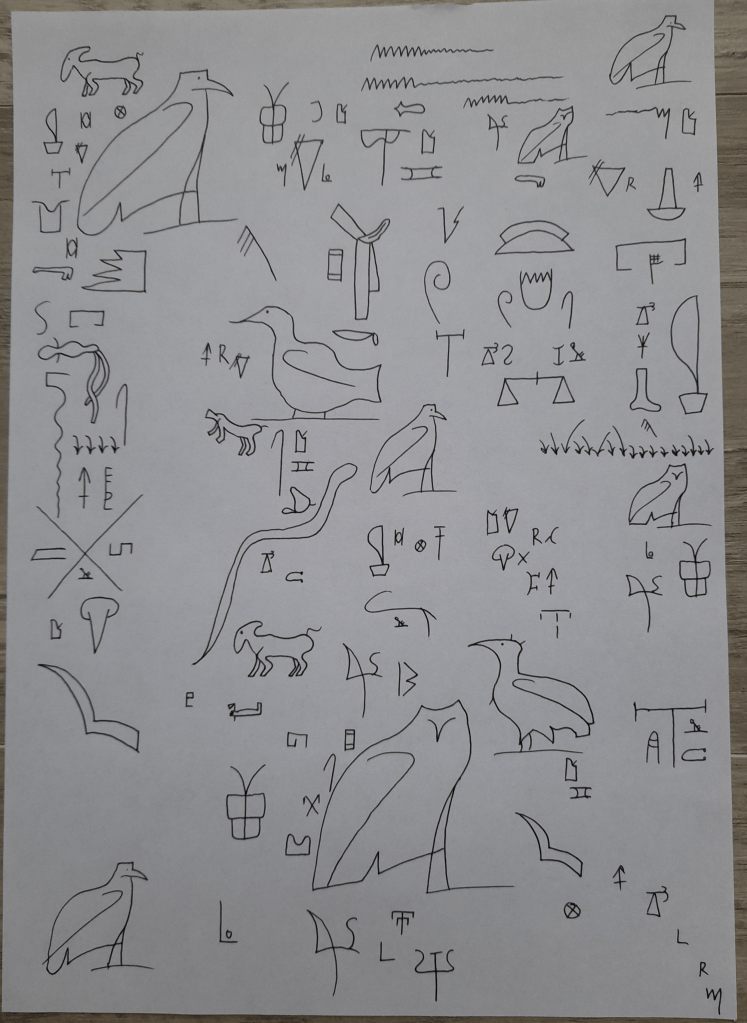
One potential way of reestablishing the continuum of deixis and world is a feralization of writing. One might proceed in two steps. First, one might restore polysemy to the imperialism of the Latin alphabet, reintroducing older elements ranging from ancient Phoenician consonant scripts to ancient Mycenaean Linear B and ancient Egyptian Hieroglyphic scripts. Thus one sentence of the preceding text may become –
10
11
A second step might then deemphasize the abstract elements and instead emphasize the deictic elements of the alphabet thus created, rendering the text-space of the previously created polysemic alphabet that much more feral –






 be you.