horizon report – nmc
2012 – higher ed:
_____________
link to 2013 report via prezi
_____________
2014 report:

p. 5
perhaps the questions on p 7… as part of problem…?
ie:learning centered… but teacher listed first..
biggest challenge… relevance… but all questions are looking into things tech et al… beyond initial relevance..
back to learner as #1… no..?
question…
how can we better facilitate curiosity…?
tech is letting us do that… better than ever before… but can’t start with our existing rules/tech..
start with individual curiosity…
every day.
if we focus on that…
year plan…
that’s it…
horizon report becomes simply another conversation..
or better perhaps…
becomes horizon listening in perpetual beta… just like individual 24/7 with c app …brain… et al.
p6
teaching and policy… both top lists
?..
not so much
to higher Ed…?
or to lifelong self organized learning…?
really..?
to support college completion…?
really..?
to fit in economic system…?
really..?
p. 32
how can we say both… higher Ed degree is a must… but that it’s got us in debt… trillions… what job could ever pay that off…
I doubt someone’s art (the thing you can’t not do)would
p. 32-33
Implications for Policy, Leadership, or
Practice
Adapting higher education systems to current
technological trends requires progressive leadership
and the ability to envision how formal institutions
will remain relevant in a time when quality learning
materials are more accessible than ever. The future
of higher education is being shaped by those who
acknowledge how online learning will redefine the
value of a degree, and are open to exploring alternative
means of proving skill acquisition through certificates,
badges, and e-portfolios. Institutional leaders must take
these options seriously if they are to make decisions
that will keep a university education relevant in a time
when it is widely acknowledged that a college degree
does not guarantee a direct return on investments.
Determining how to develop the most effective online
learning scenarios and integrate them with face-to-face
learning is among the most critical considerations related to tis issue..
in the city. as the day. c app. 2 needs and a cure.
p.33 (and another place with price 2500 for 3 months.. can get a degree in that time, or not..
flex programs, such as those being developed by th uni of wisconsin.. combine online and in -person practicums along with access to mentors and academic coaches..
more here by Anya:
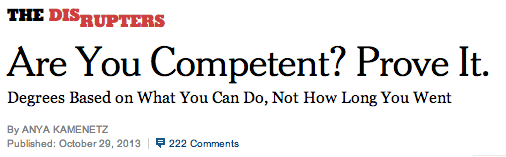
hunt
Rawl’s College – come in as stem..? missing rhizomatic expertise.. the potential of need to know vs just in case..
telling/sad that repeatedly stated as fact that degree will be required for jobs of future.. but seemingly buried in wicked problem section – questioning if that’s true..
p. 34
The expert panel was provided with an extensive set
of background materials when the project began
that identifies and documents well-known existing
technologies, but the panel was also encouraged to
consider emerging technologies whose impact may still be
distant. A key criterion for the inclusion of a new technology
in this edition is its potential relevance to teaching, learning,
and creative inquiry in higher education.
lovely.
new ideas have to relate to teaching..
so… what if teaching is our elephant…?
so.. we haven’t really braved the (assumed) wicked… no…?
at least not with this set of (lovely people) experts.. and this chunk of time and money. and prestige…
ugh
no…?
Some technologies, while intriguing, do not
have enough credible project examples to substantiate
them.
wait… don’t have enough credible project samples… but we want relevance…?
if we listened to ourselves… we are suggesting the answers..
deliberately don’t teach.
instead… listen…
as you live amongst humanity… aka city.. community… everyone…
that’s the ecosystem…oikos….house…. no…?
p. 35
oh my…
just oh my.
ie: social could have been subsumed under consumer…
serious…?
oh my.
enabling tech….
link to learning less easy to make…?
really..?
or do we mean link to classroom/hierarchy/monetary returns.. less easy to make ..?





 be you.