fyodor dostoevsky
adding page via nika dubrovsky‘s interest in him and in mikhail bakhtin

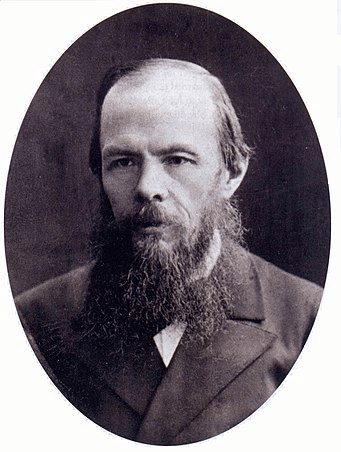
Fyodor Mikhailovich Dostoevsky (UK: /ˌdɒstɔɪˈɛfski/, US: /ˌdɒstəˈjɛfski, ˌdʌs-/; Russian: Фёдор Михайлович Достоевский, romanized: Fyodor Mikhaylovich Dostoyevskiy, IPA: [ˈfʲɵdər mʲɪˈxajləvʲɪdʑ dəstɐˈjefskʲɪj]; 11 November 1821 – 9 February 1881), sometimes transliterated as Dostoyevsky, was a Russian novelist, short story writer, essayist and journalist. Numerous literary critics regard him as one of the greatest and finest novelists in all of world literature, as many of his works are considered highly influential masterpieces. Dostoevsky’s literary works explore the human condition in the troubled political, social, and spiritual atmospheres of 19th-century Russia, and engage with a variety of philosophical and religious themes. His most acclaimed novels include Crime and Punishment (1866), The Idiot (1869), Demons (1872), and The Brothers Karamazov (1880). His 1864 novella Notes from Underground is considered to be one of the first works of existentialist literature
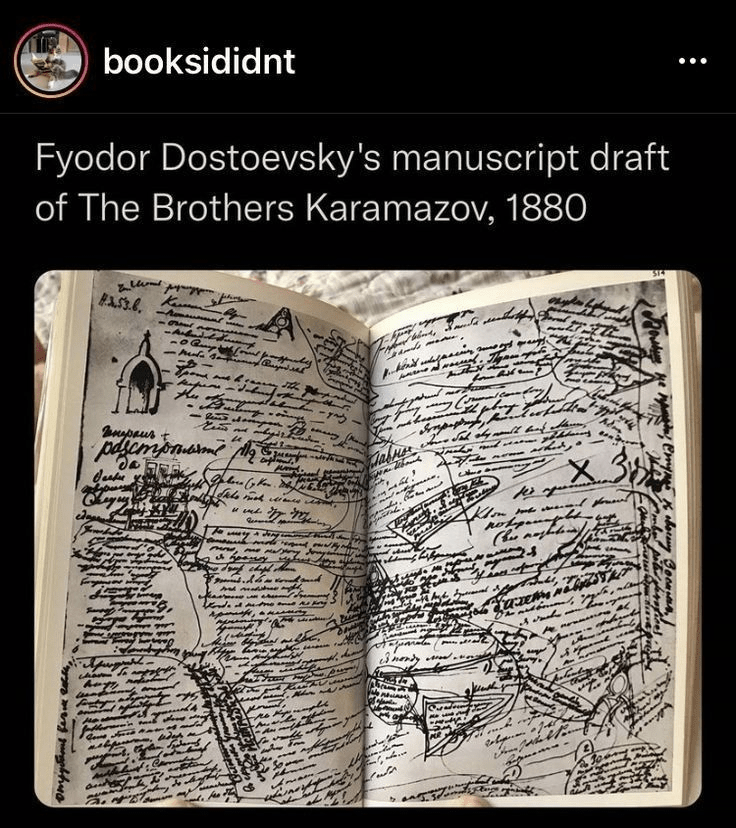
Born in Moscow in 1821, Dostoevsky was introduced to literature at an early age through fairy tales and legends, and through books by Russian and foreign authors. His mother died in 1837 when he was 15, and around the same time, he left school to enter the Nikolayev Military Engineering Institute. After graduating, he worked as an engineer and briefly enjoyed a lavish lifestyle, translating books to earn extra money. In the mid-1840s he wrote his first novel, Poor Folk, which gained him entry into Saint Petersburg’s literary circles. However, he was arrested in 1849 for belonging to a literary group, the Petrashevsky Circle, that discussed banned books critical of Tsarist Russia. Dostoevsky was sentenced to death but the sentence was commuted at the last moment. He spent four years in a Siberian prison camp, followed by six years of compulsory military service in exile. In the following years, Dostoevsky worked as a journalist, publishing and editing several magazines of his own and later A Writer’s Diary, a collection of his writings. He began to travel around western Europe and developed a gambling addiction, which led to financial hardship. For a time, he had to beg for money, but he eventually became one of the most widely read and highly regarded Russian writers.
While critical of serfdom, *Dostoevsky was skeptical about the creation of a constitution, a concept he viewed as unrelated to Russia’s history. He described it as a mere “gentleman’s rule” and believed that “a constitution would simply enslave the people”. He advocated social change instead,..t for example removal of the feudal system and a weakening of the divisions between the peasantry and the affluent classes. His ideal was a utopian, Christianized Russia where *”if everyone were actively Christian, not a single social question would come up … If they were Christians they would settle everything”. He thought democracy and oligarchy were poor systems; of France he wrote, “the oligarchs are only concerned with the interest of the wealthy; the democrats, only with the interest of the poor; but the interests of society, the interest of all and the future of France as a whole—no one there bothers about these things.” He maintained that political parties ultimately led to social discord.
*constitution ness et al
**rather.. if legit free.. would grok garden-enough et al..
In his incomplete article “Socialism and Christianity”, Dostoevsky claimed that civilisation (“the second stage in human history”) had become degraded, and that it was moving towards liberalism and losing its faith in God. He asserted that the traditional concept of Christianity should be recovered.
n his posthumous collection of sketches A Moveable Feast, Ernest Hemingway stated that in Dostoevsky “there were things believable and not to be believed, but some so true that they changed you as you read them; frailty and madness, wickedness and saintliness, and the insanity of gambling were there to know”. James Joyce praised Dostoevsky’s prose: “… he is the man more than any other who has created modern prose, and intensified it to its present-day pitch. It was his explosive power which shattered the Victorian novel with its simpering maidens and ordered commonplaces; books which were without imagination or violence.” In her essay The Russian Point of View, Virginia Woolf said, “Out of Shakespeare there is no more exciting reading”. Franz Kafka called Dostoevsky his “blood-relative” and was heavily influenced by his works, particularly The Brothers Karamazov and Crime and Punishment, both of which profoundly influenced The Trial. Hermann Hesse enjoyed Dostoevsky’s work and said that to read him is like a “glimpse into the havoc”. The Norwegian novelist Knut Hamsun wrote that “no one has analyzed the complicated human structure as Dostoyevsky. His psychologic sense is overwhelming and visionary.” Writers associated with cultural movements such as surrealism, existentialism and the Beats cite Dostoevsky as an influence, and he is regarded as a forerunner to Russian symbolism, expressionism and psychoanalysis.
Dostoevsky’s body of work consists of thirteen novels, three novellas, seventeen short stories, and numerous other works. His writings were widely read both within and beyond his native Russia and influenced an equally great number of later writers including Russians such as Aleksandr Solzhenitsyn and Anton Chekhov, philosophers Friedrich Nietzsche, Albert Camus, and Jean-Paul Sartre, and the emergence of Existentialism and Freudianism. His books have been translated into more than 170 languages, and served as the inspiration for many films.
friedrich nietzsche.. jean-paul sartre..
________
_______
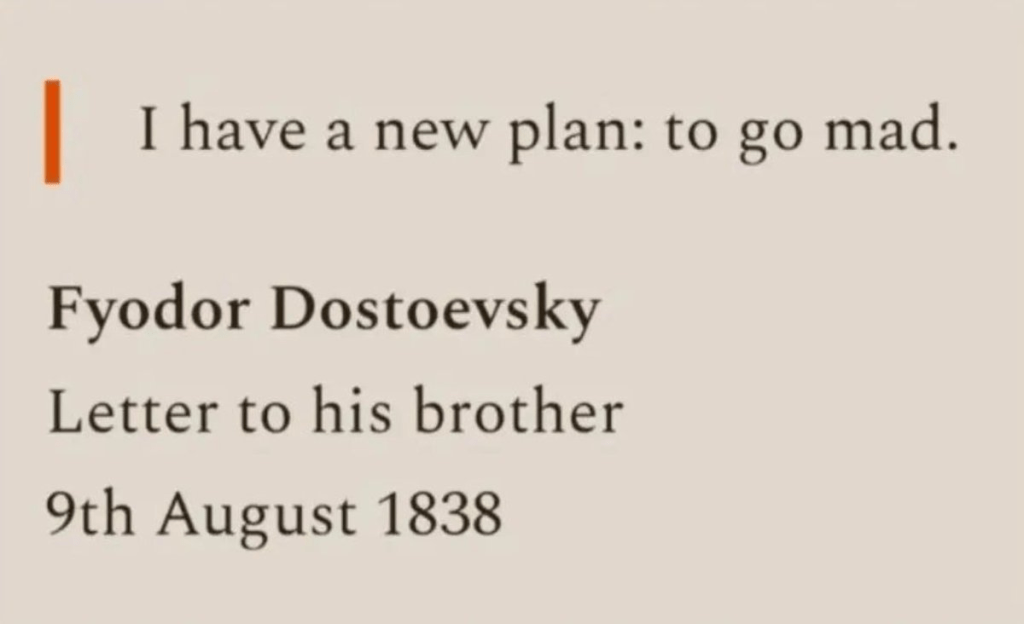
via tweet [https://x.com/Dostoevskyquot/status/1852395239958294604]:
_______
_____
_______
_______
________
______





 be you.