bernard lietaer

[brussels, belgium]
intro’d to Bernard in this podcast with Gwen, as shared by Michel via p2pfoundation:

knowledge – currency
books:
creating wealth – how to – at city level
new money for a new world – historical
________________
tedxberlin 2009:
why not wake up – we’re dealing with a structural issue
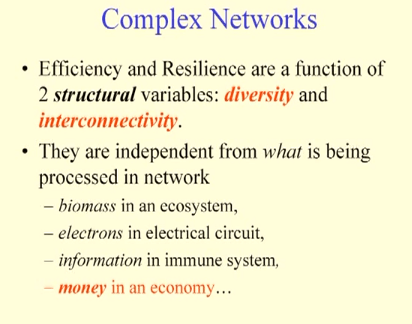
a sustainable (capacity to survive/thrive in different challenges over time.. network has some characteristics:
the balance between two key variables.. efficiency and resilience..
efficiency – capacity for system to process quantity of biomass in an ecosystem – (through put?)
resilience – capacity to survive/adapt to changes in the environment
in our economy – we are putting the only weight on efficiency..
________________
tedxflanders 2011:
Uploaded on Sep 25, 2011
Bernard Lietaer is an monetary architect, author and international expert in the design and implementation of currency systems. He was one of the designers of the Euro. He has studied and worked in the field of money for more than 30 years in an unusually broad array of capacities ranging from Central Banker, fund manager and university professor to consultant.
Why listen to him?
Throughout his life, Bernard Lietaer has been looking for the ultimate leverage to improve all systems in life. He discovered that money holds the answer. It is a key acupuncture point when it comes to addressing most things we human beings care about, such as having access to good quality health care, nutrition, housing, education and participating meaningfully in the life of our communities through work we enjoy.
As an experienced and internationally renowned consultant in monetary aspects, ranging from multinational corporations to developing countries, Bernard enlightens the structural issues of the ongoing economic crisis and offers some clear solutions.
we can make these things happen by rethinking money
95% of our money is created by someone else than govt’s and banks – it’s called – debt
why do we only use 1 currency? because govt only accepts that for payment of taxes..
experimental currency in belgium – Torekes. – dream was to have a bit of garden
we need to get outside of the money box
“a political democracy without a monetary democracy is ineffective.”
More than one currency is required in order to do things effectively.
Torekes are earned through various activities that promote urban agricultural projects — community gardens, cleaning up neighborhoods, etc. — and can be spent on material that goes towards maintaining an effective agricultural space.
______
whatever we can agree upon – could all be the domains that we empower through such a currency innovation… it becomes possible to make a living in a commercial and a non-commercial way..
wealthy could still be wealthy – but not at the cost of the rest of society
______
the key is that we are under a single currency.. we need an ecology of currencies..
we’re running out of conventional solutions…
we can make economy from the ground up – but we need large scale behavior changes
rethink what you’re doing in terms of money
________________
interview 2013:
6 min – we are facing enormous challenges that are not being addressed because everybody is doing their job in their little box.. every institution is doing what they were created for.. the risk we are running – is we are losing a good deal of humanity..
time to use the wisdom we have..
i don’t think it’s good for business that we have people starving in the street and shooting at each other..
terra – global currency that makes it profitable to think long term… do them parallel
________________
find/follow Bernard:


Bernard Lietaer (born in 1942 in Lauwe, Belgium) is a civil engineer, economist, author and professor. He studies monetary systems and promotes the idea that communities can benefit from creating their own local or complementary currency, which circulate parallel with national currencies.
Bernard Lietaer, the author of The Future of Money: Beyond Greed and Scarcity and New Money for a New World, has been active in the realm of money systems for close to 40 years in a wide variety of functions. With the publication of his post-graduate thesis at MIT in 1971 (which included a description of “floating exchanges”) and the Nixon Shock of that same year which eradicated the Bretton Woods system by unhinging the US dollar value from its gold standard and inaugurated the new era of universal floating exchanges (previous to that time the only “floating exchanges” involved some exotic currencies in Latin America), the fledgling management consultant suddenly found himself to be at the center of the financial world’s attention. The techniques that he had developed for those marginal Latin American currencies were overnight the only systematic research which could be used to deal with all of the major currencies of the world. A major US bank negotiated exclusive rights to his approach which required that he begin another career. While at the Central Bank in Belgium (National Bank of Belgium) he implemented the convergence mechanism (ECU) to the single European currency system. During that period, he also served as President of Belgium’s Electronic Payment System. His consultant experience in monetary aspects on four continents ranges from multinational corporations to developing countries.
He co-founded one of the largest and most successful currency management firms; GaiaCorp, and managed an offshore currency fund (Gaia Hedge II) which was the world’s top performing managed currency fund during the 1987-91 period he ran it.[3] Business Week named him “the world’s top currency trader” in 1992.[4]
Lietaer currently lives in Brussels, Belgium. He was a visiting scholar at Naropa University from 2003-2006 where he designed and implemented the University’s Marpa Center for Business and Economics.[5] He studied engineering at the Catholic University of Leuven, in Belgium, and held an assistant professorship of international finance at the same university. He was also a research fellow at the Center for Sustainable Resources of the University of California, Berkeley.
Within his books he describes and draws from the perceptions of freiwirtschaft. He is the originator of a complementary currency called the terra.
In 2012, he was the lead author (with Christian Arnsperger, Sally Goerner and Stefan Brunnhuber) of Money & Sustainability: the missing link,[6] a publication of The Club of Rome, in which he predicted that “the period 2007-2020 [will be] one of financial turmoil and gradual monetary breakdown.” The book was published in May 2012 and has been slated for release in several languages in November 2012.[7]
his site:
____________
___________






 be you.