de sign o
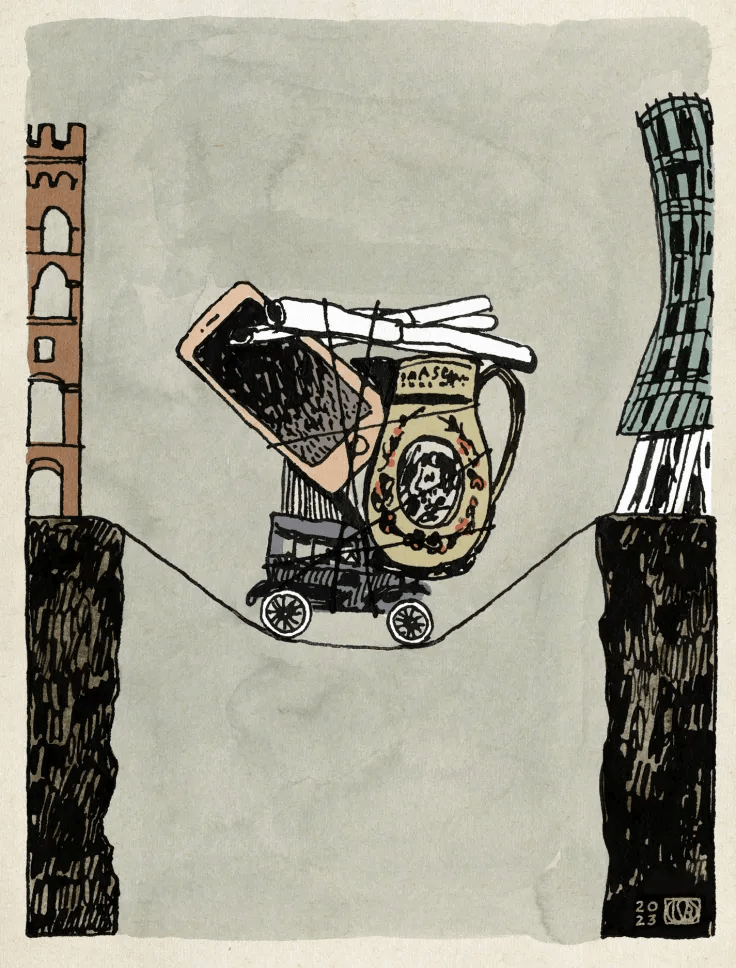
[image by LAUREN SIMKIN BERKE.. linked in article linked to image]
via benjamin bratton tweet [https://x.com/bratton/status/1703991731161907693?s=20]:
Nicholas de Monchaux on what “design” might mean going forward:
via @techreview: When we unpack the current meaning of the word “design,” we may find that we want—and need—to retool the word yet again. [https://www.technologyreview.com/2023/02/22/1068297/design-definition-needs-change/]
https://en.wikipedia.org/wiki/Nicholas_de_Monchaux: Nicholas de Monchaux is a designer and author, and currently Professor and Head of Architecture at MIT.. In 2016, he published Local Code: 3,659 Proposals about Data, Design, and the Nature of Cities, which combines several historical essays on urbanism, computing, and complexity with 3,659 designs for micro-scaled ecological interventions in San Francisco, Los Angeles, New York, and Venice. This work earned praise from The New York Times for its “intelligent enquiry and actionable theorizing
notes/quotes from linked article (feb 2023) by nicholas de monchaux –
humans and tech – Why the definition of design might need a change – When we unpack its current meaning, we may find that we want—and need—to retool the word yet again – [https://www.technologyreview.com/2023/02/22/1068297/design-definition-needs-change/]:
It was drawing, or disegno, as deployed in the making of Italian buildings during the Renaissance, that gave us the word “design”—or such was the enthusiastic explanation I received as an architecture student at the end of the 1990s. History, of course, tells a more complex story.
Though there was indeed a key shift in the meaning of “design” between 1300 and 1500, it had less to do with language and more with a fundamental shift in the making of things themselves. The relationship between drawing and design did not give rise to a word—or even expand its meaning. Rather, it diminished the word as it had previously been used, and in a way that may now be important to reverse.
The Latin root of “design,” dē-signo, conveyed to the likes of Cicero a far wider, more abstract set of meanings than we generally give the word today. These ranged from the literal and material (like tracing) through the tactical (to contrive and achieve a goal) to the organizational and institutional—as in the strategic “designation” of people and objects (where the root “design” remains visibly embedded). All these meanings share a broad sense of *imposing shape on the world, in its institutions and arrangements. .t
oi.. still cancerous distraction if *imposing anything.. and esp via institutions and arrangements.. oi
Yet the use of drawing to directly shape construction in the 13th and 14th centuries began a linguistic shift, with this sense of “design” eclipsing almost all the others.
An early snapshot of this transformation in progress is a parchment dating from 1340. Folded, creased, and perforated with nail holes, it records a contract between patron and three lead builders for the construction of the Palazzo Sansedoni in the center of Siena. Across its lower portion, the parchment records the legal and financial arrangements surrounding the palazzo’s construction; across its upper half it depicts an elevation—a drawing—of the yet-unbuilt façade, complete with annotations and dimensions.
Drawings had, of necessity, recorded the intention of builders long before 1340—traced on ground, wall, or eventually more portable surfaces. Such inscriptions, however, were secondary, and adjacent, to the building process. But the increasing prosperity of economies like that of Siena in the 1300s made it likely that prominent master builders would balance multiple simultaneous projects, so it became necessary to rely on the authority of a drawn document—a “design” in multiple senses of the word then used—to govern activities on the building site. In fact, part of the role of the Sansedoni parchment was to outline the role of a fourth, unnamed builder, who would remain on-site to direct works while the contract’s three named signatories were busy elsewhere..t Alongside this transformation, the maestro of the building site was replaced by the architetto, or architect, who would produce and record the design for the building—with authority given mainly through documents and drawings.
need a ‘de sign o’ that makes any imposing/directing/authority ness irrelevant s
humans and tech: mufleh humanity law: we have seen advances in every aspect of our lives except our humanity– Luma Mufleh
As a result, architects can sometimes take a proprietary attitude toward the word “design.” If there is a justification for such feelings, it is that architects were indeed the first to practice design in the contemporary sense—as a strategic, drawing-based mode of shaping objects and environments separate from their direct fabrication. Yet if architecture was a pioneer of design as a separate profession and course of study, it would soon have company. While the architecture students at the École de Beaux-Arts in Paris crafted dessins, or preparatory sketches, as specified by their curriculum and as part of what we now call the “design process,” the factory chimneys rising farther from Paris would mark an even larger shift in the economy of the physical world and the idea of design within it.
It was as early as the 16th century that drawings and models of porcelain home goods traveled between Europe and the kilns of Jingdezhen in China, helping specify forms and patterns of decoration—what we would now call designs—to be created for specific markets. By the 18th century, the British pioneer Josiah Wedgwood had deployed both artists and “master” potters to make illustrations and models. The intent was to allow for consistent, large-scale pottery production—in Wedgwood’s own words, to “make such Machines of the Men that cannot Err.” But in addition to eliminating workers’ scope for error, it brought an end to their individual expression. And it was the subsequent and literal mechanization of production that firmly separated the work of designing from making—with profound consequences for the definition of design, as a word and as a structure of our society.
While this concept of design has today extended across our society and economy, we can take a single industry as an example. It was Henry Ford’s Model T whose simplified 1907 design allowed gasoline-powered automobiles to become more than custom-built playthings for the rich. But it was Alfred P. Sloan’s equally important innovation at General Motors, in 1924, to introduce design as the signifier of new annual models and different price and status points for mechanically similar vehicles, from Chevrolet to Cadillac—a wasteful commercial tour de force.
So while calling a handbag or sunglasses “designer” can convey superficial branding in lieu of material value, we nevertheless deeply value “design” as one of the few activities that can make the ever more complex realities of modernity navigable at all. It is no coincidence that companies seeking to make products that are both transformational and accessible—Tesla, Apple, even IBM in its day—proclaim an elegance of surface finish as the (presumed) manifestation of an overall technological sophistication, even as they exploit the commercial value of style and status as well.
For all the world’s technological transformation, however, the underlying genesis of almost all new buildings remains a set of drawings and specifications that would have been recognizable in 14th-century Siena. This also means that the word “design,” as commonly used, still coheres with this centuries-old definition—even as it extends far beyond building. Which, ironically, is expanding away from drawing as the sole means of design. In the last few decades, architecture and its sister professions have started to embrace digital tools that begin to ease design away from delineation; technologies like 3D printing and the robotic assembly of buildings dissolve some of the traditional distance between conception and fabrication.
At the same time, such developments have coincided—perhaps not coincidentally—with the marketing and adoption of so-called “design thinking,” whose practitioners often work far afield from the drafting table. The irony of this practice is that tools derived from the drawing sense of “design”—means of sketching, diagramming, and rearranging relationships graphically, with Post-its or otherwise—are often the ones that prove so successful when applied to much more abstract problems than the immediate physical or visual environment.
Yet it is not just the success of design consultancies that should push us back to a more expansive vision of design. The diminished postindustrial meaning of design is inextricable from a corollary diminishing of the planet’s finite resources, whether the quarried stones stacked to form a Sienese palazzo or the rare-earth metals that anchor icons like the iPhone. While design can be a source for great good, it also shares responsibility for our current ecological crisis; every new thing is perhaps not much better than the old thing.
If today’s designers are reaching further downstream from delineation through prototyping and direct fabrication, we would also gain much by asking design to travel further upstream, as it were. This means the focus groups and surveys involved in product creation, the legal and development decisions involved in building, the resources and decisions on which a designed world depends.
rather.. need to let go of all that..
need 1st/most: means to undo our hierarchical listening to self/others/nature as global detox/re\set.. so we can org around legit needs
From the continuous reuse of materials in a “circular” economy, through a shift in architecture’s focus to adaptive reuse, to the redesign of food away from an unsustainable focus on meat, we must reshape not just objects but also the culture and institutions that create them. Not incidentally, such work recaptures dē-signo in its original sense: not just the search for a more beautiful shape, but the shaping of a more beautiful and sustainable world.
rather.. let go of culture/institutions.. hari rat park law et al if legit what a more beautiful/sustainable world
________
_______
________
_______
_______
_______
________




 be you.