mosa’ab elshamy

Mosa’ab is a 23 yr old self taught photographer and citizen-journalist : Turmoil in Egypt
intro’d to Mosa’ab via this post of his photos:
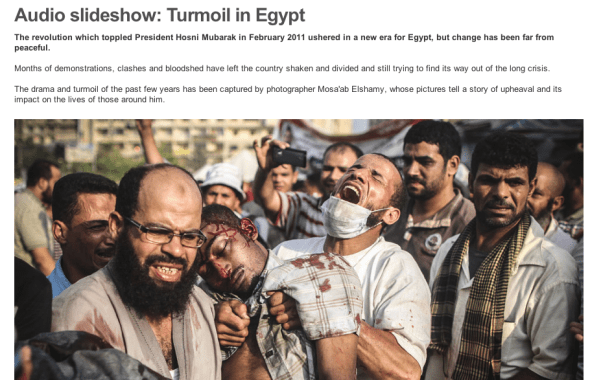
it’s going to be very difficult to move forward… blood only begets more blood and violence..
____________
find/follow Mosa’ab:

his site:

via his about page:
Mosa’ab Elshamy is a freelance photojournalist based in Cairo covering current affairs as well as in-depth socio-economic and cultural photostories. His coverage of the Egyptian revolution and the consequential events, as well as the 2012 Gaza war, has gained him wide exposure, providing images and photostories to the likes of TIME Magazine, Harper’s Magazine, The Economist, Foreign Policy Magazine and Aljazeera English. He has worked with Amnesty International on a photo campaign as well as other various institutions.
In 2012, he won the Egypt International Photography Contest and Arab Union of Photographers competition and was shortlisted for numerous awards including the Terry O’Neil award, Hasselbald and Professional Photographer of The Year. His photography has been exhibited in Egypt, Germany and England. Mosa’ab has lived throughout Middle-East and Africa, including Sudan, Nigeria, Yemen. Ethiopia and Egypt. He is fluent in Arabic, English and has a working knowledge of French.

I think to me it’s like photographing a really good story that’s gone bad. Back in 2011, when the possibilities were endless, there were signs of hope and determination and resilience. All these thingssynonymous with a revolution. It was still dreamlike. But it’s gone really bad.WV: What do you feel you’ve learned about photojournalism, about covering historic events through photos, from your work over the last two years?
ME: More than anything, it’s helped me understand the value of my work. But I feel that it’s added more to me as a human than as a photojournalist.
At moments, especially during violence, you felt that it added more to you as a human because you were there but not really. You can’t see yourself in any of the pictures that you took. You are almost invisible because you have to take cover, not let yourself be seen and be as invisible as possible. But at the end of the day, you lived every moment of it and you had evidence of the horrors that had happened.
In a photojournalism sense, I did appreciate how significant events really end up taking seconds. This is always something I think about. As a photographer you always have to keep the shutter on — we call it the burst mode. I have full sequences, and sometimes it starts with somebody standing, but in the sixth or seventh photo, he’s got a bullet through his head, and it all took less than a second.
The consequences of that moment, of this guy getting shot or avoiding a bullet that killed someone else — it’s a very significant thing, and more often that’s becoming lost. I try to focus on that in my pictures, I try to include as few people as possible; just a man sitting with a killed friend of his, or a mother mourning next to a daughter. It’s a very individual act, one person killing another person.
WV: That’s one of the things, I think, that makes your photos really distinctive, that you’ll go into these big chaotic events, rallies or clashes, and find these small, intimate, almost quiet moments. …WV: What are you looking for when you do that?
There is something very strong about a collective mass moving together for the same cause, but it’s not made up of identical people.
When you go really, really close, when you zoom as close as you can, you find all these differences that make a much more complete image.
I personally don’t use a zoom lens, so I end up getting as close as possible.
WV: You’ve done some work in Gaza but otherwise focused on Egypt. Do you ever see yourself traveling more widely as a photojournalist?
ME: I do want to travel more, because I think it adds to you as a human, and it does help as a photojournalist. But I would like to stay here and document the dark days ahead. Because it seems that more and more the truth in Egypt is getting lost, between public and private media that’s blindly following the state in its so-called “war on terror” and the other media, which is not the most unbiased, either. I feel there should be more people dedicated to trying to get that truth out. But, in the long term, I definitely would like to leave.

the part of the story that is becoming easily lost.. we focus on the numbers.. we lose humanity…





 be you.