m of care – oct 31 24
Peter Sahlins on Carnival
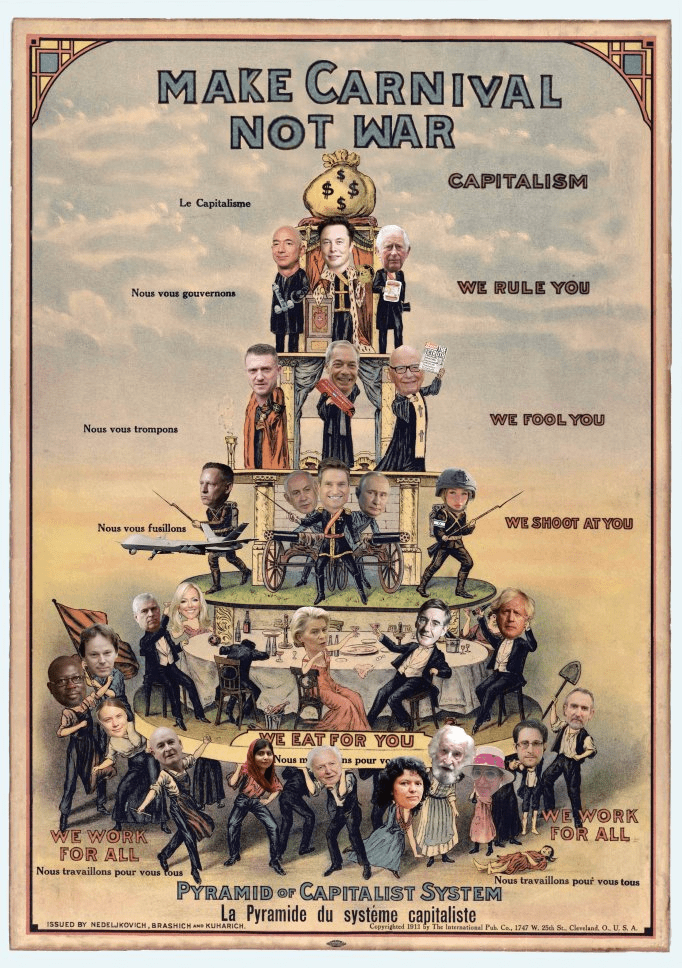
on rabelais and his world – [also adding a bunch of notes here: scott on bakhtin]
[https://museum.care/room/everyday-carnival/reading-group-mikhail-bakhtin-s-rabelais-and-his-world/]:
At the core of Museum of Care and David Graeber Institute is the idea of Carnival. The Museum of Care emerged from the Carnival4David, held in David’s memory, that took place in 250 sites around the world. The Carnivalesque tradition was followed by DGI, which is building the faculty of Carnival in St. Vincent and Grenadines. We will collectively read one of David’s favorite books, Mikhail Bakhtin’s Rabelais and His World.
Why Carnival?
The carnival is one of the oldest institutions in the world. In one form or another, it is present in every culture. It is usually thought of as just a large party but, more importantly, the carnival is an occasion for social renewal, where ordinary life is turned upside down, where social roles and identities are being changed. Employing music, costumes, sets, storytelling, comedy, and more, the carnival initiates a totally new social reality. That is why what starts as a carnival often ends up as a revolution.
notes/quotes from meeting (notes from reading below):
[note: 2 hours worth – 1st hour (started at 1p) [https://museum.care/events/peter-sahlins/]: launch reading group dedicated to Mikhail Bakhtin..and talk about david’s new book – make it diff.. discussion which include Peter Sahlens, John Filips, Isabel Jacob, Clare Patte,Michael Reinsborough, Kyrill Potapov..the role of carnival in shaping our political reality.. 2nd hour (started at 2p) [https://museum.care/room/everyday-carnival/reading-group-mikhail-bakhtin-s-rabelais-and-his-world/]: start bakhtin reading group]
1st hour:
peter: on presenting once/yr where people could imagine other possible worlds.. i want to structure it even more.. an open space.. experimentation.. these alts between modes of govts parts of same equation.. don’t exist independently of each other
?: my experience in london in 70s.. it wasn’t a day.. the real carnival was where you would build carnival months before.. inversion of industrial .. people would go there after work.. a very critical inversion of an industrial space.. just looking at carnival of a day on the streets misses it.. that inversion happens over a long time in prep.. carnival is not necessarily that event but all the social dynamics that surround it
peter: i appreciate that.. helps me understand how carnival survives.. i never thought about the back end and prefiguration..
?: yeah.. many sleep during carnival .. exhausted
clare: mine is feasts that take over spaces.. they grow food.. take public space to cook/prep food together.. takes year to prep/do.. i don’t agree you necessarily have to have difference between participant and audience.. can do this today in imagination.. have a time that is outside.. i wonder what you think about the rebel clown army.. whether that instramentalisation of something carnivalesque used in that type of resistance
peter: nothing negative in way i’m using ‘intramentalization’.. nothing to take away from carnival.. as a historian when i get to read about carnival.. i read about it because it’s been instrumentalized in one way or another.. when carnival is repressed.. that’s when it becomes present.. becomes visible.. it’s about how i can come to study it thru the filters which themselves mark its instrumentalization
peter: when i talk about carnival as calendaresque.. activities enacting the carnival.. inversion, laughter, subversion, .. all the parodies.. they really went from late nov thru easter.. end w may day.. winter season.. so divide world into 2 (winter/summer carnival/festival seasons)
peter: i’m not advocating for enactment of golden age of past.. but diff moments in lives/realities are not contained in world of abstract universal reason.. so question is how to capture the irrationality as it were and harness it for productive political purposes.. and there to me festivity has an important tole to play
clare: do you think contemp youth culture is creating that now.. ie: rave culture..
peter: from what i hear.. rave culture w its elements like molly .. is about dissolving boundaries of everyday life/relations and finding some collective experience.. is that same as carnival.. i’m not sure.. but it certainly presents self as alt.. is it productive.. in sense of empowering.. socially effective.. does it change anything.. i’m not sure..
nika: what extinction rebellion did on bridges was definitely carnival.. she shows apt art on her walls
shlomo: do you think it’s a shame that we forget that (ie’s nottinghill) carnival start as protests
peter: but it’s not always a protest.. that’s when it’s used for something.. can be used.. but that doesn’t mean uses to which it’s put are protest.. it’s not inherent in the thing..
?: ie of nottinghill saying.. don’t need guns need music.. another made faces many colors so anyone could come.. everyone probably has a diff story of how it started.. and i think that is really the story of carnival
2nd hour:
peter: bakhtin: one moment when parody reached high lit culture.. it’s been trivialized.. functions like joking/satire.. and therefore in his mind it’s echoing a moment ie: regen power of laughter.. as historian of the modern world from 15th cent..i fell sometimes you are right and he is overly condemning the post forms.. but it’s also true that there are lots of moments including pop radical movements of civ war.. when it does have the full form of regen/subverting powers.. not sure why he has to insists on its disappearance
?: one of earliest carnivals i experience in nottinghill was a social satire.. there is no fixed carnival/satire.. it is a comment on a given time
michael: david raised that carnival was an inversion.. so people got to play a king.. but on other hand an outlet.. ie: very carefully get rid of pressure/protest.. so pasted onto context of immediate moment.. w diff interps
? w glasses: that playfulness.. is subversive
nia: yeah i don’t get complaints about carnivals.. because they are playing w very logic of existing system.. if you do daily work inside structure and never have a moment to examine it.. you are trapped.. i think carnival is like the door out
michael: interesting labor union and carnival.. is it a way to contain people or for them to create it themselves
nika: i think in this intro he explains it very well.. we have all this forced celebration.. forced to dress up et al.. and it has nothing to do w carnivalesque.. i think bakhtin is telling me there is 2 ways/sides of being in carnival..
?: it’s about lived experience.. you can give someone a safety valve.. but what if that safety valve is so powerful.. we don’t want to let go.. ie: play as child.. restrained later.. carnival as return to freedom we once knew as children.. to it’s a door.. a potential escape (as opposed to safety) valve..
peter: in a free democratic society.. there was a space where there was no need for a safety valve.. and yet this was an incredibly empowering moment.. not that they couldn’t’ speak outside carnival.. but could elaborate
?: i remember one time all were shot down with guns.. but just made streets filled with sweets.. because puppets/masks filled with them
nika: david on not striking against but performing for.. creating a diff type of revolution.. we’re just needing this moment together where everybody has equal rights.. i’m wondering clare if there wasa minute when you guys felt it could spread everywhere
clare: i think it would be amazing if it could.. i just think if we act in generosity and 40k gather together for feast.. a very powerful thing.. but that is amazing..
p 10 – This temporary suspension, both ideal and real, of hierarchical rank created during carnival time a special type of communication impossible in everyday life..
this is what we need a way to communicate different/deeper with self/others/nature
even this convo.. so stuck (based) on way things are
peter: on easter laughter.. structuring of laughter so put in time/place.. and he’s pointing out how laughter knows no bounds.. can say yes.. full culture of laughter can be found in all these places.. for bakhtin what is important is that it is in all these places… and that it is structured in all these places.. meaning sanctioned in some places and not others.. ie: no laughter in courts..
michael: carnival gives people new experiences.. but.. everybody participates..
?: footlights separate you from stage..
peter: important to read bakhtin that laughter et al.. that even in this key moment.. carnivalesque is not at all times/places.. ie: not courts of law/church
?: where do inner mechs of carnivalesque come from.. it lives in every day impetus of people to make jives.. in order to have carnivaleque culture where manifestation of satire.. must have a substructure/understanding of everyday experience of subversions in the family.. the snide look.. i think all those things must exist in a culture.. and carnival allows manifestation/generalization..
nika: like one moment when everything renews.. if do it well enough maybe it will take over.. a revolution
michael: carnival against capitalism.. if we say it’s a carnival they’re not going to shoot us.. could get away with more.. carnival made by the protest
nika: david was writing.. playing language.. police don’t know how to replay.. ie: clown throwing whatever.. we all speak same language.. if you do have a diff language.. that’s a complex work
? long hair: world stuck on this digital language at moment
stas: carnival escapes.. david says people regularly upset order.. and sometime upset it more.. so can transcend festivity and become a creative moment.. is it possible to look historically at some uprises as carnivals if rise up hight enough.. to think about it as a carnival
peter: history of rev.. 19th cent.. element of carnival becomes more/more important as go forward.. 1968 quite a lot of carnival.. maybe not as much as paris commune et al.. laughter became important mode of mobilization.. so .. not a universal equation that could be made.. but tracking in history.. does seem as rev builds.. more/more elements of carnival enter into collective actions
stas: if we say every carnival is rev.. or rev unrecognized.. could there be some change after carnival that aren’t important enough to grant us a revolution
nika: i think it’s too abstract question.. ie: bolshevik rev of 1917.. very much like bakhtin described.. so actually what we can call according to bakhtin an anti carnival
peter: clearly writing at a moment in which ie: laughte gone, popular will repressed.. a managed spectacle of society.. he’s finding carnival a life force.. so for him ..
nika: on dostoevsky
peter: back to bakhtin.. i keep feeling like 1917 is a lurking ghost in his book.. informing everything he’s saying about this kind of celebration of folk culture.. because at time of his writing folk culture had completely been dismantled.. he’s clearly ceasing on a distorted portrait of rabelais.. which in my mind only understood as a displacement in his own thinking/life.. about what happened to him.. ie: he doesn’t get a job because of his thesis.. living w/o official recognition et al..
nika: i think this book is about how can we get out of that (he lived in harsh time)
?glasses: this laughter.. sounds like diff between oral/lit cultures.. imagining market places where everyone is talking to others.. every question answered w a question.. as an oral culture need to keep the bantor going .. because that’s the only culture you have.. can’t sit down and study because you’re illiterate.. sounds like open laughter.. when you’re reading something.. you don’t always laugh at the jokes.. and it’s a social thing as well.. laugh more in cinema than watching film on own
?: when write things down can forget.. so must have a memory as your own personal resource.. that’s a huge
peter: important to remember that this oral culture we’re invoking.. peasant civ was as vital.. where bakhtin has interesting account of history of w civ.. on creating a polite society and imposing it which precisely eliminates elements that bakhtin finds in rabelais.. so that story is important.. i start to have more trouble w bakhtin in his reading of rabelais itself.. everyone has to invent their own rabelais.. hard to pin him down.. esp around mouth piece of folk culture
peter: a humanist who is engaging w evangelical christianity.. writing as a good christian.. we don’t want to collapse right away into this voice of the people in which he is the mouthpiece.. he’s quoting carnival
nika: dostoevsky was nuts a bad person.. bakhatin saying
peter: but problem is rabelais was all those things.. the ultimate dialogic figure.. but when bakhtin comes to these passages to show what is christian humanism.. ‘do as you will’..
peter: humanism a philosophy/ideology which retrieves language for purposes of reading critically.. the antithesis of a peasant culture
peter: so a broadening of culture instigated by linguistics
michael: lot of people transcend thru their writing.. they’re dis attached from what people take of it.. and people projecting onto them
peter: i guess there’s a bigger point behind all this.. bakhtin is very selective in what he thinks rabelais stakes are.. and this gain of selectivity that’s filtering our knowledge of carnival is important to acknowledge.. because in each case of filtering there’s a kind of instrumentalization.. using carnival for other purposes than carnival had itself.. so all i’m doing as a historian is saying ‘careful’.. because when we think we’re reading bakhtin.. it’s a very mediated version
______________
Introduction: Rabelais and His World; on carnival: pp.1-12; on collectivity and the body: pp. 18-23; on the grotesque and the mask: pp. 39-40.
1-12 – on carnival
1
Of all great writers of world literature, Rabelais is the least popular, the least understood and appreciated.
2
There is also no doubt that he is the most democratic among these initiators of new literatures..It also explains Rabelais’ “nonliterary” nature, that is the nonconformity of his images to the literary norms and ‘canons predominating in the sixteenth century and still prevailing in our times, whatever the changes undergone by their contents.
3
Rabelais’ images have a certain undestroyable nonofficial nature. No dogma, no authoritarianism, no
narrow-minded seriousness can coexist with Rabelaisian images; these images are opposed to all that is finished and polished, to all pomposity, to every ready-made solution in the sphere of thought and world outlook. ..t
Many were repulsed and still are repulsed by him. The vast majority, however, simply do not understand him. In fact, many of his images remain an enigma. This enigma can be solved only by means of a deep study of Rabelais’ popular sources. .
To be understood he requires an essential reconstruction of our entire artistic and ideological perception, the renunciation of many deeply rooted demands of literary taste, and the revision of many concepts. Above all, he requires an exploration in depth of a sphere as yet little and superficially studied, the tradition of folk humor.
4
Laughter and its forms represent, as we have said, the least scrutinized sphere of the people’s creation. ..There was -no room in this concept for the peculiar culture of the marketplace and of folk laughter with all its wealth of manifestations. .. The element of laughter was accorded the least place of all in the
vast literature devoted to myth, to folk lyrics, and to epics. Even more unfortunate was the fact that the peculiar nature of the people’s laughter was completely distorted; entirely alien notions and concepts of humor, formed within the framework of bourgeois modern culture and aesthetics, were applied to this interpretation.
We may therefore say without exaggeration that the profound originality expressed by the culture of folk humor in the past has remained unexplored until now.
A boundless world of humorous forms and manifestations opposed the official and serious tone of medieval ecclesiastical and feudal cuIture. In spite of their variety. folk festivities of the carnival type, the comic rites and cults. the clowns and fools, giants, dwarfs, and jugglers, the vast and manifold literature of parody-all these forms have one style in common: they belong to one culture of folk carnival humor.
7
The basis of laughter which gives form to carnival rituals frees them completely from all religious and ecclesiatic dogmatism, from all mysticism and piety..t They are also completely deprived of the character of magic and prayer; they do not command nor do they ask for anything..t Even more, certain carnival forms parody the Church’s cult. All these fonns are systematically placed outside the Church and religiosity. They belong to an entirely different sphere..t
Because of their obvious sensuous character and their strong element of play, carnival images closely resemble certain artistic forms, namely the spectacle. ..It belongs to the borderline between art and life. In reality, it is life itself, but shaped according to a certain pattern of play..t In fact, carnival does not know footlights, in the sense that it does not acknowledge any distinction between actors and spectators. . Carnival is not a spectacle seen by the people; they live in it, and everyone participates because its very idea embraces all the people. While carnival lasts, there is no other life outside it. During carnival time life is subject only to its laws, that is, the laws of its own freedom. It has a universal spirit; it is a special condition of the entire world, of the world’s revival and renewal, in which all take part. Such is the essence of carnival, vividly felt by all its participants.
8
but remained fools and clowns always and wherever they made their appearance. As such they represented a certain form of life, which was real and ideal at the same time. They stood on the borderline between life and art, in a peculiar midzone as it were; they were neither eccentrics nor dolts, neither were they comic actors.
Thus carnival is the people’s second life, organized on the basis of laughter. It is a festive life. Festivity is a peculiar quality of all comic rituals and spectacles of the Middle Ages.
9
In °the framework of class and feudal political structure this specific character could be realized without distortion only in the carnival and in similar marketplace festivals. They were the second life of the people, who for a time entered the utopian realm of community, freedom, equality, and abundance.
On the other hand, the official feasts of the.. The true nature of human festivity was betrayed and distorted. But this true festive character was indestructible; it had to be tolerated and even legalized outside the official sphere and had to be turned over to the popular sphere of the marketplace.
10
As opposed to the official feast, one might say that carnival celebrated temporary liberation from the prevailing truth and from the established order; it marked the suspension of all hierarchical rank, privileges, norms, and prohibitions. Carnival was the true feast of time, the feast of becoming, change, and renewal. It was hostile to all that was immortalized and completed..t
Rank was especially evident during official feasts; ..On the contrary, all were considered equal during carnival. ..People were, so to speak, reborn for new, purely human relations. These truly human relations were not only a fruit of imagination or abstract thought; they were experienced. The utopian ideal and the realistic merged in this carnival experience, uniq ue of its kind.
This temporary suspension, both ideal and real, of hierarchical rank created during carnival time *a special type of communication impossible in everyday life..tneed 1st/most: means to undo our hierarchical listening to self/others/nature so we can org around legit needs
11
this experience opposed to all that was ready-made and completed, to all pretense at immutability, sought a dynamic expression: it demanded ever changing, playful, undefined forms. ..t the peculiar logic of the “inside out” (a eenvers), of the “turnabout,” of a continual shifting from top to bottom, from front to rear, of numerous parodies and travesties, humiliations, profanations, comic crownings and uncrownings.. a “world inside out,” We must stress, however, that the carnival is far distant from the negative and formal parody of modern times. Folk humor denies, but it revives and renews at the same time.. the utopias of the Renaissance and its conception of the universe itself were deeply penetrated by the carnival spirit and often adopted its forms and syrnboIs.
Let us say a few initial words about the complex nature of carnival laughter. It is, first of all, a festive laughter. Therefore it is not an individual reaction to some isolated “comic” event. Carnival laughter is the laughter of all the people. Second, it is universal in scope: it is directed at all and everyone, including the carnival’s partici pants. The entire world is seen in its droll aspect, in its gay relativity. Third, this laughter is ambivalent: it is gay, triumphant
12 (36)
The satirist whose laughter is negative places himself above the object of his mockery, he is opposed to it.. The people’s ambivalent laughter, on the other hand, expresses the point of view of the whole world; he who is laughing also belongs to it.
18-23 – on collectivity and the body
18
It is usually pointed out that in Rabelais’ work the material bodily principle, that is, images of the human body with its food, drink, defecation, and sexual life, plays a predominant role.
19
The cosmic, social, and bodily elements are given here as an indivisible whole. And this whole is gay and gracious.
The material bodily principle is contained not in the biological individual, not in the bourgeois ego, but in the people, a people who are continually growing and renewed. This is why all that is bodily becomes grandiose, exaggerated, immeasurable.
This exaggeration has a positive, assertive character. The leading themes of these images of bodily life are fertility, growth, and a brimming-over abundance. Manifestations of this life refer not to the isolated biological individual, not to the private, egotistic “economic man,” but to the collective ancestral body of all the people.23
However divided, atomized, individualized were the “private” bodies, Renaissance realism did not cut off the umbilical cord which tied them to the fruitful womb of earth. Bodies could not be considered for themselves; they represented a material bodily whole and therefore transgressed the limits of their isolation. The private and the universal were still blended in a contradictory unity. The carnival spirit still reigned in the depths of Renaissance literature.
39-40 – on the grotesque and the mask
39
All that is ordinary, commonplace, belonging to everyday life, and recognized by all suddenly becomes meaningless, dubious and hostile. Our own world becomes an alien world. Something frightening is revealed in that which was habitual and secure. ..On the other hand, the medieval and Renaissance folk culture was familiar with the element of terror only as represented by comic monsters, who were defeated by laughter. Terror was turned into something gay and comic.
The images of Romantic grotesque usually express fear of the world and seek to inspire their reader with this fear. On the contrary, the images of folk culture are absolutely fearless and communicate this fearlessness to all. ..fear is destroyed at its very origin and everything is turned into gaiety. It (rabelais) is the most fearless book in world literature.
madness makes men look at the world with different eyes, not dimmed by “normal,” that is by commonplace ideas and judgments. In folk grotesque, madness is a gay parody of official reason. of the
narrow seriousness of official “truth.” It is a “festive” madness. In Romantic grotesque, on the other hand, madness acquires a somber, tragic aspect of individual isolation.
Even more im portant is the theme of the mask, the most complex theme of folk culture. The mask is connected with the joy of change and reincarnation, with gay relativity and with the merry negation of uniformity and similarity; it rejects conformity to oneself..t
masks and measures et al
40
The mask is related to transition, metamorphoses, the violation of natural boundaries, to mockery and familiar nicknames. It contains the playful element of life; it is based on a peculiar interrelation of reality and image, characteristic of the most ancient rituals and spectacles.
the mask hides something, keeps a secret, deceives. Such a meaning ·would not be possible as long as the mask functioned within folk culture’s organic whole. The Romantic mask loses almost
entirely its regenerating and renewing element and acquires a somber hue. A terrible vacuum, a nothingness lurks behind it.
But an inexhaustible and many-colored life can always be descried behi nd the mask of folk grotesque.
However, the Romantic mask still retains something of its popular carnival nature. Even in modern life it is enveloped in a peculiar atmosphere and is seen as a particle of some other world.
The mask never becomes just an object among other objects.The theme of the marionette plays an important part in Romanticism. This theme is of course also found in folk culture, but in romanticism the accent is placed on the puppet as the victim of alien inhuman force, which rules over men by turning them into marionettes. This image is completely unknown in
folk culture. Moreover, only in Romanticism do we find the peculiar grotesque theme of the tragic doll.
________
_______
_______
______
________
_______
_______
_______





 be you.