leila janah

intro’d to Leila via http://www.newyorker.com/reporting/2013/10/14/131014fa_fact_heller?printable=true¤tPage=all
sounded like Dambisa Moyo and Jacqueline Novogratz and Carol Black and Kiva ness…
lovely heart.
____________________
TEDxBrussels 2011:
The Microwork revolution
king’s audacious beliefs…singularity – free from the burden of work – 2045
create dignified work for everyone
_____________
amazing work.
imagine if we can facilitate that even deeper – so that people are also doing the thing they can’t not do..
_____________
Leila on makers.com 2012:

insight from her dad:
luxury is more ruthless than war
to achieve something in life, you have to be a little bit hungry
felt bureaucracy was getting in the way of reducing poverty
why do we keep taking people from their cultures…
microworking..
work a computer can’t do but a human can
i would tell my 15 yr old self:

letter from Leila:

sama means equal
The voices of so many people I’d met in my travels formed a steady chorus in my mind: the best thing you can do to help us is to create dignified work in our communities.
I thought: outsourcing has made billionaires out of a few businessmen. Why not use the same model to provide a few dollars to the billions of people at the bottom of the pyramid?
I was inspired by the work of Muhammad Yunus, the founder of Grameen Bank, and his pioneering model of social business – the idea that you could create a business whose primary purpose was social or environmental impact, with profit taking a back seat.
_________________
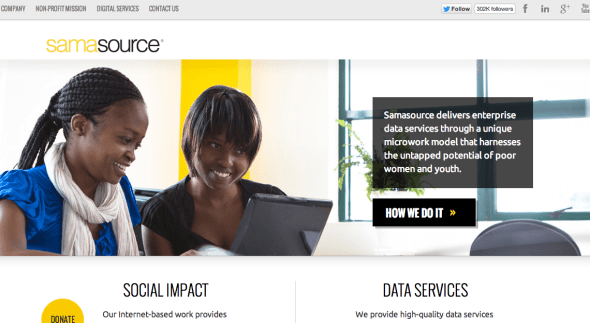
Leila is founder of Samasource:
_________
find/follow Leila:


Leila Janah is the Founder and CEO of Samasource, a non-profit social business that gives digital work to impoverished people around the world.
She attended the California Academy of Mathematics and Science. She won a college scholarship at 16, but convinced them to let her spend it teaching in Ghana, and attended Harvard University, graduating in 2005 with a degree in African Development Studies. While at Harvard, she consulted to and authored papers for the World Bank’s Development Research Group and Ashoka on social and economic rights. Upon graduation, Janah worked as a management consultant with Katzenbach Partners …
In 2008, she launched Samasource (then called Market for Change), an idea that was inspired by her experiences at the World Bank and in field work in Mozambique, Senegal, and Rwanda while she attended Harvard.
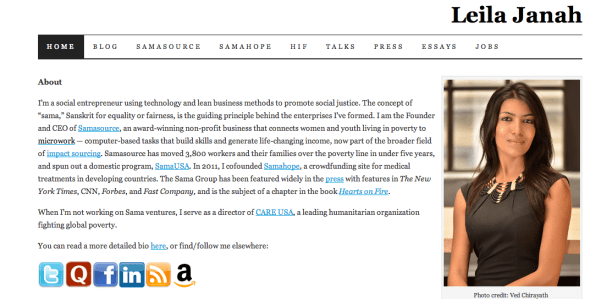
her site:





 be you.