alan november – who owns the learning

this question – via Alan – struck a huge chord.

_________________________
this video played over and over in our heads..
shift control – who should own the learning… there is so much we would have to change in the culture..
________________________
find/follow his work here:
annual conference:
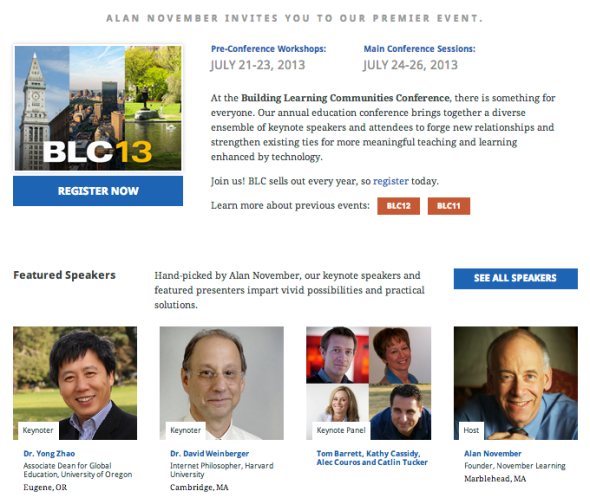
Yong Zhao, David Weinberger, Alec Couros,… nice.
and..
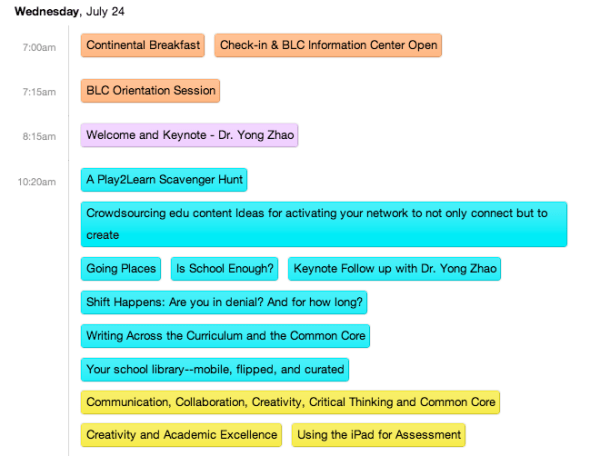
Stephen Brown, producer of Is School Enough, will discuss his documentary:
_________________________
find more of Alan – all over the web,
below find random videos and notes …
1975: barber shop
teach practical stuff, too many don’t have good medical care and it’s free
if you get kids involved in community after class
health – free, and if people knew about it they could access it.. (sounds like ed)
if involvement in community goes hand in hand with class – better off.. school in day, community after school
jackiegerstein: Two new #TED initiatives for education http://bit.ly/hskWuM & http://elev8ed.org/
1984: computer lab
designed community problem solving with technology based after the barbershop
go out in world and find real world problem to solve first
ie: yellow pages for handicapped people –
if a kids is adding value to the world, it’s amazing what they will do w/o money, grades, etc
wanted to meet with his student who built the data base
she took the job but not the salary… they are helping me build on my project, i should be paying them
fascinating what you do w/o a grade w/o money if you own it
pink – purpose is what drives, nothing else
a lot of student work, in their minds, does not have purpose
what is purposeful work, what does it look like, how do we manage it, how do we grow it
what if we can make the social interaction fair
are your students leaving a legacy
values all the way across the curriculum…
purpose 2003 – the girl on fan fiction
when i wake up i have to decide, will i do my work for my teachers or publish to the world
mathtrain.tv – tutorials designed by 6th grade kids
(what if the content of tutorial design was based in wikipedia? and/or youtube?)
we’ve underestimated kids to kids, everything is about teaching, we need kids coming to staff development
need to get to the point where kids are working harder than teachers, shift the ownership
what this means is – teachers are more important than ever.
shift in relationships and rolls and the feeling of empowerment kids have when they form a legacy
______________________
iste 10 alan november

the strategy of improving learning – is to focus on the conversation between children…
and then they said:
help
her
friends
next to:

if i had to give one tool – it would be a screencaster – like:

mathtraining.tv

highly motivating learning jobs:
(who owns the learning)
{so – a piece of digital equity – november visiting every district – yes?}
every school should gather up a team of kids
to figure out
best use of cell phones
conditioned kids to depend
on the teacher to answer their questions
can track down research centers, emails, etc for the class to do good research
november said if web was invented for one thing alone it would be:

i dont think we should put fear in kids – as soon as you tell them not to go to places (like wikipedia, youtube, facebook) that’s where they go
job #5 – learning documentary producers
job #6 – solvers of real problems
godin says school should do 2 things – teach leadership and solve interesting problems
what if school was real life…
a standard process

content was fixed,
access/process/connection was variable.
access/process/connection is fixed,
content is variable.
student centric as kids are creating their own public – engaged in meaning-making and writing about self-selected topics that are relevant and interesting to them – Wieman’s expert individual tutor – web 3.0 tailoring (internship ningl/virtual classroom – for: reflection/story telling
Cameron – knows intuitively how to create value, add his default intention is to share it with others – most of the time for free. That why he has a public.
Do we insist that the class is one public?
Or do we just insist that each one in the class finds/creates their own public (like in real life).
That would allow for more of a passion driven pursuit.
ie: some who need it – may be a part of a community of 2 (them and expert individual tutor), others may end up with a community of hundreds
Alan November – who owns the learning – change will only happen if we give up the ownership – 2 min
Thinking of the adult as the only teacher is artificially turning abundance into scarcity
and it’s minimizing our available resources exponentially.
We can ask interesting questions, like: how do you feel about your friend not being so good about math?
The leader also learns, but in different domains.
If teaching is helping others then everybody is at the same time student and teacher.
The adult in the room is also student and teacher, and is there to supervise and direct, but not to control.
1) We’re all humans and we all want to be treated as humans all of the time.
2) We all make mistakes. When those mistakes are rectified gracefully remarkable stories
are being created.
3) We all have our own cultures and values that don’t always match but we all try to do good.
w/in plns – discover design doper Alan November – myths and opportunities….
and – 2 things we’re short on: time and money
so give them back time in class and quit spending so much on gimmicks to help teach
Proof would be
1) the ability to ask any teacher on any given day, what they learned the day before.
2) visible modeling of teacher’s pln experience and their learning with their class daily. The teacher’s comfort/patience with irresolution, and the teachers ability to know what to do when she doesn’t know what to do (erica mcwilliams – usefully ignorant.)____________________________________________________
are your teachers actively involved in some type of professional/personal learning environment where they are being challenged and learning something new daily that they bring to and model for their students?
_________________
friday, january 8, 2010
a mash-up of #unboxed thinking

 Sugata Mitra’s – hole in the wall – kids teach themselves
 huge take-away fromyesterday:
 Education is still characterized as a place you go, to get taught — where we teach and our students learn how to be taught. Yet, in the real world, learning is not something that is done to you, but something that you do yourself, in your own way, with your resources and sense of resourcefulness. I am not saying that every student moment in school is spent in passive receipt or that teaching should never happen. But “being taught” is still the character of the beast, and it is getting in the way of helping people learn to teach themselves.
unboxed.
nice – @WendyDrexler: @RuthHoward teacher as facilitator as kids have the pleasure of finding things out..(feynman) http://bit.ly/cL5F2J (link to updated hole in the wall)_________
What is the Value of a Teacher? | TEDxWestVancouverED – nov 2016https://www.youtube.com/watch?v=BN4c0EqY61o
i am concerned that we’re not asking the right questions..
6 transformation questions
1\ critical thinking on the web?
2\ new lines of inquiry?
3\ making thinking visible?
4\ authentic audiences?
5\ create a contribution?
6\ do students own their learning?
if the answer is no to any of these then i’m concerned we’re using tech to do old work w new tools…. it’s a 1000 dollar pencil..
i’d like to focus on 3..
1\ should just be basic.. but we’ve overestimated critical thinking skills when using search engines.. when wolfram..when wayback.. et al..
3\ most powerful to help teachers.. now can see what thinking in new ways
what diff does it mean if thinking isn’t theirs.. owned.. right..?
4\ authentic audiences .. desire to get kids on internet working w people.. concerned esp in us..we don’t have urgency to get kids to work w people.. more about info
5 min – on kids ability to search.. saying bad to type in assignment title.. main reason: most assignments today were written before the internet..(and then he goes on to how kids should work around that… country codes.. dewey deci system of search)
whoa.. just stop there.. no? right questions.. no?
8 min .. there are these big ideas i think we should be going over with our kids..
so.. 1\ don’t spend all time on assignment written before internet 2\ don’t spend time on assignments – we have ability to facil 7 bn curiosities.. let’s do that Alan
ie: hosting-life-bits via self-talk as data
9 min – wikipedia is amazing.. not so much the content.. but because it’s crowdsourced from all over the world..
indeed.. eyes at least..wider.. opened..
10 min – here’s my concern.. we might be giving students problems that were invented before the internet.. if they use the name of the problem or some content of the problem to search.. they’re probably not getting the best info in the world..
whoa.. probably not looking into best problem in the world.. for them.. no? oy
my goal for every student is to teach them to get the best info in the world..
nice.. but i thought what question is being asked mattered more..
the revolution is information
i thought it was connection
11 min – too often they only look at the top screen .. not sophistication about the grammar and syntax
wow.. who’s owning the learning here..?
worse: if you ask your students if they know how to use google and they say yes.. and they don’t know they don’t know.. they’re not asking their teachers for help..
man.. oh man.. get out of the classroom.. the student/teacher .. problem-giver/probelm-receiver.. binaries..
i think it’s the job of the teacher to redesign the assignment to match the power of the web
that sounds like we would be missing the power of the web.. ie: no middle men.. no permission.. no assignment..
i think we have to just rewrite them all
good use of time.. crazy bad idea
13 min – (he gives links .. bullet points.. to resources) .. so all this info is available.. i’m surprised we don’t just put them on our school websites so kids can learn them on their own..
oh man.. don’t even know what to say..
____________
shared by Alan on fb:
Possibly the most important article I have written in a while. We are in a serious crisis of losing the historic mission of schools to prepare citizens for informed participation in our democracy.
Yet, in the application of reading outside of a school setting in a web-based world — where an increasing number of Americans now consume their news — at least 70% of our students failed to pass a test of reading validity.
?
not learners fault.. we have them spending all day in school reading things we choose..
[..]
Historically, we did not have to teach our students how to question the validity of information when we ensured the books in the library and in our classrooms were selected by educators. Providing our students exclusively with vetted information is no longer sufficient.
huge part of the problem.. no?
so really you’re saying.. we did better when students didn’t own the learning..
so really that’s saying.. we did better on tests.. when students didn’t own the learning..
What is really scary is the false sense of confidence that our students have about their own skills.
sounds like us.. in regard to curricula et al .. basics.. we’re sure about them.. should we be..?
If you believe you are literate, then what would motivate you to question your own assumptions about fact vs. opinion or complete falsehoods, e
this is us in regard to Ed ness..
Minimally, our students should be in a position to say that they do not know instead of confidently claiming to understand.
true.. but they are learning from our actions.. and we aren’t modeling that.
I do not know of any state or national test that measures web literacy. Without a test that requires this skill, we may be stuck in our paper-based definition of what it means to be literate.
oh my.. are you really calling for a test..?
The urge to control what our students access has prevented us from actually teaching them how to discern the difference between fact and fiction across various digital channels.
again.. i believe.. more to do with what we are modeling.. ie: we say college ed is the way to their dream lives.. they see that’s not so in so many ways/cases..
so.. they are discerning between that fact and fiction.. and coping the best they can with the game/rules they have been dealt.. until they.. meet our approval .. or whatever.. so that we finally set them free.. us free.. to ie: start our enslavement to the debts we’ve accrued.. by following all the rules.. (again.. the ones we/they could discern were not right.. way back when we were compulsorizing them)
We are in a mission-critical state of losing democracy unless we train a laser-beam focus on broadening our definition of what it means to be literate in our society.
when have we had democracy…?




 be you.