conversing with self
unpacking a quiet revolution – 1 of 5
_________________________________________

______________________________________

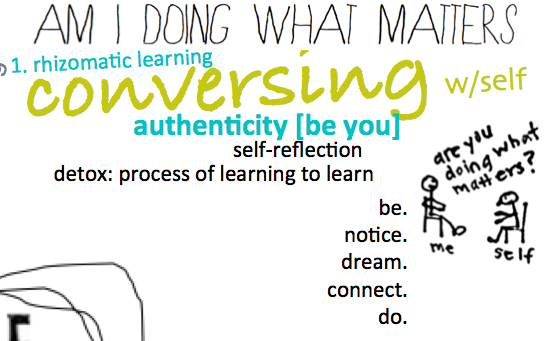
The only way to get here.. to eudamonia, to fittingness, to indispensable, is if you be you.
Frank K Sonneberg writes in Managing With A Conscience:
The problem is that many managers don’t believe people should think for themselves. Robert Waterman Jr makes just that point in the Renewal Factor when he tells the story of a general motors executive who says that H Ross Perot saw something that needed doing inside GM and told a GM manager to do it. The man replied that it was not part of his job description. You need a job description, fumed Perot, I’ll give you a job description, use your head. The bemused GM executive said, can you imagine what chaos we’d have around here if everybody did that?
While this might have been ok in the past, it might have helped us gain efficiency, that we were more manageable, less chaotic. It certainly is not to our advantage today to be bots. And not only is it not to our advantage, tech is allowing an equity in quality of life like we’ve not seen before. It’s ridiculous for us to not take tech’s ability to manage the chaos, rather than our perceived ability to manage each other, and allow us to be, to think, to become.
Imagine a world where we are now all thinking, using our heads. Imagine the chaos. Imagine the brilliance. Research tells us that after 10,000 hours of practicing something, you are an expert. It also tells us that without choosing, you aren’t really learning, or absorbing. And it follows, that you most likely won’t spend 10,000 hours. What if we boldly spent our 16,000-ish hours within public education, focusing on one thing: learning how to learn?
Imagine all the time and money and people we spend on credentialing, and training, and on proving, is no longer needed, because we are all using our heads. Imagine us all putting in the 10,000 hours of practice, with no need for pay, or reward, or outside motivation. Imagine the affordances of tech, the allurances of the web. Imagine the connectedness of people, because of these affordances and allurances. Imagine if our drive changes. Imagine us becoming us.
We’re imagining and prototyping ways to start using our own heads more. Because of the democracy of the web, we’ve had conversations with people, who, ten years ago we would have never thought to contact. We probably couldn’t have contacted. Those we contacted are amazing self-directed learners. We asked them how they did it, how they used their own heads. Then we asked youth to remix their verbiage, so that it was useful to them, more natural to them. What we came up with, for a template, or a jumpstart, for people who don’t know how to use their own heads: be, notice, dream, connect, do. stand alone site
Nothing special there, other than that some of us who had been merely following others’ orders, are now using our heads.
Some ideas that could be special, is infusing this template with tech:
- Perhaps a video speed reading over the course of some years, if you were to log yourself, talking to yourself. Might show your intent in a more human and authentic way. [we’re seeing this like Deb Roy’s use of tech in Birth of a Word, or perhaps Jerry Michalski’s journaling of his connections via the brain.]
- Perhaps an app to connect to others by these particular words or similar ideas, to create serendipity, create gatherings that matter, to find our people.
- Perhaps a focus on this self-assessment, rather than standardized assessments, will allow for and create physical and mental spaces of permission rather than proof. Allowing for a person to follow their curiosity, whimsy even, and be more creative, more useful, more fitting to their thumbprint, and so, more breathtakingly brilliant.
We’re imagining this template as a means to set people free to be themselves, to use their own heads. We are the only ones that know our own hearts, so essentially, the only ones that know whether we are on track or not. Full of bunk or not. Self-conversations seem to be a vital avenue toward improving anything. Using our own heads seems a most resourceful, if not the most resourceful, act we can participate in.
We’re imagining technology, whether it be an app to help people find each other, to help people find themselves, or all the vast means available now to communicate and connect, unleashing potential.
unprotected conversation via Nic Askew
I’m thinking Illich would like us to be using our heads, here’s a sample of me into it after detoxing for over a year.
________________________________________________
upacking a quiet revolution: one two three four five – via five elements
________________________________________________





 be you.