arthur h camins

intro’d to him via a tweet referencing his post in huffpo:
| Great summary of contradiction between what we know works best versus education policy today huff.to/1fkiyzG |
It is therefore profoundly disturbing that the twin plagues of test score mania and budget cuts have decreased attention to the very things that can stimulate children to want to know: making sense of the natural and build worlds (science technology and engineering); investigating how people live in the world (history, social science and civics) and exploring the many ways in which people express their understanding of the world (the arts)
Collaboration: Finally, we know quite a bit about the differences between behavioral and structural changes stimulated by hierarchical compliance regimes and changes that are the result of collaboration and altered belief systems. The former tend to be superficial and short lived, while the latter deep and sustained. Compliance tends to breed resentment and cover-up, while collaboration fosters trust, openness and deep personal investment.
In the current climate, acting on wisdom and hope rather than foolishness and despair takes courage. My hope is that as the school year begins teachers can summon the courage continue learning and to act on what they know about teaching and learning and that principals, superintendents, school boards and parents can work together to give teachers and their students the protected space to do so.
work together to give teachers and their students the protected space to do so.work together to give teachers and their students the protected space to do so.
work together to give teachers and their students the protected space to do so.
Arthur H. Camins is the Director of the Center for Innovation in Engineering and Science Education at Stevens Institute of Technology in Hoboken, NJ.
_________________________
the about page on his site:
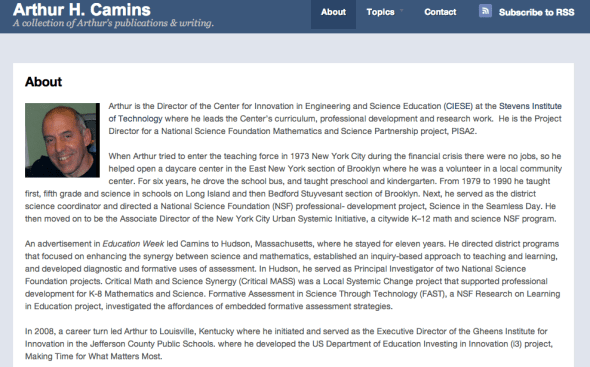
- investigated the affordances of embedded formative assessment strategies (imagine 24/7 via self/tech ness)
- Project Director for a NSF Math & Science Partnership project, PISA2
- he developed the US Dept of Ed Investing in Innovation (i3) project, Making Time for What Matters Most
Opponents of currently dominant education policies have a problem that proponents do not. Proponents, supported by unlimited funds from several well-connected billionaires, have been able to influence local, state and national decision-makers with little open public debate even while many Americans oppose the current set of market-based ideas that are driving dramatic changes in education. Pockets of resistance are popping up around the country. Educators and researchers have exposed the unfairness, inaccuracy and instability of student test scores as a measure of teachers’ expertise and primary determinant of employment status. But, for most citizens, the controversy surrounding these reforms is not yet a dominant issue in their busy lives.In fact, most parents are satisfied with their local schools. That is not surprising because for all the negative attention to international assessment comparisons, most middle-class students do OK. Policy arguments about economic competitiveness are distant from the daily lives of our children. And, for parents who struggle economically, the under-resourced, poorly performing schools their children attend is but one additional aspect of a very challenging life.
With widespread adoption of teacher evaluation systems linked to high-stakes assessments,
Opponents need a compelling strategy to capture the attention, imagination and energy of large diverse audiences.
Under-resourced neighborhoods are the permeable membrane through which a market-based transformation of education can passed with little resistance.
In the United States, we have always struggled with the inherent tension between celebrating individual freedom and embracing collective responsibility.





 be you.